




Abstract

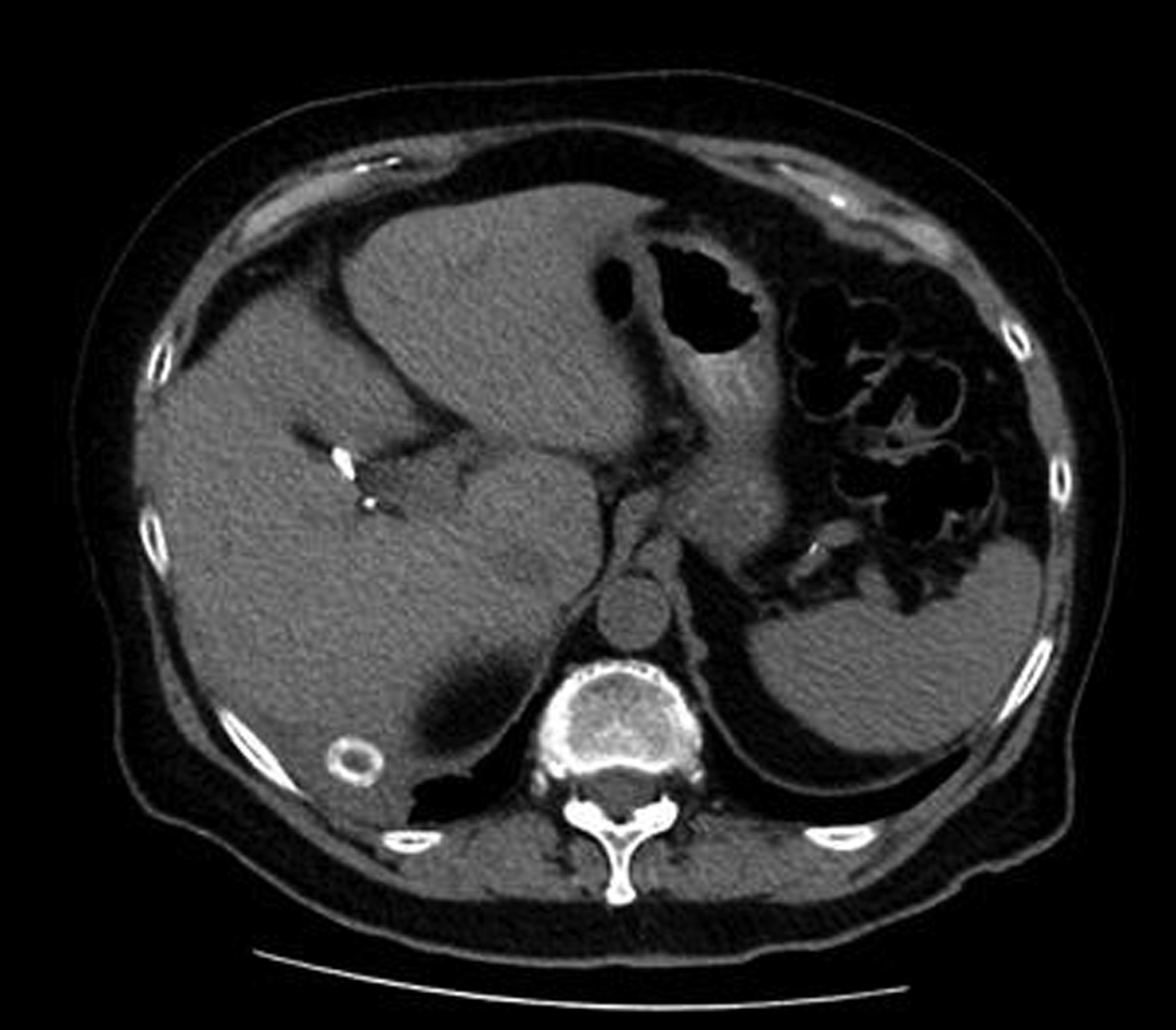
Axial computed tomography scan of abdomen showing retained 1.8-cm calcified gallstone posterior to the liver, with surrounding phlegmon.
Iatrogenic perforation of the gallbladder during laparoscopic cholecystectomy occurs in approximately 30% of procedures [1], either by tearing of the gallbladder wall during retraction or while the gallbladder is being dissected off the liver bed. Risk factors for spillage of gallstones include male gender, older age, high body mass, and omental adhesions [1]. Although the risk of infection is so low after laparoscopic cholecystectomy that antibiotic prophylaxis is not beneficial [2], spilled gallstones are a documented cause of intra-abdominal abscess and postoperative fever [1,3,4]. Therefore, an effort should be made to retrieve all spilled stones, even though infection therefrom is rare. In a series of 10,174 patients, only 0.08% of patients with spilled gallstones required reoperation for an intra-abdominal abscess [3]; those at risk had advanced age or acute cholecystitis with infected bile and large stones. Given the low incidence of long-term complications with retained gallstones, routine conversion to laparotomy for stone retrieval is unnecessary [3]; whether antibiotic prophylaxis should be instituted or modified as a result of gallstone spillage is unknown. Image-guided percutaneous drainage of an abscess caused by retained gallstones is associated with a high rate of failure; therefore, if gallstones are known to be present, they should be retrieved manually [1]. Often, gallstones are not radiopaque and therefore not visible by CT. Intra-abdominal abscesses form rarely in patients undergoing uncomplicated elective laparoscopic cholecystectomy [4]; therefore, clinicians should have a high degree of suspicion for retained gallstones in a patient who presents with a peri-hepatic abscess after laparoscopic cholecystectomy.
Nather and Ochsner in 1923 were the first to describe the posterior approach via twelfth rib resection for the drainage of subphrenic abscess [5]. Until the advent of percutaneous drainage techniques in the 1980s, this remained an important approach to the right subphrenic space, as contamination of the peritoneal and pleural spaces can be avoided. More recently, Spain et al. showed that a posterior approach via twelfth rib resection for drainage of an infected fluid collection is associated with low morbidity (11%) [6]. Patients who have had numerous abdominal procedures or failed percutaneous drainage are candidates for such an approach.
Footnotes
Author Disclosure Statement
The authors declare no competing financial interests exist.