




Abstract

To the Editor:
Most infections with S. algae have been reported from regions with warm climates, but infections with the organism have recently also been reported from areas with temperate climates [1–6,7]. We report the first documented North American case of a necrotizing soft-tissue infection caused by S. algae in the right lower leg from exposure to ocean water during Hurricane Irene in the northeastern United States in early September 2011.
A 66-year-old male with a history of diabetes mellitus, hypertension, peripheral vascular disease, coronary artery disease, congestive heart failure, atrial fibrillation, and right total knee replacement presented to the emergency department of our institution with swelling, erythema, and pain in his right leg. The patient had a low-grade fever and appeared somewhat somnolent. He had been exposed to sea water 8 d earlier while cleaning out his flooded basement. At the time of admission his heart rate was 63 beats/min, blood pressure 146/73 mm Hg, temperature 99.8°F, and respiratory rate 18 breaths/min. His oxygen saturation was 100% with breathing of room air.
The patient was admitted to the medical intensive care unit following a duplex ultrasound examination, radiography, and a computed tomographic scan that showed only generalized soft-tissue swelling of his entire right leg. He was treated empirically with vancomycin and pipercillin-tazobactam. Twelve hours after his admission he developed several hemorrhagic blisters on his right leg. His overall condition deteriorated rapidly and he developed profound septic shock and multiple organ dysfunction syndrome. He was immediately taken to the operating room for exploration of his right leg, which revealed a necrotic soft-tissue infection involving skin, fat, and fascia on the lateral aspect of the mid-leg and foot. Skin, subcutaneous tissue, and fascia were debrided until active bleeding was identified. Tissue and blood cultures grew S. algae. On the basis of the organism's sensitivity data the patient's antibiotic coverage was narrowed to ceftazadime. Post-operatively the patient required mechanical ventilation and treatment with vasopressors. Within the next few days he was returned thrice to the operating room because of rapid progression of the necrotizing infection in his leg (Fig. 1) and ultimately underwent an above-knee amputation. His course was further complicated by pneumonia, in which sputum cultures grew S. algae. He was discharged to rehabilitation with normal organ function after 60 days.
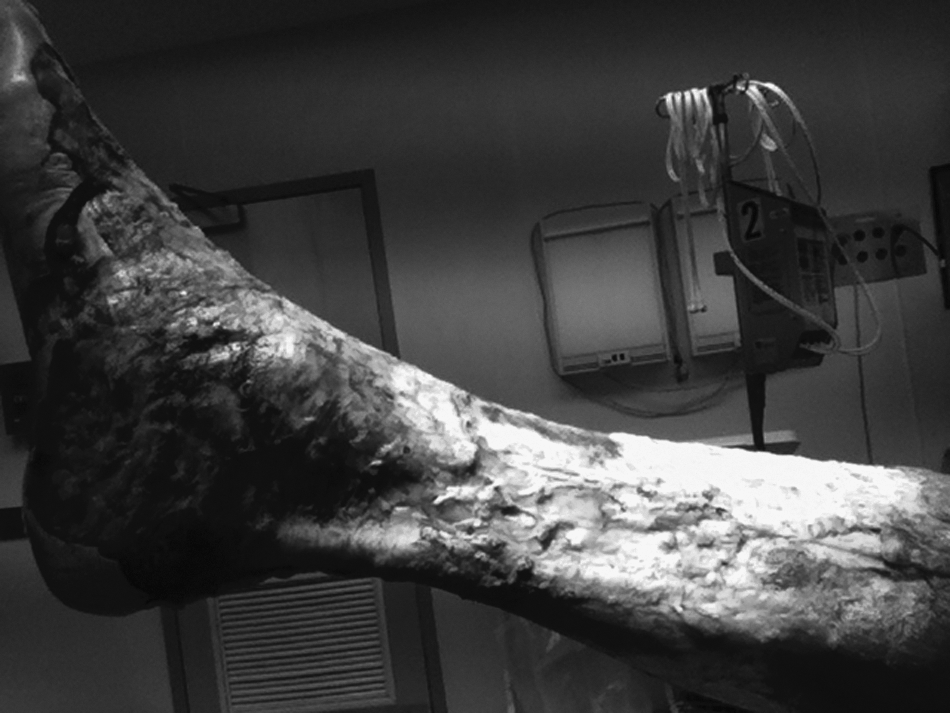
Lower leg following debridement of necrotizing fasciitis.
Discussion
This is the first reported North American case of a necrotizing soft tissue infection caused by S. algae and accompanied by septic shock and multiple organ dysfunction syndrome. Shewanella algae was first reported in sea water and in oysters from Delaware Bay in 2008 [8]. Similar occurrences have been reported in other areas of the world's oceans [1,2,9].
Shewanella infection has been identified in numerous organs and tissues, including bone, brain, and pericardium [3,10–12]. The most commonly infected tissues are skin and soft tissue [7,10–21]. These infections usually follow direct contact with sea water or the ingestion of raw fish during the summer months [2–6,22], with an incubation period that varies from 3 to 49 d [23]. More than thirty species of Shewanella have been identified. However, only S. putrefaciens and S. algae are known to be pathogenic to human beings [8]. The latter species can grow in higher aqujeous concentrations of sodium chloride (up to 6%) and survive at temperatures of up to 42°C. The high virulence of S. algae is believed to result from its ability to produce a hemolytic toxin, causing rapidly spreading infection, sepsis, and multiple organ dysfunction syndrome [23]. The major risk factors for infections with the organism are diabetes, peripheral vascular disease, chronic liver disease, renal failure, use of steroids, and immune compromise [22].
Aggressive control of local infection by the prompt debridement of necrotic tissue and goal-directed treatment for sepsis with appropriate antibiotics is the most appropriate way to manage necrotizing fasciitis caused by Shewanella. It is also important that clinicians consider atypical pathogens as the causes of soft-tissue infections during widespread environmental disruption such as that from a hurricane.