




Abstract
Abstract
Background:
Rhizobium radiobacter rarely causes human infections, most of which develop in immunocompromised patients, and especially those with intravenous catheters. Although R. radiobacter has been reported in association with peritonitis, all such reported cases have been due to intra-peritoneal devices in patients undergoing peritoneal dialysis. Herein we report the first case of a perforated ulcer complicated by peritonitis caused by R. radiobacter in a healthy adult, which was treated successfully with surgery and antibiotics.
Methods:
Case report and literature review
Results:
A 33-year-old male presented with epigastric abdominal pain of sudden onset. Physical examination was unremarkable except for the finding of diffuse abdominal tenderness with rebound tenderness. Exploratory laparotomy revealed a perforated duodenal ulcer with secondary peritonitis. The patient underwent pyloroplasty with bilateral truncal vagotomy and peritoneal toilet. Turbid ascites was sent for culture and yielded R. radiobacter and Streptococcus viridans. The patient was treated with a 10-d course of ceftazidime on the basis of drug susceptibility results, and recovered completely without complications.
Conclusions:
We report a case of secondary peritonitis caused by R. radiobacter, which expands the spectrum of infectious diseases caused by this organism.
R
Case Report
A 33-year-old male came to the emergency department because of abdominal pain of sudden onset in his epigastric region. He denied nausea or vomiting but reported having passed a single tarry stool 3 d earlier. He did not have any medical illness. On admission, his vital signs were a body temperature of 36.2°C, pulse rate of 106 beats/min, respiratory rate of 20 breaths/min, and blood pressure of 133/83 mm Hg. Physical examination was unremarkable except for diffuse abdominal tenderness with rebound. Laboratory examination revealed a white blood cell count of 9,500/mm3 (79.6% neutrophils), hemoglobin of 15.3 g/dL platelet count of 190,000/mm3, serum creatinine concentration of 0.8 mg/dL, fasting blood glucose concentration of 121 mg/dl, and C-reactive protein concentration of 7.5 mg/L (normal reference <6 mg/L). Chest radiography did not reveal any active lung lesions. Urinalysis and stool examination were normal.
Computed tomography (CT) showed intraperitoneal free air in the patient's upper abdomen (Fig. 1) and some ascites in the pelvis (Fig. 2), both of which findings indicated perforation of a hollow viscus. Following empiric treatment with antibiotics including cefazolin, gentamicin, and metronidazole, exploratory laparotomy was performed and revealed a 0.1-cm perforation of a duodenal ulcer located in the anterior wall and about 100 mL of turbid ascites in the peritoneal cavity. The patient underwent a pyloroplasty with bilateral truncal vagotomy. Pathologic examination confirmed the diagnosis of a perforated duodenal ulcer. Five days after the patient's operation, aerobic bacterial culture of the ascites from his peritoneal cavity yielded R. radiobacter and Streptococcus viridans. Susceptibility testing revealed the R. radiobacter to be sensitive to amikacin, ceftazidime, ciprofloxacin, moxifloxacin, gentamicin, piperacillin-tazobactam, cefpirome, and imipenem-cilastatin. The patient's antibiotic regimen was therefore changed to ceftazidime for 10 d, and he recovered completely without complications.
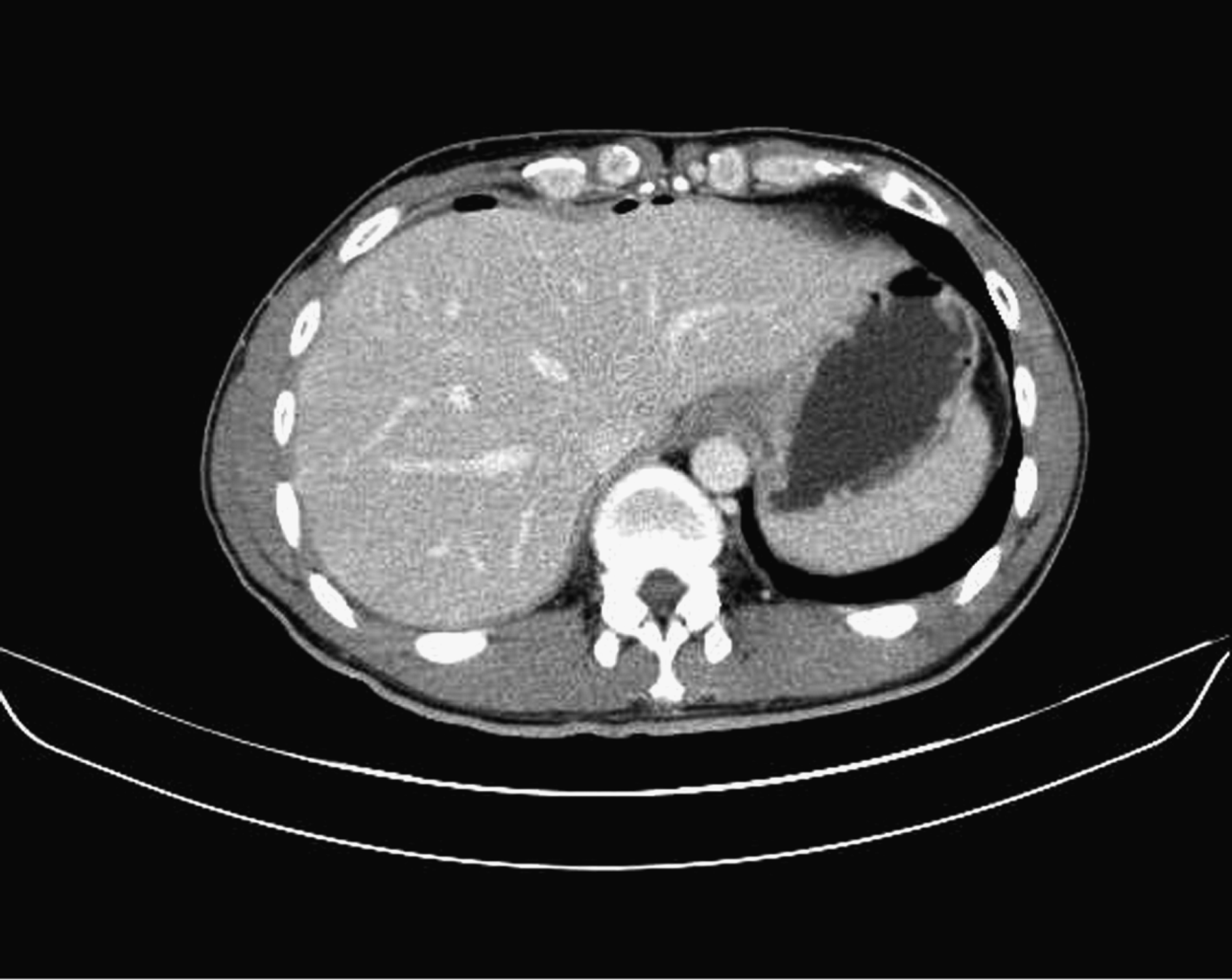
Computed tomographic image of the patient's abdomen showing intraperitoneal free air in the upper abdomen.

Computed tomographic image of the patient's abdomen showing ascites in the pelvis.
Discussion
In this report, we documented a case of R. radiobacter-associated secondary peritonitis caused by hollow viscus perforation in an immunocompetent adult. We have several notable findings. First, it is uncommon for R. radiobacter to cause human infections, and the knowledge of the clinical importance of R. radiobacter isolates is limited. Until now, R. radiobacter was only reported to be associated with several types of infection, including bacteremia (especially catheter-related bacteremia), pneumonia, urinary tract infection, prosthetic valve endocarditis, endophthalmitis, and peritoneal dialysis-related peritonitis [2–13]. Therefore, our report expands the current knowledge about R. radiobacter, and suggests that physicians should consider R. radiobacter as a pathogen causing secondary peritonitis.
Second, R. radiobacter is considered as an emerging opportunistic pathogen that most affects patients with various immunocompromised conditions, such as malignant tumors, bone marrow transplant recipients, end-stage renal disease, receiving a corticosteroid, diabetes mellitus, and human immunodeficiency virus (HIV) infection [2,12–14]. In addition, some indwelling devices, such as central venous catheters, peritoneal dialysis catheters, intraocular devices, and prosthetic cardiac valves, are other precipitating factors contributing to R. radiobacter infections [2,8,12,15]. By contrast to previous studies [2,8,12–15], our patient is not an immunocompromised adult, nor did he have any intra-peritoneal device. Although the clinical scenario such as the present case is an extremely rare occurrence, we would suggest that R. radiobacter can cause infections, in both immunocompromised and immunocompetent patients, with or without an indwelling device.
Third, the antibiotic susceptibility patterns of R. radiobacter isolates in the present case showed it was susceptible to third- and fourth-generation cephalosporins, carbapenems, fluoroquinolones, extended-spectrum beta-lactams, and aminoglycosides. This finding is consistent with previous studies that R. radiobacter is always susceptible to fluoroquinolones, fourth-generation cephalosporin, and carbapenems [15]. However, clinicians cannot ignore the potential of R. radiobacter acquiring resistance to third-generation cephalosporins [4].
In conclusion, we report a case of secondary peritonitis caused by R. radiobacter in an immunocompetent adult; the clinical outcome was favorable after appropriate antibiotic and surgical management. This case expands further the disease spectrum of infection caused by R. radiobacter, and raises the possibility of R. radiobacter as one of the etiology of peritonitis due to hollow viscus perforation.
Footnotes
Author Disclosure Statement
The authors report no conflicts of interest relevant to this article.