




Abstract
Abstract
Background:
Clostridium perfringens myonecrosis following an elective surgical procedure in a previously healthy child is a rare incident.
Methods:
Case report and literature review.
Results:
A two-year old boy admitted for elective bilateral osteotomies of tibiae was detected to be febrile at day one post-operatively with crepitus felt at his left ankle. An emergency wound debridement was performed followed by a course of antibiotics. Clostridium perfringens was isolated from tissue culture. His wound was later covered with a split-thickness skin graft.
Conclusion:
Clostridium perfringens infection following a surgical procedure in a healthy child is rare. A high index of suspicion is important to recognize this debilitating infection.
S
Case Summary
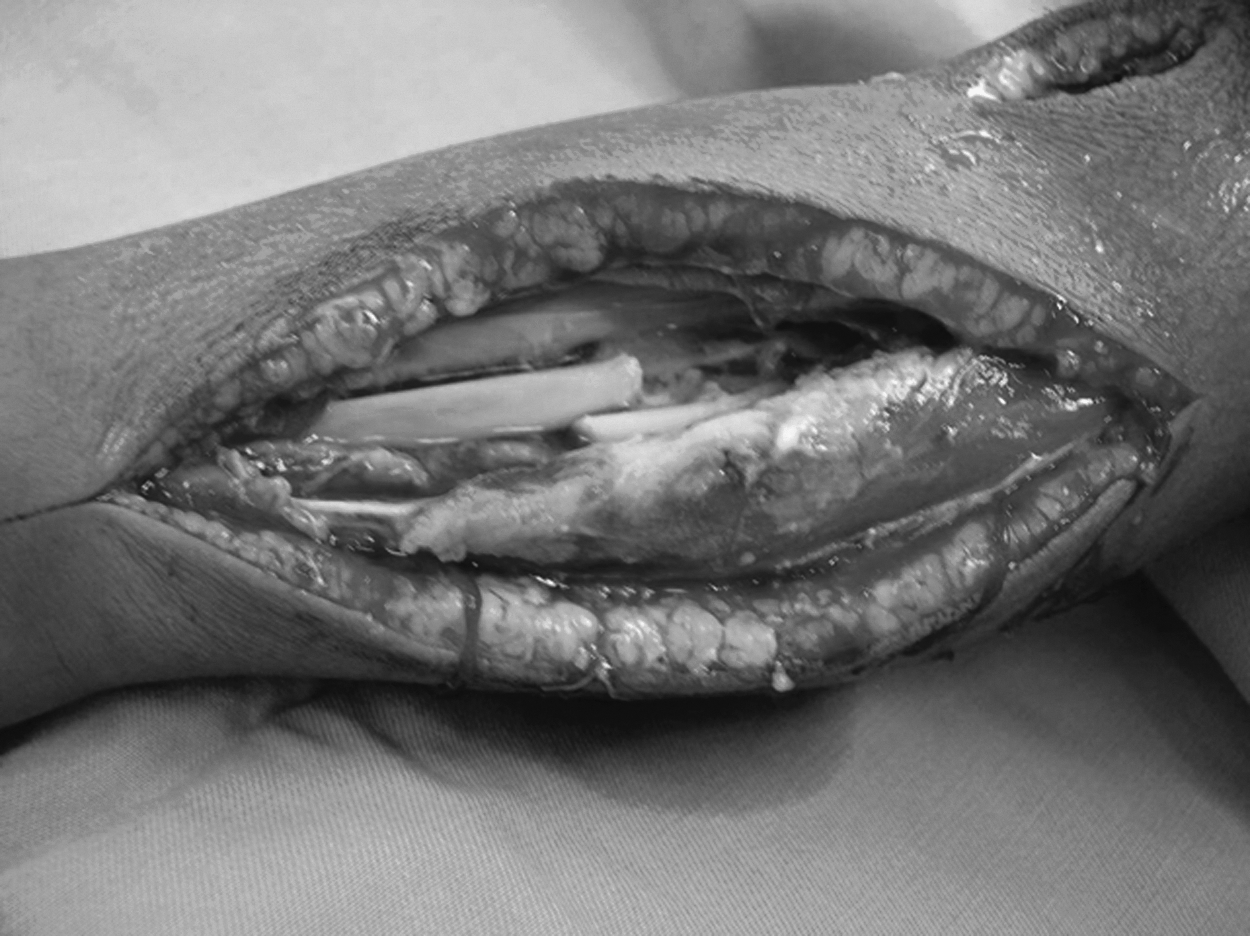
A two-year-old boy was admitted for an elective operation to correct his bilateral genu varus deformity. He was diagnosed to have Blount disease of infantile type. The surgical procedure was performed under general anesthesia without any difficulties. At day one post-surgery, he had a temperature of 39°C. His mother witnessed a brief episode of convulsion following the febrile episode. Examination showed the left foot was relatively cold though capillary perfusion was maintained. Crepitus was felt at his left ankle suggestive of a gas producing infection. Intravenous cefuroxime and metronidazole were started and emergency wound debridement and fasciotomy of the left leg were performed. The peroneus muscle was pale with no contractility on stimulation. The wound was lavaged thoroughly with diluted hydrogen peroxide solution and left open. Twenty-four hours later, the peroneus longus muscle had developed myonecrosis (Fig. 1). He underwent multiple wound debridements until the wound was clean (Fig. 2) followed by split-thickness skin grafting. Tissue sent for culture grew C. perfringens that was sensitive to penicillin and metronidazole. He completed three weeks of antibiotics. The latest follow up eight years after surgery revealed an equinovarus deformity with a shortening of 2 cm. He will need further surgery to correct this deformity.

Myonecrosis of the peroneus longus muscle.
Clean wound following multiple debridements.
Discussion
The risk of surgical infection in a clean extra abdominal surgical procedure is 2% to 5% [1]. Typically, a surgical site infection is suspected when a patient develops symptoms of infection such as fever at day three post-surgery. On inspection, the wound would be inflamed with presence of seropurulent discharge. Common organisms causing surgical site infection include Staphylococcus aureus and streptococci [2]. A deep incisional surgical site infection requires surgical debridement and antibiotic therapy [3–4].
Clostridium perfringens infection following elective orthopedic procedure occurs rarely [5–8]. Only a few cases have been reported. Most cases involve adults and immunocompromised patients. In orthopedic practice, this uncommon infection has been described following ligament reconstruction, knee allograft, lumbar discectomy, and iliac bone graft harvesting [5–8]. Cases that involve non-immunocompromised children are even more uncommon. Smith-Slatas et al. reported a child with spontaneous clostridial myonecrosis involving the abdominal and thoracic cavities caused by C. septicum [9]. In their review, they noted that neutrophil dysfunction is a risk factor. It has been suggested by Bryant et al. that phospolipase C produced by C. perfringens induces platelet/leukocyte interactions and impedes neutrophil diapedesis [10].
The diagnosis of C. perfringens infection requires a high index of suspicion. It is uncommon to have fever at day one post-operatively. The presence of crepitus at the patient's ankle prompted us to suspect this limb had a life-threatening infection [11]. Surgical wound debridement with adjunctive antibiotic therapy is still the treatment of choice. A wound swab is not the ideal specimen for the isolation of C. perfringens. It is best to send debrided tissue in addition to the wound swab [12]. This will enhance the yield for isolating C. perfringens. Spores are demonstrated rarely in a clinical specimen and culture, thus limiting the role of direct microscopy for diagnosing clostridial myonecrosis. The lack of inflammatory cells in tissue stain is a hallmark of clostridial infection, probably because of the effects of clostridial toxins [13]. A prompt diagnosis followed by surgical debridement and antibiotic therapy helps to improve prognosis. Nevertheless, residual functional disability may persist because of critical tissue losses following the infection [11].
Conclusion
Clostridium perfringens surgical site infection is rare, especially in a previously healthy child. A high index of clinical suspicion, prompt surgical debridement, and adjunctive antibiotics is paramount to save the patient's limb and life.
Footnotes
Author Disclosure Statement
No competing financial interests exist.