Abstract

That evening, my wife Dallas and I had the pleasure of sitting beside Steve at the dinner held in his honor. We reminisced about our time together at The New York Hospital. Steve smiled, laughed, and smiled again as we remembered and told stories to each other. In a flash, the evening was over. We offered to have him come over to the house for a nightcap. He declined graciously because he had a 7:30 AM flight the next morning back to Newark. We parted ways after a good firm hug. Little more than six weeks later, I heard the news of Steve's untimely death. How I wish he had booked a flight later that next day, so that we could have had more time together.
Steve was not just a scientist. He was also a great clinician, surgeon, and mentor. Those of us who had the pleasure of working clinically with him saw the respect he extended to each patient. Steve wrote:
“I am reminded of the challenge faced by all clinicians that every patient is an individual, each with their own personal experiences, emotions, and fears. The greatest challenge is to recognize these individual variations and place them in a proper treatment context. As a young physician/scientist, I was convinced that I had many of the “answers”. Over time, this certainty has morphed into a more nuanced appreciation of how each patient may respond to treatment based upon their life histories.”
This most human side of Steve was shared with those of us who worked with and learned from him. I continue to teach this important concept to general and pediatric surgery trainees each day. Steve gave so much, to so many of us. We all embody everything that he taught. One of Steve's greatest joys was knowing that this shared belief would be carried on. This goal, achieved through mentoring, prompted Steve to write:
“While virtually every patient encounter has been rewarding, each in its own way, my greatest joy has been to be a part of the career development of many internationally renowned physician/scientists. The opportunity to mentor the next generation of these patient-oriented investigators is both a privilege and an honor!”
Steve understood that mentoring is more art than science. He was a true master in the arena of mentoring. John Wooden, one of the greatest athletic coaches and mentors ever, passed away exactly one year to the day before Steve. Coach Wooden once said: “Success comes from knowing that you did your best to become the best that you are capable of becoming.” This could easily have come from Steve's lips, and been addressed to any of his mentees. The late Vince Lombardi said: “Coaches who can outline plays on a black board are a dime a dozen. The ones who win get inside their player and motivate.” I know that Steve and Coach Lombardi would have enjoyed sharing ideas with each other.
“Just do the right thing.” Steve said of these words that they were a constant admonition from his mentors. He truly held these words in his heart and lived them, not just in medicine, but in all areas of his life. Each of us who experienced Steve learned this lesson and cherishes it. Those who knew Steve, I am sure, are both grateful and pleased with how he lived this ethic.
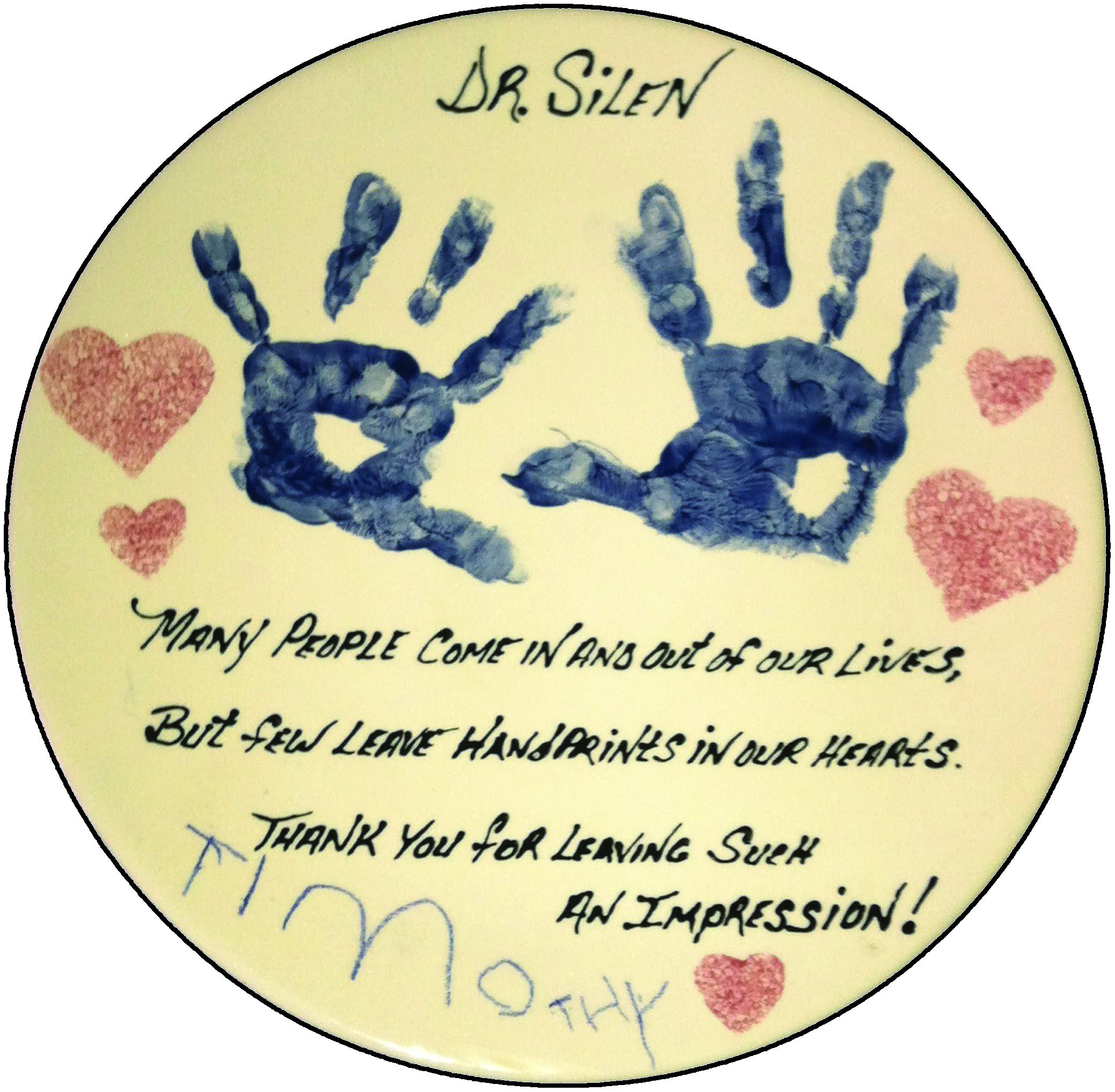
Eighteen years ago, I looked after a patient with the Beckwith-Wiedemann syndrome. Over a period of one year after I met Timothy when he was about 2 years old, I resected two separate hepatic neoplasms from him while I was working in St. Louis. One was benign and one was malignant, a hepatoblastoma, and he was cured. A few years later, the patient and his family gave me a gift that I have treasured ever since, and always will. It is one of those plates that children paint and then cure in a kiln.
A couple of years after I received the plate, I had the opportunity to show it to Steve. On this particular occasion, there was not only a twinkle in his eyes, but a little mist too. Of course, after a few moments, we both smiled and shared with each other the wonderful gift that a physician/scientist can bring to a patient.
The plate and its message are pictured in the figure. Timothy wrote: “Dr. Silen. Many people come in and out of our lives, but few leave handprints in our hearts. Thank you for leaving such an impression!” Steve agreed that this memento from a patient was priceless. Now, Steve, the message is from all of us who knew and loved you: Many people come in and out of our lives, but few leave handprints in our hearts. Thank you, Steve, for leaving such an impression!