




Abstract

T
Let me digress and explain how I came to stand before you today. In 2000, then SIS President Dr. Mark A. Malangoni (Fig. 1) appointed me to the Chair of the Membership Committee with a charge to expand the membership. This re-engaged me in the SIS through the recruitment of more than 150 new members, after which I was elected Councilor and then Secretary of the SIS, with each position lasting three years. The secretarial duties consumed an enormous amount of my time because the management of meetings and the society, final program development, the securing of industry funding, and website development and management were all coordinated by the secretary's office. Dr. Lena Napolitano, who had preceded me as secretary of SIS, accomplished the herculean task of organizing this office, and warned me about this and strongly urged that an Executive Director be appointed to handle many of these complex duties. Fortunately for me, deliverance occurred when the SIS contracted with Decisive Edge Consulting Group and Lynn Hydo, MBA, RN, to be its Executive Director in 2009.

Important mentors over my career. Clockwise from left: Robert H. Bartlett, Hiram C. Polk, Jr., Donald E. Fry, Alfred Cuschieri, Mark A. Malangoni, J. David Richardson, and R. Neal Garrison.
I attended medical school at the University of California- Irvine, and was fortunate enough to rotate through the burn unit, which was directed by Dr. Robert H. Bartlett. He was a wonderful mentor for me and it was an honor to assist him with some of the first infants [7] to be given extracorporeal membrane oxygenation (ECMO), a device he had developed with Dr. Philip A. Drinker while the two collaborated at the Peter Pent Brigham Hospital in Boston [8]. It was Dr. Bartlett who gave me a list of potential residency programs, one of which was at the University of Louisville. When I eventually matched there, he left for the University of Michigan to direct the Surgical Intensive Care Unit there. Dr. Napolitano, the Past-President of the SIS, then assumed the directorship of these units and has expanded them into a leading critical care program with the continued frequent use of ECMO [9].
Upon arrival at the University of Louisville, I met Dr. Hiram C. Polk, Jr. for the first time and worked in his laboratory early on as a second-year resident. Dr. Polk was Chairman at the University of Louisville from 1971 to 2005, continues to have a leading role in teaching and the mentorship of young surgeons, and was a founding member of the SIS in 1980. He has made a number of contributions to the understanding of surgical infections at both the basic and clinical levels [10]. His landmark prospective study of determinant factors and the prevention of postoperative wound infection, published in 1969 remains a classic, clearly demonstrating a beneficial effect of appropriately timed antimicrobial prophylaxis [11]. After assuming the Chair of Surgery at Louisville, Dr. Polk quickly established a first-class general surgery residency training program at the university, with its five main teaching hospitals and more than 1,500 beds, as well as including the Trover Regional Medical Center in rural western Kentucky. The depth and breadth of the resident experience in all aspects of general surgery at the university is unparalleled, and it has been a true honor to help continue that tradition over the past 20 years as Program Director [12]. There remains a need for general surgeons in most communities, and we continue to take pride in those residents who choose not to pursue a fellowship and go directly into the private practice of general surgery. It is fitting today that Dr. Polk received the second annual Stephen F. Lowry Award of the SIS Foundation for a lifetime of contributions to the understanding, treatment, and prevention of surgical infection.
On July 1, 1980, I encountered past SIS president Dr. Donald E. Fry, who staffed the first operation I performed at Robley Rex Veterans Affairs Medical Center (VAMC) on the following day. I removed an infected vein in the patient's forearm and the rest is history. Don has been a great mentor to me, and the two of us are today proud to have been presidents of both the Association of VA Surgeons and the SIS. I then spent almost two years in Dundee, Scotland, under the tutelage of Professor Sir Alfred Cuschieri, and had a rich clinical and research experience there in the areas of foregut physiology, oncology, and advanced gastro-intestinal surgery. At the time, Dr. Gary Vitale and I collaborated on a number of investigations and had the first computerized ambulatory pH monitoring system for detecting gastrioesophageal reflux disease (GERD) [13.14]. This experience really kicked off my academic career, as I learned how to present and publish over this time period. I directed the first randomized clinical trial at Dundee and presented the data at the American Surgical Association, showing that routine nasogastric drainage after elective operation was not necessary [15].
As I began my faculty career at the University of Louisville, I worked very closely with Dr. Neal Garrison and shared a laboratory in building 19 at the VA Medical Center in Louisville, and have continued to do so for more than 25 years. A number of surgeons, many of them SIS members, have worked in this laboratory (Table 1), and at one time there were six merit-review-funded investigators wotking in the laboratory simultaneously. Our VA has been renamed for Robley Rex, a World War I veteran who volunteered until he reached the age of 105 (Fig. 2) and was an inspiration to us all. The second of the four missions of the VA is research and education, and the VA research program at Louisville has been outstanding [16]. Although most of the VA-funded research at Louisville is in basic science, the VA has led the way in clinical outcomes research, and highlights of this are presented in Table 2. I have had the privilege of mentoring formally 18 research fellows and some 21 University of Louisville medical students through the Summer Scholars Program. Many of these young investigators have presented work at major meetings, including those of the SIS, and have had multiple publications. As a further measure, I extend my thanks to Professor Dr. Eugen Faist for founding and directing the Munich Conferences on the Immune Consequences of Trauma, Shock, and Sepsis from 1988 to 2010. These were outstanding meetings that brought together investigators from many backgrounds over a four-day period of informative free papers as well as lectures by experts in their fields. We would then ski in the Alps in the week following each conference, with many people who were prominent in the SIS, which has led life-long collaborations and friendships.

Robley Rex and Bill Cheadle shared the same birthday. Mr. Rex was twice the age of Dr. Cheadle at the time of this picture!
Veterans Administration Merit Awardee.
National Institutes of Health awardee.
Most of these were part of the Cooperative Studies Program.
The presidential addresses [17–44] of the SIS can be divided into five categories (Table 3). I will try to touch on all of these. The Society was founded by 10 members, on a Saturday in April 1980, after the American Surgical Association meeting (Fig. 3). Our first president was Dr. William A. Altemeier, and the society has expanded from 119 charter members to more than 550 members today. The society has undergone a number of transitions, including membership expansion, and has developed numerous awards, of which the Joseph Susman Memorial Award is the premier award for the top paper at the annual meeting of the SIS. The society has held a number of retreats for strategic planning, our website is in constant evolution, and our journal, Surgical Infections, edited by Dr. Philip Barie of the Weill Cornell Medical College in New York City, was granted an impact factor in 2011. The SIS Foundation has been active for more than 20 years, has more than $2.5 million in assets, but more importantly has dispersed almost $3 million in research grants to fellows and junior faculty members over the past two decades, a remarkable achievement indeed. Dr. Ori Rotstein of the University of Toronto was the initial executive director, and was succeeded by Dr. Barie. Dr. Stephen Lowry, in his presidential address to the SIS in 2008, discussed the value of connections and mentorship and charged us to adapt or to go extinct, and to cherish and promote the espirit de corps in the SIS. His memory will be cherished by all of us, his example as a superior surgeon scientist mentor will be missed. The first meeting I attended was in 1988 and my paper was discussed by three future presidents. Indeed, the annual meeting is the highlight of our society, and the annual update symposia are outstanding additions to the excellent oral and poster presentations. The Altemeier Lecture features an invited expert, usually in the basic sciences, to review and update important topics in the invitee's area of expertise. The society is as vibrant as ever today as it ever was, and attendance at the annual meetings exceeds 250 people.
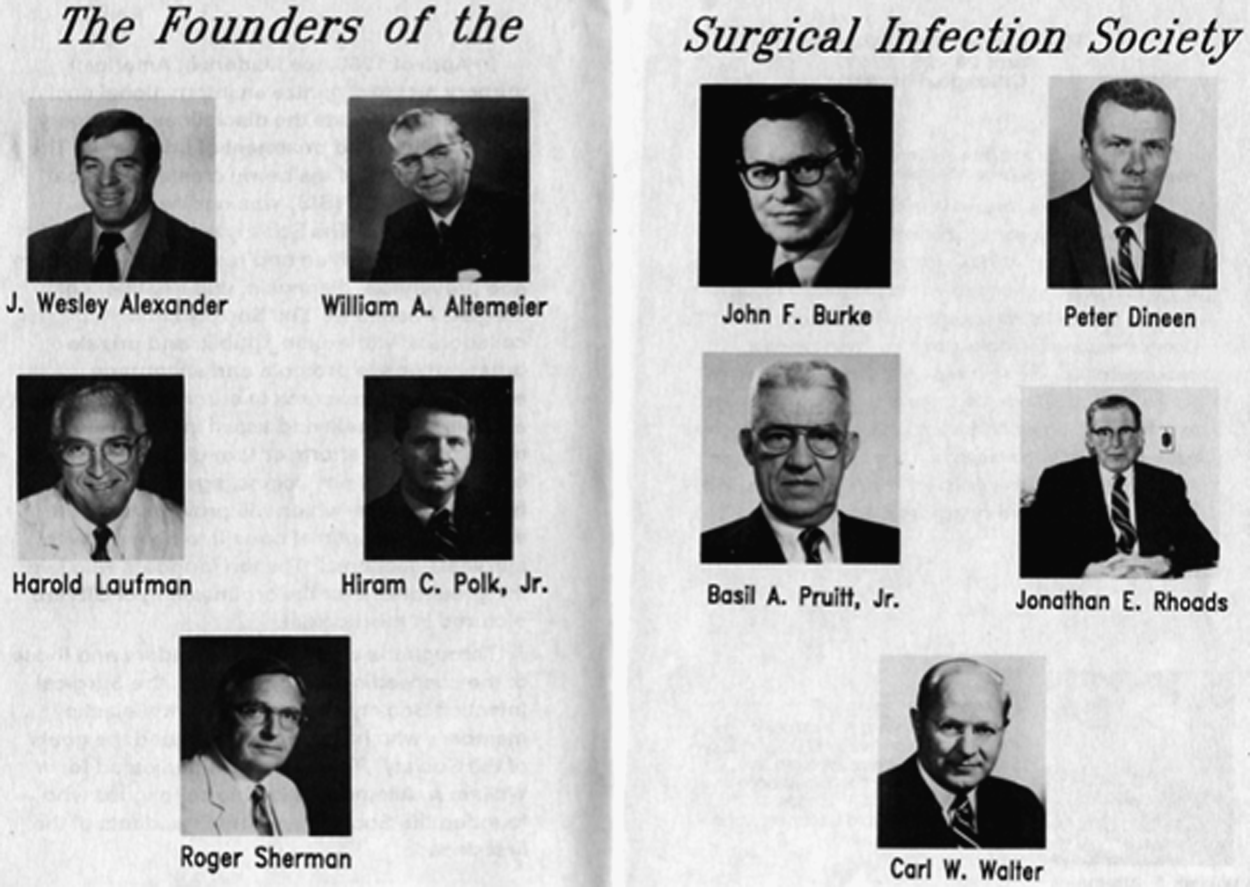
The founding members of the Surgical Infection Society.
Surgical infections can be divided into two basic major categories: Those that present to us and those that we create, which are generally complications of elective operations. Such surgical site infections probably number over one million a year in the United States, incurring three million extra hospital days and $1.6 billion in extra hospital cost, according to one estimate [45]. In fact, elective surgical procedures were rare until the development of asepsis and antisepsis, and were not routine until the late nineteenth century. Although Hippocrates was the first to mention surgical training in the operating room environment, he believed that disease that could not be cured by fire were otherwise incurable. He also coined the term “laudable pus,” meaning that a wound that discharged pus often went on to heal by secondary intention, as opposed to a wound marked by spreading erysipelas and was ultimately fatal. The plague doctors of the Middle Ages [46] believed in Galenism, and although appropriately gowned, masked, and gloved to protect themselves, believed that wound infection was caused by bad air (miasma). The development of the compound microscope was the key that led the microbiologists of the nineteenth century to describe common bacteria and fungi, and to eventually dispel the theory of spontaneous generation and miasma. The development of the germ theory of disease by Pasteur, the topic of Dr. Fry's SIS presidential address, actually occurred after Ignaz Semmelweiss pioneered the concept of aseptic technique, in which he required his students and residents to wash their hands between treating different patients and after cadaver dissections. He also had the students and residents rinse their hands and instruments in sodium hypochlorite. Sometime later, in 1865, Lord Lester began to spray carbolic acid into the wounds of patients with open fractures, revolutionizing the treatment of such injuries and achieving limb salvage, and this practice was eventually adopted to all surgical wounds.
Several Nobel Prizes were given to the investigators who discovered microbes, as well as to those who founded their treatment with antibiotics. They include Robert Koch, in tuberculosis; Paul Ehrlich, who developed Salvarsan 606 for the treatment of syphilis; Gerhard Domagk, who discovered the sulfa drugs; Alexander Fleming, who discovered penicillin; and Selman Waksman, who discovered streptomycin. Many additional Nobel Prizes have been awarded to those who have made seminal contributions to the understanding of host immunity and the inflammatory response [47]. Studies of patients with sepsis and positive blood cultures clearly showed that antibiotics improved survival [48,49], and one only has to remember how common mastoidectomy was for complicated otitis media in the pre-antibiotic era. When we fast forward to the guidelines of the Surviving Sepsis Campaign of 2012 and 2013, an even earlier broad-spectrum intravenous antibiotics are emphasized offer blood cultures are taken to combat the septic exaggerated host immune response [50]. These milestones in the fight against infectious diseases, coupled with advances primarily in the treatment of cardiovascular disease, have resulted in an unprecedented increase in life expectancy [51]. Human survival has nearly doubled in the past 100 years; however, the world's population has in the same time increased exponentially to seven billion people. This surge in the population of our planet is already a major issue, and if we do not take steps to curb it by ourselves, microbes will almost certainly do it for us [52].
It is interesting to note that at the ends of surgical procedures, virtually all open incisions are contaminated, and yet only a minority of patients develop surgical site infections (SSIs). This was demonstrated in 1963 by Dr. John Burke, who had the incisions of 50 patients who underwent major surgery be irrigated after fascial closure and the effluents cultured in broth. Burke found an average of 24 colony-forming units of Staphylococcus aureus in each wound, but only two of the 50 patients in his series developed SSIs. He coined the concept of this finding as an “irreducible minimum,” and most subsequent studies have shown similar numbers of bacteria in surgical incisions before their closure [53]. Clearly the risk of developing an SSI is highly variable and depends on patient factors, microbes, and the surgical procedure being done. Dr. Fry mentioned only 50 of these risk factors in a recent publication [54], and there are likely to be many more. The use of dressings over closed primarily incisions to prevent SSIs, however, has not been shown to be effective [55].
There is clearly a genetic influence on the risk of infection, as outlined epidemiologically by Sorensen [56]. This seminal study showed that the death from infection of a biologic parent before the age of 50 increased the relative risk of death from infection by an adoptee by almost six-fold. Indeed, as the human genome has been sequenced and its functionality has been described, one is truly impressed with host heterogeneity. There are three billion bases in the human genome, and although only somewhat more than 20,000 genes actually code for proteins, 80% of these bases have biochemical function [57]. Heterogeneity is increased even more when mutations, single nucleotide polymorphisms, and epigenetics are included, and the host landscape is therefore ever-changing. Although little in the literature relates the risk of SSI to the length of a surgical incision, data from 20 years of minimal-access surgical procedures clearly show that the risk and severity of infection are lower with port-site incisions than with standard open incisions [58,59]. In fact, there has been a shift in the risk and severity of SSIs from superficial and deep incisional infections to those that develop in an organ space with minimal access techniques [60.61].
Healthcare quality and patient safety have been a focus of public health over the past two decades, and the measurement of such quality, particularly in the hospital environment, has also evolved during this time. Hospital-acquired infections have been a particular focal point of attention, and SSIs especially so. The first systematic measurement of health-care quality began in the VA system itself, with the National Surgical Quality Improvement Program [62]. This was mandated by Congress and developed by Dr. Shukri Khuri, a cardiac surgeon and VA clinician-investigator, who first defined risk factors for surgery-related morbidity and mortality, and then validated these in an additional population. Expected rates of morbidity and mortality were developed and observed outcomes were then expressed as the O:E ratio. Outlier facilities with poor clinical outcomes underwent focused site reviews to remedy such outcomes, and overall mortality and morbidity were substantially reduced during the ensuing two decades [63]. Best practices were also benchmarked from those facilities with exceptionally low morbidity and mortality rates. This program now has been extended to the private sector through the American College of Surgeons National Surgical Quality Improvement Program (NSQIP). Federal mandates to measure clinical outcome in hospitals have led to the adoption of this and other systems of clinical-outcome measurement, and the use of databases related to this has closely tied hospital readmission rates to surgical complications [64,65].
As a measure of healthcare quality, the concept of an event that should never happen was coined initially by Dr. Ken Keiser in 2001 when he was Chief Executive Officer of the National Quality Forum [66]. Dr. Keiser had spent a term as the Under Secretary for Health in the Department of Veterans Affairs, and revolutionized the VA during this time by assigning each veteran a primary-care physician. This not only led to organized primary care for all veterans, it also helped to decompress specialty clinics and to stabilize ongoing care for each veteran's regular appointment with the veteran's assigned physician. This process occurred almost simultaneously with the development of the VA NSQIP, and arguably saved the VA healthcare system. The Agency for Healthcare Research Quality (AHRQ), which is one of 12 agencies within the U.S. Department of Health and Human Services (HHS), has now listed 29 such events that should “never” happen. They are subdivided into seven categories (Table 4), one of which is surgical, which is itself divided into the categories of wrong patient, wrong procedure, and wrong surgical site; presence of an unintended foreign body; and immediate perioperative death of a patient in Class I of the American Society of Anesthesiologists Physical Status classification system. The concept of “never” events, although clearly a laudable goal of healthcare, has been used by the Centers for Medicare and Medicaid Services (CMS) to deny reimbursement for hospital expenses related to such never events, despite meeting compliance measures and the standard of care. Such “never” events in fact occur rarely, but occur sufficiently often over time as to affect not only quality of care, but also cost of care and liability. Pronovost et al. have estimated that there are probably 4,000 such surgical “should never happen” events per year, on the basis of their 20-yr review of 9,740 paid malpractice claims for such events in the National Practitioner Databank [67].
The concern for post-surgical infections led to the development of the Surgical Infection Project (SIP) as a joint venture of the U.S. Centers for Disease Control and Prevention (CDC) and the CMS [68]. The SIP's initial study focused on pre-operative anti-microbial prophylaxis and demonstrated a general lack of compliance with dosing for such prophylaxis [69]. A subsequent collaborative study demonstrated a reduction in SSI with adherence to measures to minimize the risk of infection [70]. The Medicare Modernization and Deficit Reduction Act of 2005 mandated a series of “pay for performance” initiatives to ensure compliance with directives to prevent post-operative complications. The SIP then morphed into the Surgical Care Improvement Project (SCIP) as a result, and this fiat was in actuality a penalty for complications occurring despite compliance with the SCIP directives. The SCIP has seven compliance measures related to the prevention of infection, and the CMS developed a “no pay list” for many of these complications that were derived from the HHS list of events that should never happen. This list was published originally in 2011 and includes three complications related to health-care-associated infections that began to take effect in 2013 (Table 5). The concept of non-payment for these kinds of complications, despite compliance with directives for their prevention, seems an unreasonable goal in view of the complexity of modern health care [71]. In fact, Lee et al. have shown that the frequencies of catheter-related blood stream and urinary tract infections have not been reduced in the era of the CMS no-pay list [72]. In fact, several studies have shown that adherence to the SCIP compliance measures has not been associated with an improvement in clinical outcome [45,71,73].
Such “never” events in fact will always occur, and so it is imperative that all hospitals keep score of their occurrence, just as all VA facilities have. Private and public hospitals are now being required to keep accurate data about such events based on risk stratification and patient co-morbidities, and the means for this has been developed through the NSQIP system [74]. In fact, 3,472 of the 5,870 acute-care facilities in the United States contributed data to the CDC's National Health Safety Network (NHSN) for the 2011 report, and there has been a reduction in some hospital-acquired infections, including SSI. Similarly, checklists have been developed to reduce catheter-related blood stream infections, and this reduction has been sustained over time[75], but such infections have not decreased to a rate of zero. So, as Dr. Sawyer pointed out in his presidential address, “Stop apologizing for your data.” Such studies point out that the goal is to minimize such events, not eliminate them. From a practical standpoint, some elective procedures likely should be postponed. These include situations in which patients have a concomitant infection or elevated white blood cell count, or hemoglobin A1C or nicotine concentrations. Indeed these should be added to the routine preoperative checklist. If these are abnormal, elective surgery should perhaps be postponed.
If compliance measures have met with limited success, then how should we approach the problem of SSI? Interestingly, individual institutional efforts have been successful in reducing rates of SSI. Wick et al. reported that the use of a standard bundle of measures reduced colorectal SSIs from 27% to 18%. These included the use of a standard skin preparation, chlorhexidine-treated wash cloths, selective mechanical bowel preparation with oral antibiotics, pre-operative warming, separate instruments for bowel and wound closure, and correct prophylactic anti-microbial regimens. In fact, many reports that show improvement still have relatively high incident SSI rates as compared with those in the older literature. This may be because of more rigorous surveillance, including post-discharge monitoring, and Kazaure et al. have shown that almost one-half of post-operative complications occur after hospital discharge [76]. However, utilizing extensive patient data bases with risk-adjusted patient outcomes and focused reviews for outliers, with root cause analysis, is the best approach. In fact, the public would be better served if The Joint Commission focused on clinical outcome measures instead of the endless charade of compliance measures and overly expensive surveys that they now employ. There is scant evidence that this approach has ever improved clinical outcome. Instead, an approach has been used at the VA over the past few years that involves a formalized medical team training program for operating room personnel on a national level. This team training has yielded tangible results, with lower mortality rates in those facilities that have participated in this program [77]. This has occurred through the greater participation of all team members capable of pointing out potential errors that could lead to adverse clinical outcomes.
The imperfections of clinical practice and continuation of adverse septic clinical outcomes [78] remind us that further basic research into the host–pathogen relationship will always be needed to translate discoveries into clinical benefit, as emphasized by Dr. Timothy Billiar's presidential address to the twenty-sixth Annual Meeting of the Surgical Infection Society in April 2006 [19]. Many of us have taken a traditional reductionist approach to the immune response, to understand host cell recognition of pathogens, subsequent signaling pathways, and fundamental genetic changes that contribute to the host response to a pathogen. John Alverdy, SIS Secretary, has been studying this for many years, and has shown clearly that the host–pathogen interaction is indeed a dynamic one in which surgical stress and environmental factors alter bacterial virulence [79]. In fact, opportunistic pathogens probably sense such changes in the host environment, and host-induced microbial virulence in response to these cues can then cause disease in the host, such as peritonitis and anastomotic leak[80]. However, translation of the multitude of fundamental basic observations of host–pathogen interactions into clinical use will require advanced statistical computer modeling to provide a systems-biology integration for truly understanding SSI completely[81]. In fact, genomic responses in experimental animals may not mimic those of the human inflammatory response, as noted by the investigators in the Inflammation and Host Response to Injury, Large Scale Collaborative Research Program [82].
I am very proud to serve as your President over the 2013–2014 year, and hope to continue the excellent traditions of our past presidents. Several challenges, such as the creation of a website and industry support, confront us, but I am sure that we will prevail in the long run because of the talent and drive of many individuals in this organization. I have benefited from several long-standing relationships, including that with Pam Boone, my only medical assistant for 25 yrs; Molly Poole, my secretary and residency coordinator for 23 yrs; Kathy Fox, my former administrative officer on the Research Service and now executive director of the Clinical Research Foundation at the Robley Rex VAMC, for 22 yrs; Cindy Thoene and Pam Byrne, who have done the CME for both the Keutucky Chapter of the American College of Surgeons and the SIS for more than 20 years. A very special thanks goes to Lynn Hydo, our Executive Director. She has done a fabulous job over many years first in the treasurer's office and now in her leadership role in the SIS. I have been blessed with a wonderful family, Mary, Jack, and Joey, and thank them for their love, support, and friendship over the years. Jack spent six years at University of California at San Diego, and worked with SIS members Raul Coimbra, Brian Elicieri, and Todd Constantini, a Susman award winner, in their laboratory. This was a very productive time for him, and I appreciate their outstanding mentorship. Joey is now a sophomore at University of California at Santa Barbara (UCSB), where my father was Chancellor from 1962 to 1977. I was fortunate to be raised on its beautiful campus by the sea, in an academic environment, and to personally observe its transition to a first-class public research university under his leadership. Just four months before he died, UCSB was admitted to the prestigious Association of American Universities, a wonderful validation of his efforts that he was fortunate enough to live to see.
In closing, I would like to say that I was struck by the acceptance speech of Kenneth Boffard, a surgeon from South Africa, who was elected an honorary fellow of the American Surgical Association in 2012. He mentioned a wonderful paradigm of life: Learn, earn, and return that requires your commitment through heart, mind, and soul. Mine is the Vernon and Mary Cheadle Center for Biodiversity at UCSB (Fig. 4). The center not only houses several plant and animal collections, including my father's extensive plant collection, but also is responsible for all flora on the UCSB campus, and planning for the ecological environment in the surrounding areas. Not only will this keep my parents' legacy alive, it is a lasting tribute to the importance of the flora and fauna of the local community and the lives of those who studied it so thoroughly. Thank you all again for the privilege of this office and for your contributions to the SIS.

Logo for the Vernon and Mary Cheadle Center for Biodiversity and Ecological Restoration at the University of California, Santa Barbara.