




Abstract
Abstract
Background:
Current scolicidal agents, which have been used for inactivation of protoscoleces during surgical procedures, are associated with adverse side effects including sclerosing cholangitis. This investigation aimed to evaluate the scolicidal effects of Bunium persicum (Boiss) essential oil against protoscoleces of hydatid cysts and also its toxicity in a mice model.
Methods:
Protoscoleces were aseptically aspirated from sheep livers having hydatid cysts. Various concentrations of the essential oil (3.125–50 mcL/mL) were used for 5–30 min. The viability of protoscoleces was confirmed using the eosin exclusion test (0.1% eosin staining). Further, 48 male NMRI mice were used to determine the acute and sub-acute toxicity of B. persicum essential oil.
Results:
The obtained results revealed that the B. persicum essential oil at the concentrations of 25 and 50 mcL/mL after 5 min of exposure killed 100% protoscoleces. The mean mortality rate of protoscoleces after 10 min of exposure to the concentration of 12.5 mcL/mL was 100%. Lower concentrations (6.25 and 3.125 mcL/mL) of B. persicum essential oil, however, indicated a delayed protoscolicidal effects. The LD50 value of intra-peritoneal injection of the B. persicum essential oil was 1.96 mL/kg body wt. No significant difference (p > 0.05) was observed in the clinical chemistry and hematologic parameters after oral administrations of B. persicum essential oil at the doses 0.05, 0.1, 0.2, and 4 mL/kg for 14 d.
Conclusion:
Our findings demonstrated the potent scolicidal activity of B. persicum with no significant toxicity; it might be used as a natural scolicidal agent in hydatid cyst surgery.
C
The final host is the dog; the adult worm resides in the bowel and releases eggs that are passed in the feces. These eggs, which contain an oncosphere, are then ingested by an intermediate host. Human beings can normally become infected if they ingest substances infected with Echinococcus eggs. After ingestion, the oncospheres then migrate through the circulatory system to various organs of the host where the hydatid cysts grow [2].
E. granulosus leads to development of one or several unilocular hydatid cysts that, in human beings, are observed mainly in the liver (70%), and lungs (20%); 10% of cysts can occur in other parts of the body [2]. There are four approaches to clinical management for CE including surgical procedures, percutaneous techniques, anti-parasitic treatment for active cysts, and the so-called watch and wait approach for inactive cysts [3].
Chemotherapy with anti-parasitic agents—benzimidazoles (albendazole or mebendazole)—has also been used to manage hydatid cysts. These agents have efficacy against CE, with about 30% of cases treated and 30%–50% of patients improved after 1 y of follow-up [4,5]. The response to drug therapy is unpredictable, however, and the agents showed different side effects such as hepatotoxicity, severe leukopenia, thrombocytopenia, and alopecia [4].
At present, a surgical procedure remains the most common approach for CE management that has the potential to remove cysts and leads to complete cure. This involves risks, however, including those associated with any surgical intervention, anaphylactic reactions, and secondary CE, which is observed in nearly 10% post-operatively because of spillage of the cyst contents and viable parasites (protoscoleces) [6].
Current scolicidal solutions such as hypertonic saline, silver nitrate, and cetrimide in surgical and percutaneous approaches have limitations for being used because of the serious adverse effects such as sclerosing colangitis (biliary tract fibrosis), liver necrosis, and methemoglobinemia [7–9]. Therefore, an ideal scolicidal solution for hydatid cyst operations has a rapid and complete scolicidal effect with no local or systemic side effects.
Natural products—plants and their components—have been in use for management and cure of diseases such as infectious diseases all around the globe from ancient times [10]. Bunium persicum (Boiss). Fedtsch., called in Persian Zireh Kohi, belongs to the Apiaceae family that grows widely in the southeast part of Iran [11]. The plant seeds have been used traditionally as carminative, anti-spasmodic, to increase breast milk, and anti-epileptic treatment [12]. Various pharmacologic properties such as anti-nociceptive, anti-oxidant, anti-inflammatory, and antimicrobial effects also have been ascribed to this plant [13–16].
To the best of our knowledge and according to a survey of the literature, there is no study on the scolicidal activity of this plant. Thus, this study aims to evaluate the chemical composition, protoscolicidal effects, and toxicity of B. persicum essential oil.
Methods
Plant material
The seeds of B. persicum were collected in July 2013 from the wild plants that grow in the Jiroft, Kerman, Iran. The taxonomic identification of the plant was confirmed by Dr. Mozaffarian, Department of Botany of the Research Institute of Forests and Ranglands (TARI), Tehran, Iran. A voucher specimen (KF 1141) was deposited in the Herbarium center of the Kerman Faculty of Pharmacy, Kerman, Iran.
Isolation of the essential oil
Air-dried plant materials (100 g) were subjected to hydro-distillation for 4 h using an all-glass Clevenger-type apparatus. The essential oil obtained was dried over anhydrous sodium sulfate and stored in darkness at 2°–8°C in airtight glass vials until testing [17].
Gas chromatography (GC)-mass spectrometry (MS) analysis
GC analysis
GC analysis of the essential oil of B. persicum was performed by a Shimadzu QP 5000 (FID) chromatograph HP-5 MS capillary column (30 m × 0.25 mm, film thickness 0.25 mcm). Helium was used as carrier gas at a flow rate 1 mL/min (split ratio 1:20) with an injection volume of 0.2 mcL. Injector and detector temperatures were set at 220° and 290°C, respectively. Oven temperature was kept at 50°C for 3 min, gradually raised to 160°C at 3°C/min, held for 10 min, and finally raised to 240°C at 3°C/min.
MS analysis
MS analysis was performed using a Shimadzu QP 5050 operating at 70 eV ionization energy, equipped with an HP-5 capillary column (phenyl methyl siloxane, 30 m × 0.25 mm, 0.25 mcm film thickness) with helium as the carrier gas (split ratio 1:20). Retention indices were determined by using retention times of n-alkanes that had been injected after the oil under the same chromatographic conditions.
Identification of the essential oil components
The components were identified based on the comparison of their relative retention time and mass spectra with those of standards, Wiley 2001 library data of the GC/MS system, and literature data [18].
Drug dilution
Dilutions of the B. persicum essential oil were prepared as follows: 0.1 mL of the essential oil was dissolved in 0.87 mL of physiologic saline, and to enhance the dispersal of the essential oil in physiologic saline, 0.03 mL of Tween 20 (Sigma-Aldrich, St Louis, MO) was added to the test tube. The resulting solution was mixed adequately by a magnetic stirrer. Serial dilution was then made to obtain the essential oil at 3.125, 6.25, 12.5, 25, and 50 mcL/mL [19]. The selection of B. persicum dilutions was based on the initial experiments, which also demonstrated that physiologic saline plus Tween 20 had no effect on the viability of protoscoleces.
Collection of protoscoleces
Hydatid cysts protoscoleces were collected from the livers of naturally infected sheep and goats slaughtered at Kerman abattoir, southeastern Iran, and carried to the Parasitology Laboratory at Kerman University of Medical Sciences, Iran. The hydatid fluid aspirated by a 50 mL syringe and aseptically transferred into a flask was left to set for 30 min for protoscoleces to settle down. The supernatant was discarded, and the protoscoleces were washed two times with phosphate-buffered saline (pH 7.2). The number of protoscoleces per mL was adjusted as 2 × 10³ protoscoleces in 0.9% sodium chloride solution with at least 90% viability rate. The viability of the protoscoleces was confirmed by their flame cell motility and impermeability in 0.1% eosin solution under a light microscope.
Scolicidal effect on protoscoleces
To evaluate the scolicidal effects of B. persicum essential oil against protoscoleces of hydatid cysts, various concentrations of the essential oil were used for 5, 10, 20, and 30 min. At first, 0.5 mL of the protoscoleces (2 × 10³/mL) solution was placed in test tubes. Then 0.5 mL of various concentrations of the essential oil was added to each test tube. Contents of the tubes were gently mixed and incubated at 37°C for 5, 10, 20, and 30 min. At the end of each incubation time, the upper phase was carefully removed so as not to interrupt the protoscoleces.
Fifty mcL of 0.1% eosin stain (Sigma-Aldrich, St Louis, MO) was added to the remaining settled protoscoleces and mixed gently. The upper portion of the solution was discarded after 10 min of incubation. The remaining pellet of protoscoleces was smeared on a glass slide, covered with a cover glass, and examined under a light microscope. The percentage of dead protoscoleces was determined by counting 300 protoscoleces. Physiologic saline plus Tween 20 and hypertonic saline 20% were used as negative and positive control, respectively [20].
Viability test
The eosin exclusion test was used to assess the viability of the protoscoleces of hydatid cysts [21]. Eosin solution with a concentration of 0.1% (1 g of eosin powder in 1,000 mL distilled water) was used for the discrimination process. The live protoscoleces remained colorless and displayed characteristic muscular movements and flame cell activity after exposure to the stain (Fig. 1), whereas dead protoscoleces absorbed eosin and colored red (Fig. 2).
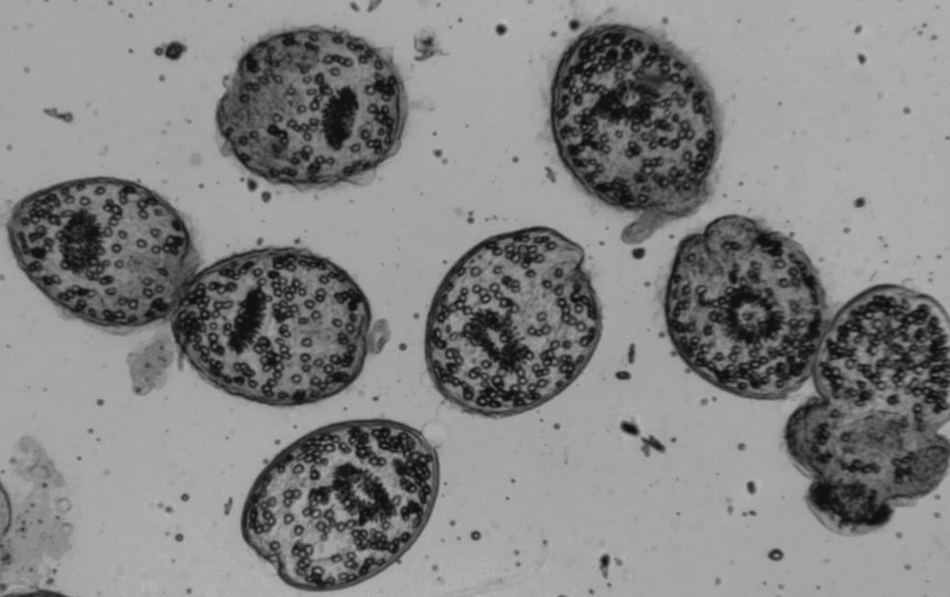
Live protoscoleces of hydatid cysts after exposure to various concentrations of Bunium persicum essential oil after various exposure times (5–30 min) with 0.1% eosin.
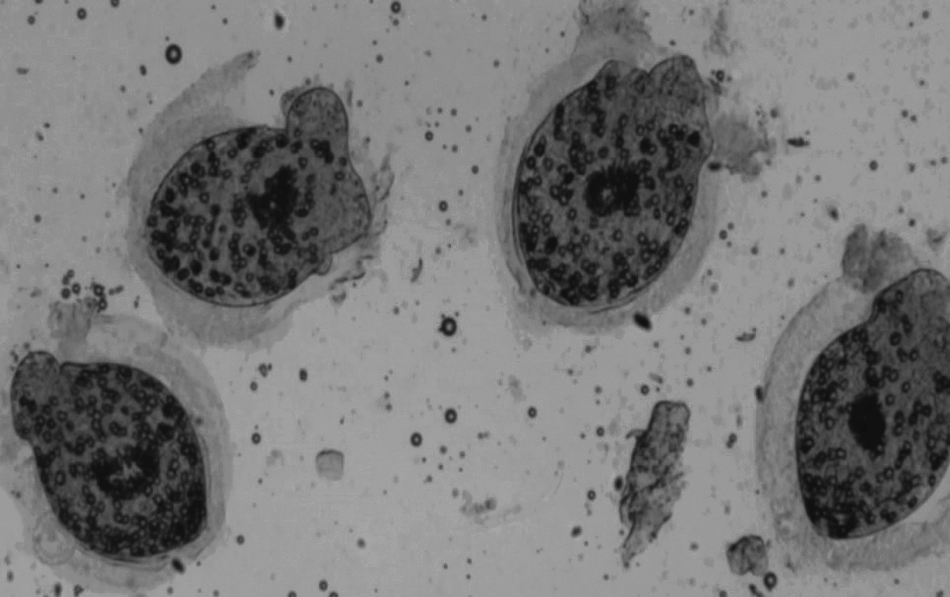
Dead protoscoleces of hydatid cysts after exposure to various concentrations of Bunium persicum essential oil after various exposure times (5–30 min) with 0.1% eosin.
Toxicity test
Ethical approval
This study was performed in strict accordance with the recommendations in the Guide for the Care and Use of Laboratory Animals of the National Institutes of Health. The protocol was approved by the Committee on the Ethics of Animal Experiments of the Kerman University of Medical Science (Permit Number: 91/27, 2013).
Animals
Fifty-four male NMRI mice (3–4 mo old, 30–35 g) were obtained from the Animal Breeding Stock Facility of Razi Institute of Iran (Karaj, Iran). Animals were housed in a colony room with a 12:12 h light-dark cycle at 21° ± 2°C and were handled according to standard protocols for the use of laboratory animals.
Acute toxicity
To determine the acute toxicity, various doses of B. persicum essential oil (0.5–4 mL/kg) were injected intraperitoneally (IP) into four groups of six mice. The number of deaths was counted at 24 h after treatment. Lethal doses to kill 50% (LD50) values were determined by the Probit test in SPSS software [22].
Determination of clinical chemistry and hematologic parameters
Thirty mice were randomly divided into five groups with six mice per group. The first group (control) was administrated physiologic saline orally (orogastric gavage), and the other groups were orally administrated B. persicum essential oil at doses of 0.05, 0.1, 0.2, and 0.4 mL/kg, respectively, for 14 consecutive days.
After the experimental period, animals were fasted overnight and anesthetized using ketamine (100 mg/kg) and xylazine (10 mg/kg) combination. Sodium pentobarbital (70 mg/kg IP) was used as the euthanasia agent; then the abdomen was opened, and blood were samples collected from the heart. For hematologic studies, total blood was collected into tubes containing ethylenediamine tetraacetic acid anticoagulant, and hematologic parameters, including hemoglobin, hematocrit, white and red blood cell counts, and platelet counts, were measured. To measure clinical chemistry parameters in serum, blood was collected into tubes containing no anticoagulant, allowed to clot, and serum was separated by centrifugation at 2000g for 20 min. The assays of aspartate aminotransferase (AST), alanine aminotransferase (ALT), alkaline phosphatase (ALP), creatinine (Cr), blood urea nitrogen (BUN), and bilirubin (direct and total), were performed using Roche diagnostics kits (Mannheim, Germany) [23].
Statistical analysis
Obtained results are expressed as the mean ± standard error of the mean. Data analysis was performed by using SPSS statistical package version 17.0 (SPSS Inc., Chicago, IL). One-way analysis of variance with the Tukey post hoc test was used to assess differences between experimental groups. In addition, p < 0.05 was considered statistically significant.
Results
GC/MS analysis of essential oil
Table 1 shows the findings obtained by GC/MS analysis of B. persicum essential oil. Twenty-four compounds were identified in the B. persicum oil, which constitutes about 97.20% of this oil. The main components were γ-terpinene (46.1%), cuminaldehyde (15.5%), ρ-cymene (6.7%), and limonene (5.9%).
Kovats index on non-polar DB-5 ms column in reference to n-alkanes.
Protoscolicidal effects
Scolicidal effects of B. persicum essential oil at various concentrations after different exposure times are shown in Table 2. The obtained findings demonstrated that essential oil of B. persicum at the concentrations of 50 and 25 mcL/mL after 5 min of exposure killed 100% protoscoleces. Similarly, the mean of the mortality rate of protoscoleces after 10 min of exposure to the concentration of 12.5 mcL/mL was 100%. The results also showed that lower concentrations of B. persicum essential oil provoked a delayed protoscolicidal effect as follow: At the concentration of 6.25 mcL/mL killed 12.3%, 41.6%, 90%, and 100% of the protoscoleces and at the concentration of 3.125 mcL/mL killed 4.3%, 21.6%, 56.3%, and 76% of the protoscoleces after 5, 10, 20, and 30 min of incubation, respectively.
The mortality rate of protoscoleces in the negative and positive controls was 4.3% after 30 min and 100% after 5 min of exposure, respectively. These findings also revealed that the essential oil of B. persicum at all of the concentrations had significant (p < 0.05) scolicidal effects compared with the control group.
Acute toxicity
Acute toxicity effects of B. persicum essential oil were evaluated in male NMRI mice. The LD50 value of IP injection of the B. persicum essential oil was 1.96 mL/kg body weight, and the maximum nonfatal doses were 1.28 mL/kg body wt.
Clinical chemistry and hematologic parameters
On the basis of the obtained findings of LD50, the doses of 0.05, 0.1, 0.2, and 0.4 mL/kg of B. persicum essential oil were chosen. No death was observed in doses of 0.05, 0.1, and 0.2 mL/kg, whereas in the group receiving 0.4 mL/kg of B. persicum essential oil, only one mouse (16.6%) died. As shown in Tables 3 and 4, there was no significant difference (p > 0.05) between chemistry and hematologic parameters after oral administrations of M. communis essential oil at the employed doses 0.05, 0.1, 0.2, 0.4 mL/kg and control.
AST, aspartate aminotransferase; ALT, alanine aminotransferase; ALP, alkaline phosphatase; Cr, creatinine; BUN, blood urea nitrogen; TB, total bilirubin; DB, direct bilirubin.
RBC, red blood cell; HGB, hemoglobin; Hct, hematocrit; WBC, white blood cell; PLT, platelet.
Discussion
Medicinal plants are the oldest medicines used by human beings. Their increasing use in recent years provides a clear piece of evidence for public interest in their use instead of conventional drugs [24]. In the present investigation, we evaluated scolicidal effects of B. persicum essential oil against hydatid cyst protoscoleces and also its acute and sub-acute toxicity in the mice model. Our findings demonstrated that B. persicum essential oil at the concentrations of 50 and 25 mcL/mL after 5 min of exposure killed 100% protoscoleces. In addition, the mean mortality rate of protoscoleces after 10 min of exposure to the concentration of 12.5 mcL/mL was 100%, which indicates that the scolicidal activity of this plant is comparable to the existing scolicidal agents including 20% hypertonic saline (15 min), 20% silver nitrate (20 min), 0.5%–1% cetrimide (10 min), H2O2 3% (15 min), and 95% ethyl alcohol (15 min).
At present, an appropriate scolicidal agent to diminish the risk of protoscoleces spillage during hydatid cyst operations is characterized by its ability at lower doses, high efficacy in a shorter time, constancy in the presence of cystic fluid, greater availability, lower toxicity, and the ability for rapid preparation [1]. The previous reviews have reported scolicidal effects of some medicinal plants such as Berberis vulgaris, Cardamom, Nigella sativa, garlic (Allium sativum), Pistacia atlantica, Zataria multiflora, Pistacia vera, and Myrtus communis [25–32]. The obtained results in the present study suggested that B. persicum could be a natural source for producing a new scolicidal agent for use in hydatid cyst surgical procedures.
We found that in GC/MS, the main components of B. persicum essential oil were hydrocarbon and oxygenated monoterpenes including γ-terpinene (46.1%), cuminaldehyde (15.5%), and ρ-cymene (6.7%). Hajhashemi et al [13] have demonstrated that γ-terpinene (46.1%), cuminal (23.9%), and p-cymene (15.9%) were the main components of B. persicum essential oil. In contrast, Foroumadi et al [33] have reported that among the 25 components identified in B. persicum essential oil, cuminaldehyde (27.0%), γ-terpinene (25.8%), p-cymene (12.1%), cuminyl alcohol (6.0%), and limonene (5.1%) were found to be the major constituents.
Moreover, in a study conducted by Shahsavari et al [14] the major components of B. persicum eesential oil were reported as caryophyllene (27.81%), γ-terpinene (15.19%), and cuminyl acetate (14.67%), respectively. It has been proven previously, however, that chemical composition of essential oil depends on species, climate, collection time, and growth stage that could alter the studied biologic activities [34,35].
Studies have reported potent antimicrobial activities of γ-terpinene, cuminaldehyde, and ρ-cymene against some pathogenic microbial strains [36,37]. Thus, it suggests that phytoconstituents in this plant could be responsible for their scolicidal activity, although their exact mode of action is understood poorly. Regarding the antimicrobial mechanism of some terpenoids compounds such as monoterpenes, however, Sikkema et al [38] demonstrated that they diffuse into pathogens and damage cell membrane structures. Some studies also showed that the antimicrobial activity of these compounds is related to the ability of terpenes to affect not only permeability but also other functions of cell membranes; these compounds might cross the cell membranes, thus penetrating into the interior of the cell and interacting with critical intracellular sites [39–41].
Considering the toxicity of B. persicum essential oil, the obtained results showed that the LD50 of the IP injection of the B. persicum essential oil was 1.96 g/kg and the maximum non-fatal dose was 1.68 g/kg. Liver and renal enzyme activities such as ALT, AST, ALP, bilirubin (total, direct), Cr, and BUN are the major characteristics of liver and renal function. Here, no significant difference (p > 0.05) was observed in the clinical chemistry and hematologic parameters after oral administrations of P. vera essential at the doses 0.05, 0.1, 0.2, 0.4 mL/kg for 2 wks.
In line with our results, Mandegary et al [42] have demonstrated that the B. persicum methanolic extract produced no mortality at a dose of 4 g/kg, but 16% mortality at a dose of 5 g/kg occurred; the essential oil showed no mortality up to the dose of 2.5 mL/kg. Therefore, according to the toxicity classification, B. persicum essential oil had no significant toxicity against male NIH mice [43].
Conclusion
Our findings demonstrated the potent scolicidal activity of B. persicum with no significant toxicity, which might be used as a natural scolicidal agent in hydatid cyst surgery.
Footnotes
Acknowledgments
We would like to thank Dr. Ghasemi Kia for the collection of hydatid cysts. The author declares that there is no conflict of interests in this study.
Author Disclosure Statement
No competing financial interests exist.