




Abstract
Abstract
Background:
Vibrio vulnificus, V. alginolyticus, and V. parahaemolyticus are commonly and opportunistically pathogenic to humans.
Methods:
In this study, a novel multiple touchdown polymerase chain reaction method (MT-PCR) was developed to benefit rapid and simultaneous detection of the presence of the three Vibrio species from the enriched clinical and environmental samples.
Results:
The method showed a sensitivity of 104 colony forming units (CFU)/mL for V. vulnificus, 103 CFU/mL for V. parahaemolyticus and V. alginolyticus, and a specificity of 100% for all the three Vibrio species. All strains of the three Vibrio species were detected in the spiked samples artificially contaminated with reference strains and were identified directly from the enriched clinical and environmental samples within three hours by this MT-PCR assay. All the corresponding bacteria were isolated from these enriched samples in 48 hours by standard microbiologic procedures.
Conclusions:
This MT-PCR method, which can detect V. vulnificus, V. parahaemolyticus, and V. alginolyticus directly and simultaneously, was rapid, sensitive, specific, and can be used in clinical diagnostics, food industry studies, and risk assessment of environment.
T
A rapid, accurate, and efficient detection of Vibrio species in clinical and environmental samples allows swift management responses for pathogens to humans, which can contribute to the quick identification of the three Vibrio species for patients and an understanding of distribution in the environment. Methods for detection of Vibrio species have been developed, but few published articles report detection of them directly from the clinical and environmental samples [8–10]. Therefore, it is necessary to establish a direct detection method to identify these three Vibrio species from the clinical and environmental samples for disease control and risk assessment of the ecosystem.
In this study, a highly sensitive and specific multiplex-touchdown polymerase chain reaction (MT-PCR) assay with an internal amplification control (IAC) was developed for simultaneous detection of V. vulnificus, V. parahaemolyticus, and V. alginolyticus from the clinical and environmental samples.
Methods
Bacteria strains and growth conditions
A total of 45 bacterial strains (Table 1) were used for the optimization and validation of MT-PCR. The strains were sourced from Marine Culture Collection of China (Xiamen, China), Center of Marine Microbial Resources Shandong University (Weihai, China), and Weihai Municipal Hospital affiliated with Dalian Medical University (Weihai, China). The strains were confirmed in our laboratory using the VITEK 2 system (bioMérieux Vitek, Durham, NC) and 16S rDNA sequencing. After selected on thiosulfate citrate bile salt sucrose (TCBS) agar, the strains of Vibrio species were grown with oscillation at 37°C for 16 hours in alkaline peptone water (APW) supplemented with 2% (w/v) NaCl. Other strains were cultured on Campylobacter agar with 8% sheep blood and grown in Luria–Bertani broth (LB) at 37°C.
Reference strains; benvironmental strains; cclinical strains.
MT-PCR = multiplex-touchdown polymerase chain reaction; IAC = internal amplification control.
Deoxyribonucleic acid (DNA) extraction
After growth in liquid medium at 37°C, all strains above were centrifuged at 2,500g for 5 minutes for DNA extraction using a DNA extraction kit (DV810A, Takara, Japan) according to the manufacturer's protocol. The DNA extraction was stored at −20°C before use.
Primers design of MT-PCR assay
The target gene sequences of V. vulnificus, V. parahaemolyticus, and V. alginolyticus were based on the available sequences deposited in GenBank. The primers of IAC were designed in the conserved region of 16S rDNA. After designed with Primer 5.0, the primers were tested for the specificity using Primer-BLAST (www.ncbi.nlm.nih.gov/tools/primer-blast/). The primers were synthesized by Life Technologies Corporation (Shanghai, China) (Table 2).
Optimization and validation of MT-PCR assay
The MT-PCR assay reaction was carried out in a total volume of 25 mcL, containing 2.5 mcL 10 × PCR buffer, 1.5 mcL 25 mM MgCl2, 2 mcL 10 mM deoxyribonucleotide triphosphate, 0.2 mcL 5U/mcL Taq DNA polymerase, 1 mcL DNA template, and a final concentration of each primer set adjusted to ensure proper amplification efficiency for each amplicon. The PCR reaction was performed on 2720 Thermal Cycler (ABI, US), and the condition was: 94°C for 8 minutes, followed by 20 cycles of 94°C for 40 seconds, 65°C (0.5°C decrease per cycle) for 25 seconds, 72°C for one minute, then another 20 cycles of 94°C for 40 seconds, 55°C for 25 seconds, 72°C for one minute, and the final step at 72°C for eight minutes.
After amplification, PCR products were electrophoresed in 1.5% agarose gels and examined under ultraviolet illumination. The DNA extractions from V. vulnificus, V. parahaemolyticus, and V. alginolyticus strains above were used as positive controls, and sterile water was used as a negative control.
Sensitivity and specificity of MT-PCR assay
The sensitivity of MT-PCR assay was evaluated using 10-fold serial dilutions of V. vulnificus, V. parahaemolyticus, and V. alginolyticus strains. After plate count was performed, each dilution was followed by DNA extraction as described above. The specificity of the MT-PCR assay was evaluated using the strains in Table 1. All amplicons were validated further by DNA sequencing and compared with deposited sequences in the National Center for Biotechnology Information (NCBI).
Application of MT-PCR assay in detection from clinical and environmental samples
The MT-PCR assay was validated by detecting the spiked clinical samples and the environmental samples artificially contaminated with reference strains. A total of 37 spiked clinical and environmental samples were analyzed using the MT-PCR assay, including 14 feces samples, 10 sea water samples, eight sediment samples, and five oyster samples.
The PCR assay was validated by detecting clinical and environmental samples. Clinical samples (45 feces samples) from Weihai Municipal Hospital and 57 environmental samples (21 sea water samples, 14 sediment samples, and 22 oyster samples) from the different sources were obtained to detect the three Vibrio species.
After being pre-treated according to the Bacteriological Analytical Manual [11], all samples were enriched in APW with 2% NaCl for 16 hours, and 0.5 mL APW were transferred into the tube to centrifuge at 12,000g for five minutes. After the supernatant was discarded, the 20 μ 1 water was added to dissolution the DNA deposit, the solution as described above for MT-PCR analysis. Meanwhile, the enriched samples were plated onto TCBS for regular culture. Some single colonies were selected from each sample to identify by standard microbiologic procedures using VITEK® 2 Compact.
Results
MT-PCR assay optimization
To obtain high amplification efficiency for each gene in the MT-PCR assay, the annealing temperature and concentrations of individual primer pairs were optimized. The annealing temperature for MT-PCR assay was established at 65°C in the first 20 cycles and at 55°C in another 20 cycles. The optimum concentrations of primers were 0.08 mcmol/L for V. alginolyticus, 0.16 mcmol/L for V. vulnificus, V. parahaemolyticus, and IAC. Amplified fragments of 740 bp for V. vulnificus, 312 bp for V. alginolyticus, 496 bp for V. parahaemolyticus, and 598 bp for 16S rDNA were obtained in a 1.5% agarose gel (Fig. 1).

Partial results of multiple touchdown polymerase chain reaction method (MT-PCR) for specificity. Lane 1, Vibrio minicus; lane 2, V. fluvialis; lane 3, V. furnissii; lane 4, V. hollisae; lane 5, V. metschnikovii; lane 6, V. cincinnatinesis; lane 7, V. carchariae; lane 8, V. fischeri; lane 9, V. harveyi; lane 10, DNA marker; lane 11, MT-PCR products of V. vulnificus (740 bp), internal amplification control (16S rDNA, 598 bp), V. parahaemolyticus (496 bp), and V. alginolyticus (312 bp).
Sensitivity and specificity of MT-PCR assay
The detection sensitivity of the MT-PCR assay was tested and ranged from 101 to 105 colony-forming units (CFU)/mL. The minimum detection limit was 104 CFU/mL for V. vulnificus, and 103 CFU/mL for V. parahaemolyticus, V. alginolyticus, and IAC. A total of 45 strains were tested for specificity by MT-PCR assay. After MT-PCR and DNA sequencing, all V. vulnificus, V. parahaemolyticus, and V. alginolyticus strains were amplified correctly to compare with the sequences deposited in NCBI while all other strains only showed a 598 bp IAC amplicon (Fig. 1).
Application of MT-PCR assay in detection of spiked samples and environmental samples
All V. vulnificus, V. parahaemolyticus, and V. alginolyticus strains were amplified correctly in 37 spiked samples by MT-PCR assay (Fig. 2). Five V. parahaemolyticus strains were detected in the enriched clinical samples, while two V. vulnificus strains, 11 V. parahaemolyticus strains, and four V. alginolyticus strains were detected from the enriched environmental samples within 3 hours by MT-PCR assay (Fig. 3). All the strains were isolated and identified in 48 hours by standard microbiologic procedures.
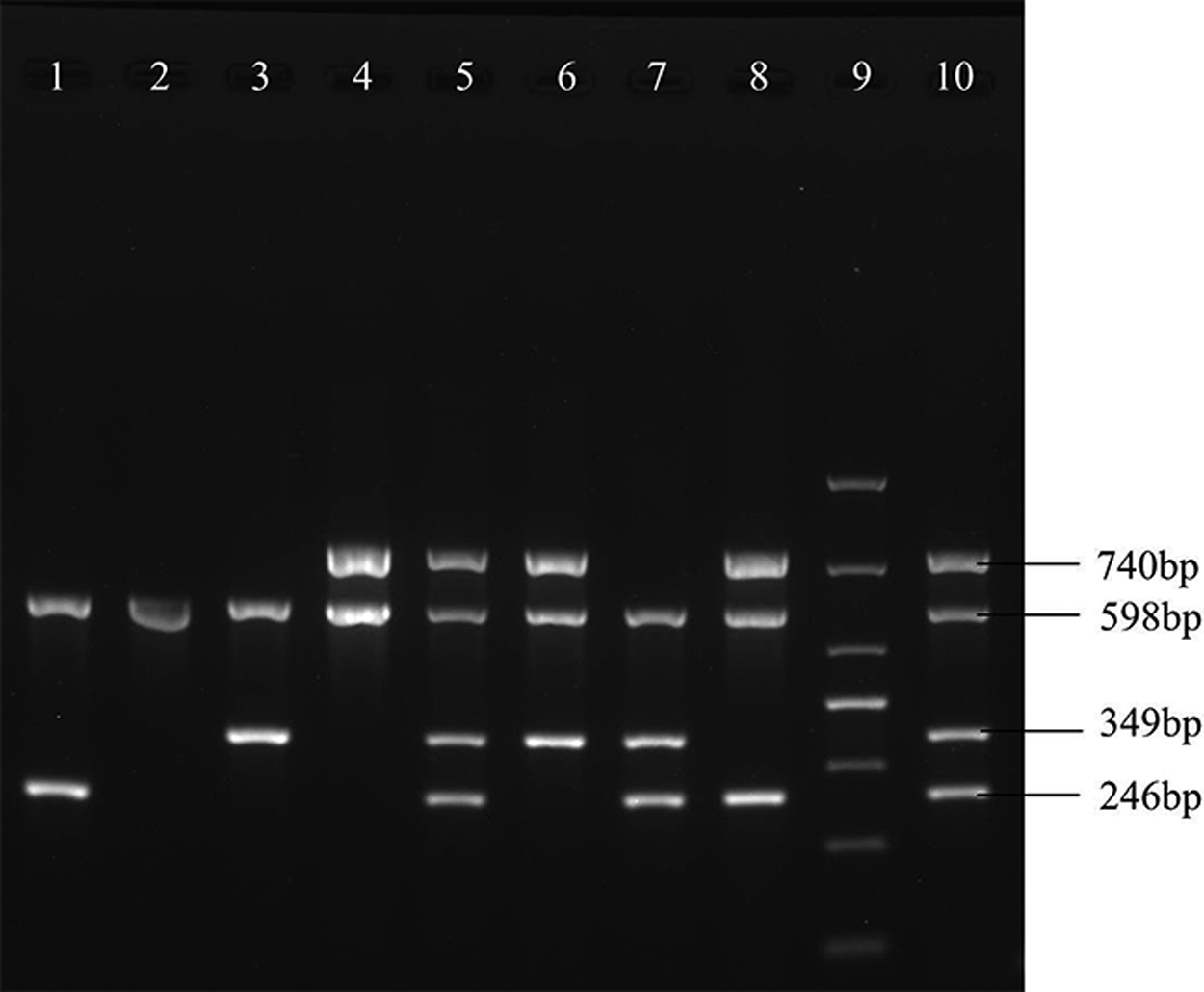
Partial Results of spiked samples by multiple touchdown polymerase chain reaction method assay. Lane 1, Vibrio alginolyticus; lane 2, negative control; lane 3, V. parahaemolyticus; lane 4, V. vulnificus; lane 5, V. vulnificus, V. parahaemolyticus, and V. alginolyticus; lane 6, V. vulnificus and V. parahaemolyticus; lane 7, V. parahaemolyticus and V. alginolyticus; lane 8, V. vulnificus and V. parahaemolyticus; lane 9; deoxyribonucleic acid marker; lane, 10 positive control.

Partial results of positive clinical and environmental samples by MT-PCR assay. Lane 1, 4, 6, 8, 10 negative samples; lane 2, Vibrio vulnificus; lane 3, V. alginolyticus; lane 5, 7, 9 V. parahaemolyticus; lane 11, deoxyribonucleic acid marker; lane 12, positive control.
Discussion
Vibrio species are naturally diverse halophilic bacteria that inhabit aquatic environments, such as estuaries and seawater. Among them, V. vulnificus, V. parahaemolyticus, and V. alginolyticus are of major concern because they are pathogenic to animals, including humans [12,13]. All of the three Vibrio species are associated commonly with seawater, sediment, shellfish, and clinical specimens.
Rapid identification for V. vulnificus, V. parahaemolyticus, and V, alginolyticus is an increasingly important issue for public health in clinical and environmental samples. Classical identification methods for these species based on biochemical and microbiologic tests are time consuming and unreliable. Therefore, it is necessary to develop a specific, sensitive, and rapid molecular method to replace the classic methods.
Detection of the human pathogen Vibrio genus often relies on molecular biologic analysis of species-specific virulence factor genes, such as tlh, trh, tdh, toxR, toxRS, ctxA, gyrB, and collagenase [14–19]. In the study, vvhA, collagenase, and toxR were selected, respectively, for the analysis for V. vulnificus, V. parahaemolyticus, and V. alginolyticus.
The multiplex PCR methods as a regular molecular assay, which use more than one pair of primers to detect different genes in a single reaction, have been validated as effective tools for simultaneous detection of various pathogens [19,20]. Nevertheless, cross-amplification reactions and false positive signals of multiplex PCR may become a major concern [21] when this technique is used as a defining method for differentiating Vibrio species in complex clinical and environmental samples.
Touchdown PCR employs an initial annealing temperature above the projected melting temperature of the primers being used, then progressively transitions to a lower, more permissive annealing temperature over the course of successive cycles. Touchdown PCR offers a simple and rapid method to increase specificity, sensitivity, and yield, especially high specificity [22]. In the present study, we developed a highly sensitive and specific MT-PCR assay with IAC for simultaneous detection of V. vulnificus, V. parahaemolyticus, and V. alginolyticus from the enriched clinical and environmental samples.
Various factors may affect the amplification efficiency in PCR assay, including DNA polymerase inactivation and the presence of inhibitors. The IAC has been indicated as an effective tool to prevent false-negative results. In a recent report, a triplex PCR assay for the identification of methicillin resistant staphylococci was developed with 16S rDNA sequence as an IAC to increase the accuracy of the assay [23]. Based on the conserved region of 16S rDNA sequences, a pair of primers was designed as an IAC in the MT-PCR to avoid false negatives in this study.
To our knowledge, this is the first study to utilize MT-PCR with an IAC for the simultaneous detection of V. vulnificus, V. parahaemolyticus, and V. alginolyticus in clinical feces, seawaters, sediments, and oyster samples. In this study, the detection limit for V. vulnificus was 104 CFU/mL, and the limits for the other two species are 103 CFU/mL with mixed DNA templates. As the largest fragment (740 bp), V. vulnificus was relatively difficult to amplify because of the bias for the multiplex PCR reaction to amplify smaller fragments [24]. The performance of the MT-PCR assay was evaluated using spiked samples, enriched clinical and environmental samples in the research. All three Vibrio species were detected correctly in these samples within 3 hours by MT-PCR assay, which were identified in 48 hours by standard procedures. This MT-PCR assay would provide a useful tool for infectious risk analysis and disease control of Vibrio species.
Conclusion
The MT-PCR assay developed in this study was a rapid, sensitive, and specific assay and can be used for the simultaneous detection of V. vulnificus, V. parahaemolyticus, and V. alginolyticus from the enriched clinical and environmental samples. It could be used in clinical diagnostics, food industry studies, and risk assessment of the environment.
Footnotes
Acknowledgments
This work was supported by Major PLA Research Project of “The 12th Five-Year Plan” for Medical Science Development (Grant No. BWS12J014), the China Postdoctoral Science Foundation (No.2015M52711), and Primary Research & Developement Plan of Shandong Province (No.2016GSF121036).
Author Disclosure Statement
No competing financial interests exist.