




Abstract
Background:
The coronavirus disease 2019 (COVID-19) pandemic has become an increasingly challenging problem throughout the world. Because of the numerous potential modes of transmission, surgeons and all procedural staff represent a unique population that requires standardized procedures to protect themselves and their patients. Although several protocols have been implemented during other infectious disease outbreaks, such as Ebola virus, no standardized protocol has been published in regard to the COVID-19 pandemic.
Methods:
A multidisciplinary team of two surgeons, an anesthesiologist, and an infection preventionist was assembled to create a process with sterile attire adapted from the National Emerging Special Pathogen Training and Education Center (NETEC) donning and doffing process. After editing, a donning procedure and doffing procedure was created and made into checklists. The procedures were simulated in an empty operating room (OR) with simulation of all personnel roles. A “dofficer” role was established to ensure real-time adherence to the procedures.
Results:
The donning and doffing procedures were printed as one-page documents for easy posting in ORs and procedural areas. Pictures from the simulation were also obtained and made into flow chart-style diagrams that were also posted in the ORs.
Conclusions:
Coronavirus disease 2019 (COVID-19) is a quickly evolving pandemic that has spread all over the globe. With the rapid increase of infections and the increasing number of severely ill individuals, healthcare providers need easy-to-follow guidelines to keep themselves and patients as safe as possible. The processes for donning and doffing personal protective equipment (PPE) presented here provide an added measure of safety to surgeons and support staff to provide quality surgical care to positive and suspected COVID-19–positive patients.
At the time of this publication, 196 countries, territories, or areas have had laboratory-confirmed cases of coronavirus disease 2019 (COVID-19) [1]. Although the transmission of this novel coronavirus is not entirely understood, live virus has been found in samples obtained from bronchoalveolar lavage, sputum, nasal swabs, bronchial brush biopsies, pharyngeal swabs, feces, and blood [2]. These potential numerous modes of transmission pose an unprecedented threat to healthcare workers all over the world.
Governmental and professional organizations have published guidelines on strategies to conserve personal protective equipment (PPE) during this pandemic, including the Food and Drug Administration and American College of Surgeons Committee on Trauma [3,4]. The procedural steps for donning and doffing airborne-contact PPE in a standard patient room or emergency department setting are well described [5,6], including for some extremely virulent micro-organisms such as Ebola virus [7]. Despite these easily referenced resources, there is a lack of published guidelines regarding donning and doffing of sterile PPE in an operating room (OR) environment. Although many institutions have curtailed elective procedures to conserve resources and limit potential exposures, it is important to recognize that some patients with suspected or confirmed COVID-19 infection will still require emergent procedures and surgical care during this time. During this current pandemic, surgeons and all proceduralists, including scrub staff, should be provided with a standardized procedure to protect both themselves and their patients should the need arise for operative or procedural intervention.
Methods
An initial review of the guidelines from the U.S. Centers for Disease Control and Prevention (CDC), National Emerging Special Pathogen Training and Education Center (NETEC), and World Health Organization (WHO), and search of PubMed and Twitter revealed no information specifically about the donning and doffing of airborne-contact PPE for providers performing sterile procedures in the OR or other procedural suites. This search consisted of searching for keywords “COVID” or “COVID-19” or “SARS-CoV02” + “PPE” + “Sterile” + “Surgery” and was performed on March 20, 2020. A multidisciplinary team of two surgeons, an anesthesiologist, and an infection preventionist was assembled to create a process with sterile attire adapted from the NETEC donning and doffing process, which provides healthcare workers with a standard procedure for non-sterile environments. The initial checklist was created on a shared file platform (Google Doc) to allow for version control and easy dissemination. Performance of the checklist was simulated in an empty OR suite with four personnel roles represented: dofficer, surgeon, scrub nurse/technician, and circulating nurse. The dofficer was defined as the person assigned to the task of ensuring proper conduct of the procedure via real-time visual confirmation using the donning and doffing procedure checklists. Adaptation of the NETEC protocol [6] was necessary to account for the transition from non-sterile to sterile zone, and for maximal protection from potential overglove failure during the operation. It was also modified to provide guidance on donning and doffing various approved forms of protective eye and mask wear, optimized for preservation of the N95 mask in times of scarcity. The process was documented with photographs corresponding to each checklist step. The protocol was reviewed by local infectious disease and infection control experts in Ebola PPE procedures and approved for use at our facility on March 24, 2020. A video education module was produced and disseminated via hospital intranet for provider education. Laminated versions of the checklist were also made available for dofficers.
Protocol
This procedure clarifies the steps for the donning and doffing (removal) of sterile surgical attire for all sterile surgical personnel (surgeons and scrub nurse/technologist) who will be scrubbed into operations on COVID-19 presumed and confirmed patients. Expect that donning will take slightly longer than for standard sterile attire, and that doffing will be more complicated with more hand hygiene steps, such as sanitizing gloved hands with alcohol gel and washing hands with soap and water for at least 20 seconds. The importance of the role of dofficer, who will coach the person performing these procedures for best adherence, cannot be overstated. Other personnel in the OR who are not required to wear sterile attire should wear an N95 mask and follow donning and doffing procedures recommended by the CDC [8].
Refer to the next pages, which can be printed, laminated (for decontamination between cases), and used as check-lists in ORs.
Donning Procedure
Steps 1–5 may be performed prior to arrival in the OR area, if desired, but a dofficer standing outside the OR will check prior to proceeding with step 7. The circulator will take on the role of dofficer at step 10 when the OR is entered. The checklist should be read aloud by the dofficer to assist in procedure adherence (Fig. 1).
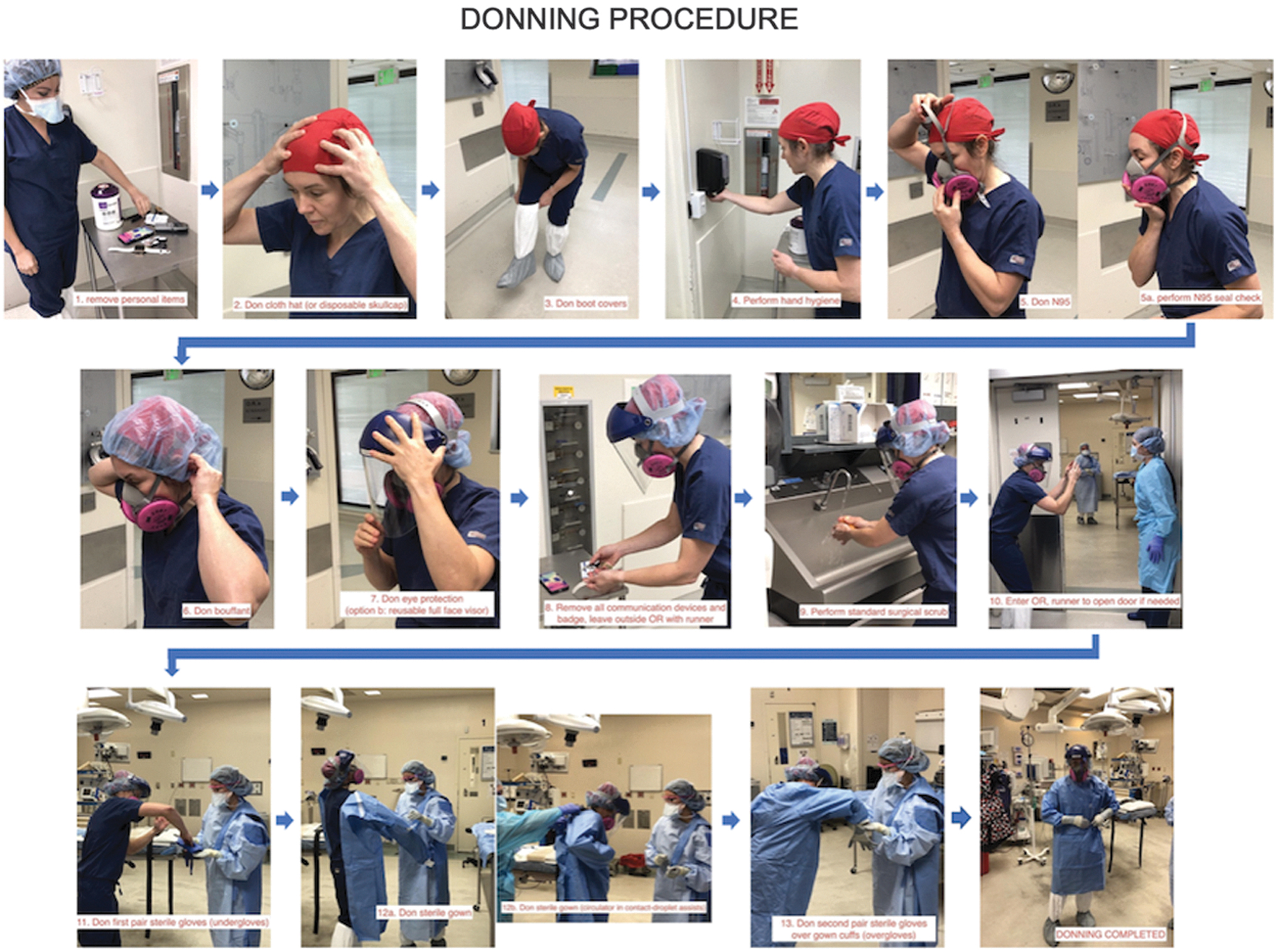
Donning procedure of personal protective equipment (PPE) for the sterile operating room environment. Color image is available online.
❏ 1. Remove personal items on head/neck (e.g., earrings, necklaces, etc.)
a. Eyeglasses can remain on.
b. Tip: Long hair should be placed in a braid or bun. A hair band should be used to keep hair away from the face.
❏ 2. Don cloth OR hat or disposable skull cap
❏ 3. Don boot covers
❏ 4. Perform hand hygiene
❏ 5. Don N95 and perform seal check according to manufacturer instructions
❏ 6. Don bouffant cap
❏ 7. Don Eye protection (choose from options below) with second mask placed over N95 (Fig. 2)*
a. Mask with attached face shield (inverted) plus simple surgical mask over N95 (for N95 preservation)
b. Full face visor (reusable ones acceptable if cleaned in decontamination solution)
c. Disposable visor glasses plus simple surgical mask over N95 (for N95 preservation)
d. Reusable goggles PLUS simple surgical mask over N95 (for N95 preservation)
❏ 8. Remove ALL communication devices including cell phones and pagers. Remove hospital ID badge. These should be left outside the OR entrance on a table manned by the runner. Clean items with disinfectant wipes.
❏ 9. Perform standard surgical scrub after dofficer confirms good respirator, eye protection and mask fit
❏ 10. Enter OR (runner can open door if needed)
❏ 11. Don first pair of sterile gloves (undergloves)
❏ 12. Don surgical gown with assistance from circulator (circulator in non-sterile PPE [8])
❏ 13. Don second pair of sterile gloves over gown cuffs (overgloves)
*Second mask donned over N95 only if N95 masks are to be reused after decontamination in times of scarcity.
Contamination event during surgery
During an operation, overgloves may be exchanged, with scrub nurse/technician changing their overgloves as well. If any other PPE is compromised during the case, remove gown and outer gloves, assess need for removal of visor and/or mask, and follow steps in doffing procedure until contamination is resolved, then start over with donning (must re-scrub). The N95 mask should only be removed after exiting OR.

Multiple options available to satisfy the three requirements of eye protection, N95 mask preservation, and usability in the operating room (OR) under sterile conditions. If an integrated visor/mask is utilized, it should be inverted on the forehead and a second simple surgical mask can be placed over the N95 for preservation of N95 in times of scarcity [9]. Some may not be suitable for full N95 coverage, especially if reusable N95 half-face masks are used, because they are bulkier than the disposable N95. If an overmask is used instead of a full-face shield/visor, the overmask should be doffed prior to removal of the bouffant. Care must be taken not to contaminate the scrub shirt: the circulator can assist in removal of the overmask by untying the lower ties to the mask first (not pictured). Color image is available online.
Doffing Procedure
Circulator will act as dofficer in the OR and observe/coach through step 12, reading each step aloud from checklist. Steps 1–12 should be performed in the OR (Fig. 3).
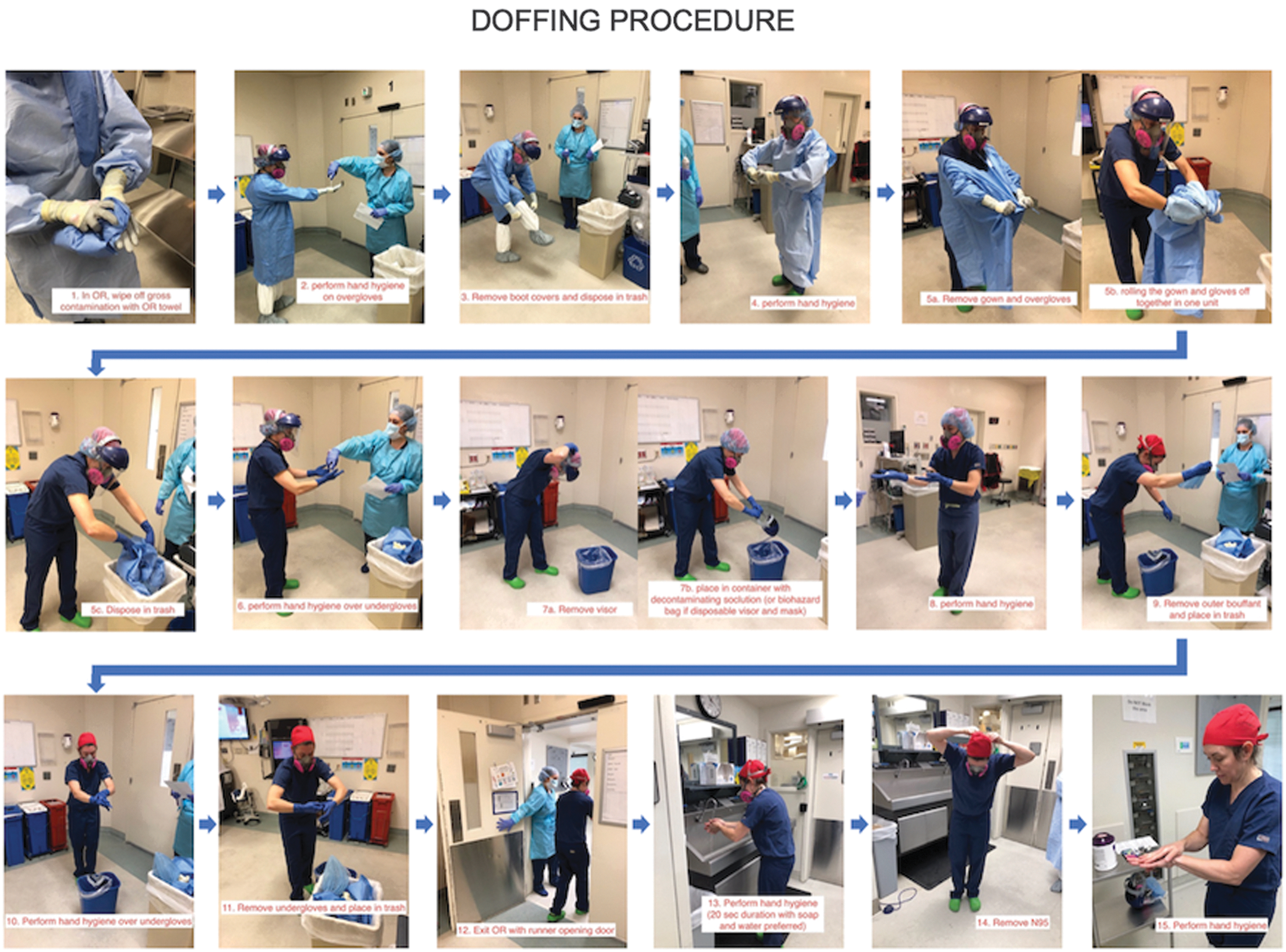
Doffing procedure of personal protective equipment (PPE) in sterile operating room (OR) environment. Color image is available online.
❏ 1. Wipe off gross contamination from overgloves with OR towel, dispose in biohazard trash
❏ 2. Perform hand hygiene (will have to use hand gel) over overgloves
❏ 3. Remove boot covers and dispose in biohazard trash
❏ 4. Perform hand hygiene over overgloves
❏ 5. Remove gown and overgloves, rolling the gown and gloves together in one unit and dispose in biohazard trash
❏ 6. Perform hand hygiene over undergloves
❏ 7. Remove visor and place in decontamination solution if reusable, biohazard trash if disposable mask/visor combo. If removing the visor/mask combination, take care to avoid touching the front of the mask. May require assistance from dofficer to remove mask safely.
❏ 8. Perform hand hygiene over undergloves
❏ 9. Remove outer bouffant and place in biohazard trash
❏ 10. Perform hand hygiene over undergloves
❏ 11. Remove undergloves and place in biohazard trash
❏ 12. With runner opening door so as not to touch door, exit OR
❏ 13. Perform hand hygiene, 20 seconds duration with soap and water
❏ 14. Remove N95.* If reusable-type mask, place in bag for decontamination
❏ 15. Perform hand hygiene
❏ 16. Go to locker room and dispose of scrubs, shower before leaving OR area
*May opt to keep N95 on to preserve mask, follow procedure for reuse and decontamination if applicable in your hospital
Doffing Procedure for surgeons transporting unstable patient to OR
❏ 1. Surgeons transport patients into OR already wearing airborne PPE (non-sterile) per American College of Surgeons Committee on Trauma (ACS COT) recommendations [4]
❏ 2. Position patient on OR table
❏ 3. Perform hand hygiene on top of gloves
❏ 4. Remove non-sterile gown and gloves
❏ 5. Perform hand hygiene
❏ 6. OR dofficer (circulator) evaluates visor and N95 for fit.
a. If adjustment needed,
i. Put non-sterile gloves on
ii. Doff visor in OR, place in decontamination receptable if reusable
iii. Perform hand hygiene
iv. Remove gloves
v. Exit OR and begin DONNING procedure at Step 3 with Dofficer
b. If visor and N95 ok,
i. Exit OR and begin DONNING procedure at Step 3
Conclusion
COVID-19 is a quickly evolving pandemic that has spread all over the globe. With the rapid increase of infections and the rising number of severely ill individuals, healthcare providers need easy-to-follow guidelines to keep themselves and patients as safe as possible. Surgeons and the staff who support them in the OR are a special risk population. Even with postponing or averting elective or even urgent operations, emergent operations, such as those for penetrating and blunt trauma or solid organ transplant, may require entering the respiratory and/or gastrointestinal tract, organ systems which are known to contain live virus in COVID-19–positive individuals [2]. As disease prevalence has increased regionally, surgeons and other proceduralists have been called upon to make difficult decisions about rationing operative interventions because of the risk of exposure and dwindling PPE supplies.
The processes presented here provide surgeons and support staff with the first sterile environment-specific education for donning and doffing PPE in the provision of surgical care to positive and suspected positive COVID-19 patients. We have made an effort to document different options for eye protection and preservation of precious N95 masks, recognizing that availability of items in the supply chain is fluid and PPE a scarce resource (Fig. 2). However, the importance of meticulous hand hygiene, and the role of the dofficer in ensuring proper PPE fit, donning, and doffing in this process cannot be overstated. Healthcare workers frequently deviate from PPE guidelines and contaminate themselves when donning and doffing PPE [10]. The dofficer, modeled after the CDC's Trained Observer, can help prevent these deviations and potential contamination events [11], and should be a standard role in every OR in which these procedures are implemented. Prior to the removal of each item of PPE in the doffing process, hand hygiene must be performed (Fig. 4). Although the process may seem straightforward, the stress of the circumstances under which it must be executed and the significant deviation from standard sterile OR practices make the dofficer's role essential as a coach and safety check.
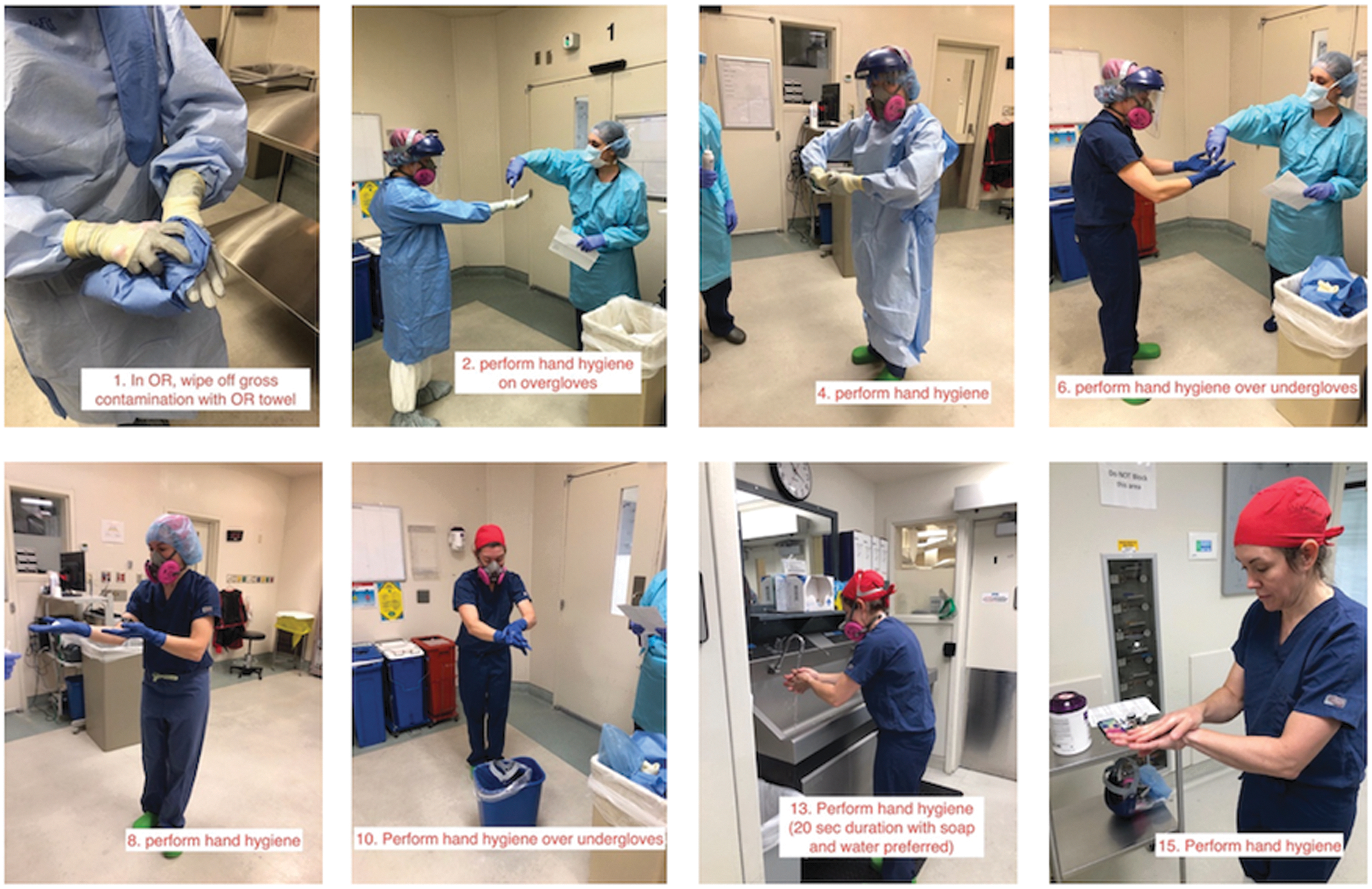
Doffing requires a meticulous attention to hand hygiene. There are eight separate steps that involve decontamination of the hands, performed prior to removal of every personal protection equipment (PPE) item and at the end of the process. The purpose of this is to decrease viral load at every possibility of contamination. Color image is available online.
Footnotes
Funding Information
No funding was received.
Author Disclosure Statement
No competing financial interests exist.