




Abstract
Background:
This study presents the effectiveness of a combined silver carboxylate (AgCar) and chlorohexidine gluconate (AgCar:CHG) chemistry assessed against two commonly encountered nosocomial pathogens, Methicillin-resistant Staphylococcus aureus (MRSA) and Cutibacterium acnes, within the context of surgical antisepsis and wound care.
Methods:
Through an Institutional Review Board- and Institutional Animal Care and Use Committee (IACUC)-approved protocol, AgCar:CHG was applied to live Yucatan porcine skin and visualized by fast red and green staining to assess level of skin penetration. Dose response curves for Cutibacterium acnes and MRSA were generated to determine the optimal therapeutic ratio of AgCar to CHG. Coatings were applied to two different clinically available sutures and antimicrobial efficacy was evaluated at 24-hour intervals using Kirby-Bauer (KB) assays. Graphite furnace atomic absorption spectroscopy was used to measure AgCar elution from sutures over time.
Results:
Synergistic application of AgCar:CHG demonstrated deep pilosebaceous gland penetration on Yucatan pig skin. The therapeutic concentration range of AgCar was determined to be between 120 × –150 × and 30 × –60 × dopage for MRSA and Cutibacterium acnes, respectively. A 1:1 therapeutic ratio of AgCar to CHG was found to have 100% bactericidal activity against both pathogens. Sutures coated with AgCar:CHG showed sustained antimicrobial activity against MRSA and Cutibacterium acnes, and were significantly more efficacious than antimicrobial sutures over the three- to four-day period (p < 0.01).
Conclusions:
This AgCar:CHG chemistry demonstrates deep skin penetration, extended elution, and broad-spectrum antimicrobial activity compared with commercially available options. This chemistry shows promise as an additional tool for the prophylaxis of surgical site infections.
Surgical site infections (SSI) lead to longer recovery times, revision surgeries, and increased costs [1]. Despite proactive management of surgical sites, the incidence of SSIs remains at 2% to 5% of inpatient surgeries [2]. Within orthopedics, two common drivers of SSI are methicillin-resistant Staphylococcus aureus (MRSA) and Cutibacterium acneses, both of which become more virulent once colonized on sutures [3–6].
Current standard of care for surgical skin antisepsis is 1,6-bis(4-chloro-phenylbiguandio) hexane, or chlorohexidine (Cardinal Health, Dublin, OH) [7]. This antimicrobial has both broad-spectrum bactericidal and bacteriostatic effects, and is often combined with gluconate (CHG) and isopropyl alcohol (IPA) (ChloraPrep®, Cardinal Health, Dublin, OH) [7]. Despite the antimicrobial activity of CHG, Cutibacterium acnes has been shown to persist within pilosebaceous glands in up to 70% of cases after application [8].
In addition to surgical skin preparation, antimicrobial sutures, frequently coated with the antimicrobial triclosan, have been introduced to help reduce SSI incidence. Sutures coated with triclosan prevent colonization directly on and immediately surrounding the suture, decreasing risk for SSI by up to 66% [9–12]. However, triclosan-coated sutures confer resistance to various antibiotic agents [13,14].
We have previously characterized a hybrid matrix of titanium dioxide (TiO2) and polydimethylsiloxane (PDMS) doped with silver carboxylate (AgCar) that interferes with bacterial replication and inhibits protein and enzyme function [15–19]. This matrix is applied as a liquid and, once dry, utilizes the metal oxide hybrid structural properties to control the release of AgCar particles [18]. Formulations of the coating have demonstrated deep pilosebaceous penetration and inhibition against a wide variety of pathogens at concentrations that do not inhibit osteoblast proliferation in vitro [18,20]. The effect of AgCar against biofilms and persister cells, as well as comparison of its safety compared with other clinically used forms of silver is unknown and subject to investigation.
This study assesses the efficacy of a hybrid mix of the AgCar chemistry and CHG against Cutibacterium acnes and MRSA. When AgCar is combined with CHG, we hypothesize that the resulting chemistry will exhibit equal or greater efficacy as a suture coating compared with CHG or triclosan alone, while maintaining deep pilosebaceous penetration and an extended duration of action.
Materials and Methods
Porcine skin preparation
Under Institutional Review Board- and Institutional Animal Care and Use Committee (IACUC) protocol number 1504000131-approved methodology, Yucatan pigs were anesthetized. The skin was prepped with pre-surgical soap and disinfected with 70% isopropanol. Three 6 × 6 inch skin sections from the front axillary regions were coated with either 10 × ChloraPrep (1:1 ratio of 2% CHG to IPA), 10 × AgCar (384 mcM silver), or combined AgCar:CHG. All compounds were applied with a commercially available sponge-tipped applicator (BI Medical LLC, North Kingstown, RI). Skin was not shaved, as Yucatan pigs have relatively minimal hair. The skin preparation was allowed to penetrate and evaporate for one minute prior to euthanasia. The degree of skin/pore penetration of AgCar was assessed through fast red and fast green staining of the tissue as determined using ImageJ (National Institutes of Health, Bethesda MD).
Bacterial culture
Bacterial pathogens, MRSA (BAA-1556) and Cutibacterium acnes (33179) were obtained from ATCC (Manassas, VA). Methicillin-resistant Staphylococcus aureus was cultured with brain heart infusion (BHI) at 37°C in aerobic conditions for at least 12, but no longer than 24 hours. Cutibacterium acnes was cultured with reinforced clostridial medium (RCM) in an anaerobic chamber and GasPak EZ system (BD, Franklin Lakes, NJ). Time to culture was 48 to 72 hours. The optical density was then measured at 562 nm and a dilution of 1 × 10⁷ colony forming units (CFU) per milliliter was created for each pathogen using the SPECTRAmax 384 Plus (Molecular Devices, San Jose, CA).
Silver carboxylate coating chemistry
The AgCar antimicrobial coating was prepared according to a patented protocol (Biointraface, North Kingstown, RI). The formulation of this AgCar eluting polymer/organometallic complex utilizes PDMS, titanium isopropoxide, heptane, isopropanol, and silver neodecanoate. The formulation of the AgCar coating is a refined version of 95% heptane:PDMS, as previously described [18]. The amount of silver neodecanoate that is added to the coating during preparation determines the doping concentration. A 10 × dopage corresponds to 384 mcM concentration of silver and a 1:1 ratio of elution vehicle to silver. Doping concentrations were determined for each bacterium by dose response curves (DRCs) to minimize silver concentrations while maintaining efficacy. The doping concentration designations were 120 × , 130 × , 140 × , and 150 × for MRSA experiments, and 30 × , 40 × , 50 × , and 60 × for Cutibacterium acnes experiments. A 0 × dopage was used as a negative control with no silver added to the vehicle matrix. A 50-50 mix of isopropanol to silver neodecanoate, termed 100% Ag, served as the positive control.
Dose response curve and drop assay
Dose response curves were generated to assess the relative efficacy of the coating and CHG against both pathogens. To generate these curves, 96-well plates were coated with 20 mcL of either the AgCar chemistry conditions described above or increasing amounts of CHG. For CHG, the 10 × condition represented a 1:1 ratio of 2% CHG to IPA. After the wells were coated with their respective conditions, excess chemistry was removed, and the coated plates were air-dried in a fume hood for 24 hours. The plates were then wrapped in aluminum foil and heated to 90°C for sterilization. All pathogens were cultured and diluted in liquid media as stated above. Two hundred microliters of the bacterial dilution (1 × 10⁷ CFUs/mL) were transferred into each coated well. Inoculated well plates were then incubated in each bacteria's respective conditions for 24 to 48 hours depending on the pathogen.
The oxidation at higher concentrations of silver, the turbid nature of Cutibacterium acnes, and the orange color of CHG each interfered with optical density measurements. Viability was measured directly by the 20 mcL drop assay. After plating and incubation, 20 mcL samples from each condition were transferred onto the respective agar media for each pathogen. The plates were incubated for 24 to 48 hours based on pathogen. After the second round of incubation, colony forming units per milliliter were calculated. The log-reduction in bacterial presence was quantified from the colony forming units per milliliter data.
Suture materials and conditions
Ethicon Polyglactin-910 Coated VICRYL® Plus (Somerville, NJ; termed Ethicon® sutures), Arthrex FiberWire® (uncoated braided polyethylene core structure; Naples, FL; termed FiberWire® sutures), and Ethicon Triclosan Coated VICRYL Plus Antibacterial Sutures (termed Triclosan sutures) were utilized. Sutures were uniformly cut into one-centimeter pieces under aseptic conditions and autoclaved. Sutures were sequentially dip-coated in AgCar and CHG and air-dried between coatings. Suture groups were weighed prior to and after coating to determine reproducibility and volume of coating bound. The 1:1 ratio of AgCar:CHG was the only combination that showed complete inhibition in every trial against both pathogens. Because of its 100% bacterial inhibition, the 1:1 ratio was used to coat sutures during the Kirby-Bauer (KB) assays.
Three control coatings were utilized in each Ethicon and FiberWire experiment: positive (100% Ag), negative (0 × ), and chlorhexidine-coated sutures (CHG). Ethicon Triclosan-Coated VICRYL Plus Antibacterial sutures (termed ABX) served as antimicrobial controls.
Kirby-Bauer assay
Kirby-Bauer assay was utilized to visualize and quantify microbial inhibition. Tryptic soy agar plates were coated with a bacterial dilution of 1E9 CFU/mL for MRSA and reinforced clostridial agar plates were coated with 1E7 CFU/mL for Cutibacterium acnes. Sutures were immediately placed onto the agar plate after sequential dip coating. Plates were then incubated in respective conditions and analyzed at specific time points. For MRSA, the zones of inhibition (ZOI) were imaged at 24, 48, and 72 hours. Cutibacterium acnes ZOI were imaged at 48, 72, and 96 hours because of the slow-growing nature of the pathogen. For each suture type, six data points were collected at three time points for each of the four experimental coating conditions, generating an N of 144 per pathogen.
Image and statistical analysis
Images from the KB assay were analyzed using ImageJ. ImageJ was calibrated to 100 nm based on the diameter of each agar plate. The ZOI was then measured using the area function.
A one-way analysis of variance (ANOVA) for coating conditions was used to determine if the effectiveness of the microbial coating was constant with respect to time. One-tailed t-tests were used to detect differences in mean ZOI between concentrations of AgCar:CHG and control conditions of CHG, ABX, and AgCar. Significance was set at p < 0.05.
Graphite furnace atomic absorption spectroscopy silver elution analysis
GFAAS (Brown University, Providence, RI) was used to measure silver elution over time. Three identical sutures were coated for each condition in the study, including both Ethicon and FiberWire sutures, and placed in individual scintillation vials with 2 mL of deionized water after adequate drying time. Depending on conditions, the sutures were removed at 24, 48, 72, or 96 hours, and nitric acid was added at a concentration of 1% to maintain the silver in solution. The samples were diluted to meet the requirements of the graphite furnace and triplicate readings of silver concentration were measured.
Results
Porcine skin data
Figure 1 shows representative histologic sections of porcine skin after application of CHG, AgCar, or AgCar:CHG. Chlorohexidine gluconate alone did not penetrate beyond the epidermal layer (Fig. 1B). In contrast, AgCar alone demonstrated far deeper penetration into the epithelium, reaching the level of the deep pilosebaceous glands (Fig. 1C). The combined AgCar:CHG chemistry was able to penetrate equally as deep into the skin as AgCar alone (Fig. 1D).

The silver carboxylate (AgCar) and chlorohexidine gluconate (CHG) chemistry is able to penetrate deep in to the pilosebaceous glands-pig skin penetrance assay.
Dose response curves
Figure 2 demonstrates the DRCs generated for both MRSA and Cutibacterium acnes when exposed to AgCar. Fifty percent antimicrobial activity was achieved by a 10 × dopage for MRSA and 5 × dopage for Cutibacterium acnes (Fig. 2A and 2B). Total bacterial inhibition was achieved by 120 × and 30 × dopages for MRSA and Cutibacterium acnes, respectively (Fig. 2A and 2B). Dose response curves were next generated for CHG against MRSA and Cutibacterium acnes (Fig. 2C and 2D). Fifty percent antimicrobial activity was achieved by a 1 × dopage for MRSA and 5 × dopage for Cutibacterium acnes (Fig. 2C and 2D). Total bacterial inhibition was achieved by 60 × and 40 × dopages for MRSA and Cutibacterium acnes, respectively (Fig. 2C and 2D).
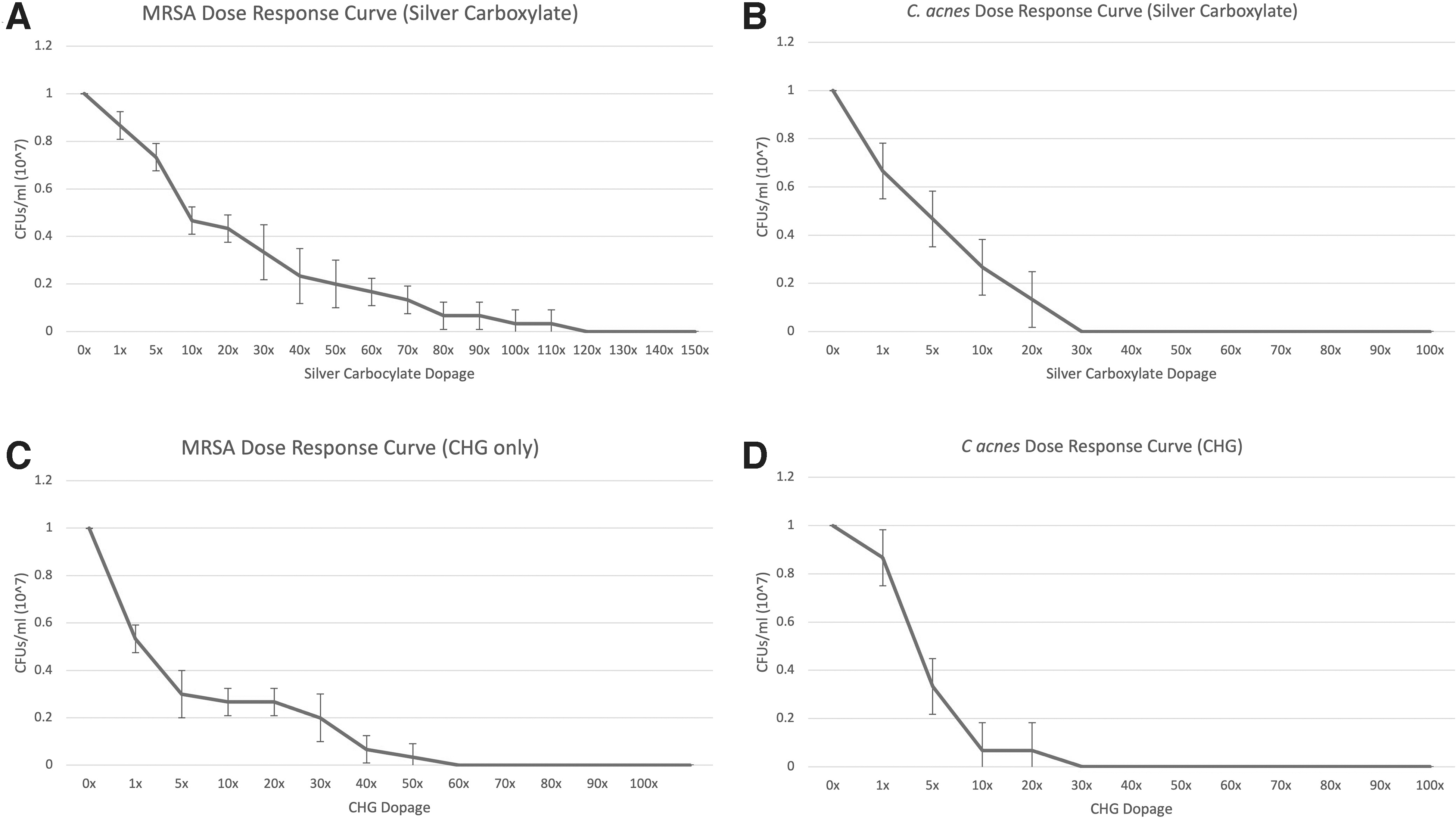
Dose response curves for isolated silver carboxylate (AgCar) and chlorohexidine gluconate (CHG). MRSA = methicillin-resistant Staphylococcus aureus.
We created two separate AgCar:CHG formulations using the minimum fully bactericidal concentrations demonstrated in the prior DRCs. For MRSA, 120 × AgCar/70 × CHG and for Cutibacterium acnes, 30 × AgCar/40 × CHG were combined. All concentrations showed more than 97.5% bacterial inhibition, however, the 1:1 ratio of AgCar:CHG was the only combination that showed complete inhibition in every trial against both pathogens.
Kirby-Bauer assay
The average ZOI for each condition at respective time points was graphed for both pathogens with FiberWire and Ethicon sutures (Fig. 3). Raw data of the ZOIs calculated with ImageJ are seen in Table 1.
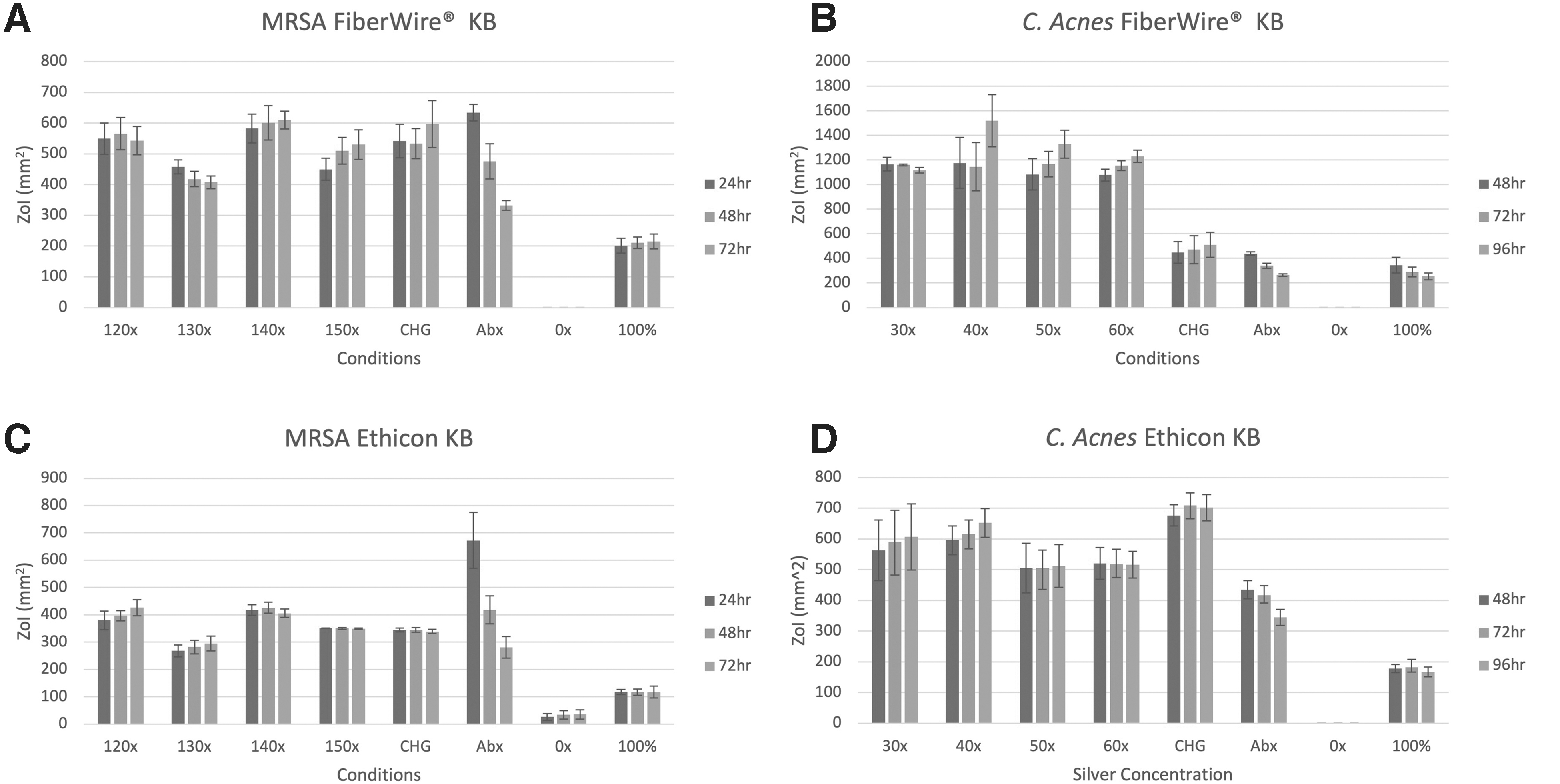
Zones of inhibition for FiberWire and Ethicon sutures coated in concentrations of silver carboxylate (AgCar) and chlorohexidine gluconate (CHG) deemed therapeutic against methicillin-resistant Staphylococcus aureus (MRSA) and Cutibacterium acnes by dose response curves (DRCs). KB = Kirby-Bauer assay.
Zones of Inhibition (mm2) Over Time for MRSA and Cutibacterium acnes
Abx = antibiotic; CHG = chlorohexidine gluconate; MRSA = methicillin-resistant Staphylococcus aureus.
FiberWire KB assay
Analysis of variance testing suggested that the 150 × concentration-maintained inhibition of MRSA over 72 hours (p = 0.53; Fig. 3A). By 72 hours, the 150 × AgCar:CHG condition had significantly larger ZOIs than 100% AgCar (p = 0.014), and equal ZOIs to CHG alone (p = 0.278). By 96 hours, 60 × AgCar:CHG had significantly outperformed controls, with greater ZOIs than the 100% AgCar and CHG controls (p < 0.001 and p < 0.01, respectively; Fig. 3B). FiberWire sutures weighed 0.004 g (standard deviation [SD] = 0.00057) prior to coating, and 0.0085 g (SD = 0.00034) after coating, representing a 53% increase in mass (p < 0.00001) attributable to loading of the chemistry.
Ethicon KB assay
Analysis of variance testing suggested that the 150 × concentration-maintained inhibition of MRSA over 72 hours (p = 0.97; Fig. 3C). The 150 × experimental coating was superior to 100% AgCar (p < 0.01) and CHG (p < 0.05) by 72 hours (Fig. 3C). By 96 hours, the 40 × experimental coating was superior to 100% AgCar, (p < 0.001), and equally efficacious as the CHG control (p = 0.269; Fig. 3D). Ethicon sutures had an average weight of 0.002 g (SD = 0.00034) prior to coating and 0.0025 g (SD = 0.00049) after coating, a statistically significant increase of 25% (p < 0.05) that can be attributed to loading of the respective coatings.
For both MRSA and Cutibacterium acnes, the coating performed better on FiberWire than Ethicon. For example, both the 150 × and 60 × conditions AgCar:CHG conditions had a significantly larger ZOIs in FiberWire® trials compared with the Ethicon trials (p < 0.05 and p < 0.001, respectively).
ABX suture KB assay
Triclosan-coated Ethicon antimicrobial sutures displayed a significant change in ZOI over time for both MRSA (p < 0.005) and Cutibacterium acnes (p < 0.001; Fig. 3). By 96 hours, 60 × AgCar:CHG performed better than triclosan-coated sutures (p < 0.05). This trend persisted across coating concentrations and against both pathogens. Isolated triclosan was the only condition, both experimental and control, in which there was observed decrease in efficacy.
GFAAS silver elution
Elution of AgCar from sutures over time is represented in Figure 4. For all experimental conditions and suture types, silver concentration increased over time (Fig. 4A and 4B). The 120 × Ethicon and 130 × FiberWire counterintuitively showed decreased silver concentration from the first time point to the second (Fig. 4A).

GFAAS data of silver release from sutures coated with various concentrations of silver carboxylate only or silver carboxylate (AgCar) and chlorohexidine gluconate (CHG).
In the therapeutic range for MRSA and Cutibacterium acnes, all of the AgCar:CHG conditions experienced an increase in the concentration of AgCar over the three time points (Fig. 4C and 4D). The Ethicon 50 × condition showed decreased silver concentration between the first two time points (Fig. 4D).
In elution data for 100% Ag control, concentration of silver dramatically increased between the first and second time points for both types of sutures, however, both experienced either minimal or no rise in the concentration subsequentially (Fig. 4E).
Discussion
We previously described a hybrid matrix of AgCar and titanium dioxide-PDMS that demonstrated extended elution, deep skin penetration, and antimicrobial activity [18]. This study found that when combined with CHG, the AgCar chemistry showed penetration into the pilosebaceous glands, increased bactericidal activity as a suture coating against MRSA and Cutibacterium acnes, and consistent AgCar elution through 96 hours.
The ability of AgCar:CHG to reach the pilosebaceous gland gives the coating access to bacteria that would otherwise be untreated by CHG alone. We hypothesize that this penetrance capability is due to the polarity of the solvents (xylene, isopropanol, and heptane) utilized in the coating, which aid in solubilizing the sebum in the pilosebaceous glands, specifically during peri-operative antisepsis of the back, shoulder, or axilla, where Cutibacterium acnes commonly colonizes [21].
Because of the stronger antimicrobial activity of CHG, we expected that when combined with AgCar, higher ratios of CHG to AgCar would prove most efficacious. Instead, we found the 1:1 ratio of CHG to AgCar provided equal or greater bactericidal activity to 3:1 ratio against both Cutibacterium acnes and MRSA. This could be related to the distinct mechanisms by which CHG and AgCar mediate bactericidal activity, and the differential doubling rates of these pathogens. The minimum inhibitory concentration of CHG against MRSA has been documented between 0.2%–0.8% [22], much lower than the concentrations we used during our study. Therefore, CHG concentrations could have been at maximum bactericidal efficacy, also explaining why an increase in CHG concentrations did not impact efficacy.
When the AgCar:CHG chemistry was applied as an antimicrobial coating for FiberWire and Ethicon sutures, we found there to be a 53% increase in the weight of FiberWire compared with the 25% increase in the weight of Ethicon. The cross-sectional area of FiberWire is 0.75 mm2 compared with 0.09 mm2 for 2.0 Ethicon [23]. The higher weight and retained coating by FiberWire are likely because of this increased thickness and surface area. In turn, FiberWire tended to display larger ZOIs than Ethicon against both pathogens.
On FiberWire and Ethicon, 120 × –150 × AgCar:CHG reached maximum effectiveness within 24 hours and maintained antimicrobial activity over 72 hours against MRSA. Against a fast-growing pathogen such as MRSA, the use of antimicrobial sutures with sustained activity for 72 hours could help reduce colonization of wounds. Similarly, a 30 × –60 × concentration of AgCar:CHG coating on FiberWire and Ethicon inhibits Cutibacterium acnes at 48 hours and maintains its effectiveness over 96 hours. Long-term inhibition against this slow-growing pathogen could have clinical significance following shoulder surgery, a locus where Cutibacterium acnes resides [24].
The ZOIs in Cutibacterium acnes experiments were larger than those from MRSA experiments, especially with Fiberwire. For example, the ZOIs in the 30 × Fiberwire condition at 96 hours (1117.10 ± 42.67 mm2; Fig. 3B) were more than twice the size of ZOIs in the 150 × Fiberwire condition at 72 hours (530.22 ± 97.48 mm2; Fig. 3A). This apparent difference in efficacy could be explained by the slow-growing nature of Cutibacterium acnes compared with the rapid and constant proliferation of MRSA.
Although previous literature notes the effectiveness of triclosan against Cutibacterium acnes [25,26], we found that the triclosan-coated sutures provided lower ZOIs than AgCar:CHG at 96 hours. The rapidly decreasing antimicrobial activity of triclosan may lead to decreased effectiveness at preventing SSIs. In contrast, the extended elution and antimicrobial activity of AgCar:CHG allows for broad-spectrum antisepsis through 96 hours.
We found that although every coating concentration displayed increasing elution through 96 hours, their elution profiles varied. Certain concentrations demonstrated a faster elution profile such as the Fiberwire and Ethicon 40 × , whereas others more slowly released their coating later like Fiberwire and Ethicon 150 × . Although no trend was found on how suture type or coating concentration affected elution profile, we have generally found that higher concentrations of the AgCar coating lead to slower release, possibly because of higher overall loading. Certain samples showed a decrease in silver concentration between the first and second time point. This could be caused by slight differences in the dip-coating application.
Limitations to this study include a lack of direct examination of the efficacy of silver-carboxylate:CHG sutures in vivo. Although porcine skin is considered a close substitute to human, further testing on human epidermis would confirm our findings. Additionally, although care was taken to fix GFAAS samples in an acidified environment and promptly measure silver concentration, silver may still fall out of solution and plate surfaces, thus decreasing measured concentrations.
Further experiments must be performed demonstrating the efficacy of AgCar:CHG sutures in a setting contaminated with MRSA or Cutibacterium acnes, and confirming the in vivo safety of the AgCar concentrations up to 150 × . Given growing concerns of antimicrobial resistance to silver [27], future investigation of a combined AgCar:CHG chemistry's efficacy against these pathogens is warranted.
Conclusion
Our data suggest that AgCar:CHG chemistry is capable of deep skin penetration, antimicrobial action against MRSA and Cutibacterium acnes, and extended elution characteristics. With the growing threat of microbial resistance, AgCar:CHG could serve as a novel technology for surgical site preparation to further reduce SSIs.
Footnotes
Authors' Contributions
D.G. assisted in study development, data collection, analysis, writing, and editing. N.V. assisted in data collection, analysis, writing, and editing.
S.A. assisted in data collection, analysis, writing, and editing. D.D. assisted in data collection, writing and editing. E.B. assisted in writing and editing
CS assisted in writing and editing. T.L. assisted in writing and editing.
C.B. assisted in writing and editing. V.A. assisted in writing and editing.
C.B. assisted in study development, data collection, analysis, writing, and editing.
Funding Information
This work was supported by Diane N. Weiss and The Sipprelle Family Foundation.
Author Disclosure Statement
D.G. and C.B. hold equity in BI Medical, LLC. N.V., S.A., D.D., E.B., T.L., C.B., and V.A. have no disclosures. C.S. has stock/stock options in Johnson & Johnson. C.B. is a stockholder in BioIntraface.