




Abstract
Background:
Zosyn® (piperacillin-tazobactam; Pfizer Medical, New York, NY), a valuable antibiotic against gram-negative bacteria, combined with vancomycin (Z+V) is known for its high incidence of acute kidney injury (AKI), particularly in the intensive care unit (ICU), leading to the frequent use of alternatives for gram-negative coverage (Alt+V). Because there are limited data describing AKI on these alternative antibiotic agents, a systematic review and meta-analysis was conducted to determine if these regimens were indeed associated with decreased rates of AKI.
Patients and Methods:
A literature review was performed electronically from its inception to November 1, 2018, screening for relevant literature by title, abstract and full text according to the Preferred Reporting Items for Systematic Reviews and Meta-Analyses (PRISMA) guidelines within the following databases: PubMed/Medline, CINAHL, Scopus, and Cochrane Central Register of Controlled Trials. Studies were included if they contained adults who had been admitted to the ICU for treatment and had received a combination of intravenous Z + V or Alt+V as well as had AKI measured during administration of these antibiotic agents. Studies were excluded if they represented pediatric populations, did not receive care in an ICU during their hospital admission, only received monotherapy for antibiotic treatment or received antibiotic treatment for less than 48 hours. Independent extraction was performed by two reviewers. Risk of bias was assessed using the Risk of Bias in Non-randomised Studies of Interventions (ROBINS-I) methodology for retrospective studies. Random-effects models were used to calculate any differences between rates of AKI after Z + V or Alt + V.
Results:
Fourteen articles (totaling 30,399 patients) were included. All studies available were retrospective in design. Compared with Alt + V, Z + V was associated with a higher risk ratio of AKI (1.79; 95% confidence interval [CI], 1.46–2.19; p < 0.001). Cefepime (C + V) was the most common alternative to Zosyn, and Z + V was associated with higher rates of kidney injury compared with C + V (1.70; 95% CI, 1.36–2.12; p < 0.00001). However, there was substantial heterogeneity in the data collected as well as high risk of bias.
Conclusions:
Zosyn plus vancomycin is associated with more risk of AKI compared with Alt+V coverage in ICU adult populations. However, the conclusions were limited by the retrospective nature of the studies, high bias of included articles, and heterogeneity of the included studies.
Acute kidney injury (AKI) is broadly defined as “a significant decrease in renal function occurring over a few hours or days.” 1 It includes increases in serum creatinine (SCr), decreases in glomerular filtration rate (GFR), or decreases in urine output (UOP).2,3 Although there have been more than 200 definitions of AKI, 4 the Risk, Injury, Failure, Loss and End-stage kidney disease (RIFLE) criteria was the first system that consolidated SCr, GFR, and UOP into progressive stages of kidney injury.5,6 The Acute Kidney Injury Network (AKIN) later simplified the RIFLE criteria from five stages into three, 7 while Kidney Disease: Improving Global Outcomes (KDIGO) developed a “precise and patient-centered” definition with three degrees of severity. 8 Despite the variety of clinical AKI scoring systems, higher grades of RIFLE, AKIN, and KDIGO have all been shown to predict morbidity and mortality.6,9,10
Regardless of the specific criteria used to make a diagnosis, AKI is associated with increased healthcare costs, length of stay, and mortality in intensive care unit (ICU) populations. 11 Some of the highest rates of AKI occur in the adult ICU population, where there is a high incidence of coinciding chronic kidney disease and administration of nephrotoxic medications.12–15 The most commonly used nephrotoxic medications in the ICU are antibiotic agents, such as vancomycin (V) and piperacillin-tazobactam (Z; Zosyn), which are routinely used for empiric coverage in patients with sepsis. Vancomycin, which provides robust gram-positive coverage, may be combined with alternatives to Z for gram-negative coverage, including polymyxins, carbapenems, fluoroquinolones, and aminoglycosides. Although the most common combination used in ICU patients is Zosyn and vancomycin (Z+V), it commonly induces AKI, which further impairs the healing of ICU patients.1,16 However, the use of alternative gram-negative coverage agents with vancomycin (Alt+V) has been reported to cause AKI as well. 17 Thus, at present, it is not clear if alternatives to Zosyn have less incidence of AKI when used in combination with vancomycin for empiric ICU sepsis coverage.
The objective of this study was to compare ICU adults being treated with Z + V to those being treated with Alt+V to identify whether or not alternative options for gram-negative coverage can provide a decreased incidence of iatrogenic AKI.
Patients and Methods
A PROSPERO (protocol #CRD42018115268) was approved in advance of conducting the systematic review, according to the Preferred Reporting Items for Systematic Reviews and Meta-Analyses (PRISMA) guidelines. 18 The search was conducted by the first author (E.B.) and a research librarian at the University of Texas-Medical Branch using MeSH terms that included “acute kidney injury” AND “Zosyn” OR “alternative” (Supplementary Table S1). PubMed/Medline, CINAHL, Scopus, and Cochrane Central Register of Controlled Trials database were searched from their inceptions to November 1, 2018. To minimize publication bias, abstracts and other gray literature presented at academic conferences were included in the initial search.
References from articles included in the primary search were reviewed manually and included as a secondary search if relevant to optimize all available studies. Only articles published in English were included. Studies eligible for inclusion investigated adults (>18 years old) who received a standardized assessment of AKI (measurement of urine output [UOP], SCr, GFR, etc.), who were admitted to the ICU for at least 48 hours, and who treated with intravenous Z + V or Alt+V for at least 48 hours. Alternatives to Zosyn included Maxipime (Cefepime, Pfizer Medical, New York, NY), Merrem (Meropenem, Astra Zeneca, Wilmington, DE; Pfizer Medical, New York, NY), Primaxin (Imipenem-Cilastin, Merck, Rahway, NJ), and Unasyn (Ampicillin-Sulbactam, Pfizer Medical, New York, NY), which are commonly accepted agents and frequently prescribed in this population. 19
Editorials, case reports, opinion pieces, and non-English studies were excluded. Additionally, studies were excluded if the duration of specified antibiotic agents was less than 48 hours or if the duration was not specified. A duration that was less than 48 hours was unlikely to be a source of AKI and therefore would not be as relevant to the population in question, which typically requires empiric coverage for several days while being treated for sepsis. If either antibiotic were administered in routes other than intravenous, the study was also excluded, since these routes are not as likely to cause AKI. Studies that did not include patients who were treated in the ICU at some point during their hospital admissions were also excluded. Finally, if the study did not include any outcomes regarding AKI, they were excluded.
Two review authors (E.B. and J.M.) independently screened studies by title and abstract, and then performed full-text review. Disagreements between the reviewers were resolved by consensus of a third reviewer (D.P.). Studies that reported duplicate data for the same population were excluded (study of the most complete dataset was used and additional outcomes were added to the total dataset if relevant). If studies did not report independent data for a given antibiotic but reported outcomes for groups receiving alternatives to Zosyn in composite, then these data were included in initial meta-analysis but excluded from potential subanalysis because data could not be assumed to correspond to an individual alternative.
Data collection was performed with a template that was standardized prior to the start of the full-text review. Demographic data were collected across included studies and analyzed to characterize the population of interest. To assess for potential confounding medications, data that were reported in the original articles on the percent of patients taking various non-antibiotic nephrotoxic medications were collected and then pooled by pharmacologic class, including loop diuretics, aminoglycosides, non-steroidal anti-inflammatory drugs (NSAIDs), etc. These data were collected in effort to provide meta-regression if adequate data were available to better delineate if differences in rates of AKI were persistent after adjusting for underlying baseline patient characteristics.
If a single control group was used to compare multiple antibiotic alternatives, the alternative data were included without duplicating the data for the controls to ensure accuracy of the meta-analysis calculations. Preliminary literature review revealed that most studies were retrospective and observational in nature. Therefore, the Risk of Bias in Non-randomised Studies of Interventions (ROBINS-I) tool developed by Cochrane was used by two researchers (E.B. and J.M.) independently to assess risk of bias of studies eligible for systematic review. Discrepancies in evaluations of risk of bias were resolved by a tie-breaker (D.P.) according to the methods recommended by Cochrane. 20 All datasets were assessed for normal distribution using the Kolmogorov-Smirnov test. For continuous data, parametric data were compared using Student t-tests and non-parametric data were compared using Mann-Whitney U tests.
Categorical data were analyzed using χ 2 tests. These analyses were performed using GraphPad Prism (version 8.0.0 for Windows, GraphPad Software, San Diego, CA) using the threshold for statistical significance at an α of 0.05. For meta-analysis, outcome data were organized in Microsoft Excel 365 ProPlus and then imported into Review Manager 5 (RevMan5, 2014) software to perform inverse-variance models and forest plots. If available, matching of outcomes was attempted by pairing studies of similar design. RevMan5 was used to calculate risk ratios for outcome measures of AKI using the random-effects method, as recommended by the Cochrane Collaboration and Borenstein et al. for dichromatic outcomes.21,22 Outcomes for meta-analysis included AKI by the standardized assessment methods (AKIN, RIFLE, and KDIGO), and data were assessed in composite for overall effect as well as by individual stage (Stage 1, 2, 3). Additionally, risk ratios of renal replacement therapy (RRT) and mortality were also compared between Z + V and Alt+V. Sensitivity analysis was performed for individual regimens of alternatives (i.e., Z + V versus C + V or Z + V versus M+V). Subanalysis was reported if found to be statistically significant, per recommendations by the Cochrane guidelines. 23 Heterogeneity was assessed using Cochran's Q and I 2 . 23
Results
After completing the primary and secondary database searches, duplicates were removed and 1,905 publications were available for screening by title and abstract (Fig. 1). After screening for inclusion and exclusion criteria, 87 articles were reassessed by full-text review. After full-text review, 68 were excluded, specifically for lack of relevant outcomes (n = 31), lack of ICU population (n = 10), inappropriate duration of antibiotic therapy (n = 6), unspecified antibiotic duration (n = 13), duplicate data (n = 5), or lack of Zosyn as comparison (n = 3). Therefore 19 studies were included in the systematic review for qualitative analysis (Table 1). Of the 19 studies eligible for qualitative analysis, only 14 had data for direct comparisons between patients taking Z + V versus Alt+V (Table 1). Of these 14 studies, seven included C + V as the alternative regimen,24–31 three included M+V,24,32,33 two included C + V or M+V,34,35 one included I + V, 36 and one included A+V. 37
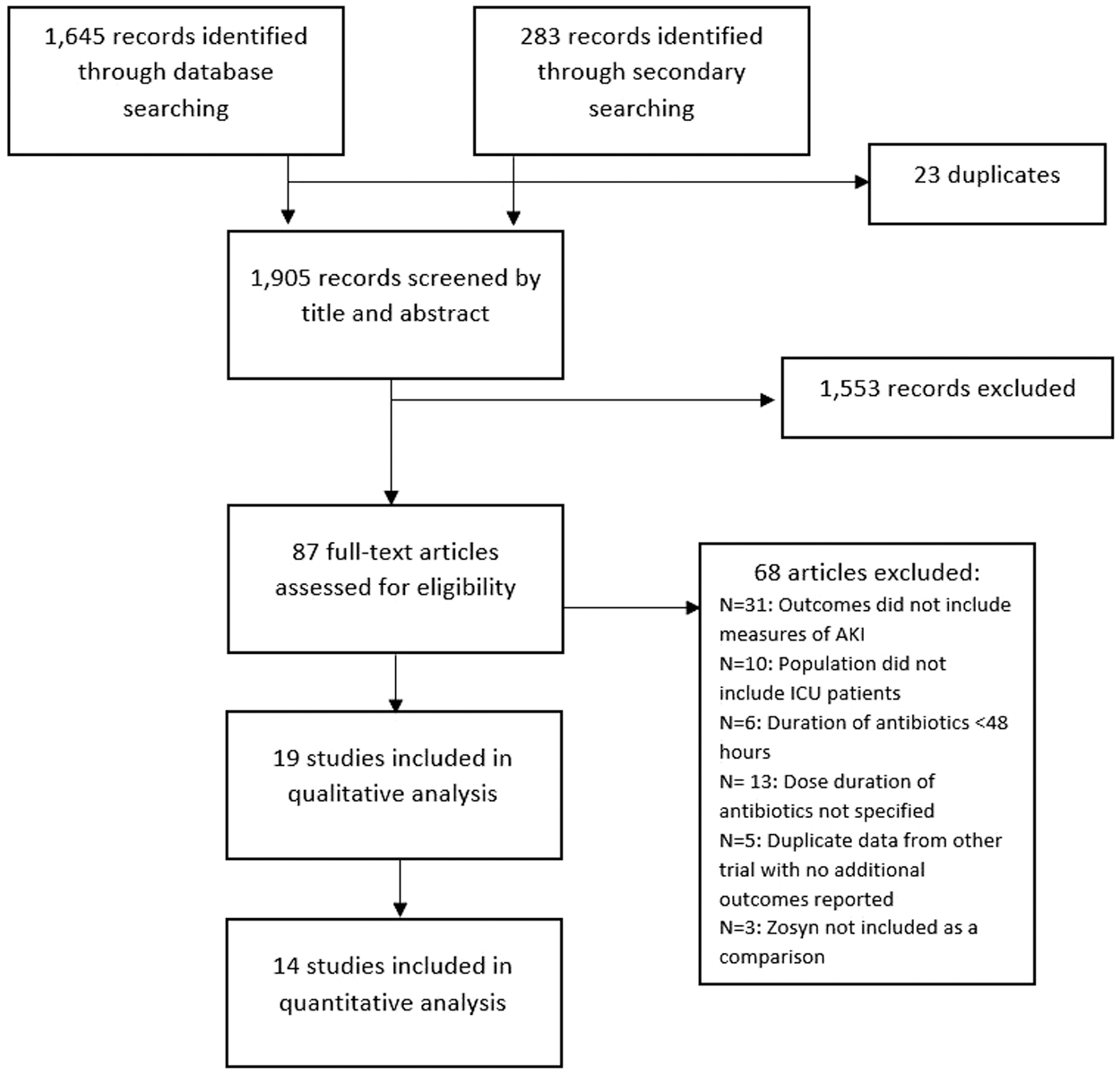
Study selection flow chart according to Preferred Reporting Items for Systematic Reviews and Meta-Analyses (PRISMA) guidelines. AKI = acute kidney injury; ICU = intensive care unit.
Studies Included in Systematic Review and Meta-Analysis with Associated Characteristics
AKI = acute kidney injury; ICU = intensive care unit; Z+V = Zosyn+vancomycin; Alt Ab = alternative gram-negative antibiotic+vancomycin (Alt+V); Alt Ab = alternative antibiotic.
Characteristics of Included Studies
A total of 30,399 patients were included in the meta-analysis (Z+V: n = 19,333; Alt+V: n = 11,066). No statistically significant differences were found between baseline characteristics, including demographic features, SCr, CrCl, or rate of coinciding nephrotoxic medication usage between groups, but these characteristics were not well defined in each study (Supplementary Tables S2 and S3). No randomized controlled trials or prospectively gathered data were found in search. Therefore, only retrospective data were included, which limited the quality of the analysis. Unfortunately, some studies incompletely reported data for studies that included multiple alternative gram-negative antibiotic regimens, which precluded meaningful sensitivity analysis when comparing different alternative regimens for baseline demographics, baseline kidney function and coinciding nephrotoxic agents. After assessment of the risk of bias in the studies, most studies were found to have moderate to high risk of bias based on the ROBINS-I tool, as shown in Table 2.
Risk of Bias in Non-randomised Studies - of Interventions (ROBINS-I)
Studies identified as potential candidates for systematic review were assessed for bias, resulting in moderate or serious risk of bias in most categories.
It was not clear from qualitative analysis whether one antibiotic combination demonstrated a higher incidence of AKI over others, so meta-analysis was undertaken to better assess this clinical question. The risk of developing AKI was higher for patients receiving Z + V compared with Alt+V, as shown in Figure 2 (risk ratio, 1.79; 95% CI, 1.46–2.19; p < 0.00001). Data were available to perform subanalysis to compare rates of AKI in Z + V to C+V, but there were insufficient number of studies for direct comparisons between Z + V and other alternative regimens. As shown in Figure 3, risk of AKI at all stages for any staging system was higher in Z + V compared to C + V (risk ratio 1.70; 95% CI, 1.36–2.12; p < 0.00001). There were inadequate number of studies and insufficient detail in the included studies to perform meta-regression to better characterize whether or not these differences were persistent after adjusting for other confounding factors that are associated with AKI in ICU populations. There were no statistically significant differences by stage in each of the grading systems analyzed (grades 1–5 in RIFLE, grades 1–3 in AKIN, and grades 1–3 in KDIGO; p > 0.05 for all). Of the three studies24,32,33 that included comparisons to Z + V versus M+V, sensitivity analysis failed to show statistically significant differences between Z + V and M + V regimens in composite or by stage in each of the grading systems examined (p > 0.05 for all). Moreover, there were no statistically significant differences in rates of RRT and in-patient mortality between Z + V and Alt+V; but, these data were not reported in the vast majority of studies and were therefore not believed to provide meaningful conclusions.

Composite of all stages of AKI in ICU patients receiving intravenous Zosyn+vancomycin versus alternative gram-negative coverage+ vancomycin. AKI = acute kidney injury; ICU = intensive care unit.

Composite of all stages of AKI in ICU patients receiving intravenous Zosyn+vancomycin versus cefepime+vancomycin. AKI = acute kidney injury; ICU = intensive care unit.
Discussion
Although potent broad-spectrum antibiotic agents are an important component of suspected infection in ICU patients, the kidney injury associated with these medications can impair the recovery of these fragile patients. The effects from AKI on long-term outcomes in the ICU population are still being elucidated. Although there has been long-standing literature establishing the negative impact AKI has on ICU patients, particularly mortality,38,39 newer literature suggests that transient AKI may correlate with the inflammatory response that serves to ultimately protect patients during life-threatening conditions. 40 Furthermore, it has been established that certain combinations of broad-spectrum antibiotic coverage, such as Z+V, are associated with higher incidence of AKI; however, it is not clear what proportion of AKI is directly related to antibiotic therapy. Cofounding factors such as hypotension, previous chronic kidney disease, and usage of other nephrotoxic agents often compound the diagnosis of AKI when often attributed to antibiotic coverage.
Zosyn plus vancomycine, a common first-line combination of broad-spectrum antibiotics in ICU patients, is associated with AKI in adult ICU patients. Only retrospective data were available from ICU adult populations receiving these antibiotic combinations. This meta-analysis demonstrated that alternative regimens are associated with less incidence of AKI according to different staging systems (RIFLE, AKIN, and KDIGO) when all stages of AKI were combined. Moreover, comparing Z + V with C+V, the only antibiotic with enough published data to provide a direct comparison with Z+V, demonstrated lower rates of AKI when all stages of AKI were combined with statistical significance. However, comparing individual stages of kidney injury between Z + V and Alt+V or C + V did not demonstrate statistically significant differences. There were also no statistically significant differences between rates of starting RRT or inpatient mortality between Z + V and Alt+V or C+V. Although the meta-analyses of AKI between these antibiotic regimens reached statistical significance, the risk of bias was so high and the heterogeneity of the studies was so great that there is likely little clinical relevance in this finding.
This meta-analysis found relatively similar rates of underlying comorbidities between ICU patients who received different antibiotic regimens, which helped highlight the role that these antibiotics played with respect to rates of AKI. However, the demographic and baseline characteristics were not detailed, and there was significant heterogeneity between antibiotic duration and dosages, making these comparisons lack clinical meaning. This analysis underscores the need for further research into this clinical question, with prospective, randomized study designs to appropriately control for numerous confounding factors within ICU populations and antibiotic regimens. Moreover, the relationships between RRT or mortality must be further characterized, rather than attributing causal relationship to the effect of the antibiotic chosen. Precise data collection, specifying how the diagnosis of comorbidities are defined and antibiotic dosing frequency and amounts, as well as the other nephrotoxic agents that are administered to ICU patients, can decrease the extremely high amount of heterogeneity that limits the ability to draw meaningful conclusions from meta-analysis. Studies that yield more information regarding the nephrotoxic characteristics of Zosyn and its alternatives will be crucial in optimizing decision-making for ICU physicians. Finally, there is need for consensus on which kidney scoring system is most feasible and accurate in this population, or if the systems can be used interchangeably, so that data can be pooled in a more accurate manner to better inform decision making regarding the risks for AKI. Therefore, we felt that the conclusion that Z + V is associated with more AKI when compared to Alt+V could only be drawn with little confidence.
Conclusions
Zosyn is often combined with vancomycin to provide broad-spectrum antibiotic coverage for adult ICU patients, but it is often believed to cause the highest rate of AKI. This meta-analysis confirmed that Z + V is associated with more risk of AKI as compared to Alt+V coverage in ICU adult populations. However, these conclusions were significantly limited by the retrospective nature of the available studies, high bias of included articles, and heterogeneity of the included studies. More study is needed to better characterize the rates of AKI associated with broad-spectrum antibiotic coverage in the ICU adult population.
Footnotes
Authors' Contributions
Conceptualization: Blears. Software: Blears. Formal analysis: Blears. Data curation: Blears, Morris, Popp. Investigation: Morris, Popp. Writing–original draft: Morris. Writing–review and editing: Popp, Lee, Norbury. Project administration: Lee, Norbury. Supervision: Lee, Norbury.
Funding Information
The authors have no sources of funding for this study.
Authors Disclosure Statement
The authors have no conflicts of interest or financial disclosures.

References
Supplementary Material
Please find the following supplemental material available below.
For Open Access articles published under a Creative Commons License, all supplemental material carries the same license as the article it is associated with.
For non-Open Access articles published, all supplemental material carries a non-exclusive license, and permission requests for re-use of supplemental material or any part of supplemental material shall be sent directly to the copyright owner as specified in the copyright notice associated with the article.
