




Abstract

To the Editor:
C
A 46-year-old female presented to our hospital with abdominal pain. The abdominal pain was mainly in the upper abdomen, accompanied by fever, and the patient's temperature was 38.2°C. There was no vomiting. She denied any history of infection. Emergency abdominal CT showed a mass about 10 × 7 × 7 cm in size with clear boundary in the abdominal cavity (Fig. 1). Laboratory tests revealed no abnormalities in relevant tumor markers.
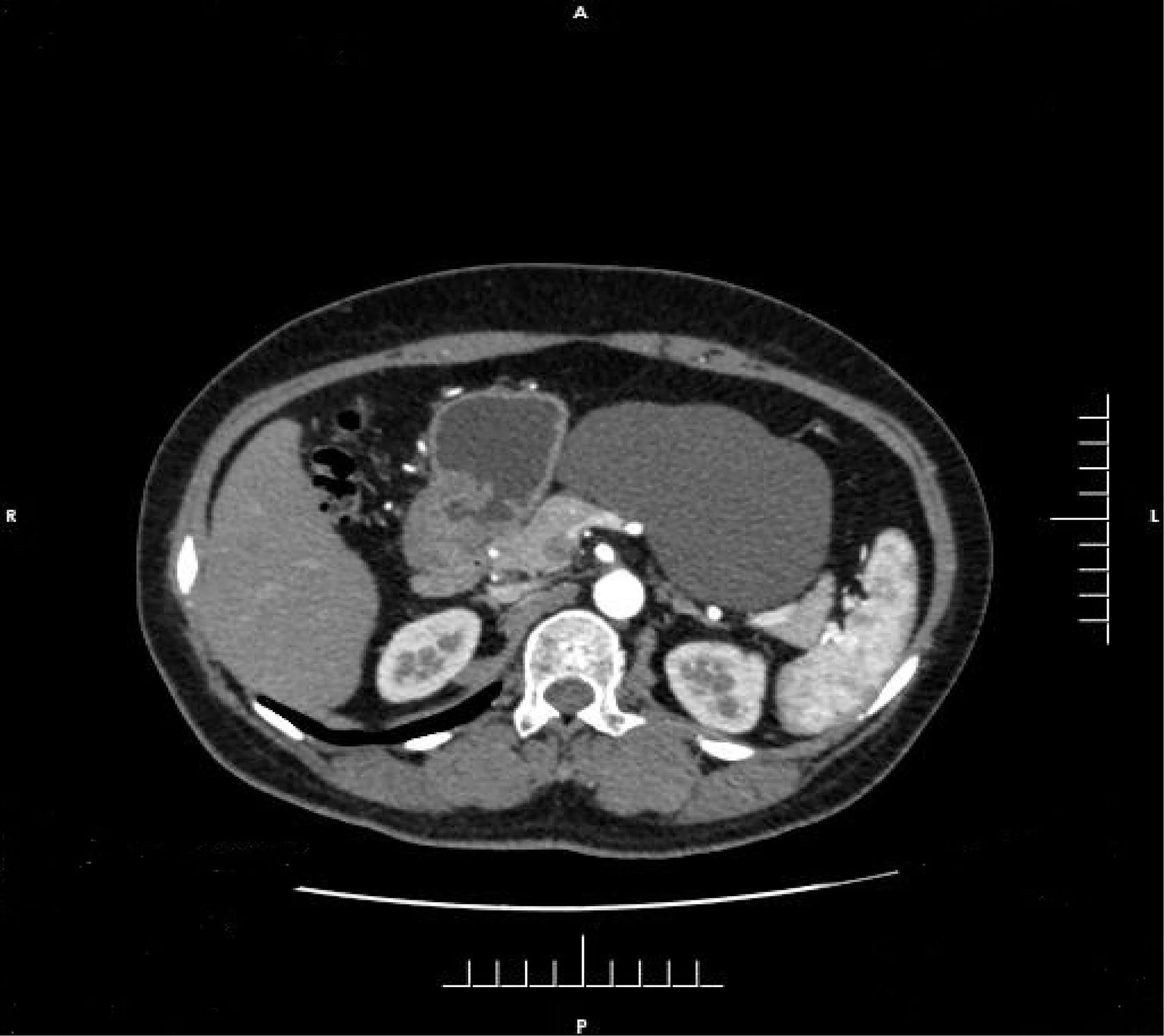
Abdominal computed tomography (CT) showed a cystic mass in the hepatopancreatic space.
The patients then underwent exploratory laparotomy. During the operation, a cystic mass of about 10 × 7 × 7 cm in size was found in the hepatopancreatic space. Part of the mass was attached to the small intestine, and the wall of the cyst was thickened, containing purulent cystic fluid. The cystic mass was finally completely removed. The histopathologic diagnosis was cystic lymphangioma with infection (Fig. 2). The pus was bacteriologically cultured as Escherichia coli. The patient recovered well without any complications after symptomatic treatment such as anti-infection.

Histopathology showed cystic lymphangioma with infection.
Cystic lymphangioma is a benign tumor of the lymphatic system. It is relatively rare and usually occurs in the craniofacial region, neck, or chest. Cystic lymphangioma of the abdominal cavity in adults is rare.2,3 Cystic lymphangioma of the abdominal cavity is mostly found incidentally without any symptoms. Cystic lymphangioma of abdominal cavity with large volume can compress gastrointestinal tract and cause vomiting, abdominal pain, and other symptoms. Cystic lymphangioma with infection or hemorrhage is extremely rare. Because of the lack of clinical and imaging specificity, pre-operative diagnosis is more difficult, and most patients need to pass the pathologic examination after surgical resection. Most patients have a good prognosis after surgical resection. For patients with infection, targeted anti-infection treatment can be performed according to the results of bacterial culture. When the cystic mass of the abdominal cavity is accompanied with infection related symptoms, the possibility of infection of cystic lymphangioma of the abdominal cavity should be considered after excluding common diseases.