




Abstract

To the Editor:
Renal tuberculosis is an uncommon extrapulmonary presentation of tuberculosis. However, in exceedingly rare instances, it may mimic renal cell carcinoma. 1 Herein, we report a case of primary renal tuberculosis masquerading as a renal cell carcinoma.
The patient, a 45-year-old female, presented with persistent left lower back pain for one year. She had no signs of wasting, fever, or other symptoms. Upon physical examination, there was no evident percussion tenderness in the left renal area. Subsequent enhanced abdominal CT imaging revealed a 1.9 × 1.2 cm low-density lesion with irregular shape and unclear boundaries in the left kidney, without obvious enhancement (Fig. 1).
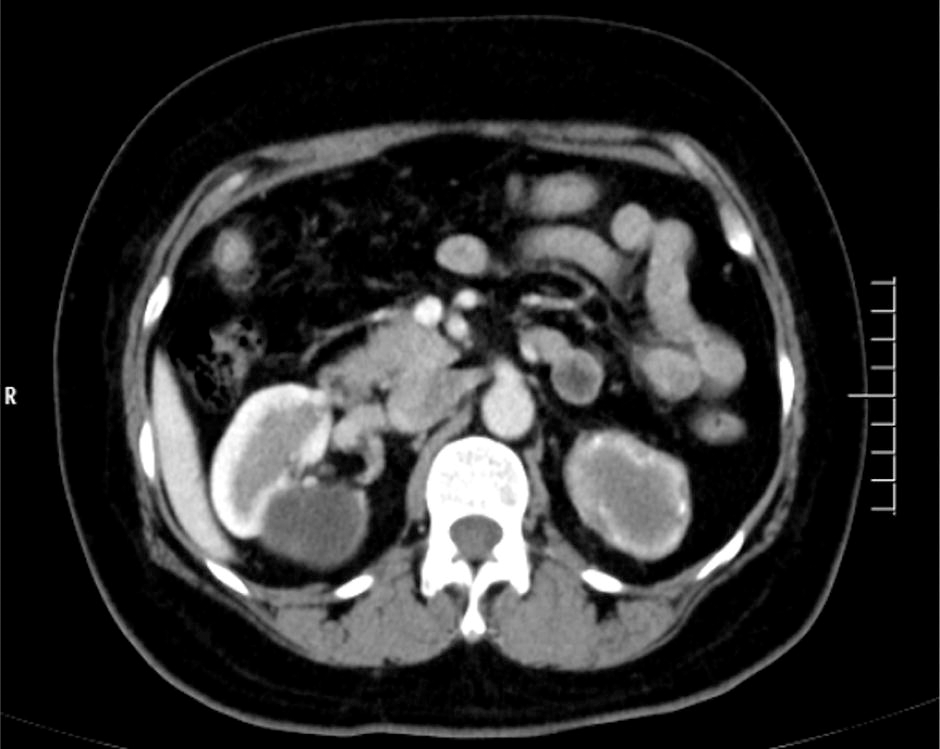
Enhanced abdominal CT imaging revealed a 1.9 × 1.2 cm low-density lesion with irregular shape and unclear boundaries in the left kidney, without obvious enhancement.
Since the possibility of malignant disease was not ruled out, the patient subsequently underwent a laparoscopic left nephrectomy. During the operation, the left kidney was obviously atrophied, and the postoperative specimens showed a large amount of caseous necrotic tissue. After surgery, the histopathology revealed necrotizing granulomatosis, and the final diagnosis was primary renal tuberculosis of the left kidney (Fig. 2). No tuberculosis lesions were found in other parts of the body. After the patient recovered from the operation, regular anti-tuberculosis treatment was carried out in the tuberculosis specialist clinic, and no abnormality was found in the follow-up so far.

The postoperative pathological findings were granulomatous inflammation with caseous necrosis.
Tuberculosis is a public health problem worldwide and one of the most common causes of death from infectious diseases. 2 Renal tuberculosis is a clinically rare case and is often overlooked in clinical practice due to its atypical symptoms. 3 Renal tuberculosis usually presents as hydronephrosis, however, in extremely rare cases, it may present as a mass of the kidney, which leads to renal tuberculosis often being misdiagnosed as a kidney tumor. A history of tuberculosis is helpful for suggestive diagnosis of the disease. The imaging findings of renal tuberculosis are not typical. Urine culture of Mycobacterium tuberculosis is helpful in the diagnosis of the disease, and tissue biopsy can confirm the diagnosis of the disease. Once diagnosed, it can be cured with systematic anti-tuberculosis therapy, avoiding unnecessary surgery. Renal tuberculosis can lead to serious complications such as renal atrophy and even renal failure, so early diagnosis is very important for prognosis. For atypical renal masses, the possibility of tuberculosis should be considered when diagnosing. Once diagnosed, anti-tuberculosis treatment should be carried out in time to avoid serious renal complications.
Footnotes
Author Disclosure Statement
The author declared no potential conflicts of interest with respect to the research, authorship, and/or publication of this article.
Ethics Approval and Consent to Participate
Not applicable.
Funding Information
No funding was received for this article.