




Abstract

To the Editor:
Dedifferentiated retroperitoneal liposarcoma is a rare retroperitoneal sarcoma whose dedifferentiated subtype and large diameter are associated with poor prognosis. 1 Herein, we report a case of retroperitoneal dedifferentiated liposarcoma with large cystic changes and with infection.
A 73-year-old female, presented with abdominal pain with lower limb edema. Since, three months, the patient has presented with progressive aggravation of lower limb edema and right abdominal distension and discomfort. It is not accompanied by fever. On physical examination, there was no palpable mass in the abdomen. Laboratory tests showed an elevated level of procalcitonin at 0.18 ng/mL. Abdominal enhanced CT results showed a right retroperitoneal cystic and solid mass about 16 × 10 × 16 cm in size, with poorly defined boundaries and internal enhancement (Fig. 1).

Abdominal enhanced CT results showed a right retroperitoneal cystic and solid mass about 16 × 10 × 16 cm in size, with poorly defined boundaries and internal enhancement.
The patient subsequently underwent retroperitoneal tumor resection. Finally, the tumor was completely removed, and white pus was visible inside the tumor, and the pus culture showed Escherichia coli. Postoperative histopathological results showed a large number of fusiform cells in the tumor, and combined with immunohistochemical results, the final diagnosis was dedifferentiated liposarcoma with infection (Fig. 2). After the operation, appropriate anti-infection treatment was given, and the follow-up is currently under way.
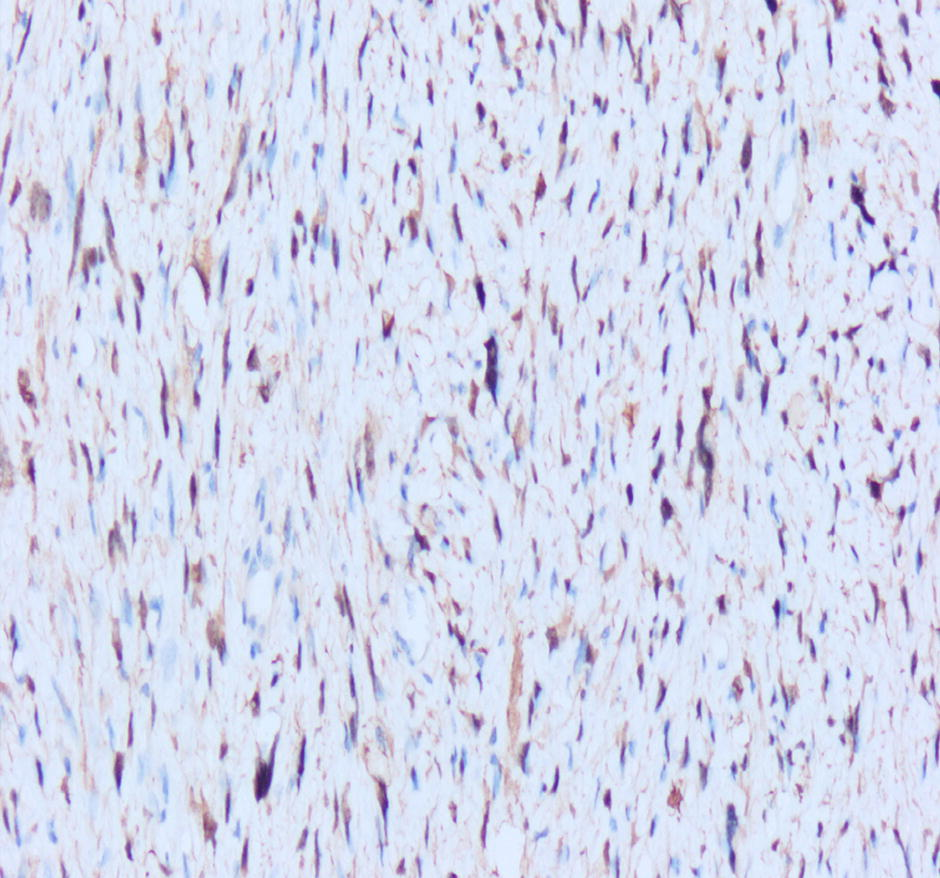
The histopathological results showed a large number of fusiform cells in the tumor.
Retroperitoneal dedifferentiated liposarcoma, a major subtype of liposarcoma, exhibits a more aggressive behavior with a tendency for local recurrence and metastasis compared with highly differentiated liposarcoma. 2 The clinical symptoms are usually abdominal discomfort and are not characteristic. The imaging findings show a mass with both fat and non-fat tissue. 3 Preoperative diagnosis is difficult, and diagnosis often depends on postoperative histopathology. Therefore, surgical resection is still the main method of treatment and diagnosis, and other treatments include chemotherapy. The possibility of dedifferentiated liposarcoma with infection should be considered in the differentiation of large retroperitoneal masses.
Footnotes
Author Disclosure Statement
The author declared no potential conflicts of interest with respect to the research, authorship, and/or publication of this article.
Ethics Approval and Consent to Participate
Informed consent from patients was obtained for this study, and their anonymous information will be published in this article.
Funding Information
No funding was received for this article.