




Abstract
Major threats to the economic future of several nations include climate change, infectious pandemics, and drug-resistant bacteria. The rise and fall of each of these behaviors seems to conform to a U-shaped or inverted U-shaped curve. In academic medicine, stakeholders in the field (infection control personnel, epidemiologists, and vaccinologists) will argue that infectious outbreaks can be prevented by surveillance programs and the development of new drugs (antibiotics, vaccines, etc.). The promise of vaccines, antibiotics, genetic manipulations, air filtration, agriculture control measures, etc., is that with next-generation technology, effective countermeasures can be rapidly deployed to combat any emerging threat to our ecosystem and hence our economy. In this piece, we advance the idea that Laffer curves and their U-type-shaped ancestors share interconnectedness across multiple domains of science including biology, economics, infectious disease, and ecology. U-type-shaped curves and their sibling, the inverted U-curve, conform to the general principle of hormesis, a biphasic response where there is a measured benefit at lower exposures to a phenomenon yet harm when exposure is excessive (i.e., low-dose stimulation and high-dose inhibition).
Introduction
In 1976 during the Gerald Ford administration (38th president of the United States, 1974–1978), Donald Rumsfeld (secretary of defense from 1975 to 1977 under President Gerald Ford), Richard Bruce Chaney (referred to as “Dick Chaney” White House Deputy Chief of Staff under Gerald Ford from 1974 to 1975), and Arthur Laffer (Associate Professor of Business Economics at the University of Chicago at the time) had dinner to discuss the US economy and taxation. 1 On a dinner napkin, Professor Laffer drew what has now been designated as the “Laffer curve” (Fig. 1). The Laffer curve is an inverted (backward) “C-shaped”-type curve that was drawn to demonstrate that as you increase the tax rate, tax revenues for the government increase, but, at a certain point, government revenue will decline as individuals’ income is either sheltered or people simply earn less to avoid the burden of further taxation. The idea was proposed that at a certain tax rate, lowering tax rates might actually increase tax revenues and thus pay for themselves. Yet, herein lies the paradox: tax revenues cannot simply be maximized by inexorably increasing the tax rate (i.e., to ≥50%) as countermeasures bear down on its intent. Perhaps, this observation underlies the famous statement by the then United Kingdom’s Prime Minister Margaret Thatcher—“Socialism is great until you run out of other people’s money.” Some have claimed that the Laffer curve is neither valid nor original. 2 In fact, Laffer himself acknowledges that the curve-shaped concept is neither original to him nor to his tax concept. In other disciplines, for example, in investigative biology, it is argued that this type of curve is commonplace. 3 Similar claims can be made by population scientists, 4 epidemiologists, infectious disease experts, 5 etc. Although there is much debate about the actual numbers, inflection points, curve shapes, and X- and Y-axis’ designations, the observation across multiple domains persists: continuous stimulation, growth, or provocation of a system, an economic marketplace, a population, or a biological pathway, which is neither inexorable nor sustainable. For example, in cell biology, continuous stimulation by an agonist of its cognate receptor will result in downregulation (internalization) of the receptor with the goal of the cell protecting itself against molecular disruption.6,7 Although clearly the particulars will be specific to each system under study, in many cases, each example is similar to a “dose–response” curve, in which the concentration and duration of the stimulus and the response conform to a “Laffer-type” or inverted “U” curve (Fig. 2). 11
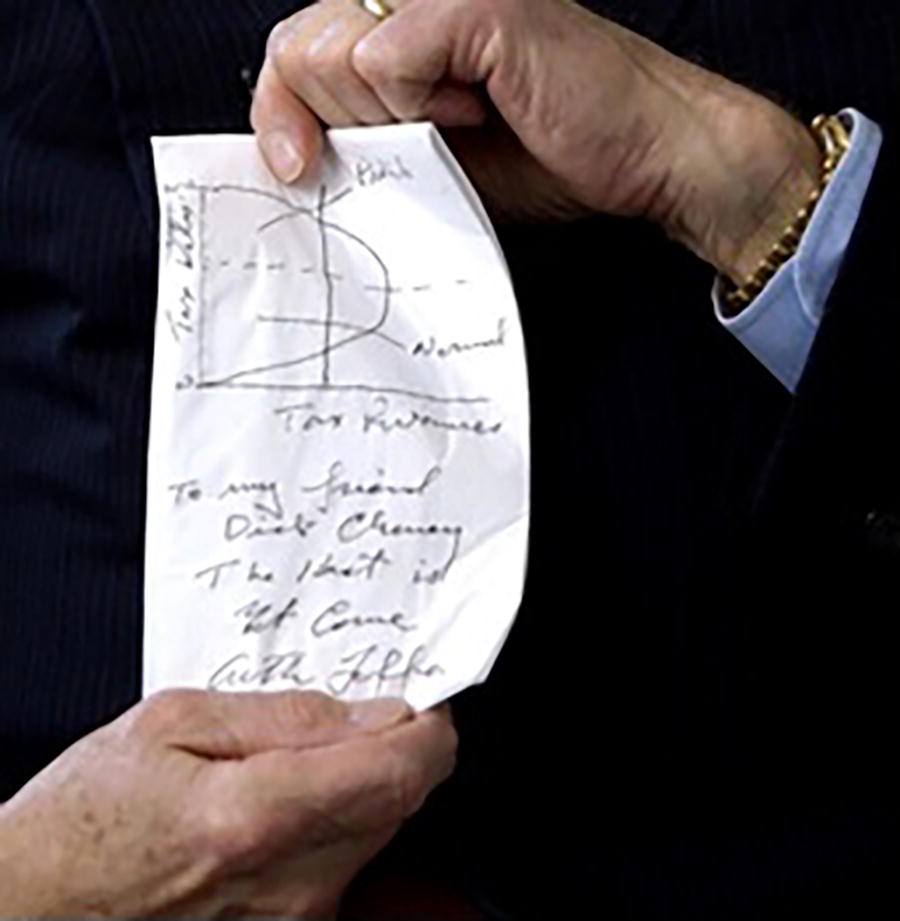
The original Laffer curve drawn on a dinner napkin.
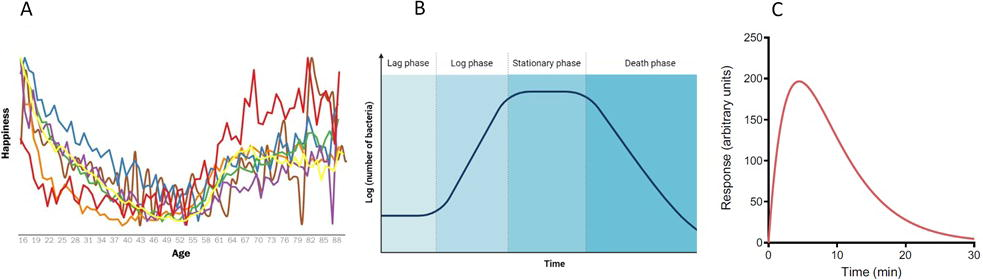
Are Laffer or U-Type-Shaped Curves Simply the Curves of Life?
Most recently, happiness over the course of one’s life has been depicted as a “U”-shaped curve. 8 Results seem to indicate that we are most unhappy at midlife (around 40) whereby our happiness rebounds and increases into our 70s and 80s. Although the values (in this case age on the X axis and happiness measurements on the Y axis) are debated, the observation that at some concentration/measurement of a phenomenon, the time over which the phenomenon will show its greatest effect versus its nadir and then rebound often forms into an unexpected U-shaped type curve. Although countless phenomena can be expressed as a U-shaped curve, most debate centers around where the various outputs lie on each axis. Perhaps, the most nascent example of the U-shaped or inverted U-shaped curve can be found in the agonist–antagonist receptor relationship in living cells whereby a given concentration of an agonist (or a drug) can stimulate a cell or biological pathway up to a certain point following which greater concentrations actually suppress it or suppress it in response to other ligands. In live biological systems, such as when bacteria are grown in a closed system or batch culture (no food added and no waste removed), bacteria will grow in an expected inverted U-shaped pattern whereby the growth curve will continue until which time resources are depleted (its peak) and then bacterial predation predominates; there are no resources (i.e., public goods) left, waste accumulates, and overall growth declines. 12 Much is to be learned from these examples when considering the rate at which human progress in biology, agriculture, and medicine is advancing. Debate continues as to whether there exists a point (a nadir) at which human progress (processed food, population growth, climate change, antibiotic consumption, etc.) ceases to be effective, countermeasures and adaptations fail, and resources (air, food, and gas) decline to the point where undesired outcomes (pollution, waste accumulation, antibiotic resistance, 13 infection, pandemics, and population decline) surge.14–16 However, without a precise definition of the inflection points, the x and y values, multiple computer simulations, validations, perturbations of the system in simulations, etc., observations lack predictive credibility and therefore are not necessarily actionable.
Will Human Progress Advance to a Point Where Infectious Outbreaks Increase in Number and Severity?
In a thought experiment, if it is assumed that climate change (i.e., global warming) continues to worsen, that the overconsumption and use of antibiotics in human beings and animals is unstoppable, that processed food becomes ultraprocessed, that obesity increases worldwide, and that urban crowding escalates, then it is possible to imagine that advances made to date including the application of vaccines, antibiotics, food safety, agriculture, sewage, and personal hygiene might paradoxically become ineffective and even lead to pandemics.16–18 Opponents of this doomsday scenario assert that it is possible that the earth’s countermeasures (i.e., nature itself) will somehow intervene to preserve its natural endowments and ecologic balance. 19 A “Gaia hypothesis” exists that suggests that the earth is an organism (Gaia) and humankind is an “infection.” 20 This hypothesis frames the earth as a living organism and our actions against it as infectious agents causing harm, disease, and its eventual erosion and collapse. Proponents posit that at some inflection point, the earth’s immune system will eliminate the infection—that is, us, our technology, and our unfettered progress. That is to say that our current technology will no longer be effective at controlling pandemics, population growth, obesity, infertility, etc. Were this idea represented by a Laffer or U-shaped curve, the curve would look like a U with time (our history) on the X axis and the threat of ecological collapse (i.e., overuse of antibiotics, climate change, rates of infertility, antibiotic resistance) on the Y axis. Viral pandemics and antibiotic-resistant organisms might surge to eliminate the “infection” (i.e., us). A U-shaped/Laffer-type curve to represent this scenario is certainly apocalyptic. 21 Yet, it is important to consider that one cannot predict how the earth’s countermeasures to human progress and our counter–counter measures will play out over time without defining all parameters and without validation by either field experiments or computer simulation. Malthusian predictions aside, although the earth’s ecological collapse may seem inevitable to some, the course of “infection” as conceptually framed by the Gaia hypothesis, does not consider the stochastic nature of the host–pathogen interaction, the bistability of virulence, and the complexity of collective assemblage-type behavior (i.e., quorum sensing) that bacteria and other infectious agents possess. 22 The idea that the earth’s doom is inevitable based on the loss of species diversity and climate change belies the known complexity of predicting the results of an experiment. 19 Although human progress can be considered a provocative stimulus to the earth ability to adapt to its changing environment, the final outcome of such an experiment over time needs more specific definition. It may be for this reason that many consider that “Inevitable Planetary Doom Has Been Exaggerated.”23,24
Behavioral Economics, the Biological Marketplace, and Game Theory
Behavioral economics, the science of explaining economic decision-making in the context of human psychological behavior, has a long history of inquiry at the University of Chicago. 25 Although many principles in this field apply Laffer-like curves to explain human economic decision-making, often games have to be played among volunteers to model and verify that decisions made in a given circumstance have a clear pattern to them and can be explained when they seem to controvert self-interest (i.e., trade-offs). For example, game theory’s main goal is to predict and thus attempt to explain human behavior using a mathematical approach. 26 In many cases, there are trade-offs, sanctions, and penalties for certain choices that must be considered when complex contingencies arise. By considering things such as choice architecture and the paradox of choice, 27 insight into how human decision-making proceeds often runs counter to self-interest.
Behavioral economics can also function to explain how bacteria both in the rhizosphere and in the human gut share public goods with reciprocal rewards when resources are limited. 28
U-Shaped Curves in Biology and Medicine
The idea of “low-dose stimulation/high-dose inhibition” in dose–response curve experiments with a cell, an agonist and its cognate receptor, neural activity, etc., being biphasic in its response is a well-established concept dating back to the late 1800s.6,29 Therefore, it should no surprise that in the field of behavioral economics, a U-shaped, C-shaped, or inverted U-shaped-type curve might exist to explain how taxation rates affect tax revenues in a similar biphasic manner. If the ostensible reason high-dose inhibition exists in the biological world is to protect the cell from overstimulation, burnout, and molecular bankruptcy, one might suspect that an individual being excessively taxed would respond similarly by protecting their assets and work activity to avoid exertional burnout and financial bankruptcy (i.e., low-taxation rate payable/high-taxation avoided). Yet, unaccounted for is the phenomenon with which bacterial cells and host cells intercommunicate via interkingdom signaling and quorum sensing in order to develop assemblage-like behavior within a networked social group-like atmosphere. 30 Similarly, individuals are taxed at a population rate and are similarly networked by multiple communication platforms (public access to information, phone, websites, etc.) and social interactions. Therefore, it is logical that responses across these seemingly disparate fields would mirror each other and behave in a biphasic U-shaped manner. In light of these observations, Laffer curves seem less inspirational and more in line with what might be predicted to occur in any biological or behavioral system.6,8
For example, it has been predicted that the next pandemic will involve antibiotic-resistant bacteria. 31 To shed light on this problem, consider the following: Antibiotics are attributed to Sir Alexander Fleming who, in 1928, discovered penicillin. Most antibiotics are produced in nature by soil bacteria and fungi at low concentrations and in highly localized environments. However, today, antibiotics are mass produced at industrial scales whereby microorganisms are grown in large containers (100,000–150,000 L or more) that contain constantly renewed growth media. Today 70% of the antibiotics produced are consumed by animals farmed for human consumption.32–35 Among the many consequences of this practice is the excretion of antibiotics into soil, on farm lands, and into the public sewage system. Meat from animals exposed to antibiotics has been shown not only to contain the antibiotics consumed by them but also antibiotic-resistant organisms. Although human beings (and other animals) have enjoyed the availability of antibiotics to prevent and treat infections, predicting a biphasic response if this practice continues is not stretch of the imagination. Thus, the consequences of exponential scaling nature’s methods of dealing with predation by mass production of the very antibiotics they use to survive seem destined to result in widespread antibiotic resistance. Again, although a U-shaped-type curve seems inevitable here, predicting an “antibiotic resistance pandemic” without defining the precise parameters of the curve, the timing of its emergence, and the potential for adaptive responses to develop as countermeasures seems specious at best. Predicting how host–pathogen interactions will play out over time and at different scales of involvement is an extremely complex process.
Another example of the escalating use of antibiotics that seems unstoppable is their use in elective surgery. 36 As our population grows and ages, joint replacement, cataract surgery, tumor surgery, dental implants, etc., will increase. Currently, there are ∼100,000 elective operations performed every day in the United States. In virtually every case, antibiotic prophylaxis is administered. 36 Although the use of prophylactic antibiotics in elective surgery has been highly effective at preventing post-operative infection, the current trend of “if some is good, more is better” is leading to the application of more powerful and broader antibiotic coverage in an effort to further reduce post-operative infections toward zero. 36 Unfortunately, the practice of applying broader spectrum antibiotics in elective surgery as a mechanism to further reduce post-operative infections is sanctioned by virtually all stakeholders in the field. The challenge is that given the perception that further antibiotic use has no immediate downside and further reductions in infections are desirable at both the individual and the population level, the practice proceeds without checks and balances. The collateral damage to the gut microbiome, the deposition of antibiotic-resistant organisms into water waste systems, and the selective pressure on colonizing bacteria to promiscuously swap antimicrobial resistance genes via horizontal gene transfer are essentially ignored.37–39 Unfortunately, this practice continues as if the unfettered use of antibiotics has no downside associated with it. Thus, as if antibiotic prescribing is completely harmless, their use continues unfettered. For this reason, apocalyptic predictions of multi-drug-resistant infections continue. Yet as the inflection points, X- and Y-axis values, areas under the curve, etc., are generated to predict the course of the bacterial resistome across environments (human gut, farms, and in food), the extent to which these adaptations play out in real time remains highly unpredictable.23,24
Conclusion
Whether examining decisions made in games prepared by behavioral economists, by cells protecting themselves against excess stimulation, or by bacterial colonies exposed to increasingly powerful antibiotics and other elements of human progress, it seems inevitable that adversity against the provocative stimulus (i.e., “us?”) will continue in the form of a U-shaped curve.
If U-type shaped curves are indeed observed at all scales and dimensions of life and are an inevitable outcome of unfettered human progress, their representation of the ongoing arm’s race between us, our environment, and the microbes that are necessary for all life on earth will continue. The extent to which U-type-shaped curves can be validated to be predictive and actionable in human affairs given the many political and economic forces that are faced remains to be determined.
Footnotes
Author’s Contributions
Dr. Alverdy conceived, wrote and edited this manuscript.
Author Disclosure Statement
J.C.A. is the founder and chief research officer of Covira Surgical, a University of Chicago startup company.
Funding Information
This work was supported in part by the National Institutes of Health (NIH), USA, grant RO1 2R01GM62344-23.