




Abstract
Abstract
This article describes a town-gown collaboration in the capital region of New York State between two academic institutions, Albany Law School and the University at Albany, and two city governments, those of the cities of Albany and Schenectady. Through this initiative, students and faculty from these institutions work closely with city government officials to develop and implement policy initiatives to help those cities combat blight in ways that are practical, feasible, scalable, and sustainable. Because blight is unquestionably a sustainability issue, strategies that can address, minimize, and even prevent blight can help communities address long-term environmental, economic, and cultural sustainability.
Introduction
In order to ensure their primacy as engines of economic development and innovation, cities must ensure that they operate in a sustainable fashion. What sustainability may mean will differ in different contexts. A city could focus on economic sustainability, making sure it is striking the proper balance between maintaining attractive services and amenities and keeping costs, and, in turn, the taxes it charges its residents, low. It could focus on environmental sustainability, looking to decrease its carbon footprint and establish resiliency measures to ensure adaptability to climate change. It can focus on cultural sustainability, striving to maintain its unique cultural character and the cultural character of its inhabitants and neighborhoods. Sustainability can also relate to sustainable development, which incorporates multiple facets of sustainability and ensures that when a community seeks to improve itself, it does so in a way that does not diminish opportunities for future generations. 1 As such, regardless of one's perspective on sustainability, the presence of blighted, vacant, and abandoned properties is a visible and notable threat to any form of sustainability. 2 In order for communities to effectively combat blight, they must engage in a range of strategies that not only promote sustainability but also mitigate and prevent the spread of blighted and vacant properties, essentially addressing the problem from many angles and with diverse partners.
This article describes a town-gown collaboration in the capital region of New York State between two academic programs, one at a law school and one at a college of government and policy, and the cities of Albany and Schenectady, New York, to develop and implement policy initiatives that can help those cities combat blight in ways that are practical, feasible, scalable, and sustainable. This description and some of the lessons learned can help others replicate these efforts in ways that are consistent with and responsive to local needs in other communities and help to further other communities' unique sustainability goals. This article describes blight and blighted properties as challenges for urban sustainability. It then describes the efforts of the joint course the authors teach, drawing students from Albany Law School and the Nelson A. Rockefeller College of Public Policy and Affairs, to help the cities of Albany and Schenectady address blighted properties within city limits. Finally, this article attempts to draw key lessons learned and their value.
Background: Blight as a Sustainability Issue
Sustainability, particularly ecological sustainability, has been defined “as a condition of balance, resilience, and interconnectedness that allows human society to satisfy its needs while neither exceeding the capacity of its supporting ecosystems to continue to regenerate the services necessary to meet those needs nor by our actions diminishing biological diversity.” (p. 5) 1 But, as described, sustainability can have economic, cultural, and social aspects. Moreover, to the extent a community faces economic or cultural sustainability issues, such issues may impact its ability to maintain ecological or environmental sustainability. The presence of blight threatens a community's ability to address sustainability's many facets.
Blighted properties threaten the sustainability of communities in which they can be found. Looking at traditional environmental or ecological factors, vacant and abandoned properties can become environmental danger zones for a host of reasons. First of all, vacant and abandoned properties often include older buildings, which can contain hazardous materials like asbestos, lead paint and pipes, and other products formerly used in their construction. These materials can potentially be released into the air or leach into the soil, creating environmental hazards. The removal of such materials can, itself, pose an environmental hazard and precautions must be taken to ensure safe disposal practices. Furthermore, vacant and abandoned properties can invite environmental hazards as they can become sites for illegal dumping of environmentally hazardous substances, which, in turn, can enter the air or the underlying soil. 2
But vacant and abandoned properties also threaten a community's economic viability, which limits that community's ability to undertake thoughtful, sustainable practices, practices that require funds and promote the economic and environmental health of the community. Blighted properties are often properties that the owner has abandoned, meaning he or she is probably no longer paying local real estate taxes on the property. This means the local government sees a direct reduction in the taxes it can collect related to this property.
Defining blight can sometimes present a challenge, however. As Joseph Schilling and Jimena Pinzón of the Vacant Property Research Network at Virginia Tech explain:
Civic leaders and government officials have struggled for nearly a century to define blight and deploy effective policies and programs to address its community impacts. Blight encompasses vacant lots, abandoned buildings, and houses in derelict or dangerous shape, as well as environmental contamination. Blight can also refer to smaller property nuisances that creep up on cities and suburbs: overgrown lawns, uncollected litter, inadequate street lighting, and other signs of neglect. Blight's legal and policy foundation can be found in longstanding principles of public nuisance: property conditions that interfere with the general public's use of their properties. (p. 1) 3
There are numerous negative externalities brought about by blighted properties, however, which are both direct and indirect. The direct effects of blighted and abandoned properties include expenditure of resources by local governments to monitor such properties through emergency services, for example, police and fire department interventions. In addition, local governments, more often than not, have to pay for the cost of maintaining both the structure and grounds of a property to prevent the risk of a collapse and to mitigate the public health risks associated with garbage and vermin. These costs add up and, for many local governments, are never repaid by the owner.
Indirect effects of blighted properties include the decline of property values because blighted and vacant properties can render a neighborhood less desirable to prospective property owners. Furthermore, when such a property is foreclosed by a bank and sold at auction, the purchase price of the property at auction often reflects a steep discount in value; appraisers incorporate that discounted price in assessing the value of neighboring properties. These forces ultimately have a direct impact on the values of the neighboring properties, which often means local governments have to take those lowered values into account when making tax assessment determinations. All of these direct and indirect forces result in a reduction in the tax base of local governments such that they will have fewer resources for essential services, generally, and economic development and sustainability measures, specifically.
Neighborhood sustainability also means neighborhood environmental preservation. To the extent that older buildings can be restored and their (nonhazardous) materials reclaimed and used during the rehabilitation process, new materials, such as lumber, brick, stone, drywall, and pipes, are not necessary. This obviates the need for the harvesting, fabrication, manufacturing, and transportation of such materials, lowering the carbon footprint of community development.
Finally, vacant and abandoned properties can undermine cultural sustainability—neighborhoods can lose their unique cultural qualities and characteristics as those residents who bear and continue those cultural components flee communities plagued by blight.
In addition, blighted properties can become magnets for crime and lead to what has been dubbed a broken windows theory of crime. 4 The physical characteristics of blighted properties can send signals to members of the community that such neglect will not only be tolerated, but perhaps even encouraged. Such neglect becomes the social norm, and in theory, leads to active criminal behavior, hastening community concerns about safety and neighborhood desirability and possibly leading to greater abandonment. The broken windows concept, by extension, leads to environmental degradation as well because vacant and abandoned properties send signals to the community that reinforce norms against sustaining and preserving the physical components of communities, leading to greater abandonment.
These forces of blight challenge local government capacity to ensure sustainability in all of its forms. As explained by Leonard and Mallach:
Despite isolated successes and community innovations, vacant and underused properties present a long-term challenge that shows no sign of lessening. Yet with rare exceptions, both governments and private entities have approached vacant and abandoned properties as a case-by-case, transactional issue, rather than looked at the underlying systemic issues that perpetuate the cycle of neglect. (p. 7) 5
What cities need, then, are systemic approaches to address the sustainability challenges posed by blighted properties. The following section describes a town-gown partnership designed to combat blight and promote sustainability in the cities of Albany and Schenectady in upstate New York.
Methods: A Town-Gown Partnership
In the fall of 2015, the University at Albany, part of the State University of New York (SUNY) system, and Albany Law School, a private, independent law school, entered into a formal affiliation to advance the role of the capital region as a leader in higher education and innovation by creating powerful synergies to tackle issues critical to the local community, New York State, and the increasingly complex world. Both institutions are anchors in the state's capital region, which includes the cities of Albany, Schenectady, and Troy. Throughout the 19th century, these cities grew in strength and size after the completion of the Erie Canal, serving as pivotal nodes in transportation and manufacturing. Schenectady boasted the main offices and plants of General Electric, and Albany has been the capital of New York State since the end of the 18th century.
In the post-World War II era, as manufacturing became less central to the U.S. economy and transportation revolved less around waterways, these communities saw a diminution in their populations, which brought about a plague of abandoned properties, particularly in Albany and Schenectady, which, combined, presently have well over 2,000 vacant and abandoned residential and commercial buildings. As each city experienced a decline of between 40,000 and 50,000 residents over the last several decades, the physical infrastructure (both residential and commercial) of the city stayed the same, or grew slightly. This caused an unbalanced and unproductive relationship between the city's population and physical structures within the city. While the number of vacant properties in Albany and Schenectady is significantly less than those of larger U.S. cities that have also seen population declines, it is still proportionately unbalanced and burdensome. In the city of Albany alone, nearly one in twenty properties is vacant or abandoned, with the city's poorer neighborhoods facing a much greater concentration of such properties.
Indeed, the vacant properties in these cities, while spread out into virtually every community in each city, tend to be concentrated in some of the poorer areas of these cities. Figure 1 illustrates the concentration of vacant properties in the more impoverished communities in and around Albany.
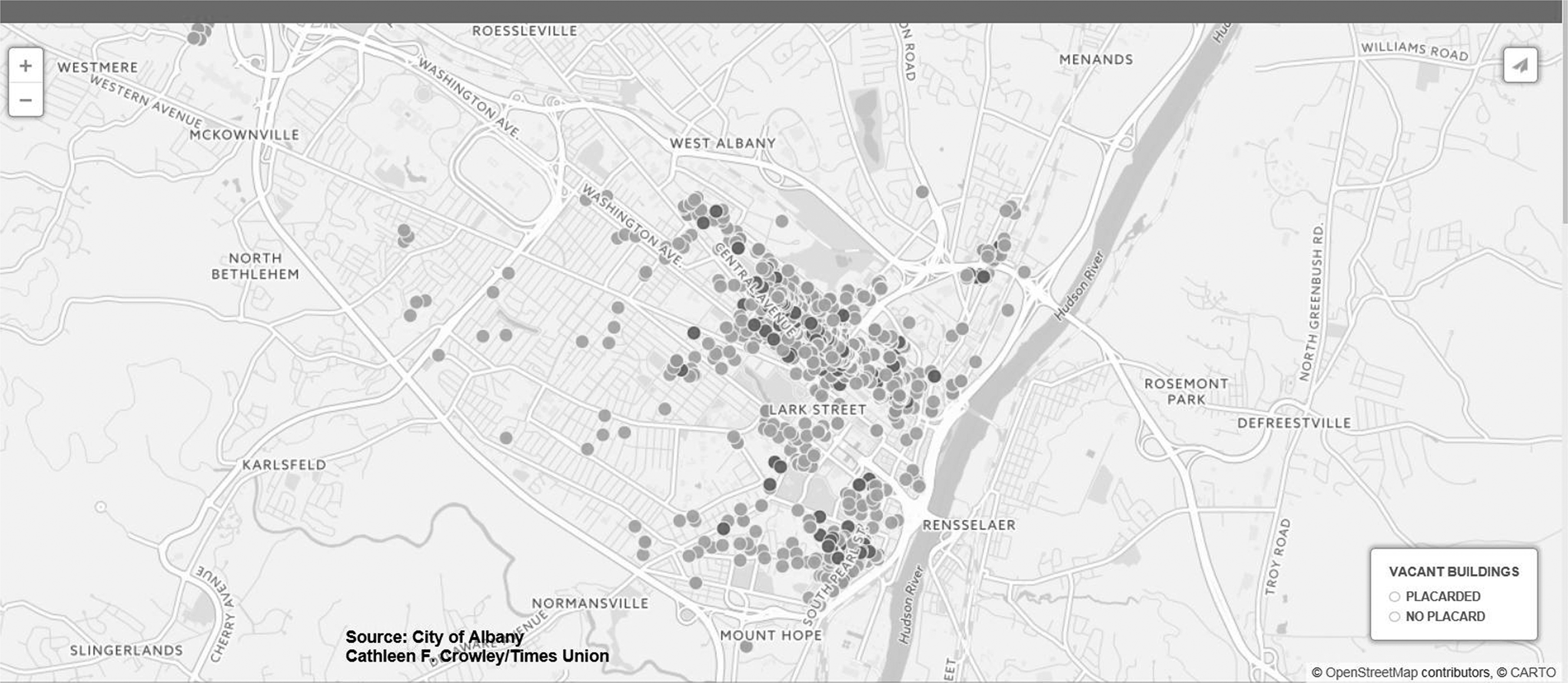
Current view of the vacant properties in the City of Albany, 2017
The Course
Both institutions in this partnership had worked with the cities individually. Specifically, in 2012, Albany Law School launched a course entitled Law & Social Innovation: Creative Problem Solving, centered on economic development issues through which law students worked with lawyers and policymakers in the City of Albany to assist them in addressing economic development and environmental issues. At the same time, the Center for Technology in Government (CTG) at the University at Albany was a lead partner in a state-funded project with the City of Schenectady to develop a resource for capital region governments to share information about code enforcement and problem properties. Each institution had a track record of working successfully in the cities, but had done so, up to this point, through individual efforts.
After the Albany Law-University at Albany affiliation was announced, faculty at the law school and the University at Albany's Rockefeller College of Public Affairs and Policy, specifically the Government Information Strategy and Management Program (GISM), joined forces to begin teaching a course entitled Law & Social Innovation, as an interdisciplinary offering. On the Rockefeller College side, the course is entitled Urban Innovation and Creative Problem Solving. The two courses are really one course: the students are taught together by this article's coauthors and they work side-by-side, in class, and out of it, on their course work and projects for the class.
The affiliation between these two institutions allows for these courses to be taught together, and in an interdisciplinary fashion, which is one of the keys to its success. Law students and public administration students work side-by-side in interdisciplinary teams, as they collaborate with mayors, corporation counsels, directors, and other city officials in an urban setting from the cities of Albany and Schenectady. The class places particular emphasis on experiential learning and is structured to allow students to spend a considerable amount of time working alongside government officials.
Moreover, this work is not just experiential, it is project-based, and students work in teams to accomplish all aspects of their projects. 6 Consistent with its interdisciplinary theme, students read about not just the law, but also texts from urban planning and urban theory, for example, Jane Jacobs's Death and Life of the Great American Cities, 7 and Richard Florida's The Great Reset. 8 They also read Dan Pink's A Whole New Mind: Why Right-Brainers Will Rule the Future, 9 and Mihaly Csikszentmihalyi's Creativity: Flow and the Psychology of Discovery and Invention, 10 about how to bring more creativity into their work; and Charles Duhigg's Smarter, Faster, Better: The Secrets of Being Productive in Life and Business, 11 on how to set achievable goals and work effectively in teams. Students then apply the lessons they have learned in their readings and class discussions to their group projects.
Working with the Cities
For the last two years, the city administrations have asked the students to work with them to examine issues of urban blight, particularly vacant and abandoned residential buildings. With blighted and vacant properties as the focus, students have researched the law, carried out a legal action, and also conducted a business process analysis to better understand the underlying rules, policies, processes, and practices that govern how the cities address blight. Taking on a legal action while also exploring the data environment allows both law students and public administration students to better understand the importance of how data collection, storage, and use is critical in carrying out the legal process. This multidisciplinary approach provides students with both strategic and tactical views of how the cities manage their vacant and abandoned properties in the quest to fight blight. In these ways, the cities become living labs in which the students do not just learn how the cities function, but also learn to work with each other and city staff to carry out affirmative steps to combat and prevent blight.
In 2016, the students explored a powerful legal mechanism, Article 19A of New York's Real Property Actions and Proceedings Law, 12 which enables cities to seize title to vacant and abandoned properties without having to go through the trouble and expense of condemning a property using the powers of eminent domain. Eminent domain is typically a cumbersome and potentially expensive process because it requires that the government institute proceedings in order to seize a property for public use, and includes a provision in which it must pay the owner of that property fair-market value, even if that value is diminished by virtue of the property's vacant or abandoned status. Even vacant and abandoned property has some value, particularly the land on which a vacant building may sit. The expense associated with compensating the owner is often prohibitive for cash-strapped local governments that wish to take action against the property but cannot afford to, in effect, purchase it from the owner.
The students identified through their research that, under Article 19A of the Real Property Actions and Proceedings Law, local governments can commence judicial proceedings against properties deemed abandoned. In order to commence these actions, the cities need information about individuals or entities with an interest in the property. For example, the city must have the names and addresses of any owner of a target property or any financial institution that may have issued a mortgage secured by the property. A critical component of the legal action is that anyone with an interest in the property—owner, bank, a government entity with a tax lien—must receive formal notice of the proceeding and have an opportunity to appear in the legal action to offer to remedy the abandoned status of the property. If any such party comes forward and presents a credible plan to address the status of the property, the presiding judge will likely give that party a chance to do so. If no one shows up to contest the proceeding, or those who do appear do not have a credible plan to address the situation, the judge will typically issue an order transferring title to the property to the government at no cost. Furthermore, such title is transferred to the city free of any legal encumbrances like an outstanding mortgage. Once title is transferred, the city has site control over the property and can take any further steps it needs to take to address the presence of blight. (See Figure 2.)

The process of judicial proceedings against properties deemed abandoned
Although their research concluded toward the end of the semester, the students were able to assist the cities in commencing proceedings on several properties, beginning the process for securing title over such properties. But the students did not just commence the proceedings. They also analyzed the functions of the city governments across several departments and made recommendations on how the cities could streamline their processes to make them as efficient and effective as possible. The students prepared model documents that track the relevant statutes to make sure the cities are complying with the requirements of those statutes when they commence these proceedings. They also conducted a cursory assessment of the city's data environment needed to support and sustain such legal actions. While successful execution of the legal action can generate benefits for the cities, the students also learned that the data environment presented challenges in accessing up-to-date and accurate information about the owner, the interested parties, and the property itself. All of these efforts were valuable for the cities, as they did not have resources to work through the data challenges and legal requirements in order to utilize the powerful mechanism of Article 19A on their own.
While discussion of the policies the cities can utilize to address blighted properties once they gain control over the properties through the 19A process is beyond the scope of this article, obtaining such site control is critical to the cities since it gives them the flexibility to make decisions about what to do with the properties without having to worry about a protracted legal fight over a nuisance demolition or incur the expense and trouble of a condemnation proceeding that would allow them to seize the property by eminent domain. The relatively simple and straightforward 19A process enables local governments to initiate a quick judicial process for obtaining site control; once they have done that successfully, they can then make strategic decisions about what to do with the property under their control. They can rehabilitate it, demolish it, or sell it off, making such decisions based on comprehensive plans for the neighborhood in which the property is located and the city in which it is found.
Armed with 19A, the local governments have the opportunity to move forward with properties in planful, sustainable, and strategic ways, rather than being forced to respond to crises arising from these properties once they reach the point of no return. The goal of arming the cities with this critical tool is to maximize their flexibility and give them options. The student engagement with these issues has taught them the value of strategic interventions and forward-looking approaches to urban sustainability issues.
Over the years since first being introduced, the course has changed considerably, responding to student and partner interests and needs. First and foremost, recognizing the importance of interdisciplinary work to address sustainability issues, the course has become interdisciplinary. When it started, it was only open to law students but now admits students in many other disciplines, including public administration, public policy, and data science. Accordingly, the syllabus has changed to incorporate, not just reflect, the subject matter the students will address as well as the techniques they will use in their work, for example business process analysis. Also reflecting its interdisciplinary character, the course is team taught by the coauthors. In addition, recognizing that the course is very demanding, the number of credits students earn for it has doubled, from two credits to four.
Discussion: The Value of Town-Gown Partnerships for Promoting Sustainability
Student research into the strategies the partner cities could use to combat blight and support local sustainability identified a powerful legal tool available under state law to address vacant and abandoned properties. This tool enables the cities to bring legal actions to secure title to such properties. Once the cities have title, they can undertake the rehabilitation for sale of such properties, if they can be salvaged. If not, the cities can demolish the properties or remediate any environmental hazards on such properties without going through complicated and expensive legal proceedings to force owners to undertake such actions. Without recalcitrant or absentee owners standing in the way, the cities can utilize a range of strategies to mitigate the blight problems found within city limits. Thus, because of the students' work, the cities will be able to address the issue of blight, meeting important sustainability goals.
In these ways, this town-gown partnership has become another asset of the cities as they look to leverage all resources at their disposal to meet their sustainability goals. The students have conducted legal and policy research, assessed and documented internal processes, interviewed government officials and community members, and devised recommendations. Cities of this size typically do not have enough resources to undertake an effort like this on their own as many have conflicting and emerging priorities that make strategic planning and research more difficult to accomplish. In the described course, there is a dedicated team ready to take on these projects in collaboration with the city leaders, and as a result leaders have gained new tactics that they may not have discovered on their own. Sometimes such insights require an outside perspective from those with different training, capacities, energies, and some distance from the problem. The students have been able to leverage that outsider perspective while gaining valuable real-world experience; the cities, have gained a powerful and cost-effective resource to develop new strategies for combating blight and promoting sustainability, at essentially no cost to the city. The partnership is highly valuable for both the cities and the educational institutions that have formed this partnership.
Conclusion
Experiential learning is not new to Albany Law School or the Rockefeller College of Public Affairs and Policy. Indeed, both have been providing these experiences to students for years. What is new is joining public policy students with law students in an urban environment to focus on innovative and creative problem solving while addressing an age-old problem: blight. This interdisciplinary, joint-institution, and multicity course will continue in its third iteration in the spring of 2018, taking into account solicited and unsolicited feedback from both the students and city leaders to improve both experience and outcomes. The authors fully expect to continue to provide valuable assistance to city leaders as they strive to provide sustainable services and address real community needs and offer students an experience in which they can make real change.
Footnotes
Acknowledgments
The authors would like to acknowledge the mayors of Albany and Schenectady, the Hon. Kathy Sheehan and the Hon. Gary McCarthy, respectively, for their willingness to collaborate with Albany Law School and the University at Albany in the initiative described in this article.
Author Disclosure Statement
No competing financial interests exist.