




Abstract
Abstract
The implementation of project‐based learning and subsequent collaborations between the university and a nonprofit, local utilities, and area businesses, originally aimed at giving senior‐level engineering students experience in real‐world problem solving within the area of sustainability, has resulted in a successful model for community engagement. Semester‐long projects involved pairing student groups in civil and mechanical engineering sustainability classes with local businesses interested in conducting feasibility studies that ranged from increasing the energy efficiency of their organization to implementing renewable energy technologies. Each project involved meetings with business owners, site visits, and energy assessments conducted by the local electric utility, activities that required the students to hone both their professional and technical skills. These projects represent a unique opportunity to provide a practical educational experience, and by leaving the projects open ended, students have had to utilize their creativity and problem‐solving skills to a greater degree than is required by traditional classroom instruction. Additionally, by giving control of the project to the clients, students had a more real‐life experience. Impacts on the citywide and university‐wide sustainability efforts have been far reaching, including new partnerships and collaborations between the City and university and a network of internship opportunities for engineering students within the community.
Introduction
A strong relationship was developed between the University of Minnesota Duluth (UMD) and the City of Duluth and area businesses through a unique and innovative program called Shines! The program paired cross‐disciplinary teams of civil and mechanical engineering students with local business owners or representatives of the City interested in conducting feasibility studies ranging from increasing the energy efficiency of their organization to implementing renewable energy technologies. Now in its third year, the Shines! Program, named because its roots were founded in solar power‐based projects, has successfully educated students in sustainability, prepared them for careers in the field, and is beginning to have an impact on citywide sustainability efforts. This article outlines the initiative's goals and provides an overview of the curriculum, several project examples, a discussion of the partnerships that developed as a result of the program, and the impacts that these projects have had on city‐ and university‐wide sustainability efforts.
Materials and Methods
Sustainable Energy Systems, offered in the Mechanical Engineering Department at UMD, historically included an overview of solar thermal and solar photovoltaics, wind energy, geothermal, fuel cells, and nuclear energy. Sustainable Design and Construction, offered in the Civil Engineering Department, was originally designed to follow the U.S. Green Building Council's LEED green building program as preparation for taking the LEED Green Associate exam. Spurred by the desire to increase active learning in a predominantly lecture‐based class, and with the goals of providing engineering students with experiences in solving real‐world, open‐ended problems and enhancing their professional skills, these courses have been transformed into a project‐based format with traditional classroom instruction and guest lecturers sprinkled in as needed to cover the original course content.
Project‐based learning promotes buy‐in from students, helps them to feel engaged in the material they are learning, and provides them with the opportunity to explore and investigate problems and scenarios similar to those they will find after graduation. 1 Through a process of inquiry in which students are given real‐world scenarios and problems to solve, students become engaged and invested in a legitimate project and gain a greater understanding of the material. 2 Presently, educators employ multiple methodologies in their instruction, often including case studies and real‐world scenarios. The Shines! program epitomizes this approach by pairing student teams with real clients. In the process, students are asked to clearly define problems or opportunities informed by their interaction with businesses; to provide researched responses that advance sustainability in governmental, institutional, and business environments; and to communicate information professionally. The level of engagement observed in the students during the semester‐long Shines! projects is a testament to the power of project‐based learning.
At the start of the semester, the professors meet with each client to discuss expectations and to develop a general scope of work. The students are presented with an overview of each project and then must to apply directly to the client sponsor of the projects they are most interested in via a professional cover letter and resume. Once assigned to their teams, an evening Kick‐Off Party introduces clients and students in a fun, professional atmosphere that sets the tone for the rest of the semester.
While a basic overview of the project is initially provided to the students, specific information on exactly how to approach the work is not. This forces students to think outside the box and figure out what questions they need to ask in order to determine how to move forward. At first, this ambiguity is usually met with some resistance, as students are used to more prescribed assignments; later, however, many students are thankful that they were pushed to explore independently, develop a strong relationship with their client, and find solutions on their own.
During the first half of the semester, students organize a site visit to see the building and meet with their client. Depending on the project, students attend an energy audit of their client's business, too. Audits are provided free of charge by the local electric utility and help teach students what to look for in terms of opportunities to improve the efficiency of a building. Often, the initial project scope, as fleshed out by the client and professors, ends up changing based on the student's exploration of the project. To help students understand the intent of each assignment, they are given a weekly writing assignment that includes student learning outcomes. These assignments include a project overview and scope, background on the technology, and review of relevant case studies.
At the midterm, students give a presentation to their client covering the aforementioned assignments as well as a list of possible solutions and a recommendation. Students are directed to use this opportunity to work with the client to identify which solution merits further study. The goal of this exercise is to help students understand the decision‐making process and the importance of communication. Often student teams are surprised when the client does not agree with their recommendation. This discrepancy is usually based on information the students were not provided with initially, for example, issues with cost, or other seemingly random reasons. Students learn the importance of verifying their assumptions, the value of communication, and importance of considering all factors of decision making, which can mean that the most technically logical choice is not always the most feasible, especially when financing is an issue.
During the second half of the semester, the students delve more deeply into the technical design and economic analysis of the option selected by the client. Students often reach out to vendors and installers to obtain actual quotes on labor and materials. This information is sometimes difficult to obtain, which forces them to make assumptions, use engineering judgment, and keep their calculations fluid, flexible, and well documented in order to incorporate new information as it becomes available. These open‐ended challenges seem to be where the most headway is made with regard to developing students' independence and critical thinking skills. The process teaches students how to communicate degrees of uncertainty to a client and to develop an array of optimized solutions based on the specific details of the project, instead of searching for the one right answer that is often part of academic problem sets.
Guest lecturers from other colleges and the community are helpful in demonstrating more abstract concepts to the students. Guest topics include how to identify your audience and communicate appropriately, how to be clear and concise when discussing technical content with members of the community, and how to perform an economic analysis, including payback, the consideration of state and federal incentive programs, and the development of financing models. At the end of the semester, students write a cumulative final report and invite their client to a formal presentation in which they outline their technical design and economic analysis of the final recommendation(s). In addition, students create a poster outlining their project for display at a final Shines! Poster Show where the community is invited to attend.
The first iteration of the Shines! program, in 2014, centered on projects located in Lincoln Park, a low‐income area of Duluth, and focused on the design of solar PV or solar thermal systems. In 2015, the projects were focused primarily on the UMD campus and included an investigation of the best locations for solar PV and the design of a more efficient irrigation system for watering athletic fields. The scope of the program in 2016 was expanded to include projects all around the city, and included a feasibility study on heat recovery options for a large regional hospital and an analysis of efficiency options for a local fire hall.
A project during the first year, with Duluth Grill, a local restaurant that prides itself on using fresh, local, organic ingredients was carried out all the way through to implementation. Student teams investigated, designed, and installed a solar thermal system to heat a hoop house where produce, fish, and rabbits for the restaurant are raised year‐round. To maintain the required temperature of 80 degrees Fahrenheit in the 5,000‐gallon fish tank inside the hoop house, the owners were paying approximately $1,000 per month for electricity. While a solar PV system was initially considered, the students quickly identified the advantages of adding extra insulation on the northern side of the structure and a solar thermal heating system to preheat the tank water. Using an available solar thermal system, the students dug the trenches for the pipes, and installed the hot water heater, heat dump, and control system. Since the installation, the owner has reported that his electric bill has been reduced significantly. Figure 1 shows the solar thermal system in front of the hoop house.
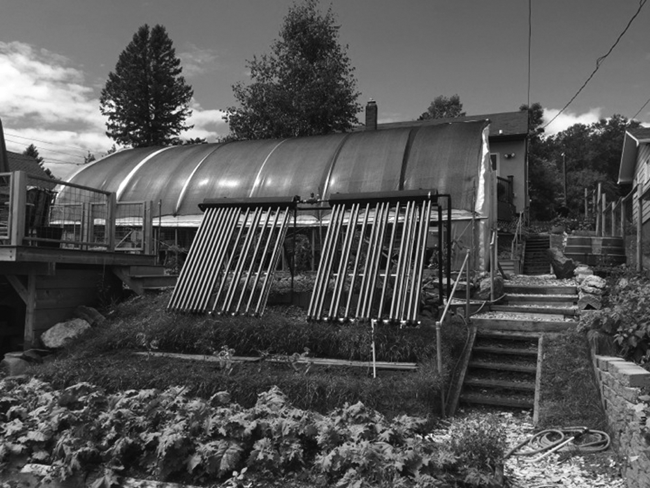
The solar thermal system proposed and installed by students for the local farm‐to‐table restaurant
Discussion
While the Shines! program was initially developed to advance the professional skills of engineering students through providing technical assistance to local entities that could result in implemented projects, a large unexpected co‐benefit of the university–community collaboration has been its impact on furthering sustainability at the community‐scale.
A community organization, Ecolibrium3, served as the initial program design and implementation partner with UMD professors. Ecolibrium3 had previous experience working with university partnerships that had varied success. A major concern when working with community organizations, government, and businesses is developing a process that is not too onerous for the client and a product that meets the client's needs, and also has a realistic potential for spawning adoption of sustainability recommendations. Often, when university programs reach out to the community, there is a lack of understanding regarding the needs of the community partner. The result is projects or assignments that meet an academic need but are more of a burden than a benefit to the client. A key component of the Shines! collaboration is a process in which assignments are used to scaffold the understanding and professional performance of the students. The process assists students in defining and meeting the needs of their client and begins an essential professional transition from academic performance to professional requirements.
A strong match between university and community partners fosters trust and transparency and is mutually beneficial, enabling significant expansion of working relationships and programmatic partnerships. The Shines! project has demonstrated this progression and expects continued growth in university‐community partnerships, as demonstrated with the following partners.
Ecolibrium3
Ecolibrium3 is a leader in energy and sustainability in Duluth. The company's initial interest in forming a partnership with UMD was to advance Duluth's participation in the Georgetown University Energy Prize Competition, and to also increase solar adoption within the community. Ecolibrium3 is working with the U.S. Department of Energy under the Sunshot Solar Market Pathways Program to increase residential, commercial, and institutional solar installations. Ecolibrium3's mission is to lead and inspire change in the community toward an equitable and sustainable future, so their focus is on providing greater opportunity to marginalized neighborhoods.
Shines! has provided powerful connections and technical assistance to help Ecolibrium3 meet community energy‐savings goals, assist businesses in becoming more sustainable and financially viable, and increase market penetration for solar installations. In the past three years, the collaboration, first developed through Shines!, has expanded to include a national demonstration project for a solar plus storage, resilient power retrofit at the Hartley Nature Center. A neighborhood‐based model was also created where an engineering intern worked with multiple businesses on an assortment of issues and projects that include reducing waste/water/energy. The student identified business waste products that can be used for the center's portable gardening project, which helps address food desert and health disparities in Lincoln Park. Shines! has also been introduced to other university departments, resulting in joint grant applications and projects on place‐based storytelling with UMD journalism, and technical assistance funds to create an online solar map for the City of Duluth with UMD's Geospatial Analysis Center. Ecolibrium3 has also hosted UMD interns and placed Shines! students in AmeriCorps VISTA positions to advance community resilience.
Minnesota Power
Minnesota Power serves as Duluth's investor‐owned electric utility. They have a strong conservation improvement program and have been a key collaborator with the university. Their participation in Shines! has created greater connection between UMD and the utility and has resulted in the utility's sponsorship of engineering interns both in the company and at local businesses. Minnesota Power has provided student teams and corresponding businesses with free commercial energy audits, allowing students to experience how an energy audit works and providing the businesses and student teams baseline energy information. Minnesota Power staff have also served as technical reviewers, expanding student understanding of the complexities surrounding energy recommendations. As a regional electric utility, Minnesota Power has great interest in the successful education of engineers as potential employees of the utility or of industrial clients in the region. Minnesota Power has also provided financial incentives to participating businesses to implement the conservation practices recommended by students, which helps Minnesota Power accomplish their energy savings goals and develop stronger relationships with business owners.
City of Duluth
City of Duluth has adopted a “lead by being” philosophy for energy and sustainability. Initially, the City participated in Shines! as a technical resource in which energy and facilities staff presented approaches to students. After the first successful iteration of the project, the City became a client, asking student teams to explore options for increasing energy resilience in city operations.
One such project focused on a small tract of land near the freeway entrance to the Lincoln Park neighborhood, which was under consideration for use as a community solar garden. The city‐owned land offers both a good space for energy production and a place in which members of the community could gather and also learn about renewable energy technology. The project had been in the early planning phases and student teams were asked to come up with a design for site layouts and potential solar PV systems that would optimize solar output and would be integral with space for community gathering and art.
A more recent project asked students to determine the feasibility of installing a solar PV array for use at the city's four water reservoirs, with the goal of capitalizing on investments in green energy. In particular, the City was interested in lowering its electrical use—over 50 percent of which is used to distribute and treat the city's water across the more than 840‐foot elevation differential from one part of the city to another—as well as reducing demand charges and increasing the resiliency of the water distribution infrastructure. The City requested an initial plan for the implementation of a one‐megawatt solar installation at the site of one of the water reservoir or pumping station. The students completed an analysis of different solar panel products, an estimate of yearly energy production, a detailed cost analysis, a site plan for the solar array, and preliminary modeling of an alternative pumping schedule to help reduce demand charges incurred from the pumping sites.
The students determined that one megawatt of solar could be installed for $2 million and would reduce demand charges, and concluded that the addition of a battery or some energy storage system would significantly increase the resiliency of the site. Initially, the City approached this project primarily with a goal of reducing demand charges; however, it has recently hired a student intern to look into options for a solar‐storage‐generator hybrid system to provide a resilient power system at the site.
The City and UMD have also expanded partnerships to include interns working on advancing the City's participation in the GreenStep Cities program; rebranding of the City's district heat system, with the assistance of Portland State University's Urban Sustainability Accelerator program and a City/UMD/Ecolibrium3 leadership team; developing a three‐year partnership with the University of Minnesota's Climate Smart Municipalities Program pairing Duluth with Saerbeck, Germany; executing a research grant on split incentives relating to efficiency and rental housing; and digitization of over 60,000 building footprints for a solar mapping tool (z.umn.edu/DuluthShines).
UMD integrates sustainability into campus operations, education, research, and outreach. Sustainability is listed as both a campus value and goal in the UMD Strategic Plan. As a Second Nature Carbon Commitment signatory, UMD aims to reduce greenhouse gas emissions 25 percent by 2020. While a stable carbon footprint in recent years is impressive, given a 40 percent increase in square footage, deeper energy conservation and efficiency projects and new sources of renewable energy are both needed. The Shines! Projects from their second year, focused on operational energy and water improvement projects for campus, and also helped catalyze the student‐led Solar University Network (SUN) Delegation, which works to advance solar energy at UMD. The SUN Delegation students created a plan to double solar energy production on campus and their student‐funded, 48‐kilowatt solar array on top of an on‐campus apartment building. Students involved in Shines! Projects have served on campus sustainability committees, and recently contributed to a request by the student government to add a sustainability chair position. In order to achieve UMD Carbon Commitment goals and assist in the City's energy transition efforts, collaborative projects are needed, and these connections and relationships are expanded and strengthened through Shines!
Conclusion
One of the main goals of the next version of Shines! will be to increase community outreach and education. The Shines! Poster Show offers a great opportunity to educate the community about what is going on at the university and about sustainability efforts by the City and local businesses, and to teach people about renewable energy and energy efficiency. Additionally, plans are underway to expand the Shines! program to include partners from the School of Business and Economics and the Department of Communication within the College of Liberal Arts, making it truly multidisciplinary.
The Shines! Program has resulted in a successful model for the university to act as a change agent in the community. 3 These projects represent unique opportunities to provide a practical educational experience. Because the projects are open ended, students engage their creativity and utilize problem‐solving skills in ways that extend their classroom experiences. By giving control of the project to the clients, students are immersed in a more real‐life experience. Classes and projects such as those mentioned are ideal places for students, in particular engineering students, to learn what drives sustainable changes, how they are achieved, and the important role that students can and will play as they enter the professional world and become members of a community.
Footnotes
Acknowledgments
The authors would like to acknowledge Ecolibrium3, University of Minnesota Duluth (UMD), Swenson College of Science and Engineering (SCSE), UMD Department of Civil Engineering, UMD Department of Mechanical and Industrial Engineering, Minnesota Power, City of Duluth, and the local businesses that have participated in Shines!
Author Disclosure Statement
No competing financial interests exist.