




Abstract

Brian Lakamp

Brian Lakamp, founder and CEO at Totem Power, speaks with
I think we are unique in the way that we think about the battery because we take what I call a smartphone or cell phone mentality about it. And what I mean is if you think about the cell phone, it is essentially an advanced energy storage device. But it is defined by the capability that the battery enables, the communication stack processor sensing capabilities, and it is all wrapped in an incredible design.
The conclusion we drew very early on is batteries are going to be really important to the grid at scale, and we think it is a shame to deploy the batteries only for peak shaving or demand response or some of the other typical purposes.
We think that if you are going to deploy on that scale and think about batteries on a distributed basis, they should pair with all of the functionality that is part of the buzzword-compliant future from 5G to smart city tech to autonomous vehicles and sensors and all that to ensure that those critical services stay up and running when people need them the most and act as a resilience asset in times of emergency.
So we are building what we believe to be a fundamental grid asset for normal operating mode and a resilience asset that keeps a society increasingly dependent on electricity, up and running through the critical hours.
That happens to be occurring at the exact same time that we are starting to think about how carriers roll out 5G at scale, which is going to have a lot more nodes and lower power with higher density. So we are thinking about deploying a whole array of different sensors and intelligence to instrument the city and drive greater intelligence and optimization of everything that one can imagine—from behaviors in certain weather, traffic optimization, water usage, all of that.
The totem energy units—pictured here in a school setting—are tall and treelike.
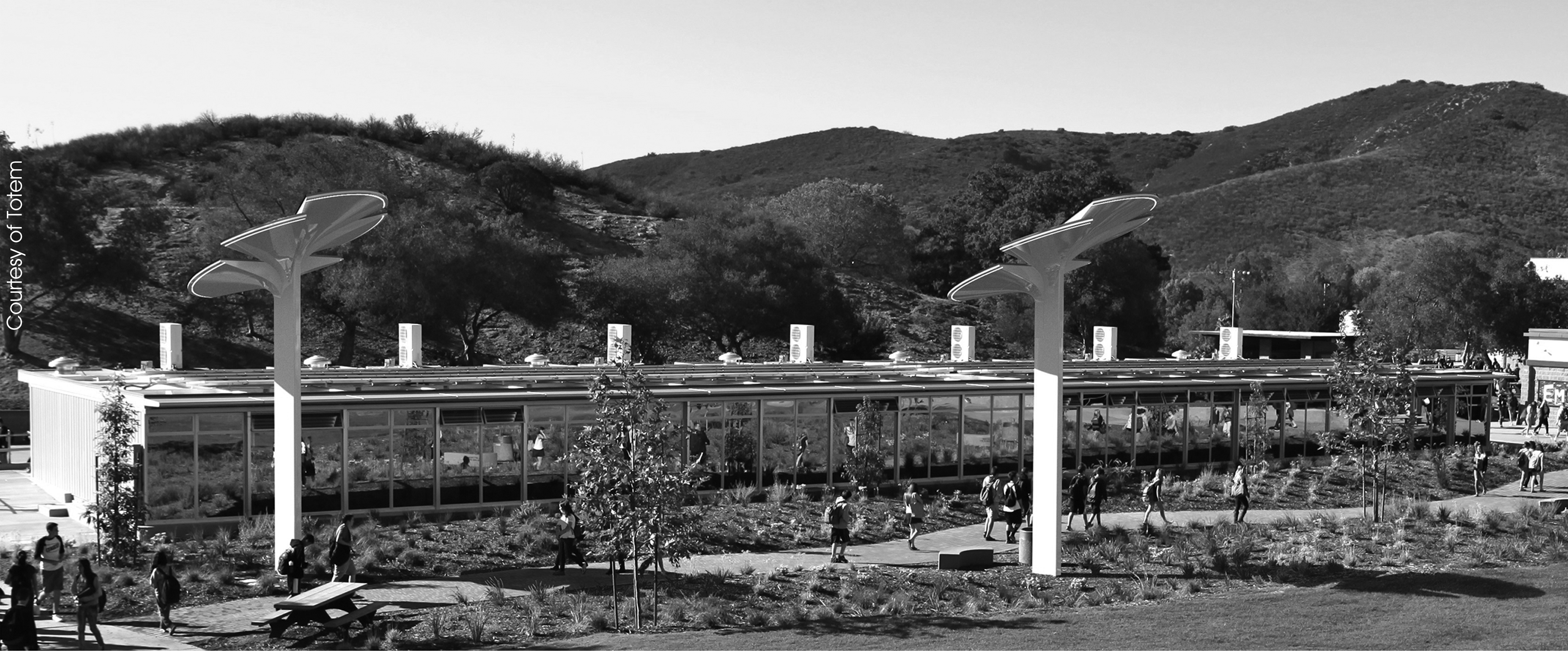
If you start to look at these things at a city level, all of it is founded upon a resilient, reliable grid. And what becomes really important is making sure you have the right energy foundation.
We at Totem do not think that that energy foundation is well served by incrementalist approaches along siloed lines. We do not think it is great to just upgrade your lights or do a separate EV-charging network or do a separate battery network. We think we are at a point where we are starting to think about those in a much more integrated, and a smarter way, so to provide dynamic grid balancing becomes really important.
We believe that doing that, coinciding with other upgrades, will make your city more resilient too. And to frame it with perhaps an overly simple analogy, back in the mid-70s, we could have worked on putting a better space bar or return button on a typewriter, but at a certain point, incrementally improving the typewriter was only going to get us so far. And we had to actually take a quantum leap into developing something that was not only a replacement for a typewriter, but dragged in the Rolodex, the filing cabinet, the calculator, the dictionary, the calendar on the desk, and all of that into something that not only improved each of those individually, but in concert, by allowing you to take contacts in your Rolodex, drop them into your mailings, and all of that. It became an infinitely more powerful and impactful device.
And we think we are in a similar spot with smart cities, where you are looking at separate infrastructure for energy, charging, lighting, security, communications, all of that. And I think there are some real opportunities to make those a much more cohesive set of infrastructure for the cities out there.
The last thing I will point out is that energy is at the foundation. What got me into this business, and what makes me so excited about it, is I feel like a kid in 1992 that had somebody tap him on the shoulder and say, “By the way, the Internet is going to happen and this is how it is going to play out.”
There is a guy named Bob Metcalfe who is one of the fathers of the Internet. He created 3Com and Internet technology. And he started referring to what is going on in energy as the “enernet.” It is a much more dynamic, diverse, distributed energy network, akin to what happened in communications over 30 years ago.
I am excited about where that fits today and what the opportunity is as the Enernet develops on probably the second, if not the most, important network that lives within cities and urban environments.
And along the way, I came across a story of a 13-year-old boy in 2011, a kid named Aiden Dywer, from Long Island, who was on a set of nature hikes and well beyond where I was when I was 13. So he came back, did a bunch of math, and concluded that trees had evolved into a Fibonacci variation in their branching structure—designed to optimize collection of solar energy.
I have no idea whether or not that math bears out. He got a lot of attention around it, ended up meeting President Obama at the time. But what that led me to was a tangential observation that, Wait a minute. Most of our infrastructure around energy and renewables is either ugly as sin or it is designed to be hidden.
The observation I took from Aiden was, trees are everywhere. They live in the fabric of the community. Could you design energy infrastructures so that they inspire, engage, and become a beacon for services and capability? You know, a symbol of power, so to speak, in communities and properties broadly.
That is sort of where the notion of Totem started and that is where the organic origin of Totem started. The minute you look at the unit, you understand what it does and it feels good, like we are collectively headed in the right direction.
And more recently, I actually moved to New York to lead the launch and operations of a product called iHeartRadio for the first four years. It is a digital radio service. I am happy to say that we grew that to scale and I was later asked to play a role as the CTO and run ventures for the company.
And as part of my responsibility as CTO, I took operational responsibility for a number of our radio towers. So if you distill all of that down, it was a bunch of freestanding pieces of metal designed to perform a public service, connected up with software at scale in a transforming industry, which is exactly what Totem is.
So it feels from that standpoint a pretty natural transition. And having sat at the front row in the transition from movies, music, and radio—that have been pretty well documented in how far along technology has pushed those respective businesses—I am fascinated and excited by the opportunity ahead in energy.
We are going to see the grid become much more dynamic, and what has been deemed utilitarian or mundane in many respects, because people just assumed it was a plug to put in the wall. I think it is going to become forefront, a lot sexier with a lot more attention drawn to it.
Secondly, I think that we are at an interesting inflection point. The conversations to date have largely been around renewables and how much you are offsetting. I think while certainly large agreements to offset your corporate energy product are important, it is not just about how you offset. It is about how you operate. And attention and focus around optimization of the grid to be dynamically balanced to integrate renewables cleanly is going to be really a big opportunity.
You are starting to see that play out already in places like California, which is producing more solar power than they can use. That to me screams of opportunity and the ability to build a better way. And I would encourage the students who are thinking about those problems to actively focus on solving that and addressing it.