




Abstract
Abstract
Mentoring has proved useful in gathering knowledge and creating leadership when mediating hands‐on Education for Sustainable Development (ESD) experiences. This article describes the implementation of an educational project transformed through an ESD leadership program. A case study in Mexico is used to discuss the importance of contextualizing local education within the global framework of the United Nation's Sustainable Development Goals (SDGs). Escuelas Ya'ax aims to empower students and help them make sustainable lifestyle choices through use of examples from their own culture; the project based at the school also helps students acquire the skills needed to lead a self‐reliant and sustainable life. To achieve SDGs 3, 4, 11, 15, and 17, a network of sustainable schools was created in five states across Southern Mexico (Tabasco, Chiapas, Campeche, Yucatán, and Quintana Roo) using knowledge of the indigenous culture of Mayan communities. During the implementation of the project various methodologies were used (for example, visual arts, co‐design, networking, and bottom‐up approaches) to seek a synergistic educational transformation. The SDGs acted as a referential guide to assure aligned objectives, but the program also incorporated shared intergenerational concerns.
Introduction
This article presents insights from an educational project within the framework of an international program based on “Mentoring” 1 as a pedagogical strategy.2,3 Mentoring for ESD Leadership (MESDL) is an arm of the International ESD Expert Net (ESD‐EN) whose goal is to strengthen international dialogue around Education for Sustainable Development (ESD), and thereby contribute to the solution of global socio‐environmental problems through education. Founded in 2009, ESD‐EN brings together experts from Germany, India, Mexico, and South Africa to implement educational projects oriented toward sustainability at the local level in collaboration with educational stakeholders from these countries. The network is supported by the German Ministry of International Cooperation and by the German agency, Engagement Global (EG), which coordinate and organize the work in the member countries. UNESCO selected ESD‐EN and EG as international partners to implement the global action program on the subject of ESD.
Since the launching of the Sustainable Development Goals (SDGs) in 2015, ESD‐EN and EG have incorporated the SDGs into the MESDL as a core component in the development of educational content and strategies, and as a method to analyze mentees' projects. This article presents insights gleaned from MESDL, which focuses on young professionals and is based on mentoring 1 as a pedagogical strategy,2,3
Mentoring for ESD Leadership Program
MESDL is a seven‐month blended learning program focused on young professionals from the four ESD‐EN member countries which is implemented simultaneously. The program started in 2017, and the case study presented in this article is part of the first generation of the program and it is addressed to the general public (20–40 year‐old approximately). It is an annual program that begins with a face‐to‐face meeting in March in Germany, and ends with another face‐to‐face meeting in Mexico. Between March and November the training is online through a virtual platform, with the possibility of having a national face‐to‐face meeting in each country. Each country selects five mentees in each generation to participate in a project in their own country. Therefore, 20 mentees can participate in each generation of the program. The program is developed around implementing each mentee's project, which has to be related to their professional practice. The training of mentees has several distinct stages (Figure 1) designed to incorporate the objectives of the program: 1.) online module phases aimed at strengthening methodological and conceptual competencies 4 related to ESD, and 2.) mentoring support for mentees in order to strengthen their skills in the implementation of their projects. These objectives coincide with the learning objectives of SDGs proposed by Rieckmann. 5
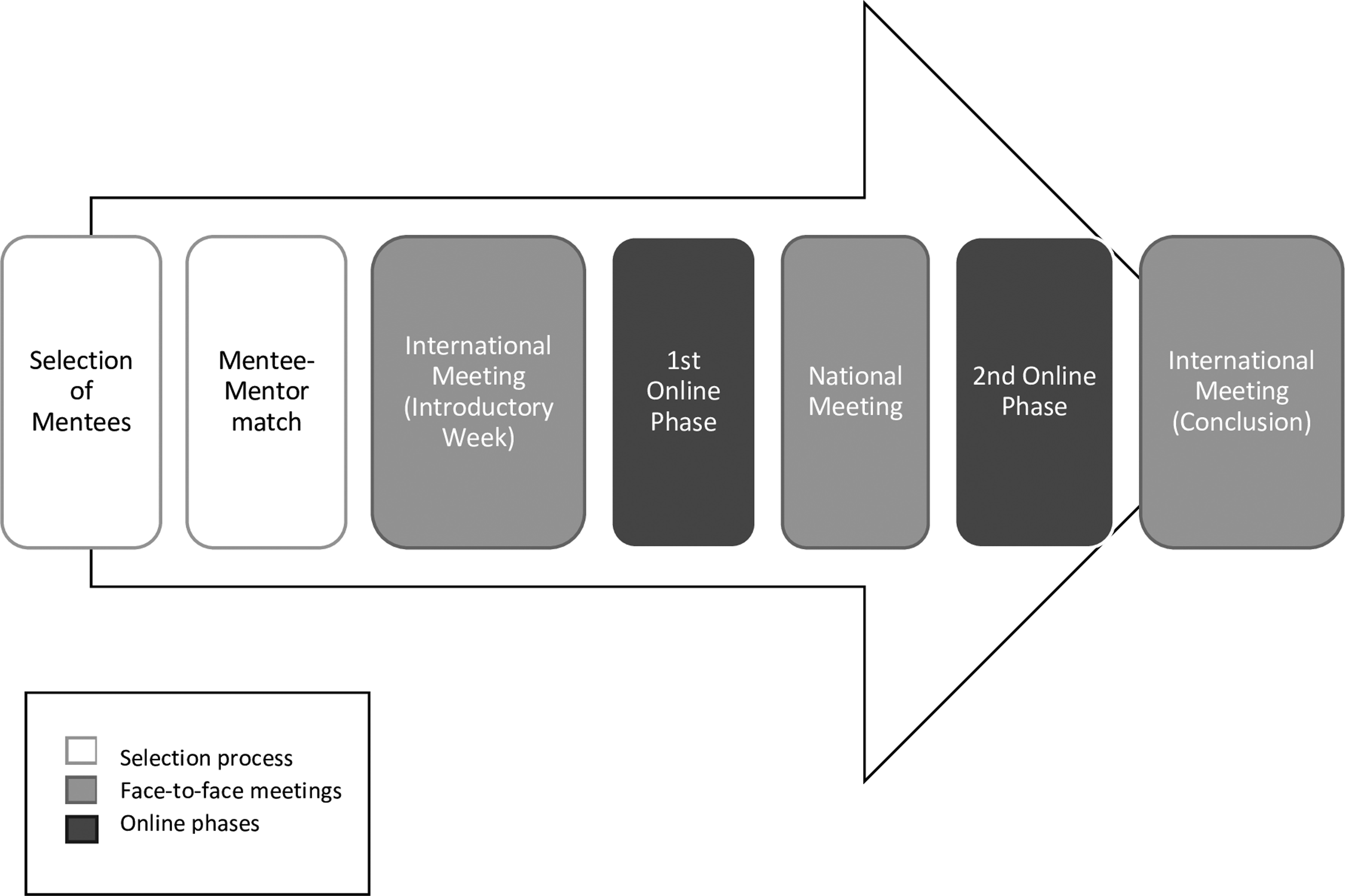
Sequence of stages in the Mentoring for ESD Leadership program
MESDL offers a teaching‐learning model with several nodes, agents, levels, and relationships, all as part of an interconnected network (Figure 2). Each agent is empowered to conditionally act on others, and to be conditionally acted upon by those around him or her. It is with this social fabric, that the 20 mentees' projects were developed, which underwent a transformation influenced by their intercultural, peer, and expert networks and by their close mentor‐mentee relationship. 6
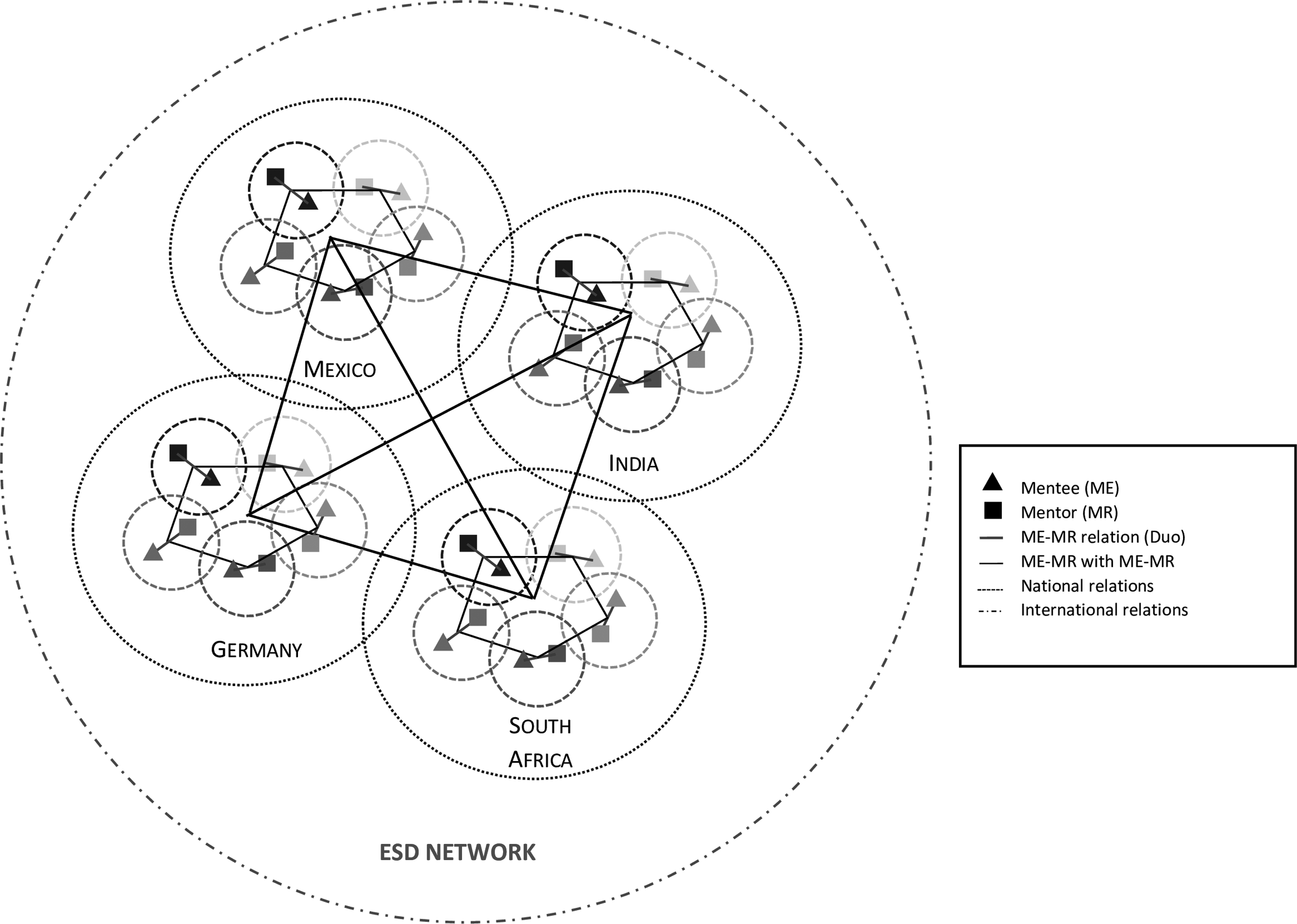
Network of actors within the Mentoring for ESD Leadership program
Case Study: Escuelas Ya'ax
This article describes one case, from one of the four ESD network countries, used as a representative example of how mentor‐mentee relationships enhance the concepts of sustainability within the curriculum. Escuelas Ya'ax is an educational project currently being implemented in Mexico. Its goal is to strengthen conservation of primate species and their habitats through school curriculum. The Mayan word ya'ax means green, life, and the sense of prosperity. An essential element of the bio‐cultural heritage of this Mayan region are primate species; hence, they are considered an umbrella species and as such, can also be used as a pedagogical strategy to bring several environmental issues into the classroom.
The project has several goals that incorporate the following SDGs: It considers significant education and communitarian action (SDG 4) as the cornerstone to achieving sustainable cities (SDG 11), conservation of life on land (SDG 15), ensuring the health and well‐being of the local communities in southern Mexico's Mayan region (SDG 3), and strengthening the connection between global partnerships with different stakeholders (SDG 17). The project is based on participatory action research and transdisciplinary methodologies, the creation of bridges between scientific and traditional/indigenous knowledge, and the creation of a leaders' network to take action for the protection and improvement of their own environment.
Ya'ax aims to empower students using the principles of sustainability seen through the lens of their own culture and traditional knowledge. The project also seeks to provide students with skills needed to lead a self‐reliant and sustainable life. The project's primary goal is to create a network of sustainable schools by endorsing a sustainable curriculum and incorporating physical changes and teaching tools to bring together environmental education and community engagement. These collaborative activities can inspire the school community, and gradually creates a culture of continuous learning, growth, and development. The innovation in this project is that the process is linked to Mayan culture and traditional knowledge and practices of the communities, and also considers primates as the regional umbrella species in five states of Southern Mexico: Tabasco, Chiapas, Campeche, Yucatán, and Quintana Roo. Other goals included: 1.) defining and strengthening, in a collective way, the ideal “sustainable ambassador school for the primates' conservation”; 2.) learning to diagnose environmental problems (school scale and then community scale) in order to find smart solutions to mitigate and improve the identified environmental conditions; and 3.) identifying environmental challenges, developing local solutions, and evaluating the process guided by an internal council leading the decision making.
In order to reach the aforementioned goals, Escuelas Ya'ax uses the following approaches to learning:
Visual participatory methods (VPM). Provide spaces for participants to reflect, learn, and talk about issues not openly discussed in the traditional curriculum.7,8 VPMs build students' skills in technology, communication, and visual methods and encourage them to be creative and playful and relate these topics to their own experiences, imaginations, and emotions.
9
Co‐design. Design a solution for the community by the community.10,11 This methodology encourages students to be aware and reflective by diagnosing and applying real solutions to what they want to improve or change. Networking. Connect experiences from schools that have overcome internal problems to become more sustainable.
12
Through using networks, students learn how to evaluate and communicate difficulties as well as opportunities and share successful experiences. Bottom‐up. Use (mainly) the diálogo de saberes (dialogue of pieces of knowledge) approach,13,14 which allows students and adults to hear and respond to the environmental context—everyone learns from each other, and all forms of knowledge are listened to and respected. The participants are the experts of their own lives, but together they can build a better environment.
How Escuelas Ya'ax Contributes to Achieving the SDGs
SDG 3 and SDG 11
Confronting natural hazards through land‐use planning for sustainable communities is a way to cooperate with nature (the commonly‐forgotten stakeholder). Mexicans have indigenous roots, ancestors who lived sustainably for countless generations, in which physical and spiritual nutrition was sourced from the natural environment. However, a good portion of this population has entirely lost this traditional knowledge. Science can provide evidence of sustainable practices, but in local contexts linking knowledge systems (scientific and traditional) could be the bridge to build joint solutions.
To help build this bridge, Ya'ax is creating a school network based on sustainable management related to the traditional knowledge of the Mayan region. The ESD process starts at school, but it is expected that the knowledge will transfer to parents and other local actors in the community. 15 In addition, promoting a network of sustainable actors actions illustrates the importance of the theoretical framework. 16 Mentors will lead by example, sharing the experiences of how sustainable actions can be achieved by equals (children‐children, teachers‐teachers, farmers‐farmers).
SDG 4
Providing access to education for all is essential, but it is also necessary to improve the teaching‐learning process at the local level in order to construct relevant knowledge in the context of the formal education process. In Mexico ESD is still marginalized in the school curricula, and its practice has been reduced to the fields of science and technology. 17 This omission reveals a deficiency in awareness and participation, enabling this topic to be dominated by a traditional education perspective, one still predominant in rural communities. 18 The traditional education model generates receptive and passive learning, reinforcing a single area of human development: the cognitive domain. 19 Specifically, Ya'ax addresses SDG 4 by promoting alternative educational perspectives applied to rural contexts (e.g., education for peace, buenvivir or good living), seeking better educational experiences because this translates into having better attitudes toward the environment.
SDG 15
As much as 63 percent of all primate species are classified as threatened with extinction. 20 In Mexico, adequate forest management can be effective in protecting primates because it offers tangible local benefits while conserving forests and sequestering carbon, as well as restoring forest cover. 21 However, this type of management requires social investment, technical assistance, capital, and training in business administration and forest management. To tackle ESD linked with forest management, Ya'ax suggests that one crucial starting point could be school, where learning concepts, skills, and tools that can be applied in the future by a new generation of stakeholders. Additionally, in pedagogical terms, if indigenous children can relate the content of the curriculum with daily practices within their community, the school content can be more significant for them. 11 In this interaction, several elements can strengthen the educational quality for indigenous students in formal school settings.
Conclusion
Ya'ax shows one of the main challenges when implementing SDGs in local contexts: coordinating global perspectives with local initiatives is not easily achievable due to problems in scale. This challenge confirms that although the SDGs are presented as desirable goals for meeting human needs and interests, they do not extend to include the kinds of complexities that are identified at the local level and in indigenous cultures, such as those in Mexico. Although the SDGs are presented as a guide to follow (from the global to the local), it is not easy to apply them to local concerns. However, if we start from the local agendas and move toward global ones, we can identify not only the challenges, but also the efforts that are being made to contribute to sustainability.
From this perspective, the socio‐environmental challenges in local contexts can be identified more easily and thus related to global objectives. From the bottom‐up, SDGs cease to be a global agenda and become an analytical tool that helps to explore the complexities of local contexts and thereby connect them globally. In this way, the MESDL becomes an educational space that helps mediate global agendas with local concerns and initiatives—space where mentors and mentees generate dialogues and reflections. In the implementation of mentees' innovation projects, theoretical‐methodological perspectives are connected with concrete practices and competencies and skills are developed for leadership in ESD, which contribute to sustainability in local contexts. The MESDL allows the analytical richness of the SDGs to be used to understand the planetary complexities from a local perspective in the transition toward a sustainable future.
Footnotes
Acknowledgments
The authors are grateful to the ESD Expert Net and Engagement Global. Thank you to the children, teachers, and school principals who are actively participating in this project. Thanks to Rosa Aurora Márquez Galicia for her artistic collaboration focused on empathy and emotional connections. The authors extend their deepest gratitude to Rob O'Donoghue and Lucía Jorge Sales for their valuable suggestions and discussions on the manuscript. We also thank Raquel Zetina Conteras for language editing and proofreading. Thanks to Fresno Chaffee Zoo Wildlife Conservation Fund and La Vallée des Singes Conservation Research Grant for financial support.
Author Disclosure Statement
No competing financial interests exist