




Abstract
Abstract
This study utilized secondary data sourced from the World Development Indicators (WDI), International Labour Organisation (ILO), United Nations Educational, Scientific and Cultural Organization (UNESCO), and the System Generalized Method of Moments (SGMM) econometric technique was used to analyze the data. Sustainable Development Goal 1, a proxy for poverty, was used as the dependent variable, while agriculture value added, employment in the agricultural sector, inequality, literacy rate, population growth rate, and gross domestic savings were the explanatory variables. The study found that both agriculture value added and employment in the agricultural sector were statistically significant in explaining poverty and negatively related to poverty in the Economic Community of West African States (ECOWAS) subregion. Therefore, based on the findings, the study recommends that the governments of ECOWAS countries should focus more on agriculture in order to become exporters of cash crops to boost their economies and increase savings that can be used to alleviate and eliminate poverty among the people.
Introduction
To say that poverty and hunger are the two main problems faced by African countries is stating the obvious, 1 and the number of people who are wallowing in poverty and hunger has been on the rise since the beginning of the decade. 2 The Food and Agricultural Organization (FAO) posited in 2016 that globally, 815 million individuals were suffering from hunger due to the high incidence of poverty. This marked the first upsurge in the rate of hunger since the food price disaster of 2007–2008, and is a substantial upsurge from the 777 million who experienced under-nourishment in 2015. According to the FAO (2017) report, this setback is due to the discrepancy and the impact of the change in climate in parts of Southeast Asia, West Asia and sub-Saharan Africa. 2
The agricultural sector occupies an essential position in the West African subregion and the sector is recognized as the heartbeat of the subregional economy. This is because its impact cuts across societies at various stages given that the West African economies—in terms of labor force, incomes, and access to food—rely heavily on the sector. Indeed, the Economic Community of West African States' (ECOWAS) agricultural sector generates more than 35 percent of the Gross Domestic Product of the subregion. 2 However, agriculture has largely remained unattractive to the populace, especially for the youth, for reasons that include: low returns on time and monetary investments, low investments in the infrastructure necessary for efficient value chains, and inadequate social protection. However, there are emerging success stories of changing attitudes among the youth in undertaking agriculture as a business. 3 The export of agricultural commodities is the main source of ECOWAS external trade, in which about (U.S.) $6 billion is generated, equivalent to approximately 16.3 percent of the tangible and intangible commodities exported from the region.4.5
Harnessing the agricultural potential in West Africa is essential for the reduction of the rate of poverty and the attainment of sustainable development. 6 The basis for this study rests on the argument that, compared to other sectors of the West African economies, sustainable development will be attained quickly using agriculture as the head-lamp. This is because an increase in agricultural production raises rural household income per-capita, which may not be the case for other sectors. However, sustainable development will only be attained when coupled with greater industrialization and urbanization, as agriculture provides the raw materials the industries need for production. This may, in turn, give rise to demand in industrial production.
Increased agricultural output and productivity tend to contribute substantially to the overall economic development of a country, more than other sectors; therefore, this study posited that it would be rational and appropriate for West Africa to place greater emphasis on the development of the agricultural sector.7–9 In addition, agricultural development is a pathway for West African countries to achieve sustainable development. As noted by Chigbu, “[I]ndeed sustainable development in the West African subregion can only be practical through the total revitalization of our agricultural sector. This will drive the sector to produce food and fibres to feed our people at a rate faster than the birth-rate; yet reducing the death rate. The injection of vigor into the agricultural sector will also fasten the creation of self-reliance, self-contentment and self-sufficiency which will be translated to national sufficiency.” 10
Exports of agricultural commodities generate a reasonable level of revenue that the governments use in paying for the importation of final products, equipment, and intermediate goods for industrial use and services. With respect to employment opportunities, the agricultural sector in ECOWAS remains the largest provider of labor with more than 60 percent of the region's active population engaged in it, despite the fact that the remuneration of the sector is less than that of other sectors. 11 In addition, agriculture is an essential determinant in the race to end poverty at all levels and to achieve food security by 2030. 2 A household that engages in farming has a ready supply for consumption, and those who live in cities (who are responsible for more than half of the region's total population) get almost all their food from the rural markets. 11 Currently, about 80 percent of the food requirements of the ECOWAS population are met by regional produce, but in the next few years, the West African agricultural produce will have to contend with a huge increase in demand as a result of an upsurge in population growth. The ECOWAS population presently stands at 290 million people and is projected to surpass 400 million by 2020, and 500 million by the year 2030. 11
Despite progress in reducing the prevalence of extreme poverty—or share of population living on less than (U.S.) $1.25 a day—in low- and middle-income countries, little progress has been made in reducing the number of people living on between $1.25 and $2.00 a day. 2 Furthermore, poverty persists, with recent estimates showing that about two billion people worldwide may be considered poor. 12 Numerous sources have shown that poverty is more prevalent in rural areas than urban areas of the developing world, including the West African subregion,13–15 which showed significant growth in government spending per capita from 1980 to 2010. Much of the growth is attributed to an increase in spending per capita on education and health, with rapid rates of increase in countries of both the developing and developed world. The most comprehensive estimates (based on household survey data supplemented with administrative data) are that 1.9 billion people throughout the developing world receive social assistance.4,5
In light of the aforementioned statements, the objective of this article is to examine the impact of agriculture as a stimulant for sustainable development in the Economic Community of West African States (ECOWAS), whose aim is to eliminate poverty by the year 2030. Thus, this article is structured as follows: the literature review and theoretical framework; the methodology; the results and discussion; and then the conclusion and recommendations of the study.
Literature Review and Theoretical Framework
The importance of sustainable development cannot be discussed in the West African subregion without considering (or consideration of) the growth in the agricultural sector. Agriculture is a major pathway to the economic growth and development of the West African subregion. As pointed out by Matthew and Adegboye, the agricultural sector also generates foreign exchange through exports for the countries in the subregion:
[Agriculture] encompasses all aspect of human activities—being the art, act, a cultural necessity and science of production of goods through cultivation of land and management of plants and animals which creates an activity web-chain that satisfies social and economic needs. Agriculture is the mainstay of mankind; therefore wise nations all over the globe give it a priority by developing and exploiting this sector for the upkeep of their teeming populations through the earning of revenue for development purposes; as well as employment for the stemming down crimes, corruption and other forms of indiscipline which work against all factors of life, living and most of all economic production. (p. 6)
8
Callistus and Mulugeta 16 examined the impact of social grants on poverty reduction at the household level in Ghana; they employed well-structured questionnaires, focus group discussions, and in-depth interviews in their study. The study found that the Livelihood Empowerment Against Poverty (LEAP) social grant had a positive impact on food consumption, frequency of utilization of health care facilities, and the school enrollment rate for children ages 6 to 13 in beneficiary households. The study recommended that the government increase the cash amount, pay transfers regularly, link beneficiaries to existing complementary services in the district, recruit more staff, and provide in-service training opportunities for them. In line with this, Omorogiuwa, Zivkovic, and Ademoh 17 carried out an empirical study on the role of agriculture in the economic development of Nigeria. The study used trend analysis in the form of historical and current perspectives as well as various descriptive methods to analyze the development of agriculture in Nigeria. The study concluded that in-depth research on the development of the agricultural sector is essential to the progress of the country.
Ogbalubi and Wokocha. 18 carried out an empirical investigation pointing out that the agricultural sector has significant potential in the transformation of the African economy. Their study further acknowledged that most important public policies in West Africa have been tailored toward food security—supply of agricultural raw materials needed by the manufacturing sector to provide adequate employment and income to farmers. The study recommended that credit facilities and extension services be provided to the farmers in order to bring about price stabilization, and to achieve this, agriculture should be made a priority. In the same vein, Gustavo and Kostas 19 investigated the relationship between rurality and poverty and the role they play in rural development and poverty reduction. They argued that there was a historical misjudgment against the primary sector which had served as a foundation for anti-agricultural bias in public policy until the late 1980s. They concluded that the less developed countries (LDCs) still need agriculture as their starting point for rural development in contrast to the advanced countries.
Matthew and Adegboye 8 examined the role of agriculture in the development of the Nigerian economy from 1970 to 2008 and employed the Johansen co-integration technique in the analysis of the data. Their study showed that the agricultural sector had no significant impact on economic development. Therefore, their study recommended that in order to develop the agricultural sector, the Nigerian government invest in research and technology to help to increase agricultural productivity, and that the government establish an agricultural fund to finance and facilitate medium- and large-scale agricultural production, which would, in turn, enhance employment and production for local consumption and for export. Further, Shane and Venkataraman, 20 observed that for sustainable development to be realized, there has to be adequate planning in the agricultural sector.
Eliamoni, Fenggying, and Chang 21 examined the role of agriculture in economic growth and poverty reduction in Tanzania from 1980 to 2014, using a descriptive analysis. Their study found that an increase in population (by household size) in rural areas and poor public services in rural areas exacerbated poverty and accelerated shifting from agricultural to non agricultural activities, especially in educated youth. The study recommended that steps be taken if the nation is to continue to pursue its goal of ensuring that arable land with favorable climate can be strategically used for food production, which would thus assure the availability of agricultural produce.
Ogundipe et al. 6 examined the effect of agricultural productivity on poverty reduction in Africa using the dynamic panel data approach and the System-GMM technique for the period from 1991 to 2015. The results from this study revealed that the agricultural value added per worker contributed significantly to reducing poverty in Africa. The study recommended that part of the development programs that are used to enhance agricultural productivity should include strategies for accessing credit in order to boost the asset base of rural farmers for large-scale commercial production. In addition, appropriate macroeconomic policies and sound institutional frameworks need to be put in place in order to improve social services and the provision of land used for farming. However, in order to obtain optimal output from farming, zoning type and size should be determined for “land use section” where zoning type is simplified into residential district, commercial district, industrial district, and available land for agriculture. 22
Bart and Barrett 23 examined agricultural technology, productivity, and poverty in Madagascar. A spatially explicit dataset was employed in this study to link agricultural performance and rural poverty. The study found that agricultural production constitutes an important part of any strategy to reduce the high poverty and food insecurity rates currently prevalent in rural Madagascar. It has been observed that the youth in the African continent prefer white collar jobs to getting engaged in the agricultural sector. This is due to the fact that crude implements are still being used to practice agriculture, predominantly in the West African subregion. This assertion was buttressed in the study by Collinson et al. 24 whose descriptive study examined youth migration, livelihood prospects, and demographic dividends in the rural northeast of South Africa. They found that only 10 percent of male youths were employed in the agricultural sector in 2000, reduced to 3 percent in 2012. Similarly, the percentage of female youths employed in the agricultural sector saw a reduction from 11 percent in 2000 to 6 percent in 2012. The study recommended that, for employment in agriculture to increase, more youth need to be engaged in it, and this would help reduce unemployment and reduce poverty.
The study discussed herein focused on the ECOWAS region, which is made up of 15 countries, five of which are English-speaking countries (Ghana, Gambia, Liberia, Nigeria, and Sierra Leone), nine are French-speaking countries (Benin, Burkina Faso, Ivory Coast, Guinea, Guinea Bissau, Mali, Niger, Senegal, and Togo), and Cape Verde which is Portuguese-speaking. The study made use of secondary data sourced from the World Bank's World Development Indicators (2017), Country Policy and Institutional Assessment (2017), Gini index, the United Nations Education, Scientific and Cultural Organizations (2017), and International Labour Organisation (2017). The FAO study observed that the United Nations' quest for sustainable development by the year 2030 has been a great achievement as the number of people living in poverty has dropped from 1.9 billion in 1990 to 836 million in 2015, though this achievement is limited to the ECOWAS subregion. 2 Variables show that within 10 years, that is, the period under study (2007–2016), the poverty rate in ECOWAS accounts for more than 40 percent of the world's poverty rate. 2 (See Figure 1.)
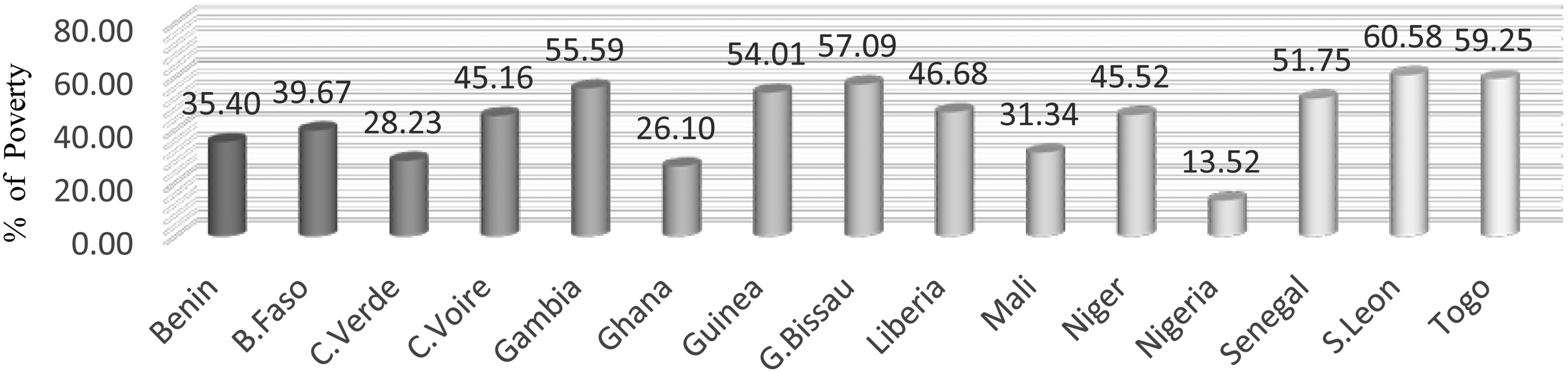
Average rate of poverty in ECOWAS countries (2007–2016)
Figure 1 presents the average poverty rates across ECOWAS countries between 2007 and 2016. It shows that in this region, the rate of poverty is highest in Sierra Leone, with a poverty rate of 60.58 percent, while Nigeria has a relatively low poverty rate of 13.52 percent. SDG 1 (Sustainable Development Goal 1: eliminate poverty in all its forms) is seen as attainable by the year 2030, as poverty rates globally fell from approximately 30 percent in 1990 to 12 percent in 2015. However, in terms of absolute population figures the extreme rate of poverty may not be eliminated, as it was reduced from 1.27 billion in 1990 to 0.75 billion in 2015. The greatest reduction occurred in countries in East Asia and South Asia, Europe and the Americas; but ECOWAS posed a different picture as the rate of poverty keeps increasing and is projected to increase further by 2030. 2 Improvement will only be attained if policies such as social protection policies are changed in the near future to reduce vulnerability.25–27
Unequal distribution of income makes the poor excluded from the growth process.28,29 According to the literature, nations with a high rate of inequality need twice as much growth as nations with a low rate of inequality to meet the goal of SDG 1. 30 Weak social protection has also weakened the reduction of poverty in ECOWAS as the highest rate of poverty is noticed among rural dwellers who depend on agriculture for survival. Social protection programs have proved to be one of the most effective weapons for fighting poverty and unproductive capacity of rural households that depend on agriculture.31,32 The current state of poverty indicates that approximately 836 million individuals are living in absolute poverty and in the less developed countries of the world, out of any five people, at least one lives below the poverty line, defined as living on (U.S.) $1.25 a day. 2 The largest number of the people who are living below the poverty line are from two main regions: Southern Asia and sub-Saharan Africa, and it is observed that two out of five children under the age of five in these regions have insufficient height for their age due to under nourishment. 2
Methodology
Various theories have been developed in explaining the incidence of poverty. Among the theories reviewed, this study adopted the Sustainable Livelihoods (SL) theory, which uses a wide-range model to explain issues of poverty. SL places interest on the net asset position rather than flows of income, and shocks (short-term impacts) rather than longer-term threats to income. 33 Following the SL model, and with respect to this study, poverty is defined in relation to vulnerability or what makes the poor vulnerable.34,35 More broadly, poverty has been defined to include income and non-income deficits—including lack of income and other material means; lack of access to basic social services such as education, health, and safe water; lack of personal security; and lack of empowerment to participate in the political process and in decisions that influence one's life. 36 The SL approach has provided a helpful structure in the study of livelihoods—welfare and poverty issues from which to derive relevant policy.
The major advantage of the SL theory is that it is focused on individuals and their livelihoods instead of resources and their exhaustion.
37
Therefore, the model for this study was adopted from the empirical work of Ogundipe et al.,
6
and the model assumed a linear relationship of the poverty (proxy for SDG 1) determinants in West Africa, which are specified in implicit form as:
Assuming that a nonlinear relationship exists among the endogenous and the exogenous variables, the explicit form of equation (1) will be:
The double log model is taken to linearize equation (2) as presented in equation (3). The model is logged to reduce the incidence of multicollinearity and other issues that may lead to spurious results, as evident in Ejemeyovwi, Osabuohien, and Osabohien. 38
Therefore, log linearizing equation (2), yields equation (3):
Where;
Hence, given that SDG 1 (the proxy for poverty) is a column vector represented as:
where: dpr means dependency rate, psav means political stability and absence of violence, and invst means investment, while other variables remain as defined (see Appendix 2).
In the Generalized Method of Moments (GMM) method, the predetermined and endogenous variables are characterized by their appropriate lags, to avoid introducing a spurious correlation between these variables and the error term.6,38
Given the growth regression for N countries and T time periods represented as:
where the study indexed time as t and i as countries. Likewise,
As noted, the regressors may also be correlated with the error term, such that:
and
This problem is solved by adopting lagged observations of the regressors as instruments, similar to Ogundipe et al. 6
To the best of the knowledge of the authors, no study has examined the impact of agricultural employment on sustainable development. This study contributes to this area, using the GMM. The decision to use the GMM technique stemmed from the fact that it estimates the model parameters directly from the moment conditions are imposed by the model. These conditions can be linear in the parameters or nonlinear. GMM was selected because of the possibility of endogeneity and omitted-variable bias. The variables that involve agriculture may be endogenous and usually have limited time variation. Thus, use of the GMM helped to solve the problem of endogeneity and omitted-variable bias, improving the results of the estimates.38–40
Results and Discussion
The results are based on the analysis of the data employed for this study. The starting point of the data analysis is the summary statistic of variables as shown in Appendix 2. The results show that the explanatory variables have a significant relationship to poverty. This supports the a priori expectations of the variables, which suggested that agriculture value added, employment in agriculture, inequality, gross domestic savings, population growth, and education (literacy rate) are expected to have a significant influence on poverty.
As has been pointed out, the GMM technique was used to control omitted variable bias and model endogeneity. Also, the GMM estimator is easily observable when the units of the dynamic panel model are relatively larger than the periods under study.41–43 However, the traditional GMM estimator has, over time, proved to have poor finite sample properties; in this regard, the series tends to be extremely persistent. 44 In these circumstances, the lagged levels of the series are only weakly correlated with subsequent first differences, thus, leading to weak instruments for the first-differenced equations. Arellano and Bover, 41 and Blundell and Bond 44 demonstrate that the GMM approach, by including extra moment restrictions, permits lagged first differences to be used as instruments in the levels of equations, and this corrects for any bias that would emerge using the standard GMM estimator. Care was taken to ensure that GMM proliferation of instruments that may outfit endogenous variables are controlled, and it was observed that the model passed both the test for instrument validity (Sargan AR(1) and AR (2)) and the test for second-order serial correlation. 42 The results from the System Generalized Method of Moments (SGMM) estimations are presented in Appendix 3.
In West Africa and other regions of developing countries, poverty remains the main barrier to population transition in response to food supply, and the best strategy for eliminating poverty is to enforce necessary changes in society. 45 This necessary change, if extended to agriculture, will have a greater reduction in the poverty rate. This is confirmed from the GMM results presented in Appendix 3, which shows that agriculture value added and employment in agriculture are both statistically significant in explaining poverty in the ECOWAS subregion. The increase in agricultural employment enhances the production capacity of the sector and reduces poverty. An increase in agriculture value added will help reduce the rate of poverty by 35.55 percent, 76.82 percent, 48.85 percent and 53.67 percent respectively (see Table 4). In addition, the potential of increased employment in the agricultural sector has the capacity to reduce poverty by 22.03 percent, 27.18 percent, 15.28 percent and 16.99 percent respectively (see Appendix 3).
This study also found that one of the root causes of poverty in the ECOWAS subregion could be a result of the high inequality in the subregion. As the estimated result shows, if the rate of inequality were to increase by 1 percent it poses a danger of increasing poverty by 55.3 percent, 49.43 percent, 9.21 percent and 3.3 percent respectively (See Appendix 3). On the other hand, the literacy rate is also statistically significant in explaining poverty and is negatively related to poverty, that is, the higher the literacy rate, the lower the rate of poverty. However, this supports the theoretical underpinning that a higher literacy rate helps reduce the rate of poverty (by 14.92 percent, 8.85 percent, 7.40 percent and 0.11 percent respectively). In this study, the authors used different lag levels (lag 2 2, lag 2 3, and lag 3 1) to run the GMM method because these lags give the best estimates from the regression analysis.
This study supports the findings of Drechsel et al. 46 who examined 36 sub-Saharan African countries; they observed that the Malthusian theory of population holds for population-agriculture-employment relationship. They argued that, in spite of the fact that the growing population is being provided with food now, a time will come in the near future when a population explosion could completely outgrow the food supplies; they also argued that the less developed countries (LDCs) are trapped in a vicious cycle of poverty. The birth rate has the tendency to be high, linked to the high rate of poverty, and so a continued high proportion of the population will continually live in poverty.35,37,47 This postulation justified the inclusion of population growth rate in equation (1) and as argued in the Solow Growth model. The results in this study show that an increase in the population growth rate results in an increase in the rate of poverty (because more people tend to chase fewer resources) by 93.4 percent, 45.9 percent, 10.1 percent and 22.6 percent respectively, as shown in the Appendices. In the same vein, gross domestic savings has a role to play in reducing poverty; this is evident from the results that show that an increase in households' propensity to save reduces poverty by 24.10 percent, 11.15 percent 10.11 percent and 77.11 percent respectively.
From the results of this study, the following policy implications are crucial for the countries in the ECOWAS subregion to consider and possibly implement. First, for poverty to be eliminated by the year 2030 in the ECOWAS subregion, agricultural produce needs to increase, and one of the ways to achieve this is to increase the employment generated in the agricultural sector. Second, the population growth rate in these ECOWAS countries needs to decrease since the rate of food production does not match the increase in the population in these countries. To this end, population control measures need to be put in place. Third, the wide gap between the rich and the poor in these ECOWAS countries needs to be reduced by reducing the rate of inequality via income and tax measures. Fourth, the governments of the ECOWAS countries should educate the farmers; the more educated the farmers, the more enlightened they will be in making use of mechanized implements in agricultural practice, and the higher their level of output. This will help reduce poverty by increasing their ability to sell what they produce and thus increase their levels of income. Lastly, the governments of the ECOWAS countries should reduce the importation of food items in order to reduce their trade deficit (i.e., their imports exceed their exports). The volume of imports in these countries is high because they already import technology and industrial goods; adding the importation of agricultural produce would further worsen the balance of payments position in these countries.
Conclusion
The West African countries may be able to exchange importation of agricultural commodities for poverty reduction; these nations will be at a relative advantage when compared with their counterparts. But several nations, including some of the continent's largest, will not be able to feed their citizens with importation of food alone, considering the adverse effect of trade deficits in their balance of payments accounts. A country like Cape Verde, among other ECOWAS countries, for instance, will continue to depend heavily on importation of its food needs. Thus, agriculture serves as an avenue for the poor to increase their earnings from their engagement in revenue generating agri-oriented activities. Whether or not the poor will make use of these opportunities depends on their level of education (literacy level), on their access to credit, and their savings habits, as well as on whether they are excluded by social custom or sanctions from government, from income-earning activities (e.g., women shut out of credit markets). The measures to increase the capital available to the poor (human, financial, physical, natural, and social capital) may consequently have huge benefits in terms of people's ability to get out of the poverty trap. Thus, the attainment of the Sustainable Development Goals (SDGs) by 2030 is feasible for the ECOWAS countries if the governments of these countries make a concerted effort to actualize them. In a nutshell, SDG 1, or the elimination of poverty, can only be achieved if agricultural output is increased, which would increase the income of the farmers and reduce poverty among them.
The following recommendations are based on the findings of this study. First, agriculture is significant at a 1 percent level and is negatively correlated with poverty (i.e., the higher the rate of agricultural output, the lower the rate of poverty). This supports the theory that agriculture has a negative correlation with poverty; again, the higher the agricultural output, the lower the rate of poverty. ECOWAS countries need to focus more on agriculture so they can become exporters of cash crops that will generate income for their economies, which can be used to alleviate and totally eliminate poverty among the people. Second, the study found that employment in agriculture is also significant, and is negatively correlated with poverty, that is, the higher the rate of employment in agriculture, the lower the rate of poverty. This supports the underlying theory that a higher level of employment in agriculture helps reduce the rate of poverty, in spite of the fact that most people engaged in agriculture in the ECOWAS countries are predominantly found in rural areas and communities and the majority still use crude farming implements, resulting in low productivity.
The governments of ECOWAS countries should encourage more people to practice agriculture via the provision of credits and extension services for persons in urban areas so they can engage in mechanized farming. Third, the study found that the literacy rate is significant at the 5 percent level and is negatively correlated with poverty—that is, the higher the literacy rate, the lower the rate of poverty. This supports the premise that a higher literacy rate will help reduce the rate of poverty. Therefore, this study recommends that farmers should be given both formal and informal education to increase their knowledge of mechanized implements and how to use them. Furthermore, this study recommends that the governments of ECOWAS countries put in place population control measures such as birth control availability and family planning education, which could help achieve the goal of reducing the population and bringing food production in line with the population, making it self-sustaining. Lastly, governments of ECOWAS countries should invest in providing social and infrastructural facilities for the populace to make the practice of agriculture a profitable and enjoyable venture.
Footnotes
Author Disclosure Statement
No competing financial interests exist.
SGMM Results (Dependent Variable: Poverty)
| GMM result at lag 2 2 | GMM result at lag 2 3 | GMM result at lag 3 1 | GMM result lag at 3 2 | |
|---|---|---|---|---|
|
|
0.35462 * | 0.7682 * | 0.4885 * | 0.5367 * |
| [0.0701] | [0.0357] | [0.0523] | [0.0514] | |
| (0.000) | (0.000) | (0.000) | (0.000) | |
|
|
−0.220 ** | −0.0272 ** | −0.1528 | −0.1699 |
| [0.0739] | [0.0118] | [0.0505] | [0.0533] | |
| (0.003) | (0.021) | (0.002) | (0.001) | |
|
|
−0.1192 | −0.1336 * | −0.0949 | −0.1449 ** |
| [0.0772] | [0.0320] | [0.0573] | [0.0673] | |
| (0.123) | (0.000) | (0.098) | 0.031 | |
|
|
0.553 | 0.4943 * | 0.0921 | 0.03312 |
| [3.5296] | [0.0832] | [.1800] | [0.1959] | |
| (0.117) | (0.000) | (0.609) | (0.866) | |
|
|
−0.1492 | −0.0485 | −0.0740 | −0.0011 |
| [0.0054] | [0.0363] | [0.07221] | [0.087] | |
| (0.400) | (0.182) | (0.305) | (0.990) | |
|
|
0.9341 | 0.4587 * | 0.10 11 ** | 0.2257 |
| [4.5002] | [0.0935] | [2.1410] | [2.9392] | |
| (0.514) | (0.000) | (0.007) | (0.442) | |
|
|
−0.2410 | −0.01115 | −0.1011 | −0.7711 |
| [13.719] | [0.0073] | [2.1410] | [1.9010] | |
| (0.232) | (0.129) | (0.670) | (0.884) | |
|
|
54.8257 * | 2.1736 * | 28.9709 * | 13.45287 |
| [13.719] | [0.379] | [10.663] | [11.579] | |
| (0.000) | (0.000) | (0.007) | (0.245) | |
|
|
0.950 | 1.25 | 0.105 | 0.850 |
|
|
0.796 | 0.95 | 0.103 | 0.923 |
|
|
0.10 | 40.99 | 29.33 | 0.25 |
|
|
(0.000) * | (0.000) * | 0.000 * | 0.000 * |
|
|
8 | 11 | 14 | 7 |
|
|
14 | 19 | 25 | 12 |
coefficients significant at 1%
coefficients significant at 2%
coefficients significant at 3%