




Abstract
Abstract
The education sector is one of the few sectors that can support, promote, and contribute to achieving all of the 17 United Nations' Sustainable Development Goals (UN SDGs). Universities, in particular, are essential to achieving the SDGs because they can equip the next generation with the skills, knowledge, and understanding to address sustainability challenges and opportunities and perform research that advances the sustainable development agenda. Universities can also provide examples and use their expertise, capabilities, and leadership to influence stakeholders to adopt and model more sustainable practices. To be effective, however, universities should be fully committed to support and implement the 2030 Agenda for Sustainable Development. The SDGs are an important vehicle for creating positive impact by embedding sustainability into university business strategies, decision‐making processes, and practices, and for improving their accountability to stakeholders. This article aims to contribute to research and practice fostering discussions and sharing the experience of the Royal Melbourne Institute of Technology (RMIT) University in Melbourne, Australia, in undertaking an ambitious and innovative project to raise awareness, foster collaboration, measure impact, and communicate the university's contributions toward achieving the SDGs across the entire university.
Background and Commitments to the UN SDGs
This article focuses on commitments to the United Nations' Sustainable Development Goals (UN SDGs) made by the Royal Melbourne Institute of Technology (RMIT) University, Melbourne, Australia. The university was founded as a metropolitan college, providing education in the arts, sciences, and technologies for working people in the 19th‐century colony of Victoria. RMIT began its engagement with sustainability quite early compared to most other universities—its University Council adopted a University Environmental Policy in 1994. Since then, RMIT has been improving its sustainability performance and, since they came into force in 2016, it has been advancing the SDGs.
In 2017 RMIT made a public commitment to support and promote the principles of the SDGs. This commitment includes: undertaking research that provides solutions to sustainable development challenges, providing educational opportunities for students to acquire the knowledge and skills needed to promote sustainable development, contributing to the achievement of the SDGs by ensuring its campuses and major programs are environmentally sustainable and socially inclusive, and reporting on activities that support implementation of the SDGs. 1
Through this commitment, RMIT recognizes the important role the education sector can play in both supporting the 2030 Agenda for Sustainable Development and contributing to the achievement of all 17 goals. The education sector is one of the few sectors that can support, promote, and contribute to all the SDGs. Universities, in particular, are essential in the context of the SDGS because they can both equip the next generation with skills, knowledge, and understanding to address sustainability challenges and opportunities, and perform research that drives innovation and advances the sustainable development agenda.2–4
Universities can also use their expertise, capabilities, and leadership to influence other stakeholders to adopt more sustainable policies and practices to achieve the 2030 Agenda for Sustainable Development. Universities can make sustainability leadership and the modeling of sustainability practices an organizational priority, incorporating sustainability best practices into their core business and operations, and regularly monitoring and reporting on their contributions to sustainable development and the SDGs.3,5,6
RMIT's University‐Wide SDGs Project
The RMIT Sustainability Committee is currently undertaking an ambitious and innovative project to raise awareness, foster collaboration, measure impact, and communicate RMIT contributions toward achieving the SDGs across the entire university. The university‐wide SDGs Project, initiated in June 2018, has been structured to improve RMIT's commitment and contributions to the SDGs through measurable impact, innovation, and partnerships. The project has four phases: 1.) Raising Awareness, 2.) Our Capabilities, 3.) Collaboration Opportunities, and 4.) Measuring and Reporting.
Raising Awareness
This initial phase is directed at developing and implementing a communication strategy to increase internal and external stakeholders' awareness of the SDGs. This is an important initiative that goes well beyond documenting awareness of the SDGs to include disseminating RMIT's commitments to the SDGs and documenting the important role universities can play in advancing the 2030 Agenda.
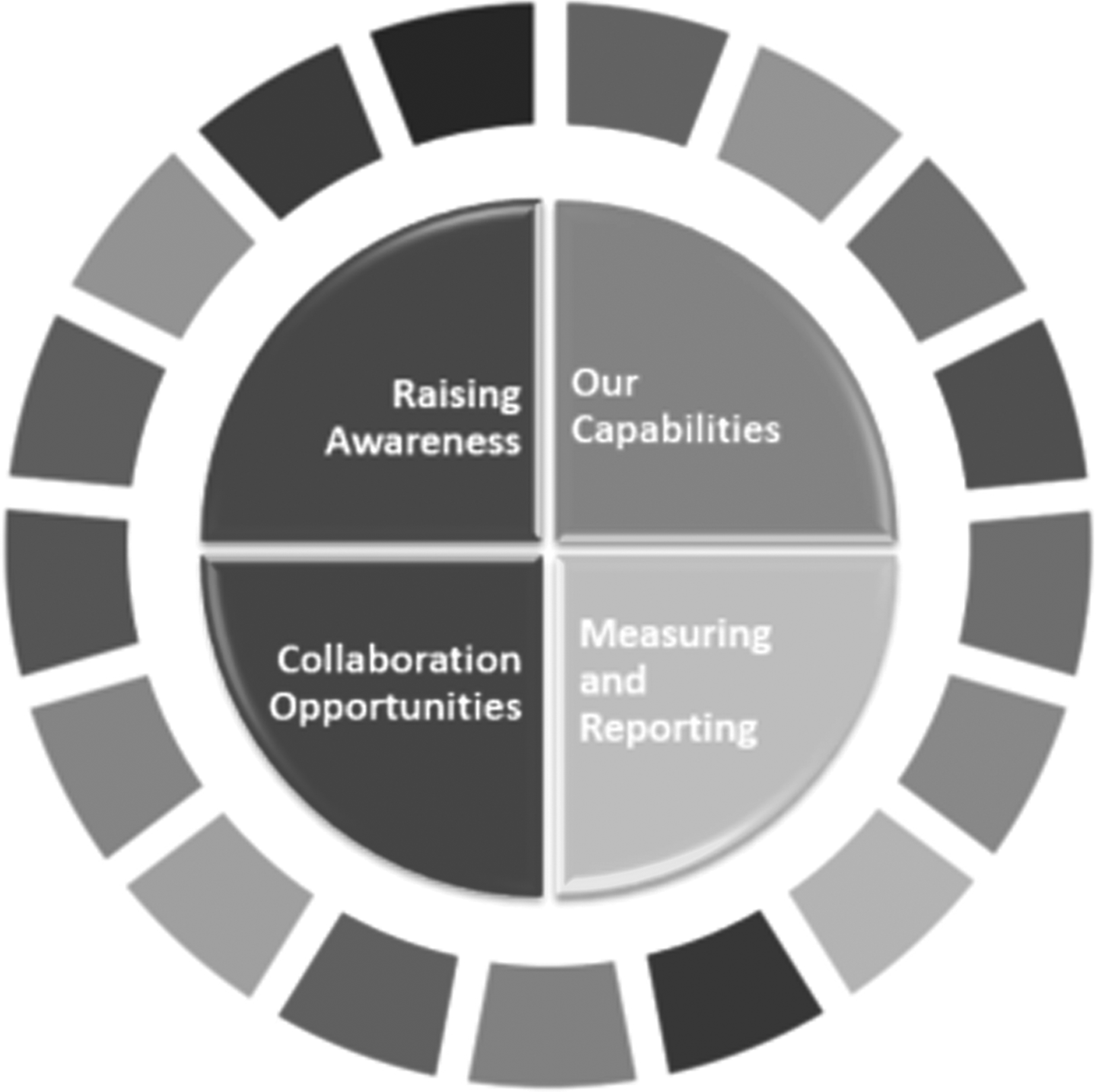
Project phases
The activities in this phase include implementing a robust communication strategy and organizing periodic events around the SDGs. These activities are important for building understanding of the SDGs, informing and engaging key stakeholders, identifying opportunities for collaboration, and creating links.
Our Capabilities
This phase establishes, analyzes, and maintains a record of RMIT's SDGs research expertise through a mixed approach, which incorporates both quantitative and qualitative data. Quantitative data has been obtained through a keyword search approach. The keyword search approach has been widely adopted by universities and research institutes worldwide to map research contributions to the SDGs. A qualitative approach has also been utilized to identify research contributions to the SDGs that could not be captured through quantitative data. The work of the Our Capabilities phase enables identification of relative strengths as well as gaps that may need to be addressed.
Collaboration Opportunities
Collaboration opportunities are identified through mapping of RMIT's business plan and strategies against the SDGs. One of the goals of this phase is to foster internal and external collaboration and facilitate research interlinkages and partnerships, to advance the SDGs.
Measuring and Reporting
Designing and implementing a measurement process to report on RMIT's research contributions to the SDGs is one of the goals of this phase. This process will be an important strategy for improving both accountability and transparency.
RMIT has been publishing sustainability reports in accordance with the Global Reporting Initiative (GRI) since 2015. RMIT sustainability reports are released annually as an open and transparent account of RMIT's sustainability performance. Building on the SDGs information included in the Annual Sustainability Report 2017, this phase will explore opportunities to further align the university's sustainability performance and reporting process with the SDGs.
Outcomes, Findings, and Lessons Learned
SDGs and Business Strategies
Embedding the SDGs into business strategies and then aligning them through an integrated approach is an effective way to explore linkages between relevant topics reflecting organizations' impacts and sustainability. Such an alignment enables universities to better understand and communicate where their activities are having the greatest positive impact, and allows them to strengthen their relations with stakeholders and improve accountability.7–9
Awareness around SDGs
Because the SDGs are still in their early stages (they came into effect in January 2016), there is still a lack of widespread knowledge about the 17 sustainable development goals and their indicators and targets. This is a particularly important issue to address as the SDGs have as their motto “no one must be left behind.” 10
It is also important to highlight that although most of the academic and professional staff at RMIT are aware of the SDGs, there is a significant number for whom the goals are new. Low levels of familiarity and awareness of the SDGs can be a significant threat to achieving the 2030 Agenda. This situation, which is not unique to RMIT, can hamper universities' enormous potential to contribute toward achieving all 17 goals through research, teaching, learning, and the modeling of sustainable practices and policies.
Keyword Search Approach
RMIT's university‐wide SDGs Project is mapping current research activities on the SDGs based on a set of keywords (keyword search approach). This set of keywords was selected using the official documents of the UN Sustainable Development Goals and the list of SDGs keywords provided by the Sustainable Development Solutions Network (SDSN) as a base,11,12 refined and tailored to fit RMIT's context.
Although the keyword search approach can help identify critical information, its results should also be considered carefully. A problem with keyword search approaches is that individual words often have multiple meanings and keyword searches often return irrelevant information (false positives). Keyword searches may also fail to capture relevant information that is not specifically tied to the search term (false negative).
It is important to have structured processes in place to refine and improve the suitability and accuracy of the keyword search approach. Examples include: conducting tests with specific databases to screen for errors, benchmarking sets of keywords against those used by other universities to map their contributions to the SDGs, and engaging key stakeholders to help refine and validate keywords. Developing mechanisms to allow researchers to identify their own research contributions to the SDGs and further explore different methods to capture contributions to the SDGs are also important. 13
Measuring Contributions to the Sustainable Development Goals, Targets, and Indicators
Due to the relevance and importance of the SDGs, different stakeholders are pushing organizations, including universities, to support the SDGs and become more accountable about their contributions. Recent findings, however, demonstrate that while the SDGs are being increasingly integrated into business strategies, few organizations are properly measuring and communicating about their contributions to the SDGs.7,9,14,15
For instance, a recent research report by KPMG 16 found that 75 percent of the world's 250 largest companies discuss their impact on the SDGs and 39 percent reference the SDGs in their CEO/Chair's message. However, only one in five of these companies reported on any of the 169 SDG targets and less than 10 percent have targets that measure their contribution to the SDGs. 16 Mori Junior and colleagues 14 found similar results assessing the extent to which the top 20 Australian Securities Exchange companies (ASX 20) by market capitalization are incorporating the SDGs into their business strategies and reporting processes.
It is important to be transparent and accountable about contributions to the SDGs, as well as about their targets and indicators. Setting clear objectives and aligning them with the SDG targets and goals allows organizations to better monitor their sustainability performance over time and revalidate priorities in relation to the SDGs.
High‐Level Commitment
RMIT's university‐wide SDGs Project has been commissioned by the RMIT Sustainability Committee. The Sustainability Committee is the highest university governing body and is responsible for promoting and coordinating sustainability initiatives across all areas of the university. It reports through the chair to the vice chancellor's executive on the university's sustainability performance and makes recommendations about sustainability‐related commitments, policies, strategies, and targets.
Having a commitment from high‐level management is not only important for bringing credibility and legitimacy to the project, it is also necessary for securing internal commitment and engagement to the sustainable development agenda. In addition, high‐profile support and commitment from senior management provide a clear demonstration of organizational vision and priorities in relation to RMIT's strategies and goals, which further increase the chance of success of the project.
Future Planning and Conclusion
The SDGs provide a remarkable and unique common platform in which organizations, civil society, and government representatives can contribute, singly or in partnerships, to solving the world's biggest sustainable development challenges. However, implementing and reporting on the SDGs should not be a checklist exercise. The SDGs should be used as a critical instrument for embedding sustainability into business strategies, decision‐making processes, policies, and practices that will have a positive impact and will also increase their accountability to stakeholders.
RMIT aims to demonstrate its global leadership by truly embedding the SDGs into its strategies, processes, policies, and practices and by using measurement and reporting mechanisms to fully and transparently disclose its performance toward achieving the SDGs.
Footnotes
Author Disclosure Statement
No competing financial interests exist.