




Abstract
Abstract
This study explored the benefits of incorporating social sustainability into the delivery of infrastructure projects within South Africa. The perspective is from that of the stakeholders. As a phenomenological study, it relied on semi-structured interviews for gathering data. Post-interview transcripts were analyzed thematically, and pre-set themes were utilized to ensure construct validity, a critical component for enabling credibility in qualitative research. Findings revealed the efficacy of social sustainability to enable the successful delivery of projects when mainstreamed into the delivery process. However, stakeholders highlighted the costly and time-consuming nature of the consultation processes—an integral part of social sustainability—as a shortcoming. This exploratory study contributes to the development of a common definition for social sustainability within South Africa's infrastructure delivery system. Further studies will attempt to attain statistical generalization of its findings using questionnaire surveys for a more representative sample. It is expected that these findings will be able to contribute to the growing discourse on the phenomenon in developing countries where there is increasing advocacy for using project delivery to combat social inequality. This study's novelty stems from its bid to explore the benefits accruable from the integration of social sustainability into infrastructure delivery processes.
Introduction
The adverse effect of the anthropogenic activities inherent in the construction industry on contemporary society's quest to achieve sustainable development (SD) has been elucidated. 1 Such effects are more prevalent within developing economies given their need to bridge their glaring infrastructural deficits. Attempts to reduce the gap have led to the commissioning of several greenfield infrastructure projects, all of which impact the attainment of sustainable communities. Relevant literature identifies the importance of the relationship between the availability of sufficient infrastructure stock, improved productivity, and local economic growth, 2 and points out that countries with developing economies are most inclined toward improving their infrastructure stock, a move that would leave unsustainable footprints on the societal landscape.
Although appreciable efforts are being made presently to ensure that processes leading to the delivery of new infrastructure assets, or the modification of existing ones, are aligned with SD principles, it appears that these efforts, to a large extent, have focused on the environmental and economic dimensions of sustainability.3,4 Such efforts have given rise to new taxonomies like sustainable construction, responsible sourcing, sustainable procurement, and green construction, among others. The neglect of the social sustainability (SS) dimension in these attempts has been observed, and scholars have buttressed this notion, attributing it to the misunderstood and indefinable nature of SS. 5
In South Africa, construction industry stakeholders have attempted to integrate aspects of SD into their respective projects. 6 The plethora of literature on this subject indicates that the country has fared differently from its peers in the developing world because of its greater focus on the environmental, social, and economic dimensions during the procurement and eventual delivery of assets.7–9 However, most studies on the implementation of sustainability in the construction industry emphasize the overt concentration of the implementing stakeholders on the environmental and economic aspects of sustainability, suggesting neglect of SS consideration during various phases of the project delivery life cycle. Those studies that do give mention to SS do so in the context of existing legislation and policy guides/charters.
This study sought to contribute to the emerging body of knowledge on social sustainability within the construction industry in developing countries by exploring the benefits of its integration into infrastructure delivery systems in South Africa. It relied on the lived experiences of representatives of particular stakeholder groups in the construction industry. Upon the elucidation of the benefits of integrating SS into infrastructure delivery, the expectation was that more stakeholders would to adopt the concept and integrate it into every facet of the delivery process.
The following sections describe the study and its outcome: 1.) a review of the relevant literature concerning the relationship between SD and infrastructure delivery systems (IDS); 2.) the realization and operationalization of SS in infrastructure delivery systems; 3.) a discussion of the research methodology applied in this study; 4.) a presentation and discussion of the findings; and 5.) the conclusion.
Sustainable Development and Infrastructure Delivery Systems
As a concept, sustainable development (SD) has continued to dominate policy and academic discourse in the 21st century. It has been described as connoting the developmental strategies or processes required to attain a desirable utopian state for the present and future society. 10 The Brundtland report, published under the auspices of the World Commission for Environment and Development three decades ago, is acknowledged as a major stimulus for renewed interest in the concept and its tenets. Since then, the uptake of ideals associated with the drive for a sustainable society has intensified.
However, buy-in of SD in developing economies grew significantly only after the United Nations World Summit on Sustainable Development (WSSD) in 2002. 11 This summit brought about increased awareness, especially among African nations, concerning the vital nature of SD. Significant frameworks, like the millennium development goals (MDG) and its successor the sustainable development goals (SDGs), were developed and adopted to guide implementation and implementation performance measurement, respectively. The latter is expected to govern the actualization of a sustainable society between 2015 and 2030.
Having become a significant policy and academic issue, concerns have arisen regarding operationalization of SD within various economic sectors, for example, the construction industry. Such concerns have been provoked by the lack of a clear definition of the concept. Such ambiguity has led to a varied interpretation of what the concept means for different stakeholders within different contexts. As part of the policy, SD goals need to be premised on a commonly shared ontology among various stakeholders. In the absence of this, its implementation remains an arduous undertaking.
One area in which policy makers believe they can use leverage to achieve SD is in the delivery of sustainable infrastructure, which includes the sustainable procurement, delivery, and maintenance of infrastructure assets and services. Tawiah and Russell 12 and Simkoko 13 have identified infrastructure project delivery systems as pivotal to the success or failure of any policy implementation endeavor. Contributions by Lahdenperä and Koppinen 14 acknowledge the significance of effective infrastructure delivery systems in the attainment of a client's objective. They describe a project infrastructure delivery system as a type of organizational framework that elaborately sets out the control systems available as well as the relationships between actors and incentives within a particular domain. Expanding on this definition, Awuzie and McDermott 15 posit that the IDS consists of a representation of all types of interorganizational and multilayered relationships existing between various stakeholder organizations during the procurement and subsequent delivery of a particular infrastructure asset and the attendant mechanisms for controlling and coordinating such relations toward the attainment of project/policy objectives. (For a better insight into the relationship between policy and the IDS, see Figure 1.) Policy, in this case, can be the attainment of SD.
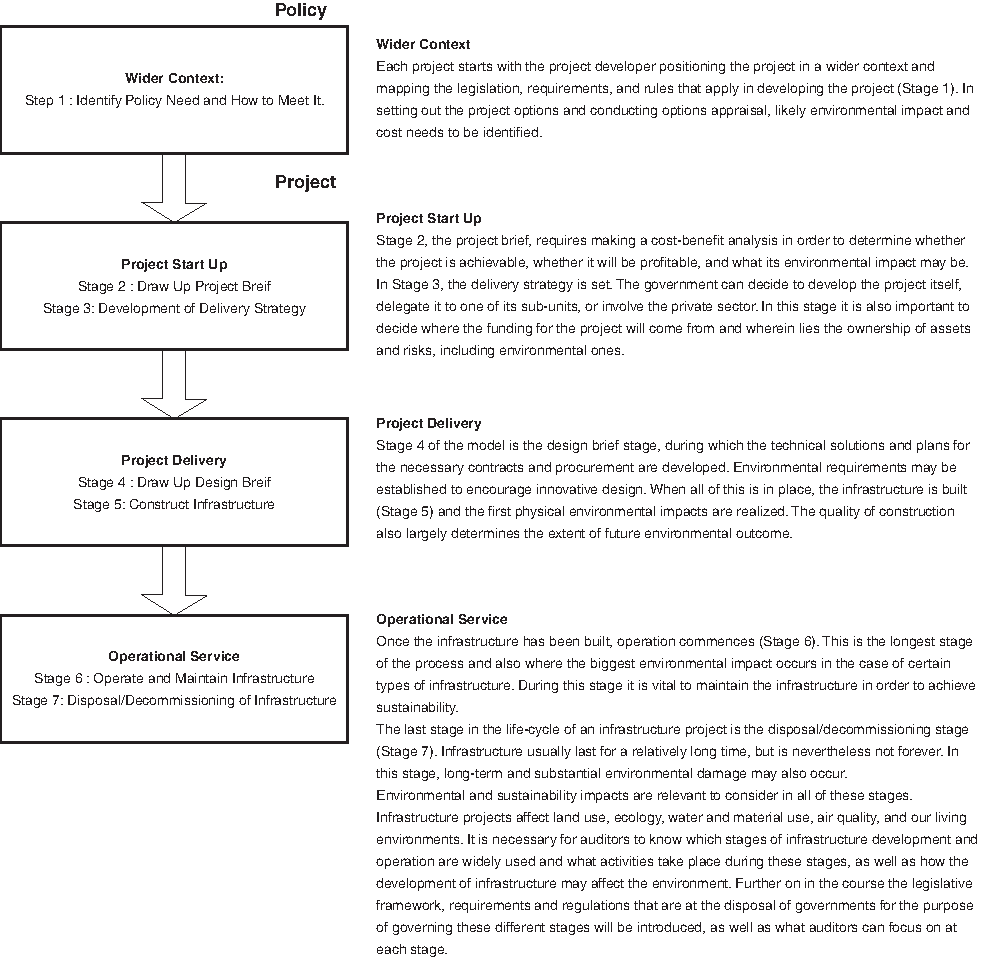
Generic seven-stage model for infrastructure delivery
Based on the preceding, the significance of the IDS in the implementation of policies relating to SD attainment can be deduced. Therefore, there is a need for effective integration of SD concepts into the IDS to engender optimal implementation performance. Presently, a cursory look at the progress reports on various IDSs across South Africa seems to confirm the dominance of the environmental and economic considerations. The SS dimension appears to be neglected due to factors such as its vague definition and lack of parameters/indicators for assessing the impact of SS on project performance. There is a possibility that stakeholders might have been integrating SS into their respective projects unknowingly, given its ambiguity and context-specific nature. Accordingly, this study sought to identify and highlight the numerous benefits for stakeholders accruable from the optimal integration of SS into IDSs in South Africa.
Integrating Social Sustainability into Infrastructure Delivery Systems
Social sustainability evolved from the broadly accepted categorization of sustainability into three pillars to enable the operationalization of the concept. 16 Prior to this categorization, sustainability as a concept had remained vague, having been used by politicians and policy makers to score cheap political points.17,18 Although society has accorded the economic and environmental dimensions significant attention, SS has only recently started to gain traction,5,10,19 reiterating the non-integration of SS into the Framework for Strategic Sustainable Development (FSSD), a framework renowned for driving SD.
Defying any commonly accepted definition, SS has been considered context-specific, unlike other pillars.3,20,21 Besides contributing to the attendant vagueness and interpretative adaptability associated with the concept, its indefinability has adversely affected realization and operationalization in economic sectors like construction. 10 Furthermore, the achievement and operationalization of SS are affected by attempts by scholars to present the three sustainability dimensions as standing alone rather than being mutually supportive and compatible.5,22
According to Abdel-Raheem and Ramsbottom, 23 practicing green construction (environmental sustainability) results in savings in the operational costs in the long run (economic sustainability), and provides a healthy work environment for the workforce (social sustainability). Scholars like Dempsey et al. 3 allude to the dynamic nature of SS, insisting that the connotation of SS within a particular context is likely to change over a specific time period. Boström 10 separates these obstacles, which exist in relevant literature, into two broad categories, namely: theoretical barriers and practice-oriented barriers. Whereas the theoretical obstacles encompass the notion of how to define and understand the concept of social sustainability, the latter is concerned with how to effectively operationalize and integrate the concept into projects.
Also, scholars have evolved different ways of approaching SS. For instance, whereas Magis and Shinn 24 view the concept from the perspective of human well-being, equity, democratic government, and democratic civil society, Murphy 25 opines that SS rests on four dimensions, namely: equity, awareness, participation, and social cohesion. Boström 10 categorizes SS aspects into: 1.) substantive aspects—aspects dealing with what SS goals to achieve in a particular context; and 2.) procedural aspects—aspects dealing with SS elements that foster sustainable development. Accordingly, he reiterates that the challenges confronting the incorporation of SS in projects are attributable to the lack of attention by stakeholders to the extant synergy between these aspects. Whitton et al. 26 posit that SS involves elements such as community cohesion, human well-being, effective dialogue, and access of citizens to decision-making bodies within their respective communities.
Weingaertner and Moberg 22 explore SS from the perspective of urban development, companies, and products, and conclude that there seems to be a shared understanding of what SS entails across these sectors. They provide three themes for developing such understanding, namely: social capital, human capital, and well-being. Also, Vallance, Perkins, and Dixon 27 attempt to provide clarity in the description of SS by proposing three paradigms: namely, development, bridge, and maintenance sustainability. Development sustainability focuses on the satisfaction of tangible or intangible human needs; bridge sustainability focuses on transforming negative social behavior toward the environment and bringing about stronger environmental ethics. Maintenance sustainability pertains to understanding how the social and cultural preferences and features are maintained over a specific period in a particular context.
From the preceding, it is evident that a lack of consensus concerning the SS concept persists within the extant body of knowledge. No doubt, this has further affected the development of a concise set of indicators for measuring the performance of SS integration in projects and thus, its optimal integration along with its peer pillars.
The construction industry, both globally and locally, is by no means immune from the significance of the vagueness associated with SS. Valdes-Vasquez and Klotz 28 attest to this, decrying the absence of a comprehensive and empirical framework for defining SS within the context of construction projects owing to its indefinability. Herd-Smith and Fewings 29 propose that SS in construction be used to refer to the engagement among employees, local communities, clients, and the supply chain to ensure meeting the needs of current and future populations and communities. Yet, Valdes-Vasquez and Klotz 28 observed that an understanding of this definition is contingent on stakeholder type and the project's life-cycle phase. They posited that one perspective of SS entails estimating the impact of construction projects on the people who live, work, and engage in various activities, a perspective usually confined to use during environmental impact assessment. Also, the application of corporate social responsibility (CSR) objectives by construction firms and client organizations were identified as another approach to SS.
Other perspectives highlighted by Valdez-Vasquez and Klotz 28 focus on design initiatives for engendering social inclusion for underrepresented groups, elimination of safety hazards from the work site, and minimizing the impact on temporary users like workforce and vendors as well as extant social interactions, etc. Furthermore, Valdez-Vasquez and Klotz 28 insist that SS is process-oriented, reiterating six critical themes for exploring the incorporation of SS processes in the planning and design phase of the construction process. These key themes include: stakeholder engagement, building user considerations, team formation, management considerations, impact assessment, and place context. Similarities were observed in the themes provided by Valdes-Vasquez and Klotz 28 and those espoused by Sourani and Sohail, 30 Abdel-Raheem and Ramsbottom, 23 and Herd-Smith and Fewings. 29 (See Table 1.)
Social Sustainability Dimensions in Construction Projects
Source: Adapted from Valdes-Vasquez and Klotz 28
It is important to note that this particular study aligns itself with the views espoused by Valdes-Vasquez and Klotz 28 pertaining to SS, i.e., that SS consists of a set of processes required to improve on the construction industry's contribution to the SD agenda.
The critical themes outlined in Table 1 are not project-specific; rather, they traverse the entire construction domain, which is comprised of infrastructure delivery. Therefore, improved knowledge concerning the aspects of SS integration and their commensurate benefits need to be explored and disseminated to ensure successful integration.
South Africa is known for its apartheid struggles in the pre-1990 era. In the post-apartheid era, which also marked the escalation of the SD mantra, efforts have been made to achieve improved levels of social inclusion of hitherto underrepresented groups in the country. Cross-sectoral efforts have led to the promulgation of policies by government and stakeholders to ensure wider social inclusion. Such policies have sought to provide economic emancipation for specific groups, provide increased access to employment opportunities, skill development, social housing, education, health care, etc. 7 In the construction industry, the use of preferential procurement practices and the integration of social benefits in the decision-making processes for new projects has been noted.8,31,32 However, given the paucity of studies, it does appear that these efforts have not been operationalized at the project delivery level, especially as related to SS.
Research Methodology
This study adopted a phenomenological research design. The rationale for this approach was to explore the worldviews of representatives of the various stakeholder groups who have a direct influence on the workings of the IDS. A phenomenological research design provides the opportunity to carry out detailed discussions and enable discovery of salient issues that are important to an interviewee. 33 Furthermore, Creswell 34 opines that this research design is most effectively utilized when there is need to describe the essence of a lived phenomenon based on the narratives of those who have shared such an experience.
In the context of this study, interviewees who had experienced the phenomenon (integration of SS) were sought out. Given the interviewees' experience, the interviewers decided that phenomenology would serve the purpose of exploring the perceptions of the benefits that specific groups experienced through the integration of SS into project delivery programs as depicted by the IDS. Relying on subsystems and stakeholder groups inherent in the IDS, as identified in Awuzie and McDermott, 15 the authors purposively selected representatives of various stakeholder groups that consist of the regulatory agencies, the project owners, contractors, consultants, and end users. However, in this study, representatives of the regulator did not participate in the interview sessions as they did not respond to multiple invitations via e-mail. There was a total of 13 interview sessions with an uneven distribution among the four participating stakeholder groups as follows: 1.) three interviewees represented the client stakeholder group as project sponsors; 2.) the contractor group had four representatives; 3.) two consultants; and 4.) four interviewees were selected from the end-user community, based on a mixture of purposive and convenience sampling.
It should be noted that this study was the first of two investigations into this phenomenon. A subsequent study will deploy questionnaires to a broader audience to extrapolate the findings of this preliminary study. It is expected that this will engender the attainment of statistical generalization.
Semi-structured interviews were deployed as a suitable data collection technique. The choice of this type of interview was predicated on its provenance as a reliable data elicitation technique, which provides the interviewer with significant levels of flexibility in his/her desire to explore the worldviews of interviewees concerning a particular phenomenon. 35 Such versatility is reflected in the use of similar but not identical questions, thus enhancing the interviewer's ability to take the interviewee's level of experience into consideration in the choice of questions.
Interview sessions spanned an average of 30 minutes, each. The sessions were recorded with permission of interviewees and subsequently transcribed verbatim. Questions asked during the interviews were centered on interviewees' understanding of the SS concept as applied to infrastructure delivery systems and their perceptions of benefits derived from them. Thematic analysis was employed in making sense of the data. 36 The emergent data is presented and discussed in the following sections.
Presentation and Discussion of Preliminary Findings
Benefits
Although a plethora of benefits were identified from the data derived from the interview sessions, only a few of those that are relevant to the various stakeholder groups are highlighted and discussed here.
Barriers
The corpus of sustainability/SS/SD literature is replete with references to varied factors that have served to undermine effective mainstreaming of SS in various sectors of the economy, particularly construction and infrastructure delivery. The authors identified these impediments and relied upon them as subthemes for coding the interview transcripts.
Limited Understanding of Social Sustainability
Several authors concur that the lack of awareness concerning SS adversely affects its integration in ongoing SD efforts.4,20 Such low levels of awareness have been attributed to the inability of practitioners, policy makers, and academics to arrive at a consensus concerning the definition of the concept. Herd-Smith and Fewings 29 have posited that such low levels are responsible for the neglect of SD during the delivery of construction projects when compared to other pillars, and this was also found to be the case in the South African construction industry. The interviews revealed that there was a limited understanding of the connotation of SS within the industry. The interviewers had to explain SS aspects to the 13 interviewees during their interview sessions as most of them professed ignorance of them.
For most of the interviewees, SS was thought to be related to improving access to employment for underrepresented minority groups, widening communal sources of livelihood, and providing skills for persons hitherto deemed economically inactive. While these can be described as salient SS aspects (see Table 1), no mention was made of other SS aspects, such as: improved safety conditions on the work site, fair labor conditions for workers, effective mainstreaming of women and foreign (migrant) workers as well as other underrepresented groups (other than racial minority groups) during construction, among others. When one of the interviewers prompted some interviewees on their approach toward these issues, especially health and safety-related issues, they affirmed that adequate consideration was accorded to health and safety on their projects. This further validates the notion that there is a limited understanding among stakeholders about the nature and composition of SS. Also, the responses obtained from these interviewees indicate the presence of a nexus between economic and social sustainability dimensions without regard for the environmental dimension since the latter is treated as separate and disconnected.
Absence of Standardized Set of Indicators for Measurement
Another obstacle confronting SS integration is the absence of a universally accepted set of indicators for measuring implementation performance, which is not the case with the environmental and economic dimensions. This makes it difficult for integration proponents to convince project owners to champion integration. During the interviews, interviewees had been told about measuring the impact of SS. Subsequently, interviewees were asked if they had used any tools or applied any indicators to measure the impact of SS on project performance. Interviewees stated that they were not aware of any specific methods they could use to measure this other than what they had been doing, namely: consulting with residents of the host community to elicit their reactions about the utility of the project during various phases of project delivery. This was not a surprise given the interviewees' limited awareness of SS.
Improved Job Creation Opportunities for Locals through Alignment of Contracting Strategies with SS Objectives
Contracting strategies have been described as enablers of SS integration in construction projects and the construction industry in general.9,37 The contracting strategy selected to realize a construction project should be aligned with the SS objectives of the project owners and end users. Evidence of this practice abounds in South Africa, where the use of targeted/preferential procurement policies and work packages such as unbundling have been used to get hitherto underrepresented communities into the construction industry.
Interviewees narrated scenarios in which they had applied preferential procurement strategies to assist contractors who were members of a particular community to tender, win, and execute work packages in their respective organizations. The interviewers were further inundated by an interviewee on how his department had initiated training programs for a select group of novice contractors from the local area. Such programs, which were referred to as Vukuphile (wake up and live) and Mangaung Community plumbers, were set up to develop technical, administrative, and financial management competencies among contractors. After their training, participants in the programs availed themselves of opportunities offered through work packages by the owners. It is beyond the scope of this study to ascertain the success of these schemes. However, it is pertinent to note that this example highlights the nexus between social and economic sustainability from the client's perspective.
Increased Societal Acceptance of Infrastructure Projects
High levels of SS acceptance by stakeholders can be achieved by incorporating stakeholders' views and by including principles of respect for people throughout the stages of the infrastructure asset delivery life cycle.26,38,39 Interviewees stated that such levels of acceptance served as an operating capital for client organizations to proceed with their delivery exercise without hindrance hence resulting in improved levels of productivity and project performance. Furthermore, interviewees affirmed that effective management of social acceptance for new projects prevented the rise of potential problems.
Consultation is an essential part of the environmental impact assessment process in South Africa. During the interview sessions, interviewees shared their experiences regarding how the consultation process for potential infrastructure projects enhanced the relationship between the local community, relevant stakeholders, and the project delivery team. According to one interviewee, community participation in the early stages of their projects culminated in optimal project performance. According to another interviewee, the consultation process made them feel like joint owners of the infrastructure asset, propelling them to support such projects. In sum, interviewees were unanimous about the benefits of effective consultation processes—a significant aspect of SS.
Improved Working Conditions
The construction industry is renowned globally for the prevalence of poor working conditions. 40 Workers in the industry have been exposed to long working hours with below-market remuneration packages, especially for laborers. The safety standards on site are often subject to incessant neglect by relevant stakeholders, undermining health and safety issues. Also, matters pertaining to access for disabled persons are often overlooked during site preparation. These are recurring issues within the construction industries in sub-Saharan Africa, a community in which South Africa forms an integral part. Upon further explanation of this benefit to the interviewees, they all acquiesced to the beneficial impact effective SS integration has had in restoring better working conditions in the construction industry and the construction sites in particular, based on their experience.
Emerging Issues
During the course of data analysis, certain realities became apparent. In particular, there was a lack of awareness of and shared understanding about the concept of Social Sustainability. During the course of the interview sessions, it was discovered that a vast majority of the interviewees were oblivious about the meaning attached to the term social sustainability. They continued to use the term to refer interchangeably to the economic dimensions of SD. This was the case with the end users and contractors who argued that SS benefits were not far-reaching enough based on proposed economic indices such as the percentage of work reserved for local contractors. Such statements could be attributable to their lack of awareness and/or understanding of SS. As if to bolster this point, prior to the commencement of the interview sessions, the authors had to explain the concept of SS to a majority of the interviewees. For instance, the interviewees overlooked issues such as respect for persons through nondiscrimination of female or migrant workers on construction sites, the provision of safe working environments, etc. Instead, they seemed to more interested in the notion that they were not benefiting financially from the siting of projects within their vicinities.
The need to integrate the three dimensions of SD during implementation within project delivery environments, as suggested by Vallance, Perkins, and Dixon, 27 is understood. This study further illustrated that for optimal integration stakeholders within a particular context need to develop a shared understanding about the components of each of the pillars of SS. It must be stated that most of the project owners/consultants and contractors have actually integrated significant aspects of SS at different stages of their work, as they explained during the interviews, but they did not know that such aspects were actually related to sustainability.
Conclusion
The optimal mainstreaming of sustainability ethos through the SD framework continues to be heralded as a viable medium for achieving a sustainable society. The construction industry and the infrastructure delivery subsector in particular have been identified as possessing the potential to undermine this objective. However, it is worth noting that policy makers are making efforts to reach out to practitioners and academics in South Africa and beyond in order to ameliorate the impact of such systems on the attainment of societal goals.
Yet, it appears that such efforts are still focused mainly on the environmental and economic dimensions of the SD tripod. The neglect of the social dimension has been attributed to several factors including its indefinability and its context-dependent nature. The impact of effective integration of SS into projects within extant construction literature appears to have been under-investigated. A proper rendition of SS, its applicability within project delivery systems, and the benefits accruing from its integration are necessary ingredients for obtaining buy-in among stakeholders in the infrastructure delivery system. This is what this study set out to do.
This preliminary study identified the benefits of mainstreaming SS into various activities inherent in delivery systems through the use of interviews that solicited the views of representatives of various stakeholder groups. It should be noted, however, that data analysis is still ongoing and that the views expressed were confined to areas in which common ground was identified among the multiple representatives interviewed. Furthermore, the study does not claim to attempt to generalize its findings given the small number of interviewees.
In sum, this study contributes to the emerging discourse on the effective integration of SS into the SD framework, especially within the construction industry in South Africa, an area hitherto neglected by policy makers, practitioners, and academics alike. Also, it provides a platform that can be used to unravel the ambiguity associated with the SS concept during the implementation of the SD framework.
Footnotes
Author Disclosure Statement
No competing financial interests exist.