




Abstract
This study evaluates the sustainability impact of replacing inefficient toilets with low-flow units in a residence hall at the University of Wisconsin-Madison. A graduate student initiated this project through the university's Green Fund, which supports initiatives that improve the sustainability of campus facilities and engages students in the process. Each toilet upgraded to an efficient unit is estimated to save at least $2,380 in utility bills and reduce water usage and greenhouse gas emissions by 54 percent over the life of the unit. This simple intervention strategy does not require any changes to daily habits, yet contributes to significant reductions in water consumption. The partnership between students and staff offers educational potential both for those involved in the project and those impacted by the upgrades. Other institutions of higher education may want to consider upgrades to high-efficiency toilets for their potential to conserve large amounts of water and save thousands of dollars in utility costs over the life of the units.
Introduction
The University of Wisconsin-Madison (UW-Madison) is a land grant research university located in the Midwest, with a total student population of more than 45,000. The UW-Madison Division of University Housing (University Housing) operates 19 residence halls that about 7,500 students call home each year.
In the spring of 2017, the UW-Madison Office of Sustainability launched the Green Fund, offering students the opportunity to imagine, propose, and implement projects that reduce the operating costs and environmental footprint of facilities on campus. Students work closely with Green Fund staff to engage the appropriate building managers, tradespeople, and other university staff to discuss and realize the projects. One of the first proposals the Green Fund supported was to upgrade the toilets in Tripp Hall, an undergraduate residence, to low-flow units and assess the impact and potential for further upgrades. The project team consisted of a PhD student, the university housing sustainability coordinator, the Green Fund program manager, and an assistant professor in the Department of Civil and Environmental Engineering.
A desire to address the increasing demands on fresh water in the face of climate change motivated this project. The total domestic water use in the United States is estimated to be 26.6 billion gallons per day, or about 77 gallons per capita per day. 1 Toilets are the main source of water use at home, estimated to be between 26 and 41 percent of an average home's water consumption.2–6 The average U.S. household uses the toilet an estimated four to six times per day, with an average flush using 3 gallons of water, resulting in about 12 to 18 gallons per toilet per day.2,7–9 If all households replaced their existing toilet units to United States Environmental Protection Agency (EPA) WaterSense® units, the United States would save an estimated 520 billion gallons of water per year. 10
Despite the current federal standard for toilets of 1.6 gallons per flush (gpf), many older, highly inefficient toilets remain. Large buildings with high occupancies, such as multistory apartments and university residence halls, are among the greatest potential beneficiaries of retrofits but are rarely evaluated. 11 The installation of a wall-mount toilet, common in institutional settings, often costs more than a ground-mount unit typical in a private home, but the high traffic in a residence hall gives a toilet more use and therefore a greater impact. Additionally, college students are estimated to use an average of 93.6 gallons of water per day, 21.5 percent more than the average American's daily water use. 6 By replacing toilets in residence halls, higher education institutions have an opportunity to improve operational sustainability and influence students while they are forming habits and attitudes that will shape their future lifestyles, and subsequently, their environmental impacts.
This article outlines the efforts to modernize the toilets of a residence hall on the UW-Madison campus, providing justification for change, water-use calculations, anticipated savings, and a discussion of the incentives for other institutions of higher education to follow suit.
The Process
The graduate student who led this project originally approached University Housing with the idea of installing waterless urinals. During early discussions, staff members in University Housing noted that they typically build their residence hall bathrooms without urinals. Operationally, this gives University Housing more flexibility to respond to fluctuations in the population living in the residence halls. If UW-Madison residence halls include urinals, they are often located in publicly accessible bathrooms on the first floor.
Based on reports from colleagues at peer institutions, University Housing staff and the supervisor of the plumbing shop at UW-Madison Division of Facilities Planning and Management expressed concerns about the potential for significant maintenance issues resulting from the flow of pure urine from waterless urinals into sewage pipes. This can cause the buildup of uric acid crystals in the interior of the piping, which needs to be flushed out with caustic chemicals and, ironically, significant amounts of water. Given these reports, the project team turned its attention to low-flow toilets.
The team selected Tripp Hall because a neighboring undergraduate residence, Adams Hall, has a nearly identical layout, resident population of about 245 students, and equal number of toilets. The hope was to design a study to measure the impact of the toilet upgrade at Tripp Hall and use Adams Hall as a control. The UW-Madison built both residence halls in 1926. Given the age of the buildings, installing a water meter to measure the impact of the intervention proved to be challenging in practice and would cost more than the installation of the toilets. The team opted to simply run calculations rather than measure the water consumption of the two sites side by side.
Doctoral student and lead author Johnny Uelmen, along with University Housing staff, conducted a toilet inventory, recording the flow rate of each unit in Tripp Hall to identify the toilets that required upgrades (see Supplementary Fig. S1). The team identified 42 toilets for replacement, with an average flow rate of 3.5 gpf and a maximum flow rate of 4.6 gpf. The detailed time line in Figure 1 displays key activities, outcomes, and personnel involved throughout the project.
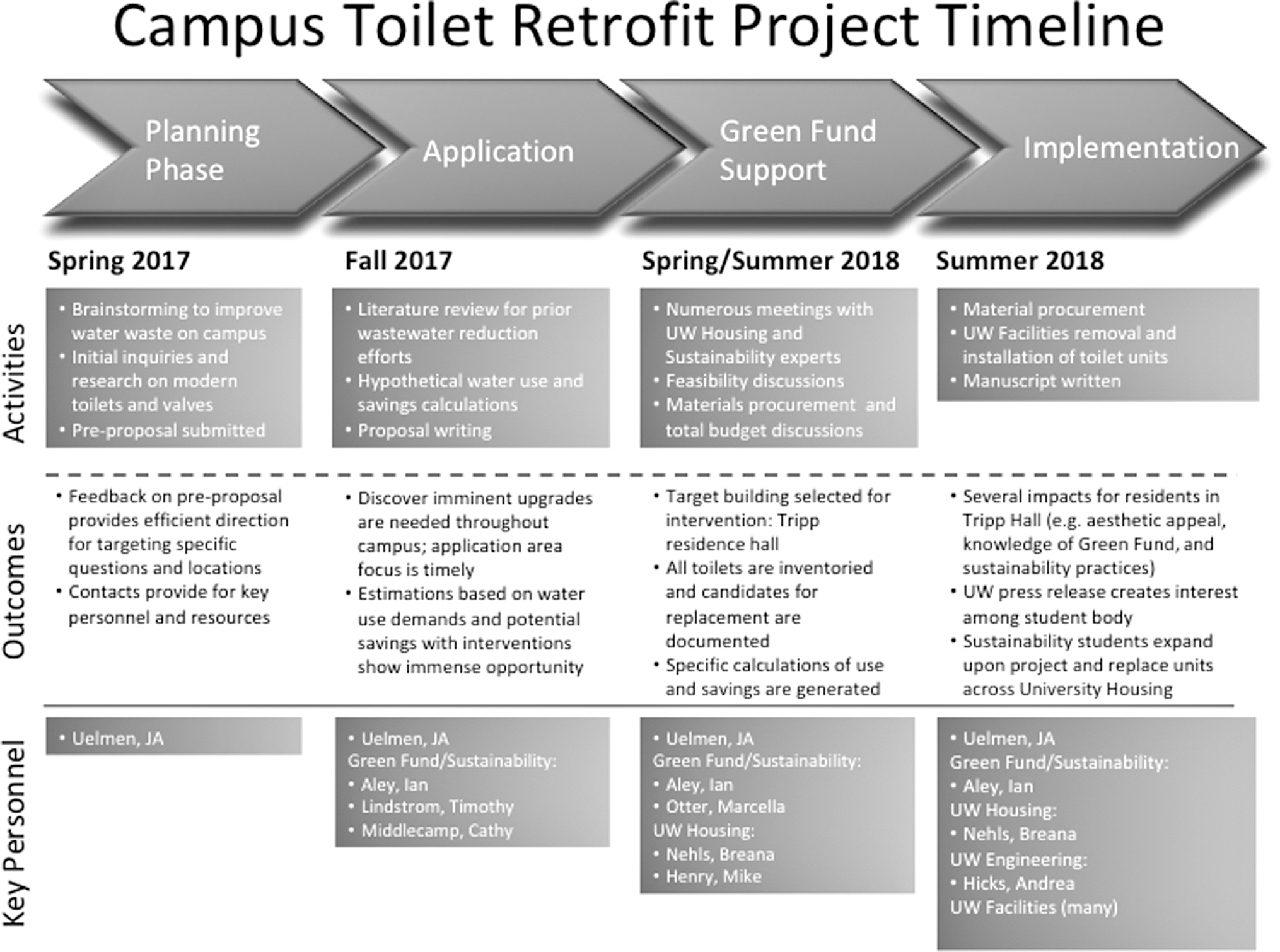
Toilet retrofit project time line of key activities, outcomes, and personnel on the UW-Madison campus. Total duration of project, from initiation to completion, was 20 months.
Employees from the UW-Madison plumbing shop replaced the outdated units with Sloan Regal 1.6 gpf units (see Supplementary Fig. S3). After reviewing the literature and consulting with colleagues, the project team decided to install manual, low-flow, single-option flush valves rather than automatic sensors or dual-flush options. Dual-flush options leave room for unintended additional water use, particularly when a user accidentally chooses the higher-volume flush. Dual-flush units can also clog and damage waste water pipes when users choose the lower-volume flush option for solid wastes. 3 University Housing raised concerns about the potential for automatic sensors to trigger unintended flushes resulting in water loss, a criticism that was echoed in a study by Khan et al. 12
The Impact
Upgrading 42 toilets in Tripp Hall to 1.6 gpf high-efficiency units resulted in an estimated annual reduction of 531,000 gallons of unheated tap water, reducing annual utility costs by $4,990 and eliminating 4,020 pounds of CO2e greenhouse gases. (See Table 1.) Using a conservative estimate of 20 years for the working life of the unit, each toilet will generate at least $2,380 in total net cost savings, paying for itself in 1.83 years (Table 2). Over the expected life of all new toilet units, the project estimates a total savings of at least 10.6 million gallons of water, 80,400 pounds of CO2e greenhouse gases, and $99,800 in cost savings.
Estimate of Annual Water Consumption in Tripp Residence Hall, Comparing Previous, Outdated Toilets with New, Replacement Units
Some outdated toilets consumed up to 4.6 gpf, but none consumed less than 3.5 gpf. Estimates from this study are based on all toilets consuming 3.5 gpf, providing a conservative estimate of the true usage and savings.
Project Worksheet: A.) Itemized Budget, B.) Payback Period Estimates, C.) Cost Savings, D.) Economic Impact, E.) Environmental Impact, and F.) Social Impact. (For worksheet and calculations see Supplementary Material.)
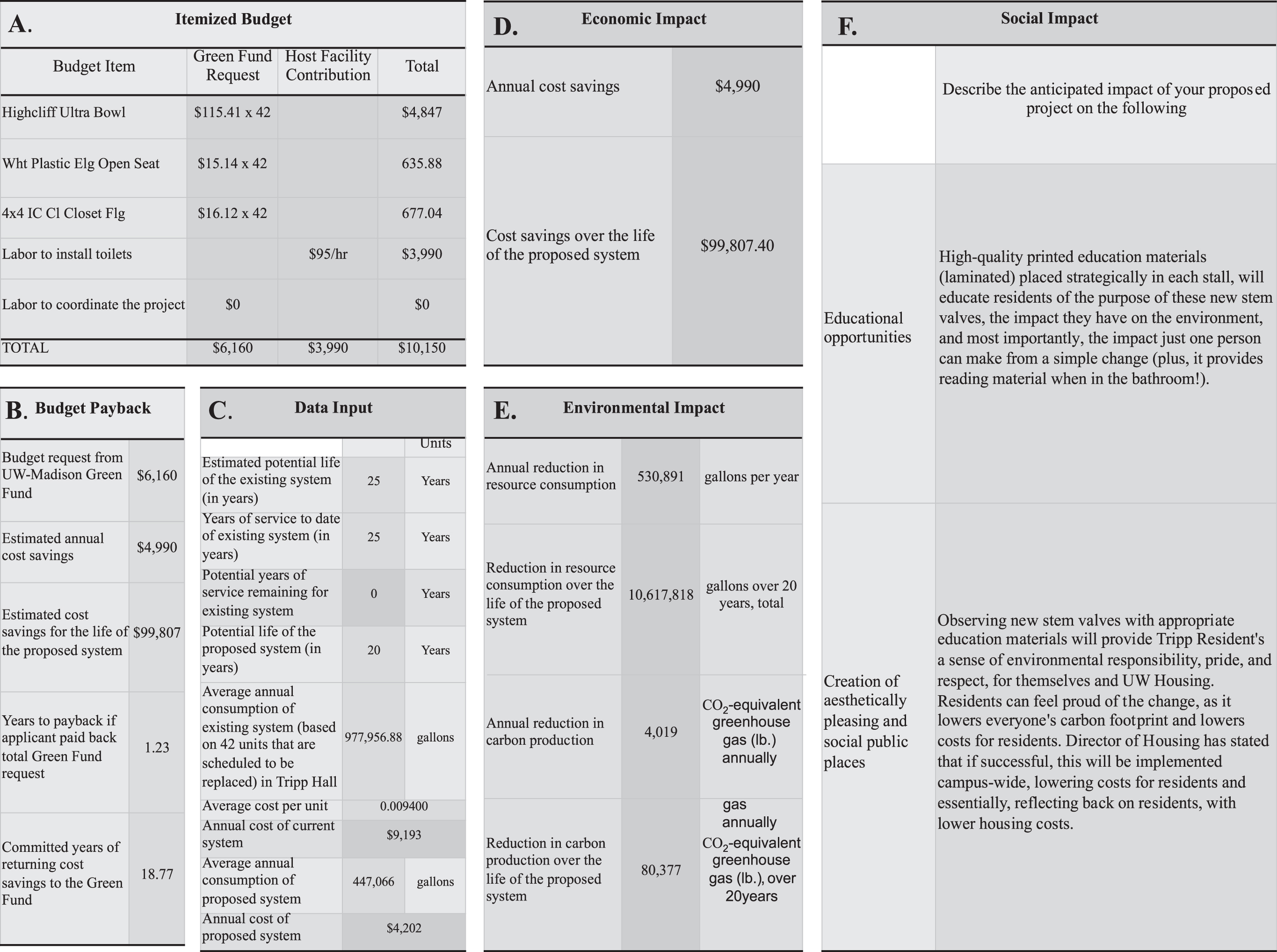
These calculations are based on background data provided by the EPA WaterSense® and eGrid summary tables, 13 the local electrical utility Madison Gas and Electric, 14 and Madison Metropolitan Sewerage District (MMSD). 15 All parameter values have been calculated as a constant, fixed term (Table 3) with the exception of greenhouse gas emissions, which are a combination of four pathways of energy specific to Madison (Figure 2).
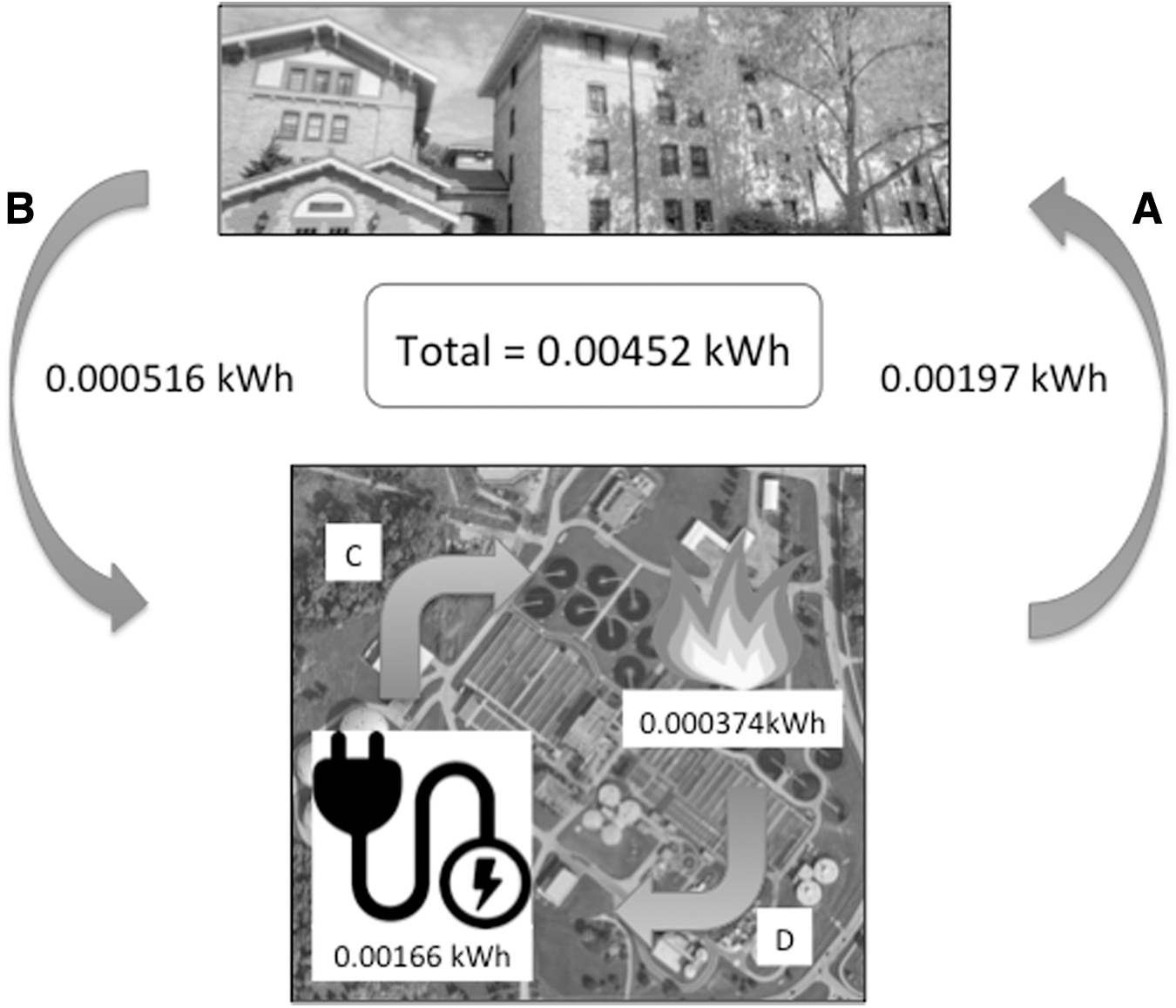
Four pathways of energy required to deliver and treat a gallon of cold waste water, specific to Madison, WI:
Key Background Parameters Used for Calculating Water Usage, Utility Costs, and Greenhouse Gas Emissions
Greenhouse gas emission estimates are based on EPA eGrid, specific to the region in which Madison, Wisconsin is located.
In total, an estimated 0.00452 kWh is required to deliver and treat each gallon of tap water. Based on the region in which Madison is located (MRO East), 1.68 lb. of CO2 emissions (the benchmark used as a reference for other greenhouse gases) is generated per kWh, 13 producing an estimated total of 0.00757 lb. of CO2 emissions per gallon of tap water.
The estimates derived in this study align with other studies2,12 that showed a single toilet with an estimated life span of 20 years can save 253,000 gallons of water and reduce 1,910 lb. of CO2e greenhouse gas emissions.
The Story Continues
Inspired by the impact of this pilot project, a team of undergraduate students enrolled in an engineering course (CIV ENG 421: Environmental Sustainability Engineering) worked with faculty and staff to conduct an inventory of the flow rates of toilets in 11 residence halls across campus. This 3-credit elective course is offered each fall semester in the Department of Civil and Environmental Engineering and is open to students beyond those in engineering degree programs. Andrea Hicks, one of the coauthors of this study, is the instructor of the course. She and colleague Courtney Grant have detailed community-based learning efforts revolving around teaching sustainability 16 that were applied in this course. For this project, the students identified 82 toilets that used 4.5 gpf, which have since been replaced with 1.6 gpf units enabled by a Green Fund proposal submitted by the students. The team worked with a local aggregate crusher to recycle the porcelain from the outdated toilets rather than send them to the landfill, thus nearly eliminating solid waste generated by the project. (See Supplementary Fig. S2).
Why Other Institutions Should Retrofit Their Toilets
While the upfront cost of replacing multiple toilet units in large buildings may be daunting, there are both immediate and long-term benefits of doing so. 4 In the short-term, modernizing a facility's toilets provides a new, fresh look. Posting educational signage showcasing water conservation data behind each stall door can educate users about the large contribution their residence hall is making toward a more sustainable environment. The numbers are inspiring: the EPA 2 estimates one updated toilet can save up to 13,000 gallons of water and $140 in utility costs per year and more than $2,900 over the lifetime of a single toilet.
Despite the potential for immediate savings, institutions may struggle to find the funds to include a major retrofit in their maintenance budget. Some water utilities offer rebates to offset initial capital costs associated with toilet upgrades. If a rebate can arrive within the same budget cycle as the upgrade, this could help institutions justify the investment and ease cash flow issues. U.S.-based institutions can search for rebates on the EPA Water Sense® website. 17
Toilet water consumption has drastically declined over the past three decades, as reflected by decreasing federal standards from as high as 5 to 6 gpf in the 1970s to 1.6 gpf today. However, when planning to upgrade any inefficient toilet, one must be cognizant of some key limitations. As a general rule, the lower the water consumption, the higher the likelihood of increasing the number of flushes per visit and potential for clogging pipes. Despite these concerns, high-efficiency toilets as low as 1.28 gpf consistently received high performance ratings. Models of ultra-low flush (<1.6 gpf) are being produced and are available for purchase for commercial settings.
Perhaps the most important finding from this project is the potential to engage students in the retrofit process. The UW-Madison Green Fund connected students with key staff for this project, but institutions of higher education without a green fund could engage in this process through a community-based learning course, the activities of a student organization, or a shared governance planning process. A toilet retrofit may not be as high profile as, for instance, the installation of a rooftop solar array, but as this study shows, it can be hugely impactful. Student engagement in the Tripp Hall retrofit brought visibility to the issue, which led to the broad-based audit and retrofit of 11 additional residence halls by the group of engineering students as part of a Green Fund proposal. Other institutions of higher education may observe similar patterns of student engagement inspiring additional student-led projects.
Conclusion
The findings from this project highlight the impacts of retrofitting toilets. While reductions in the emissions of greenhouse gases are encouraging, the main savings are in the long-term reduction of water and utility costs. The skills and experience gained by the students involved in this project add an additional layer of benefit to this upgrade.
Advances in technology and education are required in order to meet our global energy and water demands. When broadly implemented, toilet upgrades can conserve significant amounts of water, providing a practical and attainable solution in preserving this vital natural resource. These upgrades can improve resilience in the face of climate change by allowing communities to allocate limited fresh water supplies for drinking and other essential uses. The project team hopes that the findings from this report will support individuals and institutions in reducing water consumption through the retrofitting of inefficient toilets.
Footnotes
Acknowledgments
This project was made possible by the collaborative efforts of the UW-Madison University Housing, Facilities Planning and Management, and Office of Sustainability. Several highly knowledgeable and helpful individuals, most notably Mike Henry, Cathy Middlecamp, Marcella Otter, and Tim Lindstrom, assisted with logistics, material procurement, and water and energy estimates. Lastly, a special thank you to the undergraduate students: Dan Mrotek, Emma Nelson, Ryan Rooney, and Gabby Campagnola, who were inspired by this project and took efforts to expand the toilet retrofits across University Housing.
Author Disclosure Statement
All authors state no competing financial interests exist.
References
Supplementary Material
Please find the following supplemental material available below.
For Open Access articles published under a Creative Commons License, all supplemental material carries the same license as the article it is associated with.
For non-Open Access articles published, all supplemental material carries a non-exclusive license, and permission requests for re-use of supplemental material or any part of supplemental material shall be sent directly to the copyright owner as specified in the copyright notice associated with the article.
