




Abstract
Abstract
It is almost universally accepted that most of the UN SDGs cannot be implemented successfully unless meaningful, effective, and transformative learning processes accompany the implementation. The article shows that learning outside—in and with nature—can offer great possibilities for enabling and enhancing the development of underutilized, multidimensional learning capacities, particularly those of children, and thus serve as an important strategy for coping with the many complex challenges associated with implementing the SDGs. It shows how successful learning works and what the critical success factors for implementing learning outside are.
Introduction
It is almost universally accepted that most of the United Nation's Sustainability Development Goals (UN SDGs) cannot be implemented successfully unless meaningful, effective, and transformative learning processes accompany the implementation. Learning outside—in and with nature—or udeskole as they call it in Denmark, promises to nourish multiple dimensions of learning, so that long‐term understanding is enhanced. However, are the claims for its effectiveness evidence‐based? What is the quality of research in this area, and does it go beyond opinions and personal convictions? This article offers answers to these questions and shows that learning outside can offer great possibilities for enabling and enhancing the development of underutilized, multidimensional learning capacities, particularly those of children, and thus serve as an important strategy for coping with the many complex challenges associated with implementing the SDGs.
How Does Successful Learning Really Work?
Given that any meaningful progress toward realizing the UN SDGs rests on complex, transformative, and often demanding learning processes, it might be prudent to revisit this question—the answer to which we too often take for granted.
Based on the impressive progress made in brain and learning research in the last few years, some central aspects of learning now appear in a new light. As opposed to a computer hard drive whose storage capacity becomes exhausted, it seems that there are no known limits to the human capacity to learn. Rather, we know now that the more we learn the more connections we establish among different learnings and the more we increase our capacity to advance understanding. The more we learn, the better we get at integrating and understanding issues, complex experiences, and abstract concepts such as Einstein's theory of relativity—in other words central concepts about how the world works. 1
If this insight is taken together with the understanding that real, three‐dimensional, multi‐sensorial experience activates a multitude of brain regions, leading to deepened connections among these regions and consequently to more resilience with regard to mental processes,2–5 it seems inevitable to draw the following conclusion: Learning that activates as many senses as possible (seeing, smelling, touching, hearing, moving, …), which takes place in dynamic, real‐life learning environments, and which demands active and self‐guided involvement of the learners, is very effective. In addition, research shows that learning the same content while in motion, as opposed to being stationary, is much more effective and evokes better long‐term results (p. 260). 4 If learners—and this does not only apply to children—are moving about, can touch things, view them from different perspectives, can smell, taste, and hear them, learning is more profound and more resilient and yields better long‐term recall.
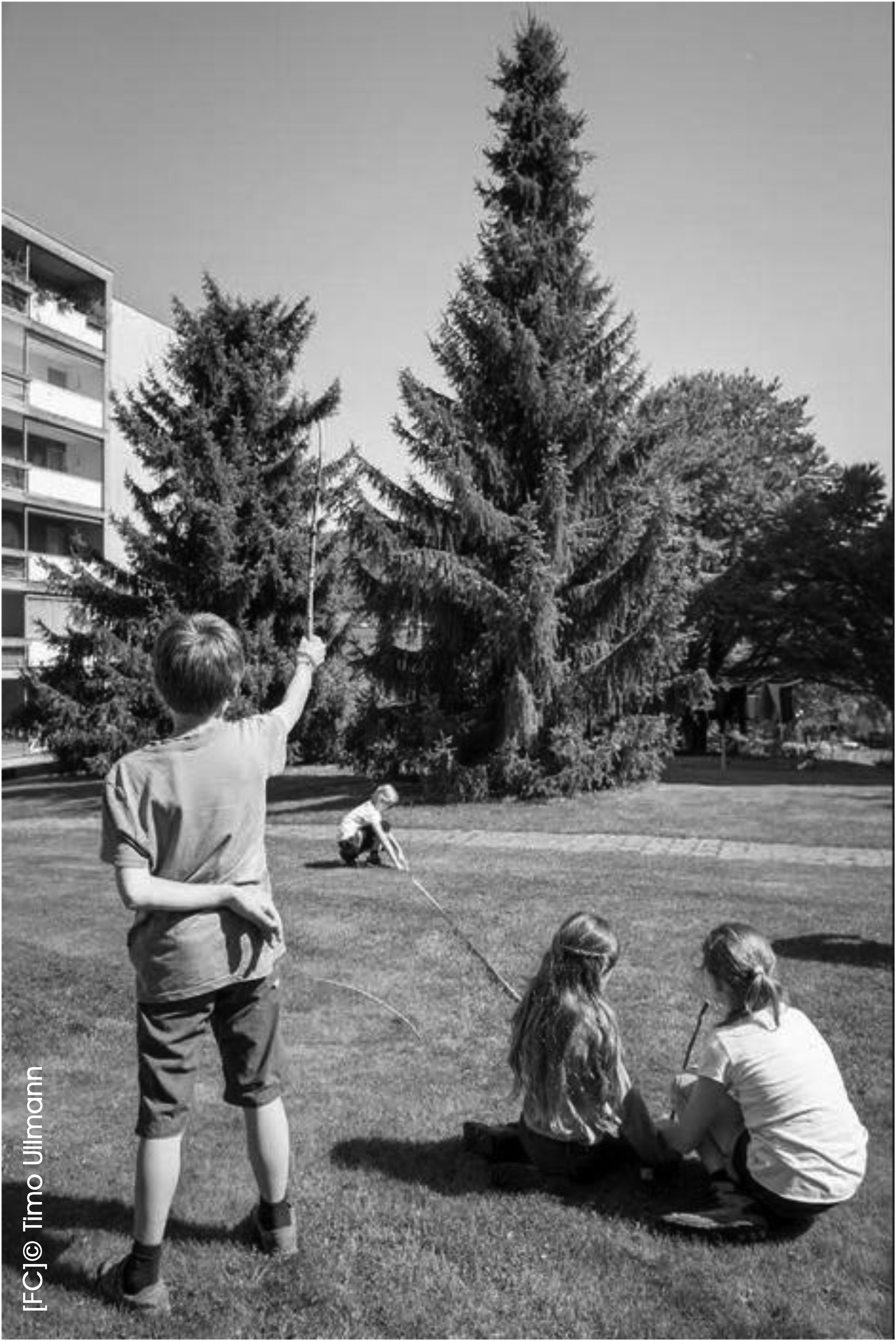
Pupils measure the height of a tree in an urban green space with different methods. The entire curricula of primary school children can be taught outside, with multiple additional benefits in the cognitive, emotional, social, creative, and health realms.
We should also not ignore the central insight from Hattie that effective learning is, above all, based on successful social interaction between tutor and learner. 6 This understanding is also supported by research into excellence, which has thoroughly debunked the myths around talent and genius. To succeed in any domain with a high level of competence requires a good dose of so‐called non‐cognitive skills (such as grit, perseverance, and resilience) as well as tutors who push and stretch learners not too much but not too little outside their comfort zone (pp. 180–182), 5 (pp. 40–43, 96, 207). 7 In addition, it seems that collective learning is more effective—something known by everybody who has floated his/her own “fantastic” idea in a team only to witness this idea mature afterward into something clearly better, more complex and meaningful through the collaborative process.8,9
What Are the Benefits of Learning Outside?
All of the foregoing seems to indicate that learning outdoors or in other real‐life situations can indeed contribute substantially to effective, meaningful, long‐term learning. However, we must also take this message with a grain of salt. First, many of the mentioned conditions for learning can also be created in indoor spaces (such as crafts workshops, museums, sports halls, research labs, or factory floors). Learning outside does not have a scientifically tenable exclusive claim on effective, meaningful learning. Second, current research results are so sparse or even contradictory that it would be unwise to voice grand, unidimensional claims.
A recent, very thorough meta‐study on the effectiveness of learning outside found only 13 studies—among a pool of 7,830—that lived up to reasonable methodological standards. 10 Studies in this area frequently suffer from poor study design and lack of methodological rigor in addition to representing very small numbers of participants. They tend to reflect special teaching situations rather than regular teaching; they are generally neither randomized nor reproducible; and the duration of the intervention studied is often short. Importantly, they mostly raise serious questions about the relationship (read influence) of researchers on the participants. Very often, they have a circular design—in other words, they tend to validate the initial hypothesis with notoriously unreliable, subjective self‐reporting of the participants. Attempts to triangulate the collected data (thick description) or even to use objective measuring tools (such as measuring movement with an accelerometer rather than asking teachers if and how far pupils moved) are very rare indeed. Finally, the conclusions drawn are often not linked to the data. So far, so bad. We may be forgiven to continue to dream about double‐blind studies in this area. Nevertheless, despite these many challenges, there are bright spots of progress, such as the methodologically sound and very carefully and plausibly executed TEACHOUT study in Denmark. 11
So, what significant effects of learning outside, as compared to schooling indoors, did the Becker et al. meta‐study
10
and the TEACHOUT study
11
demonstrate? There are six primary conclusions:
There is a well‐researched trend worldwide indicating that motivation drops continuously from the moment kids enter formal schooling until they leave. Learning outside does not increase motivation, but it does appear to stabilize motivation in comparison to the indoor control group, which is impressive enough. In addition, some studies found that learning outside actually increases interest in learning. Learning outside stimulates better social interaction not just between teachers and pupils, but also among pupils themselves and external adults. Trust, reliability, and loyalty are built during learning outside through increased interaction with external adults (for example foresters or gardeners), through sharing common experiences in very diverse situations, social encounters, and learning environments, and through sharing significant informal time together (such as on the way to and from the forest). This increase in social competencies not only improves learning itself (by enhancing concentration and focus), it also has the long‐term effect of enhancing social cohesion indoors, which can transfer back into creating more cooperative classrooms. Pupils who learn outside also make more new friends than the indoor control group. Perhaps not immediately obvious, learning outside noticeably improves language competencies (talking, understanding, vocabulary, reading, writing, etc.). This is especially pronounced for children who are not native speakers of the language of the classroom. In order to communicate about their new experiences outside, children are stimulated to interact verbally, to ask questions, to name hitherto unknown things, to describe experiences and actions, and to learn new vocabulary. In this process, they are often confronted with professional language they are not familiar with, such as when a forester explains how water flows from roots to leaves. In addition, unlike the well‐defined and quickly familiarized classroom, the living, dynamic real‐world environment is slow to become known or named. In addition, there is a power shift outside—pupils are doing much more talking than their teachers. Learning outside also enhances academic learning. Since it takes place in contextualized real‐world situations, it supports an intensive immersion into knowledge (time to reflect, to connect with existing knowledge, to ask questions, to do research, etc.). Similarly, it supports self‐efficacy, the experience that one's actions influence and shape reality. It enables true‐to‐life, hands‐on learning in diverse, stimulating, emotionally rich, authentic and meaningful learning environments. Learning in new, unfamiliar environments also pushes pupils to go beyond their comfort zone, which, as we have seen, has a positive effect on learning. It nourishes the development of complex mental models and the transfer of this learning to different situations and contexts, which are crucial skills for addressing and implementing the SDGs. The TEACHOUT researchers showed that complex math problems were solved significantly better outside than inside. Self‐confidence and sense of responsibility increase. Pupils who have been learning outside regularly are more focussed, self‐reliant, and independent, even several years later. Last but not least, pupils (especially boys) and teachers are constantly on the move outside. This additional physical activity has positive health effects, including reduced stress and decreased mental health problems.
Critical Success Factors for Implementing Learning Outside
Returning to our initial questions about the effectiveness of learning outside, it seems that current neuroscience and learning effectiveness research suggest an affirmative response—that learning outside, in nature, or in cultural spaces—is effective learning. In addition, it seems to enhance diverse learning dimensions, from cognitive, emotional, and social to health and creativity. Based on these insights, teachers might ask themselves, How can I integrate learning outside more often and better into my teaching?
Here we can benefit considerably from the critical success factors that emerged from Danish explorations, which have now led to more than 20 percent of all schools teaching outside one day per week, all year round. Indeed, udeskole has even helped facilitate a rejuvenation of entire areas in Copenhagen. Rundown neighbourhoods turned into thought‐after living areas once the schools started to teach outside on a regular basis and everyone involved, from teachers to pupils and parents, experienced and understood the manifold benefits this brings to the entire community.
We identified six critical factors for successfully leveraging learning outside as follows:
Seek support from headmistress/headmaster and parents, particularly because additional financial resources and staff time are often required, at least initially. To gain this support, it is crucial to have well‐documented, evidence‐based arguments that demonstrate the benefits of learning outside. Acquire continuous professional development in the form of tandem or peer‐to‐peer arrangements in or between schools, as these seem to be among the best options for strengthening the learning outside competencies of teachers. This allows experienced outdoor teachers to train newcomers/rookies on the job. Additional support can be provided through regional or national exchange networks. Identify trained or certified environmental educators who can coach schools and teachers on how to more systematically and successfully integrate and anchor learning outside into the daily teaching routines and the cultural DNA of schools. Draw on proven, high quality instructional materials such as Draussen unterrichten. Das Handbuch für alle Fachbereiche (Teaching Outdoors. The Handbook for All Subject Areas),
12
and websites that provide easy‐to‐use examples of how to teach all subject areas outdoors. Focus on learning goals. Danish schools report that focusing on learning goals (we want to learn outside, not just have fun) often leads to reflection on high‐quality learning among the entire teaching staff. Such discussions about school and quality development can help the team to work together more cooperatively and collectively, by doing more team teaching, by learning from and with each other, and by coming to a shared understanding of pedagogical goals. Integrate learning outside into teacher education and training. This is central to the long‐term success of any effort to institutionalize learning outside.
Conclusion
We have established that learning outside is effective and meaningful learning, which can nourish both the multiple dimensions of learning and long‐term understanding. This has profound implications for educational interventions in the context of the challenges posed by the SDGs. None of the issues at stake—be they poverty, well‐being, climate action, or responsible consumption—lend themselves to easy solutions. It is therefore vital that we harness the power and potential of learning outside to help unlock untapped capacities that can aid us in coming to terms with complex, real‐life challenges. Learning outside is uniquely placed to help children and adults connect to all life and nurture the self‐confidence and sense of agency that are necessary to take on the formidable responsibility of shaping humanity's common destiny. Learning in nature can also stimulate our innate desire to understand the world around us, thus increasing both motivation and our willingness to communicate and share with others. In short, learning outside is a crucial, largely untapped strategy for enhancing the successful implementation and meaningful realization of the SDGs.
Footnotes
Author Disclosure Statement
No competing financial interests exist.