Abstract

UN Secretary-General: More Women Needed in STEM
Women and girls remain “woefully underrepresented” when it comes to careers involving Science, Technology, Engineering and Math (STEM)—a fact that needs to be corrected to ensure continued progress in sustainability research, according to United Nations Secretary-General António Guterres. He cites gender stereotyping, a lack of visible role models, and unsupportive—or even hostile—policies and environments at a national level as reasons. “The world cannot afford to miss out on the contributions of half our population,” Guterres says. “We must do more to change workplace culture so that girls who dream of being scientists, engineers, and mathematicians can enjoy fulfilling careers in these fields.” The contributions of women are also crucial to the UN's ability to meet its Sustainability Development Goals, a 17-point call for action by all countries—developed and developing—to implement strategies that improve health and education, reduce inequality, and spur economic growth, while also tackling the challenge of climate change. The goals can be found at https://sustainabledevelopment.un.org.
Women are underrepresented in the scientific fields—a situation that must improve for the good of sustainability, according to the UN Secretary-General.

Devastation of “Third Pole” from Global Warming All But Inevitable
Calling it “the climate crisis you haven't heard of,” a report by the International Centre for Integrated Mountain Development (ICIMOD) predicts that the Hindu Kush Himalaya (HKH) region—often referred to as Earth's “Third Pole” and home to Mount Everest—will lose one-third of its snow and ice by 2100 even if global warming is kept to the goal of a 1.5°C increase as outlined in the Paris Climate Agreement. If planet-warming carbon emissions are only cut by half and the global average temperature rise hits 2°C, the Himalayas will lose about half of their ice. But if carbon emissions continue at the present pace, global average temperatures will soar by 4 to 5°C, destroying two-thirds of HKH glaciers. The HKH region spans Afghanistan, Bangladesh, Bhutan, China, India, Myanmar, Nepal, and Pakistan, all of which would be devastated by the changes, according to ICIMOD study lead author Philippus Wester. “Impacts on people in the region, already one of the world's most fragile and hazard-prone mountain regions, will range from worsened air pollution to an increase in extreme weather events,” Wester notes. “But it's the projected reductions in pre-monsoon river flows and changes in the monsoon that will hit hardest, throwing urban water systems, and food and energy production off kilter.” The report, The Hindu Kush Himalaya Assessment, is available at https://bit.ly/2DTuIGh.
Even the Himalayas won't escape the impact of global warming—the region faces devastation over the next 80 years, no matter how much is done to limit climate change.

Top 10 States for LEED Led by Illinois, Massachusetts
Illinois was the nation's leader in sustainably-built housing during 2018, with more than 68.1 million square feet of projects that were certified green by the U.S. Green Building Council (USGBC). Massachusetts, Washington, New York and Texas, respectively, also ranked in the top five of the association's list of Top 10 States for LEED. Buildings certified as examples of Leadership in Energy and Environmental Design use less energy and water, reduce carbon emissions, and save money for families, businesses, and taxpayers, according to USGBC President and CEO Mahesh Ramanujam. “These Top 10 states are examples of how we can create lasting, measurable change and improve the quality of life for everyone in our communities,” he asserts. “A better future requires a universal living standard that leaves no one behind—and that future would simply not be possible without the extraordinary work being done in these states.” The Top 10 list is based on 2010 U.S. Census data and includes commercial and institutional green building projects certified throughout 2018. The full rankings list is available at www.usgbc.org.
UC-Clermont College Completes Wind Power Mission
The University of Cincinnati-Clermont College is now 100 percent wind powered, the latest in a slew of steps to increase energy efficiency on campus, according to school officials. The wind power is generated in northern Ohio, northern Indiana, and Texas, and will save the equivalent in CO2 emissions of electricity used by 3,683 homes in one year, says Stephen Young, UC Clermont's senior assistant dean of facilities and technology services. In addition to the benefit of using renewable energy, the college is projected to save approximately $25,000 annually. Other recent green upgrades include upgraded coolers and boilers, energy-efficient glass, digital thermostats and occupancy sensors, and LED lighting. When complete, all projects combined are expected to reduce UC-Clermont's energy costs by 25 to 30 percent and reduce campus energy consumption by 40 percent, Young says. “The power purchase decisions that we make and the energy efficiency upgrades that we are making demonstrate the University of Cincinnati's commitment to innovation and sustainable energy solutions,” explains Dean Jeff Bauer. “In addition to the environmental benefits, the cost savings from these projects will allow us to continue to focus our funds on our core mission—student learning.”
Wind power is how the University of Cincinnati-Clermont College will power its lights—most of which are now LED.

World Will See Mass Migration Thanks to Climate Change
Climate change-induced intercontinental migration will also result in worldwide economic strife, according to the U.S. Government Accountability Office (GAO). The number of persons streaming across borders from one heat-stricken locale to a climate-friendlier nation is expected to triple by the end of the century. And, climate change in three of the world's most-densely populated developing regions—sub-Saharan Africa, South Asia, and Latin America—could lead to displacement and internal migration of more than 140 million people before 2050. “Climate change is the unpredictable ingredient that, when added to existing social, economic, and political tensions, has the potential to ignite violence and conflict with disastrous consequences,” Environmental Justice Foundation Executive Director Steve Trent says. “Policy makers and business leaders need to make [climate change] a priority.” That's less likely than in the past, according to the GAO. Its report, Climate Change: Activities of Selected Agencies to Address Potential Impact on Global Migration, notes that many of former President Obama's climate change-related programs and memos have been rescinded by President Trump. “State Department missions are less likely now than they were before to recognize climate change as a risk to their strategic objectives,” the report notes. “Guidance for diplomats and other foreign service workers needs to be reinstated that clearly documents the department's process for climate change risk assessments for integrated country strategies.”
Less Rise in Ocean Level, More Extreme Weather in Future
The melting of Antarctic ice sheets may not have as huge an impact on sea level rise as previously predicted, but there could be much more severe weather over the next century, according to research from King's College of London (KCL) and Victoria University of Wellington (VUW). Scientists studied in detail ice losses that occurred three million years ago, 125,000 years ago, and over the last 25 years, and found that these ice cliff collapses aren't needed to reproduce the sea level rises that the Earth experienced in the past, notes KCL lead researcher Dr. Tamsin Edwards. “This suggests that they might not be an important feature in predicting sea level rises in the future,” Edwards explains. The research indicates it is unlikely that melting from the Antarctic will cause sea levels to rise more than 39 centimeters by 2100, compared to a previously forecasted increase of more than 1 meter. A second piece of research from VUM, however, shows that current climate models do not consider the full effect of melting ice sheets in Greenland and Antarctica. It illustrates that the melting will slow the Atlantic Ocean's circulation and trap warm water below the surface in the Southern Ocean, leading to more Antarctic ice loss. The ice sheet melting also increases temperature variability in both the atmosphere and oceans, which could result in more-frequent extreme weather events. “This unpredictability is going to prove extremely disruptive for all of us, and will make adaptation and planning much more difficult,” VUW lead researcher Nick Golledge says.
Melting ice shelves, such as the Larson Ice Shelf in Antarctica, may not be as dangerous to water levels as thought—but the weather is another story.

Most U.S.-Made Carpets Are Heavy on Contaminants
Toxic substances are found in nearly every major brand of carpet in the United States, according to a report by researchers at the Ecology Center (EC), Global Alliance for Incinerator Alternatives (GAIA), and Changing Markets Foundation (CM). The study is the first of its kind to test the nation's six leading carpet brands for specific toxic chemicals. According to the report, 60 percent of flooring sold in the United States is carpet, with 11 billion square feet sold per year. Of that, less than 5 percent is recycled, and less than 1 percent is recycled and turned back into carpet. The study also notes that more than four billion pounds of carpets annually are dumped in American landfills or burned in incinerators, releasing deadly pollutants into the air, soil, and water. Major carpet contaminants include per- and polyfluoroalkyl substances (PFAS), which are associated with cancer, hormone disruption, obesity, and developmental disorders, and were detected in six of the 12 carpet samples tested. Five carpets were found to contain phthalates, a plasticizer often used in PVC carpet backing that has been linked to hormone disruption and have reproductive and neurobehavioral impacts on children. Many samples in the study included 4-nonylphenol (branched), a chemical commonly used in affordable housing projects and attributed to developmental and reproductive disorders. “Municipal governments are under increasing pressure to increase recycling rates,” says GAIA Associate Director Monica Wilson. “We must fundamentally transform the carpet industry to minimize waste, including banning toxic substances from carpet, and incentivizing the design of safe and fully recyclable carpets.”
Age Is Becoming Key Factor in Environmental Protection
Environmental issues appear to be going the way of other once-divisive topics such as gay marriage, criminal justice reform, and marijuana legalization. According to a report by Columbia University's Earth Institute, support for the environment is increasing due to younger generations' incisive views of the future and what they have already witnessed in regard to climate change. “It is not simply that younger people have heard about the environment and climate change most of their lives. They have experienced the climate impacts that scientists at one time could only model and predict,” report author Steve Cohen notes. “Sadly, the climate future projected in the 1990s is the reality of 2019.” Social media, the cornerstone of communication for anyone under age 30, has also done its part in influencing attitudes about the environment. Images of litter-covered beaches, oil spills, and melting glaciers can quickly be transmitted for everyone to see. The green thinking divide between older and younger persons will soon carry a political impact as well. “Because the environment is also protected by state and local governments, federal actions may seem distant and unimportant,” Cohen asserts. “But if regulatory failures and human health impacts begin to take place that are traceable to actions in Washington, young people may be mobilized to contribute money and vote to ensure change.”
Dangers of Nitrogen to Undergo Examination by U.K.
The United Kingdom is investing (U.S.) $22.5 million in an international research program aimed at studying the challenge that nitrogen pollution poses for the environment, food security, human health, and the economy in South Asia. The South Asian Nitrogen Hub, a partnership led by the United Kingdom's Centre for Ecology & Hydrology and comprised of 50 organizations from across the United Kingdom and South Asia, will be established with the funding from United Kingdom Research and Innovation (UKRI). The hub is one of 12 being created worldwide to “address intractable challenges in sustainable development,” according to UKRI Chief Executive Sir Mark Walport. “From tackling climate change to preventing and treating infectious diseases, the search for knowledge is a global endeavor that requires collaboration between the world's best minds,” he says. Public debate about planetary health tends to focus on carbon, notes Professor Mark Sutton of the Centre for Ecology & Hydrology, an international nitrogen expert who will oversee the South Asian Nitrogen Hub. But nitrogen is also critically important, as it is connected to air pollution, biodiversity loss, the pollution of rivers and seas, ozone depletion, health, economy, and livelihoods. UKRI South Asia will examine nitrogen levels in agriculture in India, Pakistan, Bangladesh, Nepal, Afghanistan, Sri Lanka, Bhutan, and Maldives. “Better nitrogen management will provide solutions to all of them,” Sutton says. “[It also] offers a triple win for the economy, health, and environment. Joining up across the nitrogen cycle will catalyze change for a cleaner, healthier, and more climate-resilient world.”
Lyft to Offer New Green Mode for Riders
Environmentally conscious Lyft riders will soon be able to summon a hybrid or electric vehicle with the tap of an icon, rejecting the conventional combustion engine as their commuting mode of choice. According to a company press release, users of Lyft's Green Mode will be able to hail one of thousands of new electric vehicles (EVs) being brought onto the platform along with existing hybrids. Green Mode is “aimed at easing the concerns of those who rely on ride-hailing to get around but are conscious of the impact their habit might have on the environment,” the company notes. Independent research indicates that services such as Uber and Lyft add to urban congestion because ride-hailing vehicles spend time roaming city streets for a fare or driving to a passenger's pickup location. “Efforts such as Green Mode will provide cleaner transportation options for Lyft riders and increase net earnings for our driver community,” the company notes. “Once adopted widely, EVs hold the promise of making cities more livable by dramatically reducing air pollution.” Lyft also plans to introduce thousands of EVs to its driver rental program, Express Drive. The program lets drivers borrow a vehicle to collect earnings on the platform, with maintenance and insurance costs covered by the company.
Riders of Lyft's transportation service will be able to select combustion, electric, or hybrid vehicles for commuting.

Companies Seeing Challenges, Moneymaking from Climate Change
An increasing number of companies around the world are recognizing the challenges and opportunities presented by climate change and other environmental issues, according to a new report from Trucost and GreenBiz Group. The 2019 State of Green Business report indicates that in recent years, there has been a sharp increase in the number of companies reporting a growing awareness of the environmental impacts of product manufacturing and use, as well as the impacts of those products at the end of their useful lives, according to GreenBiz Group Chairman Joel Makower. Much of companies' recognition has been driven by customers and consumer preferences. A large number of companies are also recognizing opportunities to capitalize on goods and services that minimize negative environmental impacts, or that have a positive influence on mitigating climate change, or increasing water conservation, among other issues, Makower notes. “We have reached a turning point in corporate sustainability, from assessing companies' impacts on climate change and other environmental issues, to understanding the impacts of climate and environmental issues on companies' operations and profits,” he says. “The world's largest investors are seeing that, too, pressing companies to better understand and disclose these risks, a trend that will only grow in the coming years.” The report is available at www.greenbiz.com.
Earth's Economic Health Declining with Rise of E-Waste
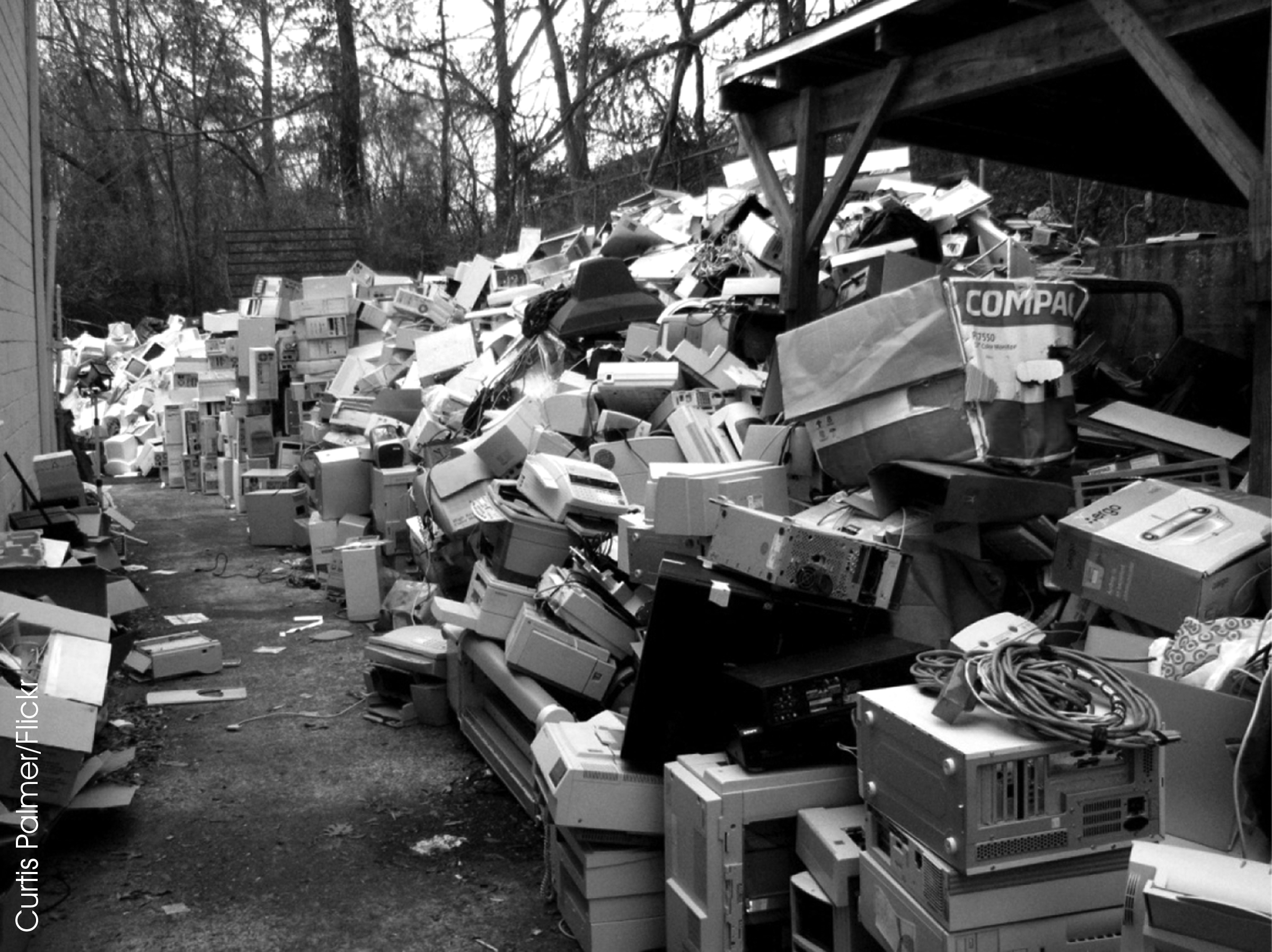
There is now so much electronic waste thrown away each year—about 50 million tons—that the weight of all commercial airliners ever made and about 6,850 Eiffel Towers pale in comparison. According to a report by the United Nations, a new vision for disposal of e-waste is needed—and soon. A New Circular Vision for Electronics—Time for a Global Reboot calls for a “circular economy approach,” where products created by manufacturers and purchased by consumers are used more effectively, leading to less of a need to consume future resources. A key part of this approach is using technology from the Internet of Things, much of which can result in smarter recycling and tracking of e-waste. “A circular economy brings with it tremendous environmental and economic benefits for us all,” says Joyce Msuya, acting executive director of UN Environment. “Our planet's survival will depend on how well we retain the value of products within the system by extending their life.”
Tons of electronic waste continues to pile up each year, leading the United Nations to call for a new approach to its disposal.
Oceans Headed for a Deeper Hue by Century's End
Earth's blues and greens will be even more prominent by the end of the century due to global warming, according to a study by the Massachusetts Institute of Technology (Cambridge, MA) and the University of Southampton (Southampton, England). Climate change is impacting phytoplankton, tiny water-dwelling organisms that convert sunlight into chemical energy. An increase of 3°C will turn more than half of the planet's oceans from blue to deep blue, or from green to an even darker green, says report coauthor Anna Hickman, a professor of ocean and earth science at Southampton. In general, the greener parts of an ocean, the more life it contains; the deeper blue, the less life it contains. The change also means a shift in the types of phytoplankton in existence as ones that are more efficient at absorbing carbon dioxide from the air die off. “The [research] model suggests the changes won't appear huge to the naked eye, and the ocean will still look like it has blue regions in the subtropics and greener regions near the equator and poles,” says lead author Stephanie Dutkiewicz, a research scientist at MIT's Department of Earth, Atmospheric and Planetary Sciences. “That basic pattern will still be there. But it'll be enough different that it will affect the rest of the food web that phytoplankton supports.” The study appears in the journal Nature Communications.
The Big Blue Marble is going to have deeper ocean hues by 2100 due to global warming-induced phytoplankton growth.

New Board Game to Support the SDGs: Go-Goals!
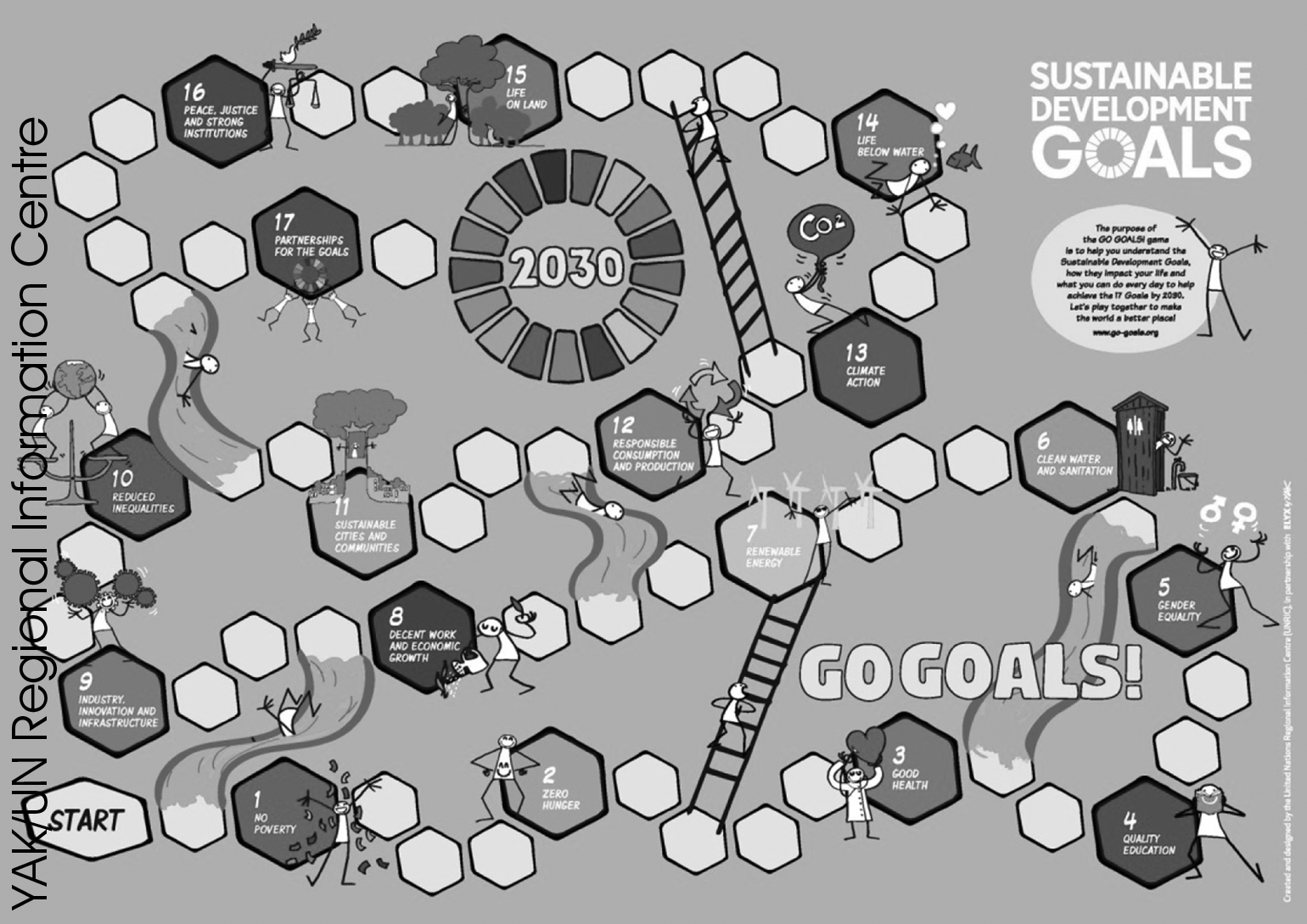
A board game designed to teach children about the importance of sustainability and the United Nations' Sustainability Development Goals (SDGs) is expanding its reach. The board game called Go-Goals! is now available in 17 languages from the UN Regional Information Centre (UNRIC). According to UNRIC, Go-Goals! enables players ages 8 to 10 years old to discover how the 17 SDGs impact their lives and what they can do every day to help achieve the goals by 2030. The SDGs are an effort by all nations to implement strategies to battle climate change. Game questions are tied directly to specific goals, such as where most people in poverty live (No Poverty), how many minutes of exercise children should have every day (Good Health), and which innovations are best at fighting climate change (Industry, Innovation, and Infrastructure). “Our aim is to help people understand their role in the future of the planet as individuals, team players, and most importantly, as responsible global citizens,” UNRIC states. “We need younger generations to be key players for a brighter future.” The game is available free at https://go-global.org.
Children can learn more about sustainability and green thinking through Go-Goals!—a board game from the UN Regional Information Centre.
“Chemical Noses” to Catch Scent of Environmental Toxins
Scientists from five European countries have joined forces to develop next-generation “chemical noses” to remove industrial pollutants from the environment. According to a report from the Estonia Research Council, the European Commission has allocated (U.S.) $3.3 million to finance a project to build a device that detects and sends signals on hazardous pesticides and other toxins. This smart electronic-nose-device would enable removal of the pollutants before release into the environment. “[Environmental toxins] are becoming an ever-increasing problem,” says Riina Aav, professor of environmental sustainability at Tallinn University of Technology in Estonia. “Many agricultural pesticides and pharmaceutical drugs that enter the environment are chiral, which means they exist in two non-superimposable forms. This molecular quirk makes it difficult for the pollution control technologies to identify and remove many of these pollutants.” Chiral pollutants are found in pesticides, herbicides, fungicides, Freon substitutes, dyes, antibiotics, and many other drugs. The project is slated to end in 2021.
Verizon Set to Perform $1 Billion in Green Improvements
Over the next three years, Verizon plans to spend $1 billion on projects with a positive environmental impact, such as solar and hydrogen fuel-cell electricity production at existing properties. The company also plans to invest in bigger solar and wind farms in areas near its large facilities. According to Jim Gowen, vice president for Verizon's global supply chain and chief sustainability officer, the company will also allocate proceeds to improve the energy efficiency of its buildings. Some funds will also go toward Verizon's reforestation program, a commitment to plant 2 million new trees by 2030, including 250,000 in areas hit by the series of major hurricanes in 2017. Gowen says the funds will ultimately help Verizon fulfill a promise made in 2018 to obtain at least half of its energy via renewable sources by 2025.
Verizon has big plans: $1 billion slated for numerous green efforts and improvements through 2022.

CSU-Northridge Recognized by Bee Campus USA
Sustainability efforts at California State University at Northridge (CSUN) have earned the campus an official certification as a Bee Campus USA Affiliate. According to a school press release, the certification is awarded to campuses around the country that show a dedicated effort to the protection of bees and other pollinators. “If you looked around campus three years ago, you would have noticed much more grass,” says CSUN Director of Sustainability and Energy Austin Eriksson. “Today, we have removed upward of 360,000 square feet of grass and replaced it with local drought-tolerant landscaping. Many of the plants selected for the drought-tolerant plant palette are pollinator friendly, especially to our local pollinators.” Eriksson adds that CSUN has committed to minimizing its use of pesticides that are harmful to bee populations, and the university has joined 57 other U.S. campuses in improving college landscapes for pollinators. Bee Campus USA is an initiative of the Xerces Society for Invertebrate Conservation, a nonprofit organization based in Portland, OR. More information can be found at www.beecityusa.org.
California State University-Northridge has become one of the more prominent bee-friendly campuses due to its pollination protection efforts.

Need for Action against Climate Change Reaches Urgent Status
The years 2015 to 2018 were officially the four warmest on record, leading United Nations Secretary-General António Guterres to call for “urgent climate action and increased ambition” toward controlling global warming. Data from the United Nations World Meteorological Organization (WMO) shows that global surface temperatures in 2018 rose by 1°C from the average temperature during 1850 to 1900. In addition, the 20 warmest temperatures have occurred in the past 22 years, according to WMO Secretary-General Petteri Taalas. “The long-term temperature trend is far more important than the ranking of individual years, and that trend is an upward one,” Taalas asserts. “Many of the [recent] extreme weather events are consistent with what we expect from a changing climate. This is a reality we need to face up to. Greenhouse gas emission reduction and climate adaptation measures should be a top global priority.” Scientists have long maintained that limiting global warming to 1.5°C will require global net emissions of carbon dioxide to fall by about 45 percent from 2010 levels by 2030, reaching net zero around 2050.
More Giant Retailers Consider Sustainability When Purchasing
A coalition of 115 major corporations, including Walmart, Target, Kellogg, and Dell, reduced the combined carbon emissions of their supply chains by 633 million tons of carbon dioxide and saved $19.3 billion for their companies in 2018, according to a new report from nonprofit green research firm CDP. The report, Cascading Commitments: Driving Upstream Action through Supply Chain Engagement, finds that for some big buyers, sustainability is now a major factor in their purchasing decisions. Of a subset of 27 major purchasers, 73 percent said they are currently deselecting, or considering deselecting, existing suppliers based on their environmental performance. In addition, 63 percent are currently using, or considering using, data from CDP disclosures to influence whether or not they contract with suppliers. A decade ago, only 4 percent and 9 percent, respectively, had the same opinion. “In the [past] 10 years, we have seen a fundamental shift in expectations around business action on sustainability,” says Sonya Bhonsle, CDP's global head of supply chain.
An increasing number of major corporations, such as Walmart, are using sustainability as a way to determine which suppliers to use.

Green New Deal Gets Thumbs Up from Public—But Barely
American voters narrowly support the Green New Deal, a proposal to end fossil fuel use and create clean energy jobs by raising taxes, including those on carbon emissions. According to a poll by think tank Data for Progress and YouGov Blue, 43 percent of registered voters favor the measure and 38 percent oppose it. Another 10 percent were neutral and 9 percent responded that they were “unsure of their opinion.” The poll identified a generational divide: Millennials—defined by the Pew Research Center as people ages 18 to 37—were 24 percent more likely to support than oppose the policy. In contrast, the Silent Generation—people older than 72—were 25 percent more likely to oppose than support the Green New Deal. According to Sean McElwee, co-founder of Data for Progress, the younger generations are more accepting of their responsibility toward slowing climate change, particularly within the next decade, and the potential $54 trillion “intergenerational climate debt” it might bring.
Pay-As-You-Throw, Courtesy of Yale
Yale University conducted a Pay-As-You-Throw (PAYT) pilot program in select locations across campus to encourage responsible waste management. Traditionally PAYT is a system in which homeowners are charged based on the amount of waste that they produce, just as utilities are charged based on usage. According to the university, buildings were assigned to one of three test groups, in which each was sent a form of “test bill” each month based on the amount of waste produced. The process differs from current protocol, where buildings are charged based on square footage, regardless of the amount of waste produced. The university notes that the pilot program, which finalized in April, 2019, will assess the amount of trash and single-stream recycling generated by each building. Large bulky waste, like furniture, electronic waste, food waste, and construction waste was not assessed. The program supports the materials goals of the Yale Sustainability Plan 2025, which includes achieving a diversion rate of 60 percent by 2024 compared to waste produced annually since 2017. Yale is believed to be the first college in America to pilot PAYT—a program style increasingly being used by municipalities across the country and abroad.
Companies Relying on Tech to Achieve Sustainability
Emerging technologies are rapidly changing how companies prevent pollution, keep employees safe, and set sustainability goals, according to a report by the National Association for Environment, Health and Safety, and Sustainability Management (NAEM). Among the findings: 77 percent of respondents are using mobile devices to interface with employees, conduct audits, and log incidents; 31 percent are using Internet of Things tools such as smart sensors and wearable sensors; 20 percent are using artificial intelligence tools such as machine learning natural language processing; and 14 percent are using drones to assist with activities such as inspections and compliance monitoring. “There is a remarkable change taking place in how [employers] do their jobs,” says NAEM Executive Director Carol Singer Neuvelt. “Technology is creating new opportunities for risk reduction as well as new opportunities to understand the impact of their programs in real time.” The report is available at www.naem.org.
Ben & Jerry's Makes Good on Promise to Ditch Plastic
Ben & Jerry's has eliminated single-use plastic spoons at its 600-plus stores worldwide. According to Jenna Evans, Ben & Jerry's global sustainability manager, the shops will now only offer wooden spoons, and straws will be made of heavy paper. The change is expected to prevent 2.5 million plastic straws and 30 million plastic spoons from being handed out each year. Evans explains that if all the plastic spoons used by just the company's U.S. shops were placed end to end, they'd stretch from Burlington, VT to Jacksonville, FL. “We're not going to recycle our way out of this problem,” she says. “We, and the rest of the world, need to get out of single-use plastic.” The company also plans to phase out clear plastic cups, plastic-lined cups, and plastic lids by the end of 2020. Greenpeace praised the brand for setting clear, short-term targets and for acknowledging that recycling alone is not enough to solve the world's mounting plastic problem.
Wooden spoons are the utensil de rigueur for Ben & Jerry's ice cream when dining in one of the company's shops.