




Abstract
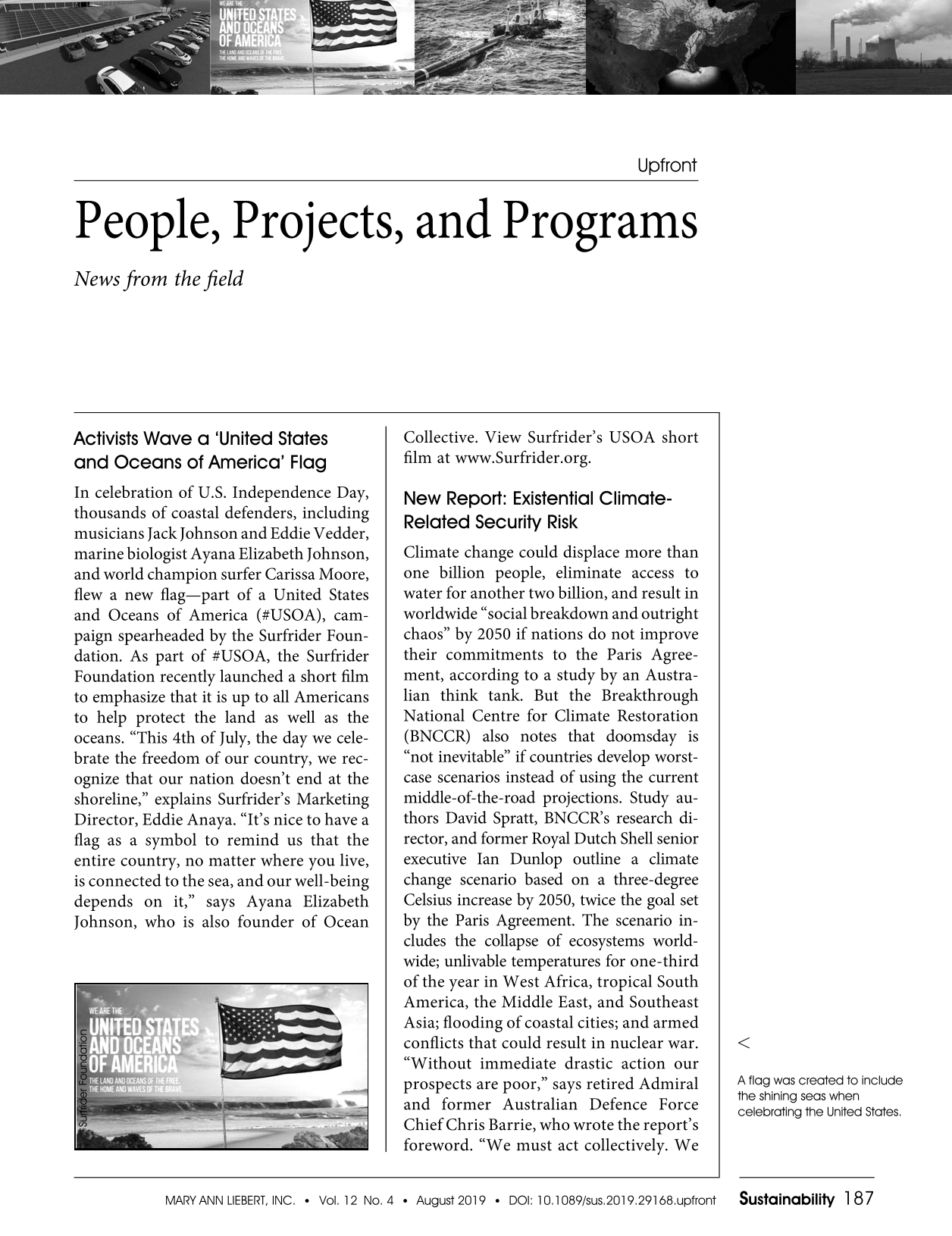
Activists Wave a ‘United States and Oceans of America’ Flag
In celebration of U.S. Independence Day, thousands of coastal defenders, including musicians Jack Johnson and Eddie Vedder, marine biologist Ayana Elizabeth Johnson, and world champion surfer Carissa Moore, flew a new flag—part of a United States and Oceans of America (#USOA), campaign spearheaded by the Surfrider Foundation. As part of #USOA, the Surfrider Foundation recently launched a short film to emphasize that it is up to all Americans to help protect the land as well as the oceans. “This 4th of July, the day we celebrate the freedom of our country, we recognize that our nation doesn't end at the shoreline,” explains Surfrider's Marketing Director, Eddie Anaya. “It's nice to have a flag as a symbol to remind us that the entire country, no matter where you live, is connected to the sea, and our well-being depends on it,” says Ayana Elizabeth Johnson, who is also founder of Ocean Collective. View Surfrider's USOA short film at www.Surfrider.org.
A flag was created to include the shining seas when celebrating the United States.

New Report: Existential Climate-Related Security Risk
Climate change could displace more than one billion people, eliminate access to water for another two billion, and result in worldwide “social breakdown and outright chaos” by 2050 if nations do not improve their commitments to the Paris Agreement, according to a study by an Australian think tank. But the Breakthrough National Centre for Climate Restoration (BNCCR) also notes that doomsday is “not inevitable” if countries develop worst-case scenarios instead of using the current middle-of-the-road projections. Study authors David Spratt, BNCCR's research director, and former Royal Dutch Shell senior executive Ian Dunlop outline a climate change scenario based on a three-degree Celsius increase by 2050, twice the goal set by the Paris Agreement. The scenario includes the collapse of ecosystems worldwide; unlivable temperatures for one-third of the year in West Africa, tropical South America, the Middle East, and Southeast Asia; flooding of coastal cities; and armed conflicts that could result in nuclear war. “Without immediate drastic action our prospects are poor,” says retired Admiral and former Australian Defence Force Chief Chris Barrie, who wrote the report's foreword. “We must act collectively. We need strong, determined leadership in government, in business, and in our communities to ensure a sustainable future for humankind.” The report, Existential Climate-Related Security Risk: A Scenario Approach, is available at www.breakthroughonline.org.au/papers.
Floating Solar Power Plant to Launch in 2020
Efforts are underway to build, off the east coast of Africa, the region's first independent power-producing floating solar photovoltaic (FPV) array. According to a report from the Clinton Foundation, the FPV will be in the Providence Atoll lagoon region, near Mahé Island, Seychelles, and will provide renewable energy to more than 77,000 people. “This innovative project represents a groundbreaking step forward for island nations and other regions with limited land available for solar development,” asserts Fiona Wilson, senior regional manager with the Clinton Climate Initiative. “Floating solar photovoltaic energy holds immense potential for islands, and our partners in Seychelles are demonstrating true leadership in addressing the global climate and energy crisis.” Construction and operation of the facility is expected to occur in 2020. The plant will be the first utility-scale floating solar project in a marine environment worldwide, paving the way for further marine projects—a crucial opportunity for island nations and other land-scarce energy systems, Wilson says.
If all goes according to plan, Providence lagoon off Mahé Island, Seychelles, will host a floating solar power plant by 2020.

Plan to Purge Plastic from Ocean Gets Second Green Light
Call it The Great Cleanup, Round 2. Operators of an effort to dismantle the Great Pacific Garbage Patch—a 1.8 trillion-ton island of plastic debris located halfway between Hawaii and California—plan to launch a new campaign this summer. According to Boyan Slat, CEO of The Ocean Cleanup (OC), the nonprofit behind the cleanup, the plan is to improve upon what was learned during a first attempt in September 2018 that critics consider less than successful. Slat admits that OC's $360 million floating boom system—with a 2,000-foot-long mesh screen designed to form a U-shape behind the patch and trap an estimated 150,000 tons of drifting plastic each year—experienced unexpected setbacks. These included an unpredictable ocean current speed that prevented retention of collected plastic, and a severe weather-induced stress fatigue fracture in its main collection tool. But ultimately, that's how progress is made. “We do not know with certainty that [our] proposed options will solve the issues we have encountered. In fact, there may still be further unknowns, as is the nature when doing something that has never been done before,” Slat explains. ”What we do know is that every day we are not yet operational, the plastic pollution problem is not getting better.” OC's goal is to have half of the Great Patch cleaned within five years by using dozens of floating booms. Several big names from the tech industry are in Slat's corner, such as PayPal co-founder Peter Thiel and Salesforce.com Chief Executive Marc Benoiff. Others are taking a wait-and-see approach. “Clearly, any piece of debris cleared from the ocean is helpful,” says Rolf Halden, a professor of environmental health engineering at Arizona State University. “But there's not much point to cleaning up the mess unless we also stop the tons of plastic entering the oceans each day.”
Organizers of a plan to clean plastic waste from the Pacific Ocean are finding that it's not so easy to sweep away one trillion tons of our bad habits.

‘Brands for Good’ Announced at Sustainable Brands Detroit
A coalition of global brands has unveiled Brands for Good, an initiative designed to “help consumers understand how their behavior can reduce climate change, protect natural resources, and ensure a more-inclusive society.” The initiative was announced at the recent Sustainable Brands ’19 Detroit conference, and, according to the company's CEO KoAnn Vikoren Skrzyniarz, “Brands for Good's work is more than the ‘right thing’ to do… . Consumers tell us they will follow and reward brands who lead with more-delightful products and experiences, more-meaningful relationships and more-measurable actions that help them live better today and create a more-sustainable future for all.” Founding partners of Brands for Good include Dentsu Aegis Network, National Geographic, Nestlé Waters, PepsiCo, Procter & Gamble, SAP SuccessFactors, SC Johnson, Target, and Visa. Affiliate partners include the Association of National Advertisers (ANA), EY, Futerra, Global Citizen, Porter Novelli, and WeSpire. The coalition's first order of business is to create a lifestyle transformation roadmap to identify a select number of “impactful sustainable behaviors and offer detailed guidance, tools, and resources to help the public make more-sustainable lifestyle choices,” according to Dentsu Aegis Network CEO Tim Andree. “It's clear that people want brands to help them live more sustainably,” Andree asserts. “This means that there is a business case, as well as a moral case, for action. As an industry we have a tremendous opportunity to influence and make positive change, so that people feel inspired and empowered to take part in creating a better future for our society.” More about the initiative can be found at: https://sbbrandsforgood.com/
Sustainable Brands launches Brands for Good, a sustainability initiative founded and supported by major corporations.

Britain to Sign 2050 Carbon Emissions Goals into Law
In a first among Group of Seven (G7) nations, Britain will make its new commitment to reach net zero greenhouse gas emissions status by 2050 into law. G7 nations—Canada, France, Germany, Italy, Japan, the United Kingdom, and the United States—are those with the largest and most-advanced economies in the world, and they are facing increasingly severe impacts from the climate crisis. “Now is the time to go further and faster to safeguard the environment for our children,” former Prime Minister Theresa May says. “Reaching net zero by 2050 is an ambitious target, but it is crucial that we achieve it to ensure we protect our planet for future generations.” Britain's net zero target is in line with the 2015 Paris Climate Agreement, which calls on countries to reduce carbon emissions to net zero by mid-century to try to keep the global temperature rise as close as possible to 1.5 degrees Celsius. According to a report in Reuters, Britain hopes its decision will encourage other governments to follow suit before 2020, when countries are due to ratchet up their goals under the Paris Agreement.
Gulf of Mexico to Have Even Deadlier Zone This Year
The Gulf of Mexico dead zone—a region of oxygen-depleted water that no longer can support marine life off the shores of Louisiana and Texas—in 2019 will be the second-largest such area ever recorded, according to a study by researchers at Louisiana State University (LSU). The zone is expected to measure about 8,717 square miles—roughly the size of New Hampshire. The average Gulf dead zone is about 5,309 square miles; the record is 8,776 square miles set in 2017. Dead zones, also known as hypoxia, are often caused by runoff from cropland—consisting of large amounts of nitrogen and phosphorus—and abnormally high rainfall during the spring. According to report coauthor and LSU marine ecologist Nancy Rabalais, this year's zone could end up a record setter. “We're still seeing runoff due to the floods in April and May,” she notes. “[Ultimately] we could be at an all-time high.” The dead zone doesn't pose much threat to creatures such as fish, crabs, and shrimp, who will simply move to other areas. But less-mobile creatures such as worms and certain crustaceans will perish, threatening the food chain for several months, Rabalais adds.
Storm-driven runoff from the Mississippi River is expected to make the Gulf of Mexico's dead zone its second-largest ever in 2019.

UT Austin Awarded $1M Grant to Focus on Solar Cells
The W.M. Keck Foundation has awarded a $1 million grant to a team led by University of Texas (UT), Austin, chemists to develop a coating for silicon-based solar cells that could boost their efficiency by as much as 20 percent, according to a university press release. The project is described as a bold research challenge that, if successful, could make solar power generation cheaper. “The goal of our project is to claw back some of [the solar cells'] energy loss by chemically attaching organic dyes to the surface of the silicon cell that reduce heat losses and convert more of that energy into electricity,” says principal investigator of the project, Sean Roberts, assistant professor of chemistry at UT Austin. The UT College of Natural Sciences and the office of the vice president for research have announced providing funds totaling $278,500 for the research.
Plastic Bag Bans Lacking in Most of the U.S.—and World
Only 16 states have some sort of restrictions in place on single-use plastic bags, and only two—California and Hawaii—have full bans, according to Which States and Countries Have Banned Plastic Bags, a report by ReuseThisBag.com. Four states—Delaware, Maine, Rhode Island, and New York—have mandatory plastic bag recycling or reuse programs. In addition, 200 U.S. cities and 50 countries have banned or taxed the use of plastic bags, with generally positive results. These range from an all-out ban implemented in 2012 in San Jose, CA, which has reduced plastic bags in storm drains by 89 percent and in creeks and rivers by 60 percent, and has seen a 59 percent drop in residential plastic waste. Internationally, Ireland's 22 cent-per-bag fee has cut usage by 90 percent, while anyone making, selling, or importing plastic bags in Kenya could be fined $19,000 and sent to jail for four years. Such actions are a bit drastic but they make a point, according to ReuseThisBag.com. “It's crucial that America and the rest of the world follow the lead of countries and states that have acted,” the report notes. “Globally, as many as 160,000 plastic bags are used every second—and currently, only 1 to 3 percent of them are recycled. This simply isn't sustainable behavior.” The report is available at www.reusethisbag.com.
Coal Usage Falls 40 Percent from 2008, Hits 41-Year Low
Coal consumption in the United States is at its lowest level since 1978, with potential energy production dropping behind renewables for the first time, according to two industry-specific reports. In 2018, Americans used 687 million tons of coal, nearly all of it as an energy source, according to the U.S. Energy Information Administration. That's down from the industry's peak of 1.13 billion tons in 2008. The steep drop is the result of increased capacity by power plants to run on renewable sources such as wind and solar—which officially surpassed coal in April 2019 because of lower operating costs of renewables—according to the Institute for Energy Economics and Financial Analysis (IEEFA). Analysts note that coal's decline comes in spite of the Trump Administration's efforts to boost the industry by scaling back environmental regulations. Economics, they say, means more to the public than the number of restrictions placed upon a product's production and development. “Coal has no technology path,” asserts Jeff McDermott, managing partner at investment bank Greentech Capital Advisors in New York City. “It's got nowhere to go but extinction.” IEEFA notes, however, that having the capacity to generate more electricity from renewables than from coal does not mean it will happen immediately—it probably won't be a regular occurrence for at least several years, according to Matthew Hoza, senior energy analyst at consulting firm BTU Analytics in Lakewood, CO.

years, largely due to the ever-more-affordable renewables such as solar and wind.
With Everest Trash, What Goes Up Doesn't Usually Come Down
Mount Everest is becoming a dumping ground for its sudden parade of climbers. According to a report in The Hill, the government of Nepal and teams of volunteers spent 45 days cleaning up 12 tons of trash from the world's tallest mountain. The garbage, collected from mid-April to the end of May, included empty oxygen cylinders, plastic bottles, cans, batteries, food wrappings, fecal matter, and kitchen waste left by hordes of climbers eager to “conquer nature” but not so eager to pick up after themselves. A record 800 people plan to make their trek up one of the two popular routes to the top this year. “You don't need a map to get to the Everest base camp,” says climber Dragana Rajblovic in an ABC News interview. “Just follow the trash.” Things have become so bad that in February, China closed its base camp to tourists and now only allows climbing in spring. Climbers must also bring at least 8 kilograms (17.6 pounds) of trash to hand to authorities upon their return and pay a $1,500 rubbish collection fee. Meanwhile, on the more-commercial Nepalese side, officials are charging each climber a $4,000 deposit, refundable only if they bring back at least 17.6 pounds of waste. But given that a mountain climb can cost $100,000, a $4,000 garbage fee may feel like tip money, according to Dandu Raj Ghimire, director general of Nepal's tourism department. Despite the cleanup efforts—conducted annually now for several years—there are still about 20 tons more garbage to remove, according to the Everest Summiteers Association. Climate change, which is causing Everest glaciers to retreat, is making it easier to recover refuse. But it's also making it more dangerous to climb, which is leading to another unpleasant recovery: dead bodies. Seventeen bodies have been found during cleanups since 2017, including four so far this year, according to an ABC News report.
The world's tallest mountain now has one of the planet's biggest trash problems, due to an increasing number of not-so-eco conscious climbers.

Congress Considers Expanded Penalties for Pipeline Protests
The U.S. Department of Transportation (DOT), Pipeline and Hazardous Materials Safety Administration (PHMSA) has released a proposal calling for Congress to expand a law that threatens fines and up to 20 years' prison time for “damaging or destroying” pipelines currently in operation. According to a report by Politico, the expanded version would add “vandalism, tampering with, or impeding, disrupting or inhibiting the operation of” existing pipelines or those “under construction.” PHMSA spokesperson Darius Kirkwood asserts that the goal is to “deter individuals from activities that can cause serious harm,” such as attempting to tamper with valves on existing pipelines. “This proposal is not meant in any way to inhibit lawful protesters from exercising their First Amendment rights,” Kirkwood says. Environmental activists see it differently. Sierra Club campaign director Kelly Martin calls it a “blatant attempt” to intimidate anyone who speaks against pipeline projects. “Rather than focusing on shielding corporate polluters from public protest, the administration should be working to ensure that communities are protected from dirty, dangerous fossil fuel projects,” Martin explains. Current pipeline safety law authorization lapses on September 30, 2019, and Congress has taken some tentative steps toward beginning its work on extending it. Politico notes that congressional Democrats “are almost certain to block the proposal.”
Bank of America to Go Solar in Journey to Carbon Neutral
Bank of America has begun installing solar panels throughout its operations as it moves toward its goal of purchasing only renewable electricity and becoming carbon neutral by 2020. According to a company press release, in 2019 the program is expected to generate more than 25 megawatts of green power for 15 financial centers in Arizona, California, Connecticut, Florida, Illinois, Kansas, Massachusetts, Maryland, Missouri, Nevada, New Jersey, New York, North Carolina, Rhode Island, Texas, and Virginia. Panels will also be installed on ATMs in those locations. By 2021, program will be expanded to another 60 operations in these states, and Delaware and Florida. “Having solar energy onsite to power our facilities is part of our responsible growth strategy and reduces our operational impact on the environment,” says Andrew Plepler, global head of Environmental, Social and Governance at Bank of America. “This work … provides an innovative experience for our clients [and] is key to our role in helping to accelerate the transition to a sustainable, low-carbon economy while supporting the communities where we work and live.”
Protests against pipeline projects could be subject to harsher penalties and jail time under a proposal made to Congress by the U.S. Department of Transportation.


states as part of its carbon neutrality goal for 2020.
University in Mexicali Goes Big with Solar Power Project
Centro de Enseñanza Técnica y Superior Universidad (CETYS University) in Mexicali and Tijuana, Mexico, has begun construction of a solar power project that will make it the largest renewable energy project in Mexico and Latin America. According to a university press release, the $1.7 million effort will generate the equivalent of half of the annual energy consumption of the college's Mexicali campus, cutting annual carbon dioxide emissions by 1,397 metric tons. Of the system's 3,000-plus panels, 2,873 will be in Mexicali, with the remainder on the CETYS campus in Tijuana. “This is the most ambitious sustainable energy project led by any educational institution in Latin America,” says Isaac Azuz Adeath, project leader for the solar initiative and research coordinator at the CETYS University College of Engineering. “In both the number of panels and the energy produced, this project sets a new Latin American standard for the contributions colleges and universities can make in the fight against climate change.” The project will boost the state's overall solar energy capacity by 20 percent, he adds.

percent.
Recycling Becomes Hard Sell for Some U.S. Cities
Asia's growing disinterest in American recycled materials is forcing many communities to curtail or discontinue their plastic and paper collection programs because they are too expensive. According to a report in the New York Times, China's decision in 2018 to stop buying U.S. recyclables because of its excessive garbage content has left many recycling companies with fewer buyers. In addition, some recyclers are recouping profits by raising their prices by up to 400 percent on their No. 1 customers: U.S. cities. This leaves many municipalities with an unpleasant choice of raising taxes, cutting city services, or abandoning recycling altogether. Mitch Hedlund, executive director of nonprofit Recycle Across America, notes that for some of the largest companies, recycling has been a loss leader—something used as part of cities' full garbage collection needs. But recycling programs have been so successful that even handling all of a city's trash processing does not make life profitable for the waste management industry—which means more declined business. In response, some cities are finding other ways to get rid of their reusables, such as in Philadelphia, where a portion of recyclables are burned in a plant that converts waste into energy.
In 2019, it's not as easy for cities to handle their recyclable waste as it once was—which is forcing them to find other, creative ways of processing it.

Oh, the Shame: One Grocer's Anti-Plastic Message
A Canadian grocery store has taken a new tactic toward convincing customers to stop using single-use plastic bags: Shame. Customers who don't bring their own bags to East West Market in Vancouver, British Columbia, must purchase plastic bags with statements such as “Wart Ointment Wholesale,” “The Colon Care Co-Op” and “Into the Weird Adult Video Emporium.” Owner David Lee Kwen says the plan came after a five-cent single-use bag fee failed. “It's human nature to not want to be told what to do,” he notes. “This is a humorous way to make them think about a growing problem.” Like the rest of the world, Canada is dealing with an overflow of nonrecyclable plastics. In response, Prime Minister Justin Trudeau has implemented a ban on single-use plastics that takes effect in 2021. East West's bags include a note at the bottom: “Avoid the shame—bring a reusable bag.” Many of the store's customers do just that. But, there's a misfire: People like the messages so much, they're intentionally leaving nonplastic bags at home and buying the specially labeled ones at a nickel each. “Some of the customers want to collect them because they love the idea of it,” Kwen explains. “[But] even if you have the bag, you still have to explain its origin to your friends. And then, we've started a conversation.”
East West Market in Vancouver is trying to convince customers to use less plastic, using messages designed to make them think twice about harming the environment.

A $500K Grant Goes to USGBC for LEED Expansion
The U.S. Green Building Council (USGBC) has received a $500,000 grant from Bank of America, which the group will use to support LEED certification efforts in 15 cities and communities. According to USGBC President and CEO Mahesh Ramanujam, the grant will provide financial assistance, educational resources, and technical support throughout the certification process. LEED helps local governments develop and track plans for a wide variety of programs, including green infrastructure, public health, energy, social equity, and transportation.