




Abstract
The absence of federal action on climate change in the United States has motivated local and regional efforts to reduce greenhouse gas emissions through the adoption of 100 percent net-renewable electricity resolutions. As of 2020, more than 150 cities, counties, and states have committed to such resolutions, with six U.S. cities having already achieved their goals. Implementing 100 percent net-renewable electricity resolutions, nevertheless, requires hurdling many significant obstacles, including developing and procuring sufficient renewable electricity resources from local utilities, navigating complex energy regulations, balancing costs with other community priorities, and convincing local citizens of the merits of renewable electricity and efficiency for their homes and businesses. Through semi-structured interviews with city, community, utility, and nongovernment environmental organization representatives and secondary sources, this article investigates how the cities of Salt Lake City, Park City, and Moab, the first three cities in Utah to enact 100 percent net-renewable electricity resolutions, have been tackling those challenges. It provides an overview of their most significant outcome thus far—passage of the Community Renewable Energy Act of 2019, which prompted several additional Utah cities and counties to also commit to 100 percent net-renewable electricity. Guided by frameworks of collaborative and transformational leadership, coupled with community-based social marketing, this article offers guideposts to help other communities chart a transition to 100 percent net-renewable electricity.
Introduction
An absence of federal action on climate change in the United States has led to increased local and regional efforts to reduce greenhouse gas emissions. 1 More than 150 U.S. cities, counties, and states have passed resolutions that commit them to 100 percent net-renewable electricity 2 in which their total electricity needs are to be met or offset with renewable electricity generation, including solar, wind, geothermal, hydroelectric power, and demand management, such as energy efficiency or energy storage technologies. 3 Thus far, cities that are currently powered by 100 percent net-renewable electricity include Kodiak Island, AK; Aspen, CO; Georgetown, TX; Greensburg, KS; Rock Port, MO; and Burlington, VT.
Diverse motivations have prompted 100 percent renewable electricity transitions, including greenhouse gas reductions and climate change concerns, economic benefits, price stability, energy independence, and energy reliability. 1 As role models, these cities have demonstrated that powering communities with 100 percent net-renewable electricity is not only possible, but also economically feasible. Indeed, wind and solar power costs continue to fall, becoming increasingly cost-competitive with (and in many circumstances, less expensive than) traditional fossil fuel as electricity sources. 4 While these small cities may only have a marginal impact on reducing overall global greenhouse gas emissions, such local actions can inspire other communities to adopt similar measures and influence state and federal policies. Consequently, finding strategies to scale local actions is an important part of climate change mitigation research. 5
Cities, counties, and states pursuing renewable electricity resolutions can serve as informative laboratories for understanding the varied strategies and actions that might be employed to hurdle obstacles facing the transition to 100 percent net-renewable electricity. 6 In the state of Utah, Salt Lake City, Park City, and Moab were the first cities to adopt 100 percent net-renewable electricity resolutions in 2016 and 2017. In each city, the city councils adopted their resolutions unanimously and began engaging the community, building alliances, and negotiating with their utility monopoly, the fossil fuel-dependent Rocky Mountain Power, to procure renewable electricity. (For a more detailed description of how these cities adopted their resolutions, see Developing and Implementing a 100% Renewable Electricity Resolution: A Research-Based Framework. 7 ) One key outcome was passage of the Community Renewable Energy Act in 2019, which provided structure for Rocky Mountain Power to procure renewable resources and a deadline for other Utah cities and counties to commit to 100 percent net-renewable electricity if they so desired. By the end of 2019, 23 Utah cities and counties had come forward to participate in Rocky Mountain Power's future 100 percent net-renewable electricity program, representing about 37 percent of the state's electricity load. 8
This research explores how Salt Lake City, Park City, and Moab worked to find pathways to implement their 100 percent net-renewable electricity resolutions. Drawing on 13 semi-structured interviews conducted between October and November 2018 of city, community, utility, and nongovernment environmental organization representatives and secondary sources, this investigation describes the key challenges encountered with fulfilling the cities' resolutions, the strategies and actions launched to overcome these challenges, and the most significant outcome of those activities thus far, the Community Renewable Energy Act of 2019. Guided by transformational and collaborative leadership and community-based social marketing frameworks, the proposed recommendations are designed to help other communities on their paths toward 100 percent net-renewable electricity.
Study Area
While the state of Utah is recognized for its solar, wind, and geothermal energy potential, in 2017, 70 percent of Utah's electricity was generated by coal-fired power plants. 9 Historically, fossil fuel development (for coal, oil, and natural gas) has been a valued staple of Utah's economy. The dominant utility in the state, Rocky Mountain Power, powers its service territory with 63 percent coal and 14 percent natural gas. 10
The Mormon religious faith has long dominated the socially- and politically-conservative Utah population, which generally has not viewed environmental issues as a priority. 11 Climate change, in particular, is viewed largely with skepticism. 12 In 2010, for example, the Republican-dominated legislature passed a joint resolution calling climate science “questionable” and people concerned about carbon emissions “alarmists.” 8 Eight years later, in a stunning reversal, high school students spearheaded passage of a resolution for the Utah State legislature to acknowledge that changes were indeed happening to the state's climate. 13 With this backdrop, the experiences of the three cities in conservative Utah are instructive cases for understanding how politicians, administrators, and citizens have forwarded renewable electricity goals.
Salt Lake City
With a population of approximately 200,000, Salt Lake City is the capital of Utah and the state's largest city. 14 It is notorious for poor air quality and has been attempting to improve it for decades. Sustainability staff and city council members identified air concerns and the climate crisis as the major motivations for the city's 100 percent net-renewable electricity resolution, which was adopted in July of 2016. 15 The resolution called for: 1.) transitioning to 100 percent net-renewable electricity community-wide by 2032 (though the city later revised its timetable to achieve that goal by 2030 16 ); and 2.) reducing carbon emissions by 80 percent by 2040 (using 2009 emissions as the baseline). The resolution also called for benchmark goals, such as transitioning to 50 percent renewable electricity within municipal operations by 2020 and reducing carbon emissions by at least 50 percent by 2030. After the adoption of the resolution, the City created its Climate Positive 2040 plan, which outlined its pathway to achieve these goals.
Park City
Located about 30 miles east of Salt Lake City in Summit County, Park City is an affluent ski town in the Wasatch Range and former host site of the 2002 Winter Olympics. The population of Park City is approximately 8,500. 17 The Park City Council adopted its resolution in March of 2016 to: 1.) become net-zero carbon and power the entire community with 100 percent net-renewable electricity by 2032 (though that goal also was revised later to be achieved by 2030 18 ); and 2.) make municipal operations net-zero and powered with 100 percent renewable electricity by 2022. 19 With an economy dependent upon a healthy snowpack, Park City recognized the threat that climate change posed to its tourism industry and stated that this resolution was an important step for reducing heat-trapping carbon. Recognizing that the city cannot solve the climate crisis alone, Park City encouraged other communities to join it in its ambitious effort. In October 2017, Summit County followed with a resolution to transition to 100 percent net-renewable electricity by 2030, making it the first county in Utah (and one of 13 across the United States 2 ) to adopt such a goal. 20
Moab
Located in southeastern Utah's red rock country, Moab is internationally recognized for adventure sports and has a population of approximately 5,500. 21 Inspired by the renewable electricity resolutions of Park City and Salt Lake City, Moab's City Council set its own goal to act on climate change. Adopted in February 2017, the resolution committed the city to: 1.) achieve a 50 percent reduction of greenhouse gas emissions by 2032 and 80 percent by 2040, relative to 2018 emissions; and 2.) transition to 100 percent net-renewable electricity within municipal operations by 2027 and community-wide by 2030. 22
Moab still contends with its 20th-century legacy of uranium milling and mining, and its clean electricity resolution stated that transitioning to a low-carbon community would help address climate change as well as bring local benefits, such as improved air quality, public health, energy security, and local jobs. Aiming to leverage Moab's world-renown reputation, city officials sought to influence the broader dialogue on global climate change and to encourage others to follow.
The Utah Chapter of the Sierra Club worked with all three cities to pass their resolutions through its national Ready for 100 campaign. Realization of the cities' 100 percent net-renewable electricity resolutions would hinge on the leadership of city officials to engage with Rocky Mountain Power to develop and procure sufficient renewable electricity resources and to convince residents and businesses of the merits of citywide renewable electricity use. The Sierra Club aided in this process by partnering with Salt Lake City, Park City, and Summit County to lobby for the Community Renewable Energy Act and by encouraging other cities to take advantage of the legislation.
To enact change, leaders must influence others and mobilize forces to transform and reform systems both internally (within organizations) and externally. 23 External leadership in a community, for example, involves serving as a spokesperson, creating and maintaining a network of supportive relationships with people outside the organization, influencing outsiders, and forming alliances to solve shared problems. Past environmental research offers three frameworks for how leaders address obstacles and engage others to change their attitudes and behaviors to achieve environmental goals: transformational leadership, collaborative leadership, and community-based social marketing. These processes are used to interpret and analyze the three cities' community engagement activities for implementing their 100 percent net-renewable electricity resolutions.
Leadership and Community Engagement
The pursuit of sustainability and its various aspects (e.g., implementing 100 percent net-renewable electricity, addressing the oceans plastics crises, curtailing deforestation, etc. ) are often described as wicked challenges, characterized as difficult-to-define, multicausal, without clear solutions, unstable, beyond the capacity of any one organization to understand or address, and fraught with disagreement about causes and appropriate solutions. 24 Consequently, tackling wicked problems requires multiple perspectives, as well as multiple forms of expertise, knowledge, and creativity; it warrants changing behaviors of large and influential groups, including a critical mass of citizens, and working across both internal and external organizational boundaries, engaging individuals and stakeholders in policy making and implementing solutions. Scholars propose that addressing wicked problems necessitates leadership that is transformational and collaborative to bridge differences, reframe discourses, and unleash human energies to identify paths forward. 25
Transformational leaders identify needed change, create visions to guide the change through inspiration, serve as role models, and execute the change with the commitment of members within a group. 26 This leadership style heightens consciousness of the morality and collective interest among members, be it a societal good (such as climate change) or a more personalized good (such as helping people reach their own potential), to help achieve those collective goals. Leading by example, they emphasize emotions and values, encouraging creativity in followers, who are seen as complex and rich resource for expertise and action and are critical for addressing complex environmental problems. 26 Ideally, transformational leaders actively encourage others to follow their vision, communicate in a way that inspires others, stretch others to think more deeply and innovate, and show care and concern for others. 27
Similar to transformational leadership, collaborative leadership emphasizes a shared goals orientation. Specifically, it focuses on the mutual influence among members of a less hierarchical, more egalitarian set of individuals (as found in a city or community). Collaborative leaders engage in joint problem solving, shared decision making, and open processes for tackling environmental problems. 28 Inherent in collaborative leadership is the concept of constructive controversy or constructive dissent—the idea that open and energetic discussion, including critique and mild conflict (especially related to the leaders' ideas), within a framework of cooperative interdependence, will lead to participation, creativity, and innovative problem solving.
In addition to leadership perspectives, community-based social marketing is another framework that has been used broadly to encourage sustainability-focused behavior changes through a combination of psychology and social marketing, 28 and it has been employed in past energy transition research. 29 Community-based social marketing consists of five steps: 1.) selecting the behavior to promote, 2.) identifying barriers and benefits associated with that behavior, 3.) developing strategies, 4.) piloting the selected strategies, and 5.) evaluating the program after implementation.
To encourage behavioral change among targeted individuals (e.g., acceptance of renewable electricity, enacting energy conservation), community-based social marketing involves recognizing and then increasing the perceived benefits of advocated behaviors (e.g., engaging in energy efficiency) and escalating barriers of undesired behaviors (e.g., use of fossil fuels). Likewise, it also entails decreasing perceived barriers of advocated behaviors while decreasing the benefits of undesirable behaviors. This is accomplished through the use of commitments, social norms, prompts, incentives, convenience, and effective communication to assist individuals in adopting new behaviors, rather than attempting to accomplish them simply through informational campaigns.
Collectively, past environmental research indicates that transformational and collaborative leadership are necessary to navigate the uncharted waters of wicked sustainability problems, such as implementing 100 percent net-renewable electricity resolutions, and community-based social marketing encourages more sustainable behaviors within populations. These perspectives provide lenses for understanding the community engagement strategies that emerged among the three Utah cities examined in this study.
Methods
To investigate how Salt Lake City, Park City, and Moab implemented their 100 percent net-renewable electricity resolutions, this study used a qualitative exploratory framework, drawing from 13 semi-structured interviews (each lasting between 30 and 90 minutes) of individuals known to be closely involved with the cities' resolutions, along with secondary sources, including video/audio recordings from city council meetings, city council meeting agendas and minutes, city reports, and news media. 30
The interviews were conducted in October and November of 2018. Initial participants (called informants in the study) who were central to the 100 percent net-renewable electricity resolutions were identified from city council meeting minutes and news articles. Using snowball sampling, these initial informants then nominated other individuals as being relevant for the study. All told, the 13 study participants included two city officials from Salt Lake City, three officials and one community leader from Park City, and five officials from Moab. One representative from Rocky Mountain Power and one representative from the Sierra Club were also included. Nine of the interviews were conducted in-person, with the rest accomplished over the phone or video call. The interview questions with the Rocky Mountain Power representative were answered via e-mail.
Inductive thematic content analysis of interview transcripts identified reoccurring, data-driven themes and patterns for each city, which were then compared across the cities to identify similarities and differences. Following case research protocol, an initial draft of the results was reviewed by two of the informants for accuracy and feedback, which was incorporated into the final analysis. 31 The resulting themes regarding challenges and strategies to address those challenges are reported in the next section.
Identified Barriers
Pursuit of the 100 percent net-renewable electricity resolutions centered on overcoming four major hurdles: 1.) procuring renewable electricity resources, 2.) understanding and reducing costs, 3.) staying focused on the resolution, and 4.) encouraging community participation. Figure 1 shows these four barriers as well as the strategies the cities are using to confront them.
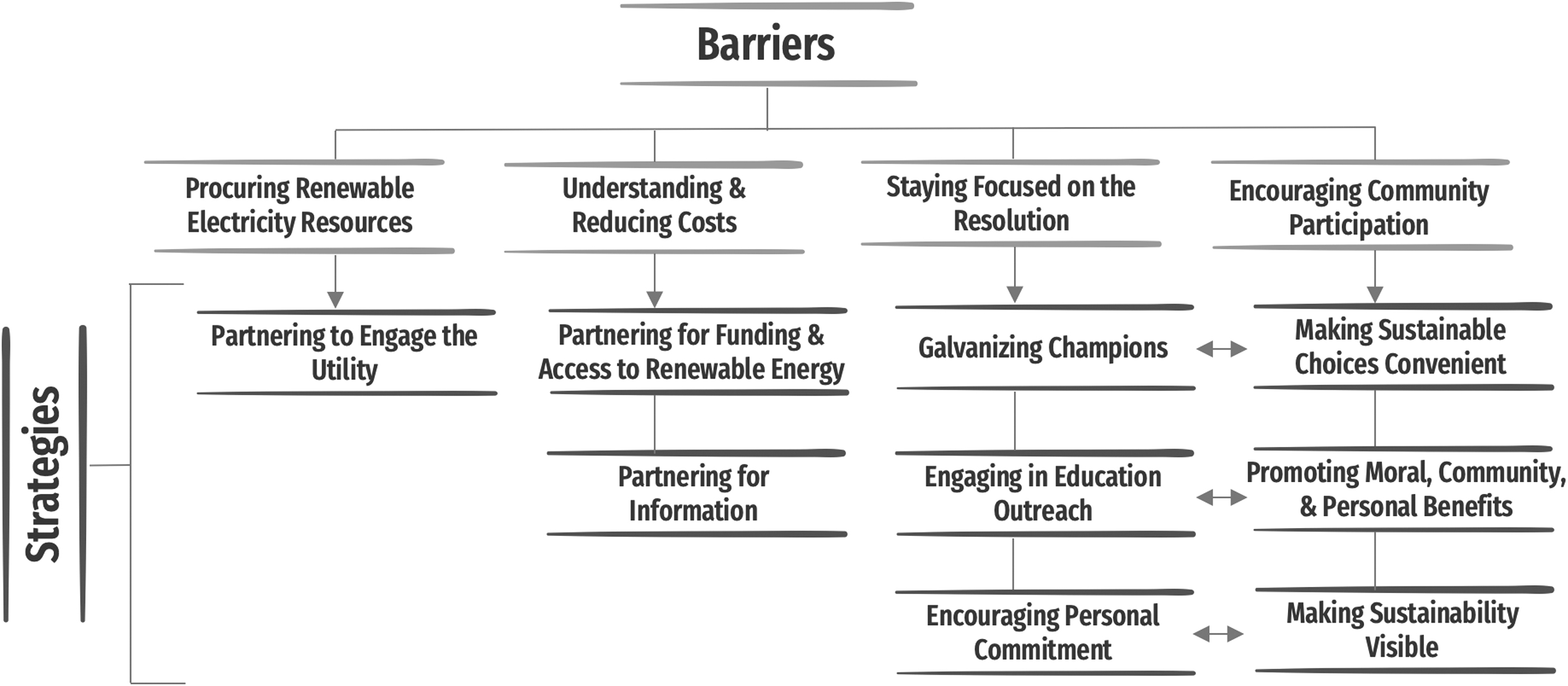
Summary of barriers and strategies for implementing 100 percent net-renewable electricity resolutions
Procuring Renewable Electricity Resources
“For us, the biggest single piece of the puzzle [was] getting Rocky Mountain Power, our existing utility, to build [for] us a hundred percent renewable facility,” noted a Park City official, “and [we had to] convince them that we're not interested in renewable energy credits. We're not interested in buying existing solar. We wanted new renewables created.” Renewable energy credits, or RECs, are certificates that represent the renewable nature or greenness of electricity generated from existing renewable electricity production facilities (e.g., wind or solar farms). Utilities may purchase RECs on the market to help meet their renewable electricity obligations without having to develop or seek new renewable energy sources.
32
Consequently, critics assert that purchasing RECs creates a false sense of accomplishment. These Utah cities were insistent on building and adding new renewable facilities to the grid, not simply purchasing RECs to meet their renewable electricity goals. There was significant risk that Rocky Mountain Power would not want to cooperate. A Sierra Club representative added:
[Rocky Mountain Power] owns the largest coal fleet in the western United States. It is a utility that has not shown a willingness to retire those coal plants in a reasonable fashion, and that is a major barrier because we can't just bring new [renewable] capacity online without the consideration of what's going to be retiring.
Encouraging Community Participation
The other piece of the puzzle centered on securing community-wide buy-in to renewable electricity and energy efficiency. One Park City official explained that voluntary behavior change is difficult when sustainability is not a perceived community priority.
Park City is full of wonderful distractions. We have great powder days. We have incredible summer single-track riding, golf, great arts and culture. All these things going on. People move here to enjoy that high quality of life and that competes with activism.
Another Park City staffer questioned if it was possible to get an entire community to adopt renewable energy and efficiency short of a mandate:
I'm not sure that we'll really be able to move out of a voluntary basis, but we have to be creative about the kinds of carrots and sticks [to motivate participation]. We're going to have to be more aggressive with our community members and figure out how we can help them to reduce their energy consumption, too.
The staffer also noted the problem of overcoming the affluent lifestyles of the residents to encourage more energy efficiency:
Residential emissions, that's the thing that really keeps me up at night. … I've heard of people that have heated driveways and leave them on all year. A lot of those are electric! At the end of the day, it doesn't matter if it's renewable electricity. It's waste! I mean we don't need to produce that much just to heat sidewalks and driveways in the summertime. That's just ridiculous!
Similarly, a past Moab city official talked about excessive home size and inefficient vehicle usage. “We've got to change society. We've got this consumption mentality… it's not sustainable.” A Sierra Club representative added that political forces hamper energy efficiency because of perceived upfront costs.
Every year there's a bill that tries to upgrade Utah's building codes. Right now, our residential building codes are some of the worst in the country. And we lobby on it every year. The problem is it fails every year because the housing lobby here in Utah is so powerful.*
Staying Focused on the Resolutions
Several informants noted that other city problems, priorities, and functions can distract cities from making progress on their 100 percent net-renewable electricity resolutions. A Park City official said:
… the challenge for all of us is how does [the 100 percent net-renewable electricity resolution] fit in our priority matrix? We've got a lot of urgent things we need to get done in town. How much does this fit, how much does it detract from our other goals, and where does it fit in with urgency? We're working really hard on transit issues, social equity issues, and such.
A past Moab official echoed:
We've got a housing crisis and an infrastructure crisis … there are still some things that are immediate that need to be resolved, so you've got to keep it in front of people. … Other issues are going to come into play that are going to distract that. So you've got to prioritize.
Understanding and Reducing Costs
Finally, the potential (and unknown) cost of renewable energy from the utility, upfront costs of renewable energy installations for homes or businesses, and energy efficiency upgrades pose substantial barriers. For example, a Salt Lake City staffer explained that people generally don't think about long-term cost savings when it comes to investments into efficiency:
It's more a matter of just messaging and reflecting upon that [opportunity to] spend a little extra for this light bulb and you're going to save a lot of money. If people made the best financial decisions for themselves in the energy realm, our jobs would be a lot easier or even go away just because if we were constructing [buildings], purchasing the right appliances, doing all that, they all make sense financially. It's thinking life cycle, not just merely upfront cost.
Informants from Moab noted that upfront costs of renewable energy installations (e.g., solar panels), efficiency upgrades, and sustainability programming were a major challenge due to the city's limited budget and for residents of modest means. “Many people struggle financially,” noted one Moab city official, “so part of [the challenge] is figuring out what options are there that [community members] can afford.” Another Moab city staffer added, “I spend a large part of my time thinking about how we can finance [our sustainability initiatives].” While Moab experienced more financial issues than Salt Lake City and Park City, all three cities were seeking ways to reduce the implementation costs of their resolutions.
Piloted Strategies
Given the unknowns and challenges facing the cities, the informants revealed numerous engagement strategies they piloted to advance their 100 percent net-renewable electricity goals. The first priority was to engage Rocky Mountain Power.
Partnering to Engage the Utility
In 2016, Mayor Jackie Biskupski began talks with Rocky Mountain Power with the objective to develop a renewables program for Salt Lake City.
8
After passing their own resolutions, Park City and Summit County joined the conversation, along with the Sierra Club, Utah Clean Energy, and others. Leaders believed that a coalition was necessary to exert pressure on the utility monopoly to cooperate. A Moab city official noted:
One of the reasons I wanted to do the resolution soon was so that we could participate [in utility negotiations with] Salt Lake City, which is such a large customer for Rocky Mountain Power. We could scoot in on their coattails more easily than we could negotiate [for 100 percent renewable electricity] on our own.
Within the coalition, the cities played different roles in engaging Rocky Mountain Power. A Park City official added:
Salt Lake being a big city has a lot of leverage and a lot of credibility. [Park City] as a smaller entity, with probably more of an accepting public [to the idea of renewable electricity], we were able to be a little more nimble and aggressive. So, helping each other, we were able to move this along.
Specifically, explained another Park City staffer, “Park City threatened to create its own municipal utility [and leave Rocky Mountain Power if it didn't cooperate]. While Park City wouldn't be a big loss of customers, if Park City created its own utility, it would have opened the door for other larger cities, such as Salt Lake City and Ogden, to join us.”
A utility representative denied that Rocky Mountain Power was “resistant” to the cities' proposals or unwilling to cooperate. Rather, their stated reasoning was
[b]ecause Rocky Mountain Power is an essential public service, strictly regulated by the State of Utah and five other western states, there are a number of legal and regulatory issues to address in order to accomplish what these cities envision. One critical issue is ensuring that the actions of one group of customers do not impose additional costs on other customers. A long-standing regulatory principal in utility policy is that individual customers (or customer groups) whose energy requirements or actions introduce additional costs to serve them should pay those costs in their rates.
Rocky Mountain Power ultimately invited state Representative Stephen Handy, a Republican lawmaker with expertise in energy, into the talks with the cities and Summit County in summer 2018. Politically, the talks played well among Utah's conservative legislators. “Here is a corporation and their customers working together to meet the market demand for clean energy. That works [positively] on many levels with a conservative audience,” observed a Sierra Club representative. Representative Handy assisted in providing legislative structure on how Rocky Mountain Power would transition to renewable energy, retire existing coal-fired power plants, provide directives for the Public Service Commission regulators to approve reasonable renewable energy rates for the communities, and avoid cost-shifting to ratepayers outside the communities pursuing 100 percent net-renewable electricity. The talks ultimately led to the Community Renewable Energy Act of 2019, one of the most significant outcomes of the cities' engagement strategies (see section, The Community Renewable Energy Act of 2019). Not knowing the potential outcomes of these negotiations, however, the cities also embarked upon other challenges.
Partnering for Funding and Access to Renewable Energy
Partnerships with organizations that offered grants and programs to reduce the cost of energy efficiency upgrades and access to renewable energy were critical for engaging businesses and households across all three cities. Rocky Mountain Power had existing subscription programs, Utah Subscriber Solar and Blue Sky, for customers willing to pay a slight price premium over the standard power rate to access renewable energy, which was helpful for those who couldn't install renewable energy systems of their own due to upfront cost or situations (e.g., living in an apartment). The price premiums were then used to access power from a solar array in Millard County, Utah, or purchase RECs. Rocky Mountain Power also had a Wattsmart program for households and businesses, offering expertise and incentives for efficiency upgrades (e.g., in LED lighting retrofits).
In terms of grants, Rocky Mountain Power provided $50,000 for Moab's electric vehicle (EV) charging ports and over $600,000 for Park City's EV charging and electric bus system. The National Renewable Energy Laboratory also assisted Moab with the development of local solar projects to increase energy independence. Additionally, the Utah Governor's Office of Energy Development provided a commercial property-assessed clean energy program (C-PACE), a low-cost, long-term financing option for energy efficiency, renewable energy, and water conservation projects for commercial businesses. In sum, all the cities leveraged partners and programs to address the affordability of renewable energy and efficiency to gain community support.
Partnering for Information
All three cities also touted the importance of partnering with many organizations and communities to provide/share knowledge and tools for best practices, establish cost and benefit projections, and assist in community engagement and sustainability programming. One Salt Lake City staffer noted:
I think that we're really fortunate in Utah to have a network of nonprofits that are informed of energy policy and legislation and the regulatory realm with the public service commission. Utah Clean Energy has been intervening in very formal energy dockets for a long time. And just having the support network of nonprofits, that's a huge value to [Salt Lake City]. I'd advise cities [that] if you have individual organizations doing that work in your state, connect with them early!
Aside from local nonprofits, Moab and Park City reached out to Colorado ski towns for their expertise. A Park City official added:
We have some friendly competition with Aspen that is also working on many of these same goals, and I know their mayor well, and we're always challenging each other to try whatever innovative thing the other one is doing.
A concerned Park City resident helped organize the inaugural Mountain Towns 2030 summit held in October 2019 in Park City to formalize engagement among intermountain city and community leaders, businesses, and officials to discuss best practices and solutions in their pursuit of net zero carbon emissions. The inaugural summit included keynote speeches by Dr. Jane Goodall and Paul Hawken. 34 Mountain Towns 2030 plans to hold annual meetings to facilitate ongoing exchanges.
To better understand potential costs and benefits of their resolutions, Park City, Salt Lake City, and Summit County commissioned studies by Salt Lake City-based Energy Strategies, LLC, to evaluate various pathways for each community to achieve 100 percent net-renewable electricity and their cost impacts to the residents and businesses of each city. Collectively, the studies leveraged a number of assumptions to conclude that electricity rates could be 9 percent to 14 percent higher over the standard rate should the cities transition to 100 percent net-renewable electricity by 2032. 35 For an average Park City residential customer, for example, this would translate into a $15 to $17 increase in a monthly electricity bill. 36 While actual costs and benefits remained unknown and would be dependent on a number of future regulatory and energy resource decisions, these studies provided some preliminary estimates of possible cost impacts and were shared with their respective communities as part of the public discourse.
Taken together, the informants' descriptions of the various partnerships parallel processes characterized by collaborative leadership, including seeking and sharing of information and joint problem solving. In particular, Park City's threat to create its own municipal utility had Rocky Mountain Power refused to supply and help the cities procure 100 percent renewable energy is reflective of collaborative leadership's frequent presence of conflict within the context of the parties' interdependence to encourage participation in innovative problem solving. 37 The fact that Park City and Salt Lake City commissioned studies to identify how Rocky Mountain Power could procure sufficient renewable energy sources at a reasonable cost, as noted by a Park City staffer, “demonstrated to Rocky Mountain Power that the cities were working together to find solutions.”
Galvanizing Champions
Many of the informants expressed the critical importance of identifying and promoting champions to keep city officials and staff focused on resolution goals and to inspire community members to participate in city sustainability initiatives. The goal was to normalize renewable energy and efficiency. Two types of champions were identified: 1.) city officials and staff who were leading by example and were often identified as the faces of their city's sustainability movement, and 2.) role model businesses, organizations, and individuals in the community. Strong leadership for the resolution was needed from the mayor, city council, and city staff to bring attention to the moral urgency of sustainability and enact change in city operations. One Salt Lake City staffer noted:
Salt Lake City has a long history of acknowledging climate change and attempting to create policies that address it, going all the way back to 2000 with [former mayor] Rocky Anderson at that time and then carried through the eight years of Mayor Becker's administration and now certainly with Mayor Biskupski. Across all three mayors, there has been a willingness to discuss climate change publicly, to embed certain policies within city operations and within community goals that reflect the need to act on that.
As an example, Salt Lake City has built multiple net-zero carbon buildings, including a public safety building (the first of its kind in the nation) and two fire stations.
“We've always had good supportive councils, which was really important,” another past Moab city official added. “My philosophy has always been you lead by example. I think that's the critical component.” From Park City, an official explained the importance of electing people with the values and experience in pursuing sustainability:
It has been a goal of mine since I'd been in office. I actually took my business to net zero [carbon] back in, I think, 2007 or 2008. I am the majority owner and operate a hotel in Park City—or did until recently. And so, it's been something that I've felt strongly about. When I got on the council, it was a goal of mine [to make Park City net-zero carbon], although I have to admit it seemed like a long shot.
Informants also noted that community champions—individuals, businesses, and organizations—modeling efficiency and renewable energy development were important to inspire others and establish social norms. One Moab city official noted:
Integral to all of this, and what was helpful at the beginning were some of the businesses who've already made personal commitments [and] were willing to be examples. There have definitely been a number of bike shops over time, some food places, some lodging places that have put up [solar] panels. [The community] wants to know, how's this going to work? How expensive is this going to be? [Can I afford this?] Sometimes [these business champions] are really helpful.
In Park City, some of the early adopters of renewable energy were the ski resorts, including Vail Resorts. One city staffer pointed out:
They have a commitment. I think it's called their Epic Promise Commitment. It's zero waste, zero impact to their land, and I think zero carbon by a pretty aggressive date. And they own two resorts [in Park City], and the amount of economic influence they have in town is massive.
As a tourist town, gaining support among the lodging businesses was crucial for encouraging tourists to employ sustainable practices (e.g., turning off lights and air conditioners in rooms, reusing towels, etc.). Moab's Sustainability Department launched the Green to Gold Business program to help lodges and other businesses reduce resources and save money. One Moab official noted:
I'm hoping that the Green to Gold program [gives] businesses, many of which will be tourist-oriented, [a] more tangible way to engage with sustainability and measure it. And then [those businesses] can advertise that they're a member of this program.
Finally, a number of organizations across all three cities championed renewable energy, efficiency, and sustainability efforts, including the Park City Foundation, the League of Women Voters in Moab, local radio stations, and Utah State University-Moab. The importance of champions taking up the cause of the 100 percent net-renewable electricity resolutions parallels the concept of transformational leadership of serving as role models, articulating the moral imperative for the community, and setting social norms for such actions.
Engaging in Educational Outreach
Aside from galvanizing champions, all three cities employed a variety of education initiatives aimed at city employees and the community, ranging from the passive sharing of information on city websites and social media to more interactive forms of education. For example, Salt Lake City launched the Climate Leaders curriculum for its city staff to educate employees about the risks of climate change in the community and ways to address it.
One Park City staffer noted how the city's Sustainability Department sought to normalize sustainability via face-to-face community engagement:
There's enough information out there that you'd get through newsletters and all that. But I don't think that is what people need. They need to be around other people that are doing these things and have in-depth discussions to learn and internalize how to do things in line with what the planet can handle. So with our engagement series, we'll do a couple of fun events each month around the topic.
Park City was fortunate to have the cooperation of a local radio station that “everybody listens to,” the city staffer added. “We have lots of [public service announcements] on the local radio station and discussions on the radio because [that radio station is seen] as a valuable community asset.”
Encouraging Personal Commitment
The cities employed two key mechanisms to encourage personal commitment with the 100 percent net-renewable electricity resolutions: 1.) community challenges, such as Moab's Bike to Work and Clean the Air challenges, that foster friendly competition within communities to build commitment; and 2.) encouraging inclusion of other city departments and multiple sectors of the community to become involved in planning for the resolutions. Park City's Summit Community Power Works Challenge allows residents to explore and engage in actions to reduce their environmental impact. “There's 70 different actions that everyday people can take,” a Park City staffer explained, “and they range from easy to challenging. [The challenge] quantifies all the analytics, like how much money you're going to save, how much energy. And then you can earn points.”
To encourage other city departments to support the resolution, Park City's Sustainability Department is encouraging them to design their own plans to achieve the city's energy goals. One Park City staffer explained:
There has been a lot of internal negotiating and trust building with other [departments]. We've taken the approach of engaging [the Water Department] and asking them how they're going to figure it out. Of course, there was some resistance, but then there's a lot of creativity that is within that team that hadn't been tapped. The ball was in their court to figure it out, and people started actually getting into it. [The Water Department] got really excited and now they're really proud that they're going to have a net-zero [energy] water treatment plant in the future. And so that is one of my favorite things about my job—converting the contrarians to being supporters when it comes to sustainability efforts. And they can see that the financial benefits are going to be so much better. But then, also, we've been praising and elevating those people as heroes. If there is some freedom and creativity, then it starts to make it more of their own.
Moab brought key individuals from various sectors across the community to develop the city's community energy plan. Inclusion into the process creates a sense of ownership, which can foster goal achievement.
38
A Moab staffer explained:
We had three charettes. The whole idea is you bring all these community members and stakeholders together [for] three-, four-hour meetings. And you really try to get a comprehensive group of people—choir, non-choir, business, religious organizations, educational folks—the sectors [that] would make the most sense for our community. What we came up with was we're going to focus on hotels, restaurant sector, residential remodels, and new [buildings], and then a large-scale solar [installation]. And then within those sectors, we have targeted about how we outreach [with] time lines of when all that's going to happen.
These findings align with community-based social marketing, which calls for involving community members in the planning and building of commitments to the resolution and sustainability behaviors.
Making Sustainable Choices Convenient
Community-based social marketing emphasizes reducing the barriers of sustainable choices and behaviors,
28
and all three cities strove to simplify and streamline decisions and actions to support 100 percent net-renewable electricity. A former Park City staffer observed:
It's how do you introduce [residents] to the solution. Make the solution as accessible and as simple as possible, and make sure that it's normalized across a community [so] that people understand that it is the community ethos or ethic.
Incentives are also recommended for community-based social marketing, and another Park City staffer talked about how the city created a one-stop website for residents to learn about incentive programs for energy efficiency and renewable energy:
We've collected all the incentives that are available, through tax breaks or state programs, onto one [web]site. [Getting] all the information that's available into one spot, I think, will help people make more energy-wise decisions.
Another former Park City staffer added that people “get confused” about researching renewable energy and energy efficiency, and that can inhibit action, concluding:
The more you can, do it for them – lay it out: Here's a great vendor. Here's how you get quotes. This is what it should cost. Then they'll execute on it because then it's kind of greased. … the longer they see the [implementation] process, the less likely they are to do it. So, if you shorten it, make it easy, and make it palatable to justify to their bosses or board or investors, the better it goes.
Promoting Moral, Community, and Personal Benefits
Central to transformational leadership is how leaders must build support for a vision by promoting its moral imperative. Likewise, community-based social marketing encourages the promotion of the relevant benefits of sustainable behaviors that are aligned with the community and citizens. Effective messaging, then, is critical for portraying some vision or behaviors as compatible with a community's interests.
28
All three cities engaged in communicating their renewable electricity resolutions in moral, community, and personal terms. Park City, for example, touted its resolution's need to help maintain a “healthy snowpack,” and Salt Lake City framed its resolution with regard to “reducing air pollution.” On the Salt Lake City mayor's blog, Mayor Biskupski wrote:
I strongly believe that transitioning to 100 percent clean and renewable energy—like wind, solar, and electrified transportation—will protect kids and families from pollution, create new jobs and local economic opportunities, and ensure that all people have access to affordable energy solutions.
Another Salt Lake City official added that framing messages to an audience's values is important:
I think that the approach [to engage the community] needs to not be one of environmental sustainability, but an economic conversation with the community about livability for residents, affordability for households, and the future of energy production. We need to have a conversation at a basic level with residents about what the future holds. And it's not just about the environment. It's about your livability and affordability as a family, as a household, what we pay for our power, and the jobs that produced that power. [The conservation] needs to be forward thinking and not stuck in the past.
Similarly, a Moab city official echoed the need to frame the resolution around conservative rural values of economics, jobs, and community energy security:
A lot of people might not relate so much to the environmental or health benefits or climate change, but [rather] the bottom line of the economics was very relatable. You know this [resolution] has the potential to create the possibility for more energy that doesn't depend on coal, which is so up and down, and renewables tend to be less susceptible to the boom-bust cycles. And certainly, if you can build some [electricity production] capacity closer [to users] it increases your [energy] security as a community. And you have less reliance on the outside, and I think that, especially in rural places, is something people could appreciate.
In short, the cities were aligning environmental behaviors with local values and concerns of the community.
Community-based social marketing also promotes the need for incentives to encourage behavioral change. “The benefit needs to be there,” a Park City staffer asserted, adding:
We're not going to just come talk about like, “you need to save energy.” We need to show [the public] incentive programs. And there are a lot of those, and [we] connect them with the right information of how they can save energy.
Salt Lake City has already instituted free level-2 electric charging ports and free parking at city meters for electric vehicles (EVs). It also offers a 50 percent discount on its public transit Hive Pass, which includes buses, streetcars, and city trains. Park City has incentives for developers to construct more efficient buildings.
Finally, some informants noted that energy efficiency and sustainability behaviors need to be framed as enjoyable. One example is how Park City allows residents to check out Energy Detective Kits that allow them to see where energy is being wasted in their homes. A Park City staffer explained:
Trying to make home weatherization fun, [the Energy Detective Kits] contain a thermal camera so people can actually see where their leaks are. They're just fun! Kids love playing with those things.
In sum, all three cities promoted the moral, community, and personal benefits of energy efficiency and sustainability behaviors through a variety of messages, incentives, and programs.
Making Sustainability Visible
Community-based social marketing asserts that sustainable behaviors and initiatives need to be tangible and visible to help foster social norms.
28
Because clean energy resolutions are not readily observable, several informants noted the importance of making renewable electricity, efficiency, and sustainable behaviors conspicuous. “The electric busses are like the most important thing,” noted one Park City activist, “because they're visual … you can't see the solar panels, you can't see wind [turbines] if they're down in southern Utah.” A former city official from Moab added:
It can't just be this abstract thing. It's got to [have] some tangibility to it. People see the solar array on top of the roof of this building.…You walk into city hall and there's a visual display of how much energy we're producing and what the offset is [and] what the benefit to the environment is. You know, you can see it.
Visible outreach tools are important for communicating sustainability actions. For example, participants in Moab's Green to Gold business program were not immediately apparent. Thus, a Moab staffer explained, “the tourism board is working with [Moab's Sustainability Department] to highlight the hotels and restaurants that have joined.” Publicity in social media, newspapers, radio stations, the city government website, and signage can make sustainability efforts more evident and normalize actions.
The Community Renewable Energy Act of 2019
To date, the Community Renewable Energy Act of 2019 stands as the most significant milestone of the cities' strategies to implement their 100 percent net-renewable electricity resolutions. Specifically, over the next decade, the legislation has authorized Rocky Mountain Power to create a program to meet individual community preferences for 100 percent net-renewable electricity. Of critical importance to the utility, costs associated with new clean energy investments cannot be shifted to other customers not participating in the renewable electricity program. 10 The Act addresses three of the cities' identified barriers and aspirations.
New Renewable Electricity Development
A key aspiration of Park City and Salt Lake City was to have their resolutions promote new clean energy development, not simply gains obtained with RECs or use of the utility's existing renewable resources. The Act fulfills this aspiration by directing Rocky Mountain Power to construct or procure new renewable energy resources and prioritizing local Utah renewable energy projects. 10 Given its more modest budget, Moab has agreed to work within Rocky Mountain Power's Wattsmart Community program involving assistance with efficiency, renewable energy, and EVs that will minimize overall costs and may be accommodated from the utility's existing renewable energy sources.
Automatic Community-Wide Participation
One of the key challenges facing the cities was securing voluntary community-wide adoption of 100 percent net-renewable electricity, and prior to the Community Renewable Energy Act, one Park City staffer acknowledged, “I'm not sure that we'll really be able to move out of a voluntary basis.” The Act addresses this issue by automatically enrolling all customers of participating communities to receive renewable electricity with the opportunity for customers within those jurisdictions to opt-out of the program if desired. A Park City staffer noted that automatic enrollment was “a very strategic piece of the legislation” as it was modeled after other types of utility programs in California and Park City's own Watersmart program that had very high participation rates with few customers choosing to opt-out. “People take the path of least resistance,” added the Park City staffer, and academic research finds that people typically do not take the trouble to opt-out of default or automatic enrollment options. 39 Utah's 100 percent Communities Pledge of Support campaign was recently instituted by some local nonprofits to garner pledges from Utah residents and businesses to stay the course and not opt-out of the 100 percent clean energy from the Community Renewable Energy Act.
Motivating Other Communities to Follow
Finally, informants noted that they hoped that their cities' leadership in establishing their 100 percent net-renewable electricity resolutions would inspire others to follow. The Act set a deadline for other Utah cities and counties to join the bulk purchase program by the end of 2019, resulting in a total of 23 cities and counties making 100 percent net-renewable electricity resolutions. These communities represented some of Utah's most populated, including Salt Lake County, West Valley City, West Jordan, Orem, and Ogden. In total, they represent almost 37 percent of Utah's electricity load. Those communities must now pass individual ordinances to make their participation official. 8 Given its success thus far, some analysts and advocates assert that the Community Renewable Energy Act may be a model for other states seeking to transition to 100 percent net-renewable electricity.
Evaluating Outcomes
Collaborative Leadership
Informants in this study spoke about their cities' community engagement strategies to advance 100 percent net-renewable electricity resolutions in terms paralleling collaborative and transformational leadership and community-based social marketing. The most significant outcome to date, passage of the Community Renewable Energy Act of 2019, was a direct result of collaborative leadership.
Beginning with Salt Lake City Mayor Jackie Biskupski in 2016, individuals representing city, county, and state governments, activist organizations, and the local utility took initiative and worked together over several years to address the complexities of how the local utility could provide renewable electricity within the confines of its thorny regulatory obligations. This resulted in landmark legislation. But even so, in the coming decade, the players will need to continue to work with one another and the Public Service Commission to tackle appropriate rates and cost and benefit allocations to the cities seeking 100 percent net-renewable electricity. Collaborative leadership notes that conflict is likely in such participatory processes, but that conflict may be necessary to create mutually equitable solutions.
Given the wicked and complicated nature of addressing many sustainability issues, participatory styles and processes of information gathering, information sharing, and bottom-up decision making may be the most appropriate in the context of cities pursuing 100 percent net-renewable electricity resolutions. Collaborative leadership, nevertheless, may be contingent upon the utility's willingness to be a partner and a state government willing to address inherent regulatory oversight. Had Rocky Mountain Power decided not to partner with the cities to achieve their resolutions, a more confrontational engagement strategy may have been warranted and the outcomes could have been very different. As a Park City representative told Utility Dive in 2020, “That would have set up a battle in the legislature or for municipalization.” 8 Consequently, to better understand the dynamics and outcomes of collaboration versus conflict, future research may seek out case situations in which cities have had to be more confrontational with their utilities or state governments to advance their 100 percent net-renewable electricity resolutions. In 2010, for example, Boulder, Colorado, began to create its own municipal utility to procure more renewable electricity to meet its carbon reduction targets after it perceived its then utility, Xcel Energy, was uncooperative. The move has resulted in a decade-long legal battle that has led to more time fighting Xcel and navigating regulatory issues than cutting carbon and thus may serve as a cautionary case regarding confrontation. 40
Transformational Leadership
The importance of galvanizing champions, serving as role models, building of trust, and promoting the moral, community, and personal benefits of 100 percent net-renewable electricity were revealed by the informants as central to their cities' community engagement strategies to win support of residents and businesses and to keep city administrators focused on achieving resolutions. Transformational leadership calls for leaders to influence others' perceptions, beliefs, and goals to increase commitment to a common purpose for action. 25 This form of leadership may be needed to continue building support for renewable energy in the coming decade to minimize people opting-out of the Rocky Mountain Power renewable electricity program.
Community-Based Social Marketing
Finally, to win community support for their cities' resolutions many of the informants' described practical psychological and behavioral tactics that correspond to the principles of community-based social marketing, including the use of establishing commitments, making sustainable choices more convenient, effective message framing, creating/showcasing incentives, and making sustainability tangible to establish social norms. Commitments, one of the main community-based social marketing techniques, are effective tools for increasing behavior change due to self-perception theory, which posits that agreeing to small tasks shifts the way individuals perceive themselves and can alter their attitude on an issue. 28
Research indicates that written commitments, especially those that are made publicly and have witnesses, are often more effective than verbal commitments. Further, voluntary commitments are more successful than commitments made under pressure. Park City's Summit Community Power Works Challenge allows residents to commit voluntarily to energy efficiency, in writing through online sign-ups and in public through shared participation with the network of individuals also participating in the challenge. Such programs should empower individuals and create a sense of efficacy with regard to the city's energy goals.
Another key tool in community-based social marketing is social norms, and normalization of green behaviors was a dominant theme echoed by the informants via galvanizing renewable energy and efficiency champions and making sustainable practices tangible and observable (e.g., Park City's electric buses and Moab's City Hall digital display of its solar panel's energy production and off-sets). People's actions are strongly influenced by social norms, and past research shows that people will adopt green behaviors that they perceive as widely accepted and normal. 41 Working to establish the normalization of renewable electricity and efficiency should continue to be a priority.
Two engagement strategies of community-based social marketing that were not mentioned by informants in this study were 1.) the use of prompts to remind individuals to participate in specific sustainable behaviors, and 2.) initiatives to reduce the appeal of unsustainable behaviors. Research indicates that prompts can be effective tools for motivating behavior. Prompts should be phrased to encourage positive behaviors, such as “please recycle,” rather than to discourage negative behaviors, such as “don't litter,” and should be placed as close to the target behavior as possible. 28 In the context of energy efficiency, cities could implement helpful prompts such as locally-themed light switch stickers to remind people to turn off the lights, or hotel room signage to encourage towel reuse. 42 With regard to making unsustainable behaviors inconvenient or unfavorable, the cities could consider higher parking fees to discourage driving or an adjusted rate payer structure that would discourage wasteful energy usage. Future research could examine such initiatives and their impacts.
Guideposts and Conclusions
Although fulfillment of the cities' 100 percent net-renewable electricity goals is still years away, evaluating progress to date points to three important guideposts for other communities contemplating similar goals.
Build partnerships to leverage resources and collective clout. Engaging the utility in talks and building alliances with other cities and stakeholders were important for exploring the pathways for procuring 100 percent net-renewable electricity. Given the regulated nature of most electricity utility services, the involvement of state officials and regulators will likely be necessary to navigate potential government hurdles beyond city jurisdictions. Partnerships with other cities, organizations, and agencies are also needed to procure know-how, secure grants, and tap programs to cover costs associated with efficiency initiatives and renewable energy installations outside of the utility.
Normalize renewable electricity, efficiency, and sustainability. While the Community Renewable Energy Act of 2019 will enroll residents and businesses to receive renewable electricity automatically, minimizing the number of customers seeking to opt-out remains an important hurdle. The number of opt-outs may be dependent, in part, on the renewable electricity rate outcomes ultimately approved by the Public Service Commission vis-à-vis the standard rate. However, one potential deterrent to opting out may be perceptions of normalization of renewable energy as a community ethic. Normalization of renewable electricity, efficiency measures, and sustainability behaviors may be set through leading by example, championing role models, making renewable energy tangible and observable, and securing household and business pledges to refrain from opting out. One Salt Lake City staffer observed how polls across the country continue to show broad, mainstream public support for renewable electricity:
I think there are a lot of avenues to inspire a net-100 percent commitment from a city/county council body and the broader public. Polling at all levels is one of the more powerful reference points for normalizing the concept and aligning local energy policy with community values.
A recent report from the Yale Program on Climate Change Communication, for example, found that majorities of U.S. registered voters support funding more research into renewable energy sources such as solar and wind (87% of registered voters, 96% of Democrats, 85% of Independents, and 78% of Republicans) and generating renewable energy on public lands (86% of registered voters, 93% of Democrats, 89% of Independents, and 78% of Republicans). 43 Likewise, a March 2020 Western Resource Advocates poll found that Utah registered voters support early retirement of Rocky Mountain Power's coal-fired power plants and a more rapid transition to clean energy by a margin of 53 to 33 percent. 44 In short, polling shows that support for renewable electricity is becoming a broad social norm.
Converge 100 percent renewable electricity goals with a renewed vision of community quality of life. While most of the informants described aspects of how 100 percent net-renewable electricity were being made tangible at present—from visible solar panels on net-zero buildings to electric buses and electric vehicle charging ports, to digital displays of electricity production and off-sets in hotel lobbies—few articulated grand visions of what their communities could look like in 10 to 20 years under 100 percent renewable electricity. One exception was a Park City staffer who expressed a vision for the future as follows:
If we can start designing for a car-free city, that would be amazing! But at least designing for bikers and walkers instead of cars [would be helpful] because if we keep adding more parking and designing the city to be for cars, then we're never going to solve the problem.
Cities pursuing 100 percent net-renewable electricity should align their resolutions with the reimagining of better, more vibrant living for their residents and businesses; this may include improved carbon-free transit and traffic calming, more walkable and bikeable communities, and car-free open plazas for social gatherings, eateries, and entertainment.
The COVID-19 pandemic of 2020 has forced people across the globe to radically adjust their lives to include social distancing, sheltering-in-place and teleconferencing, and reduced travel to help mitigate spread of the virus. Despite the pandemic's toll on humanity and the economy, shelter-in-place orders have resulted in some startling positive outcomes for the environment, including reduced greenhouse gas emissions and cleaner air. 45 Government recovery efforts and investments should consider ways to build on new practices that have benefited the environment (e.g., working at home, reduced travel) and further cut carbon, and move to prioritize local culture, clean air, fitness, and greenery over cars and parking lots. Cities may promote their 100 percent net-renewable electricity resolutions as the foundations of their communities' quality of life planning and more vibrant and sustainable futures.
Understanding the barriers cities and communities face as they enact 100 percent net-renewable electricity resolutions and the strategies they are employing to hurdle them is important for transitioning the world onto a cleaner energy path. The experiences and lessons learned from Utah's first three cities to implement 100 percent net-renewable electricity resolutions provide insights about how other communities may chart their own transition to 100 percent net-renewable electricity.
Footnotes
Acknowledgments
The authors thank Antje Graul, Cathy Hartman, Victoria Stafford, and two informants from this study for their insightful comments and feedback on previous drafts of this analysis and paper.
Author Disclosure Statement
No competing financial interests exist.