




Abstract
Collagen is a key component of the extracellular matrix, and by far the most prominent constituent of all load-bearing tissues. Its abundance and self-assembly capacities render it a practical scaffold material for tissue repair and regeneration applications. However, some difficulties exist in artificially regenerating functional collagen structures to match native tissues and their respective performances. There are two major limitations of existing collagen-based scaffolds: The first one is poor mechanical performance, and the second one is the failure to closely mimic natural tissues as to provide the necessary topographic and mechanical cues required for cell propagation and differentiation. The complexity of inducing sufficient order and alignment stands at the base of the impediments to successful formation of artificial collagen scaffolds, which closely match native tissue strength and morphology. Recombinant human collagen produced in transgenic tobacco plants has the capacity of forming highly concentrated liquid crystalline dope that can be aligned by application of shear force. Leveraging shear alignment of liquid crystalline recombinant human collagen opens new possibilities toward obtaining scaffolds that may be able to provide the necessary mechanical support, while closely mimicking the molecular signals and mechanical cues displayed to natural cell milieu. Such scaffolds may prove advantageous in the development of improved medical devices in fields, such as ophthalmology, neurology, and orthopedics.
Introduction
Load-bearing tissues are composite materials that heavily rely on anisotropic fiber arrangements to maximize performance. Tendon properties, for example, are highly dependent, already at a nanoscale level, on the organizational hierarchy and the uniaxial alignment of fibrillar collagen.6–8 Tensile tests performed on bone samples have shown that collagen fiber orientation and density were the best predictors of bone strength. 9 Insufficiently ordered scaffolds are inadequate providers of mechanical strength, and therefore incompetent for regeneration of load-bearing tissues. In a recent review of currently available scaffolds, 10 the low mechanical properties of biological scaffolds were specified as their leading disadvantage. The strongest reviewed products had only about 10% of the ultimate tensile strength of the natural ligaments they were designed to replace.
The physical microenvironment of a cell plays a significant role in its behavior, including adherence, proliferation, and differentiation. For this reason, the lack of structure and order in collagen-based scaffolds withholds them from realizing their potential in the field of tissue repair or tissue engineering. The difficulty in creating and maintaining the naturally occurring three-dimensional (3D) environment and proper signaling (mechanical or chemical) that the cell requires for propagation and differentiation stands at the base of the faltering advance toward development of effective cell-based therapies. 11 As the extracellular matrix (ECM) is essentially composed of fibers, great efforts have been dedicated toward understanding the interactions between cells and their fibrillar environments. As some degree of alignment is present in almost every collagenous tissue, fiber alignment and topography have been the focus of many of these works. Fiber alignment has been shown to impact both cell directionality and differentiation, 12 while fiber diameter can dictate cell fate without any additional signals. 13 Mechanical aspects of the matrix have also been shown to affect cell differentiation, as demonstrated for cell lineage specification and its dependence on matrix elasticity. Soft media resembling brain tissue (elastic modulus, E, of around 1 KPa) induced undifferentiated stem cells to take on a neuronal phenotype, whereas stiffer media led to myogenic (10 KPa or osteogenic (100 KPa) phenotypes. 14 The characteristic cross striations of collagen fibers, also called “D-bands” −67-nm periodic striations at right angle to fiber axis, have been shown to play a role in directing fibroblast movement. 15 When considering the overwhelming complexity and intricacy of ECM-driven effects on its inhabiting cells, the immense advantage of fabricating cellular scaffolds from ECM-similar materials is further highlighted.
Numerous attempts to direct or align collagen fibrillogenesis have been made, employing various methods to create both 2D (aligned collagen surface) and 3D (aligned collagen scaffold) matrices. Each method yields scaffold products with feature-added advantages, but so far, none have matured to meet the need for more ordered, biomimetic collagen scaffolds. Efforts to obtain aligned collagen surfaces has been invested via techniques such as surface templating, 16 chemical patterning, 17 nanolithography, 18 and shear flow. 19 Some of these methods were successful in generating high degrees of microscopic order and alignment, but their applicability in tissue engineering techniques, or in fabrication of relevant scaffolds, is still minimal. The collagen layer formed is mostly confined to the supporting surface, limiting its usability in the field of tissue regeneration or repair. Electrochemical fabrication 20 and alignment by magnetic field 21 have been used to create 3D scaffolds, and formed 3D arrays of aligned collagen. However, alignment is weak and control of scaffold uniformity beyond several millimeters proved difficult.
Numerous works of extrusion22–24 of low-concentration collagen solution into different coagulants, in combination with different drying and crosslinking techniques, have attempted to generate collagen fibers. While these methods successfully produced fibers, an internal fibrillar structure is either completely absent, or the fibrils inside them are short, sparse, randomly sized, and loosely oriented. This profile highly contrasts that of the dense, parallel, aligned, and uniform array of fibrils in natural tissues. Electrospinning has also been used to create collagen fibers.25,26 This method is very useful for fabrication of aligned mats of nanofibers, but fails to maintain the natural nanostructure of collagen molecules and fibrils. 27
Liquid Crystalline Collagen Alignment
A liquid crystalline phase is an intermediate phase between a liquid and a crystal, formed when ordered states of a material have a lower free energy than disordered states (shown theoretically by Onsager for a suspension of high aspect ratio colloidal particles 28 ). Collagen has been shown to form liquid crystalline phases (mesophases) beyond a certain concentration threshold, a characteristic that has been studied by the group of Giraud-Guille.29–34 It is well established that certain organisms take advantage of mesophase states to create ordered protein structures; the most renowned being silk forming arthropods.35,36 Notable examples of mesophase-based protein alignment systems, which have been studied for more than 30 years, include spider dragline silk37,38 and silkworm (Bombyx mori) silk. 39 Collagen mesophase alignment has been reported in the well-studied dogfish egg capsule formation system 40 and in Mussel byssus.41,42 Although the structures and the processes in each of these species significantly differ, some common basic principles have been observed (for a detailed comparison see Ref. 43 ). In short, all three alignment systems (spider silk spinning, silkworm silk spinning, and dogfish egg capsule formation) begin with an isotropic and relatively dilute dope that is gradually concentrated during the process. All systems use shear force to align the mesogenes, and all of them meticulously control ionic composition and pH to manipulate the mesophase properties. Several works29,33,44 have suggested that a transient liquid crystalline phase may, in fact, be a natural intermediate in the formation of collagen tissues in humans. This hypothesis is supported by the following findings:
(1). In vitro studies of type I collagen and procollagen29,33 have shown that at elevated concentrations, both molecules form several different liquid crystalline phases, in a concentration- and pH- dependent manner. 45 Radioactive labeling experiments performed in vitro, have shown that at the last stages of secretion, procollagen-bearing vesicles reach high packing densities,46,47 and may correspond with liquid crystalline phases.
(2). The liquid crystalline structures obtained by neutralizing mesophasic acidic collagen solutions demonstrated a striking morphological similarity to that of certain tissues, such as compact bone and tendon.30–32,34
Shear-Induced Alignment of Mesophase Recombinant Human Collagen in Generation of Ordered Scaffolds
Recently, transgenic tobacco plants expressing the two human genes encoding heterotrimeric collagen type I (rhCOL1), along with the human prolyl-4-hydroxylase (P4H) and lysyl hydroxylase 3 (LH3) enzymes genes, were established. 48 The plants produce correctly folded collagen heterotrimers, which proved fully functional. The collagen heterotrimers also successfully underwent fibrillogenesis, to form D-banded fibrils, the hallmark of properly folded native collagen. The resulting recombinant human collagen (rhCollagen) lacks the higher molecular weight forms (i.e., crosslinked collagen dimers and trimers called betas and gammas) that constitute at least 30% of tissue-derived collagens. Moreover, the rhcollagen proved highly soluble and more hydrophilic than commercially available animal or human cadaveric collagen; it is soluble and flowable in acidic solutions, even at concentrations of up to 40% w/v. Both of these properties render the recombinant human collagen an ideal source material candidate for preparation of high-purity liquid crystalline solutions that are both homogenous and uniform.
As previously mentioned, mesophases are aligned by shear forces, 49 a property that can be utilized for in vitro deposition of aligned collagen scaffolds for tissue engineering. When an acidic concentrated liquid crystalline collagen dope is exposed to shear force, the collagen molecules are aligned in the direction of the shear, forming a nematic mesophase a state in which all the molecules point in the same direction, but can move freely past and around each other.9,50). After order is attained, fibrillogenesis is induced, and the liquid collagen monomers self-assemble into fibrils, while still preserving their alignment. The process of fibrillogensis is driven forward by several factors, including neutralization of pH, increased temperature, and increased ionic strength. The high uniformity and concentration of rhcollagen mesophases facilitate the formation of dense, uniform matrices of aligned collagen fibrils. High concentrations of collagen enable a rapid and smooth sol–gel transition from nematic mesophase to aligned, solid collagen fibrils, while simultaneously limiting deviations from the direction of shear by forcing the fibers to form in the direction of the molecules.
Shear force alignment of nematic rhcollagen mesophase was tested by injection into coagulant baths (Fig. 1A and by a thin-layer application (Fig. 1B). These techniques are relatively simple to implement and especially suitable for production of collagen structures required for biomedical applications (e.g., continuous fibers or films).
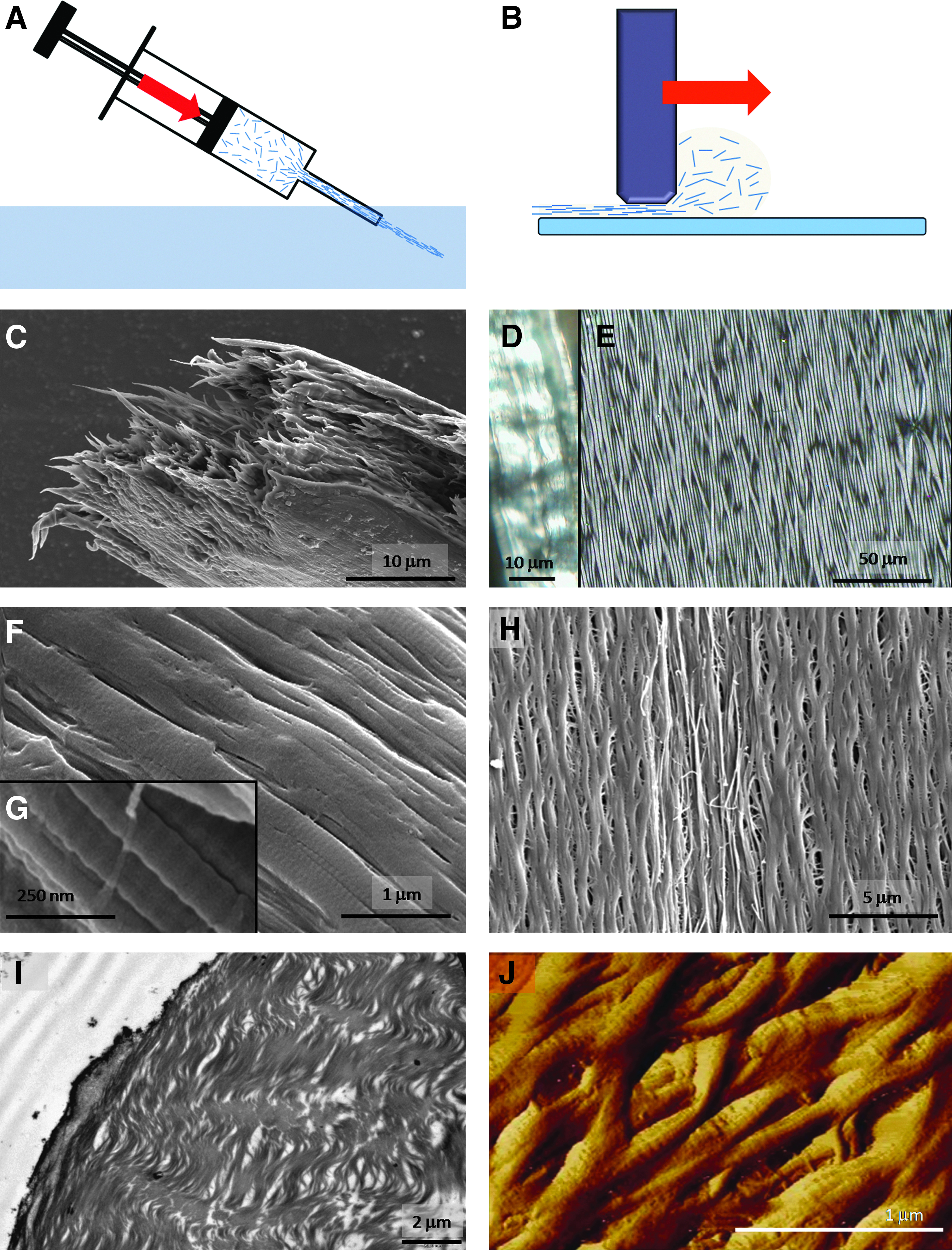
An illustration of shear alignment of Type I rhCollagen mesophases.
The fibers formed by mesophase extrusion display a strong resemblance in structure and morphology to the native tendon as imaged by scanning and transmission electron microscopy (SEM and TEM). Sections of the mesophase wet spun fibers visualized by TEM show the fibers internal structure to be composed of very long, uniform, densely packed, and parallel fibrils, all aligned with the fiber axis in the direction of the applied shear (Fig. 1I). The fibers exhibit a wavy pattern, reminiscent of natural tendon crimp, which is visualized by polarized light microscopy (Fig. 1D). SEM imaging of the fibers outer surface show it is composed of aligned, parallel fibrils, 50 to 500 μ in diameter that stretch along the fiber axis. D-banding is clearly observed (Fig. 1F, G). SEM images of the fiber fractured-end reveal an internal structure of multiple well separated fibrils.
Membranes created by mesophase shear alignment display an ordered array of parallel, well separated fibrils, aligned with the direction of shear (Fig. 1H). As with the fibers, crimp-like arrangement of the fibers is observed. Atomic Force Microscopy imaging of the membranes shows the fibers are D-banded (Fig. 1J).
The combination of high-purity recombinant human collagen and mesophase alignment principles promise to significantly advance us toward formation of collagen scaffolds closely resembling the structure and composition of native aligned tissues, while providing the mechanical properties that will mimic the natural milieu that the cells need to proliferate and differentiate along the lineages required for specific tissue types.
Future Prospects and Summary
Collagen is the most abundant protein in the body, and constitutes the primary material in load-bearing, support, and structural tissues. Aligned and ordered collagen structures form the foundation of tissues, such as bone, tendon, cornea, blood vessels, and nerve sheaths. The ability to control collagen alignment can contribute to many medical disciplines. In orthopedics, aligned collagen fibers can improve the ability of artificial tendons to withstand tensile stresses. In ophthalmological applications, progress in the efforts to meet the growing need for a thin and transparent artificial cornea would be advanced by an array of transverse layers of parallel thin and uniform fibrils. In neurological applications, nerve guides require constructs that can direct the regrowth of peripheral nerve axons, a role that aligned collagen fibers can fill.
Use of shear aligned mesophase collagen enables formation of highly ordered and aligned scaffolds, closely mimicking the morphology and structure of native collagen tissues. Use of this technique, which is exploited in multiple natural systems to order and align collagen, will assist in extending biomimeticity of collagenous scaffolds from the nano- to the microlevel.
Harnessing mesophase shear alignment and recombinant human collagen toward tissue scaffolding will significantly advance tissue repair and tissue engineering disciplines, by improving mechanical strength and morphological parameters of currently available scaffolds. We are of the opinion that improved structural similarity will undoubtedly translate in functional similarity.
Footnotes
Disclosure Statement
No competing financial interests exist.