




Abstract
Extracellular matrix (ECM)-based scaffolds, through their inherent bioactivity and molecular recognition signals, provide the ideal substrate for tissue engineering and regenerative applications. Collagen, the most abundant ECM protein, has proven itself to be a very versatile material with applications in many fields, including the leather and food industries, cosmetics, drug delivery, and tissue engineering. However, doubts persist about the optimal source of collagen for tissue engineering applications, given possible immunogenicity and disease transmission associated with animal sources and reduced bioactivity and availability of recombinant technologies. In this special edition, an attempt is made to elucidate the advantages of plant-derived human recombinant collagen and its applications in tissue engineering, particularly skin and wound healing. While results are promising, the widespread use of animal-derived collagen means that recombinant technologies may find applications in niche areas.
Collagen provides structural support and tensile strength to various tissues of the human body, including skin, ligaments, tendon, and bone. It consists of a right-handed triple helical structure with the repeating amino acid triplet sequence 1 : Glycine-X-Y, where X is often proline and Y is frequently hydroxyproline. The presence of the small amino acid Glycine at every third position on the polypeptide chain allows for close packing of the triple-helix along the collagen molecules central axis. Nonhelical, globular regions exist at either end of the collagen molecule, and prevent fibril formation before cleavage by appropriate proteinases. The properties that have contributed to its popularity as a scaffold material include its relatively low toxicity, natural degradation by matrix metalloproteinases, ease of crosslinking and functionalization as well as the homology of the amino acid sequences that exist between species.
The use of animal-extracted collagen in the fields of biomaterials, drug delivery, and tissue engineering is widespread.2–7 Researchers have mainly focused their efforts on the formulation of collagen into a wide variety of different forms, some of which have reached clinical translation. Collagen sponges have a wide range of applications varying from skin wound healing,8,9 to bone scaffolds10–15 to cardiac patches.16,17 Collagen hydrogels, due to their injectable nature and in situ self-assembly, have also been used for a variety of applications, including the myocardium,18,19 intervertebral disc,20,21 as a dermal substitute, 22 for corneal applications 23 and for regenerating cartilage.24,25 Aligned forms of collagen have been developed and utilized to act as a bridge for tendon,26–28 spinal cord, 29 and peripheral nerve regeneration. 30 Collagen films have primarily been used for wound healing, 31 as they create a barrier between the wound and the external environment, thus reducing the possibility of infection. Collagen can be easily functionalized to add additional therapeutic benefit and bioactivity. For example, sponges and hydrogels can be functionalized with therapeutic genes11,15,32 or proteins,9,12 or used to deliver stem cells,16,19,33 while collagen microspheres not only have high capacity for loading, but also offer localized and sustained delivery of bioactive/therapeutic molecules, such as genes, 34 protein, 35 or stem cells.25,36
Despite the use of collagen in vitro, in preclinical models and in the clinic, there are a number of issues that continue to cause concern. One major obstacle to the clinical translation of these therapies is the source of the collagen used. As Figure 1 outlines, the main sources of collagen type I are porcine skin, bovine tendon, and human cadavers. Unfortunately, each of these has drawbacks associated with its use. The major drawback is possible disease transmission, allergic reactions, 37 contamination with pathogens, as well as antigenicity and immunogenicity associated with the use of collagen telopeptides, although substantial evidence to prove this is lacking. 38 In addition, batch-to-batch variability as well as cultural reasons add to the concern about animal-derived collagen. As a result, much effort has been made in the field of recombinant protein production 39 to utilize expression systems that will allow the formation of recombinant human collagen in a consistent, efficient, and safe manner.
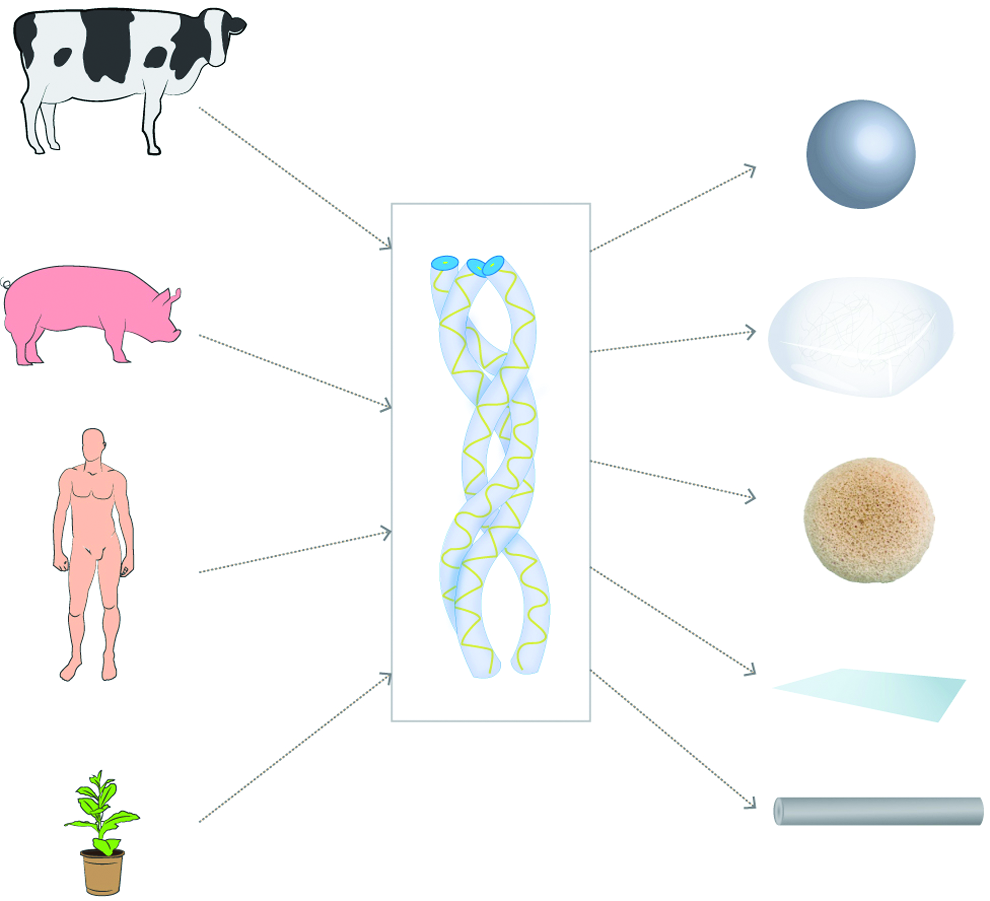
Collagen—sources and forms: the principal sources of collagen (bovine tendon, porcine skin, human cadavers, and human recombinant, from top to bottom) are displayed as well as some of the forms (microspheres, gels, sponges, films, and fibers, from top to bottom) into which collagen has been processed for tissue engineering applications. Color images available online at www.liebertpub.com/tea
The recombinant collagen has been developed in a number of different expression systems, including yeast, silkworm, mammalian cells, transgenic animals, and bacterial systems. Recent developments have seen the production of a post-translationally hydroxylated collagen in relatively large amounts using a transgenic tobacco plant. 40 This collagen would theoretically bypass the concerns that exist with an animal-derived collagen. Recombinant collagens have been used in bone, 14 ocular,41,42 and skin applications, as seen in this issue of Tissue Engineering. They have been used mostly as sponges, but also more recently as electrospun fibers and gels, and have been compared favorably with animal collagens with respect to processability and therapeutic efficacy. 43 Despite these promising signs, recombinant technologies have suffered from a number of drawbacks, which include high cost, low yield, and the lack of cofactors or enzymes in the systems, which are critical to the stable formation of bioactive and biofunctional collagens. Because of these disadvantages, conveniently extracted animal collagen has remained the standard for use in both research and clinical.
While preliminary studies have shown the potential of recombinant collagens, whether produced in yeast or plants, it seems that until higher yields reduce its prohibitive price, researchers are unlikely to embrace its use over collagen from animal sources. However, possible uses for recombinant collagens could involve niche areas, such as the production of type II collagen, which is difficult to extract in large enough quantities from animals and has been associated with the induction of arthritis. 44 Niche areas may be used as testing grounds to fully demonstrate the benefits of recombinant collagens over animal-derived collagen, and may help to bring the technology to the forefront of tissue engineering research and closer to clinical translation.
Footnotes
Acknowledgment
This authors wish to acknowledge financial support from Science Foundation Ireland under Grant No. 07/SRC/B1163.
Disclosure Statement
No competing financial interests exist.