




Abstract
For treating pulpal pathological conditions, pulpal regeneration through transplanted stem/progenitor cells might be an alternative to conventional root canal treatment. A number of animal studies demonstrated beneficial effects of stem/progenitor cell transplantation for pulp–dentin complex regeneration, that is, pulpal tissue, neural, vascular, and dentinal regeneration. We systematically reviewed animal studies investigating stem/progenitor cell-mediated pulp–dentin complex regeneration. Studies quantitatively comparing pulp–dentin complex regeneration after transplantation of stem/progenitor cells versus no stem/progenitor cell transplantation controls in intraoral in vivo teeth animal models were analyzed. The following outcomes were investigated: regenerated pulp area per root canal total area, capillaries per total surface, regenerated dentinal area per total defect area, and nerves per total surface. PubMed and EMBASE were screened for studies published until July 2014. Cross-referencing and hand searching were used to identify further articles. Standardized mean differences (SMD) and 95% confidence intervals (95% CI) were calculated using random-effects meta-analysis. To assess possible bias, SYRCLE's risk of bias tool for animal studies was used. From 1364 screened articles, five studies (representing 64 animals) were included in the quantitative analysis. Risk of bias of all studies was high. Stem/progenitor cell-transplanted pulps showed significantly larger regenerated pulp area per root canal total area (SMD [95% CI]: 2.28 [0.35–4.21]) and regenerated dentin area per root canal total area (SMD: 6.91 [5.39–8.43]) compared with no stem/progenitor cell transplantation controls. Only one study reported on capillaries per or nerves per total surface and found both significantly increased in stem/progenitor cell-transplanted pulps compared with controls. Stem/progenitor cell transplantation seems to enhance pulp–dentin complex regeneration in animal models. Due to limited data quantity and quality, current evidence levels are insufficient for further conclusions.
Introduction
C
Stem/progenitor cell transplantation for tissue regeneration has been applied with promising results in various medical fields, including the treatment of cardiovascular diseases 4 and for periodontal regeneration. 5 Generally, such treatments aim at modulating the local microenvironment to be more inductive for endogenous cells,6,7 to enhance the migration, proliferation, and commitment of endogenous and/or exogenous stem/progenitor cells to suitably committed cells, and to favor the biosynthesis of extracellular matrix components for tissue regeneration. 8 The locally delivered stem/progenitor cells thereby exert their effects at multiple levels, including neovascularization, 9 immunomodulation, 10 and tissue regeneration, 5 relying on their multipotency 11 and sensitivity to local paracrine activity. 4
The pulp–dentin complex originates embryonically from the neural crest ectomesenchyme and constitutes physiologically and functionally a single unit, providing vital functions for tooth homeostasis. 12 The dental pulp is a richly vascularized and innervated connective tissue comprising heterogeneous cell populations, among which stem/progenitor cells are anticipated to constantly replenish odontoblasts to form secondary and tertiary/reparative dentin throughout adult life. 13 In reparative/regenerative approaches, mesenchymal stem/progenitor cell transplantation into endodontically treated root canals was therefore attempted to regenerate the damaged dental pulp–dentin complex.
So far, most of this research has been performed in animal experiments due to remaining doubts about the safety and efficacy of such treatments as well as ethical constraints. However, to translate experimental outcomes from animal models to human clinical trials, both the design and the results of these animal studies need to be critically and systematically appraised to identify gaps in their validity and to assess the reported effects of the regenerative endodontic therapy. The goal of the present study was to provide such systematic and critical review of the available data from animal studies on stem/progenitor cell transplantation for pulp–dentin complex regeneration.
Methods
Reporting of this review follows the guidelines outlined by the SYstematic Review Centre for Laboratory animal Experimentation (SYRCLE). 14
Searching
We systematically screened electronic databases (Medline via PubMed, EMBASE) for articles published between November 1971 and July 2014, and additionally performed hand searches in relevant journals, including Journal of Dental Research and Journal of Endodontics, Stem Cells, and Tissue Engineering. Unpublished (gray) literature was searched through opengrey.eu. Our search strategy used a two-pronged approach, combining keywords for stem cells with keywords for pulp regeneration (Supplementary Table S1; Supplementary Data are available online at www.liebertpub.com/teb). No language restriction was applied. Screening of titles and abstracts was independently performed twice by two reviewers (K.F.E. and K.J.). A third reviewer (C.D.) was consulted in case of disagreement to reach a consensus regarding potential eligibility. Identified articles were assessed in full text and eligibility independently decided by two reviewers (K.F.E. and K.J.). In case of disagreement, consensus was obtained by consulting a third reviewer (C.D.). Bibliographies of full texts were used for cross-referencing.
Selection
The following inclusion criteria were applied:
1. Study design: We included animal studies transplanting stem/progenitor cells in intraoral experimental pulpal regeneration models, mimicking the clinical oral condition in humans. Studies needed to quantitatively report on one or more of the defined outcomes. 2. Intervention: stem/progenitor cell transplantation without further treatment with growth/differentiation factors etc. 3. Control: no stem/progenitor cell transplantation. Controls were groups without active treatments, that is, only scaffold/carrier or no treatment (empty pulpal cavum) groups. 4. Outcomes: We assessed one primary and three secondary outcomes: pulpal regeneration (regenerated pulp area per amputated root canal total area); dentinal regeneration (regenerated dentinal area per total defect area); vascular regeneration (capillaries per amputated root canal total area); and neuronal regeneration (nerves per amputated root canal total area).
Quality assessment
For risk of bias assessment, guidelines outlined by SYRCLE
14
were used. The following domains were evaluated:
1. Selection bias: The method of sequence generation was assessed and results of randomization were controlled by evaluating baseline characteristics of test and control groups (age, sex, weight, rearing conditions). Allocation was evaluated with regard to the allocation sequence (sequence generation before lesion induction or not) and adequate concealment. 2. Performance bias: Random housing (i.e., comparable housing of test and control animals) was assessed since housing conditions might influence study outcomes.
14
Blinding of operators and personnel involved with the animals was evaluated. 3. Detection bias: Blinded outcome assessment and outcome assessment at random (i.e., test and control animals were randomly assessed) were evaluated. 4. Reporting bias: If available, comparisons between published protocols and eventually reported data were made. Selective reporting was further evaluated by comparing expected with actual outcome reporting. 5. Other bias, for example, by industry sponsorship.
Data abstraction and study characteristics
Aggregated data were abstracted from each included study using pilot-tested spread-sheets. Data abstraction was independently performed by two reviewers (K.F.E. and K.J.) and eventually pooled, with consensus being reached by discussion or mediation by a third reviewer (C.D.). Missing information was retrieved from study authors if possible. The following outcomes were assessed: study design (random or nonrandom allocation of interventions, parallel-group or split-mouth study), animal model (in which animals and teeth were interventions performed), defect to be regenerated (what kind of defects were treated and how were they induced), stem/progenitor cell generation (source and preparation of stem/progenitor cells), carrier (type and preparation of carrier), intervention groups (what interventions were performed in which teeth, total, and group sample size), examination (follow-ups and histological preparation and assessment), planned and reported outcomes (assessed from text, tables, or through evaluation of figures), funding information, and reported conflict of interest. For further quantitative evaluation, data from the latest time point at which relevant outcomes were reported were used, as long-term effects are more relevant with regard to regeneration outcomes.
Quantitative synthesis
The unit of analysis for quantitative synthesis was the treated pulpal defect. To standardize the results of studies assessing the same outcome through different measurement parameters, we used standardized mean differences (SMD) and 95% confidence intervals (95% CI) as effect estimates. 15 If studies reported separate estimates for subgroups of test and control interventions, two interventions most closely fitting to the inclusion criteria—as decided by two reviewers (K.F.E. and K.J.)—were used for meta-analysis. Inverse generic meta-analysis was performed using Comprehensive Meta-Analysis 2.2.64 (Biostat, Englewood, NJ).
Heterogeneity was assessed using Cochran's Q and I 2 statistics. 16 Since heterogeneity was mostly found to be substantial (I 2 >50%), random-effects models were used for meta-analysis. Given the low number of included studies, no subgroup or metaregression analyses were performed. Publication bias was assessed using funnel plots as well as the Egger regression intercept test. 17 Note that given the low number of included studies (Fig. 1), the outcomes of such tests should be interpreted with caution.

Flowchart of study selection. Details of studies excluded at the full-text stage can be found within the Supplementary Tables.
Results
Our search yielded 1364 records, with 92 articles being possibly eligible after review on the abstract level and hand searching. Eighty-seven studies were excluded (Supplementary Table S2), while five studies were included, reporting about 64 animals and 222 pulps (Fig. 1). Two of these studies allocated treatment and controls at random,18,19 while three used a nonrandom design. All studies were published between 2004 and 2013 and used parallel-group designs. All but one study 19 used dogs as experimental animals. Four studies transplanted allogenic stem/progenitor cells into the experimental defects, while one study transplanted autogenous cells. 20 All stem/progenitor cells were isolated from adult animal dental pulps, except for one study that obtained the cells from the pulps of deciduous teeth. 19 Two studies selected subcultures from the pulp stem/progenitor cells for transplantation.21,22 Follow-up ranged between 28 and 180 days (median 90 days). Pulpal, dentinal, vascular, and neuronal regeneration were reported histologically by three, two, one, and one studies, respectively (Table 1). Regeneration was investigated on multiple hematoxylin and eosin-stained histological sections taken at intervals ranging from 100 μm to 150 μm in conjunction with digital imaging techniques. For vascular and neural regeneration assessments, staining through BS1-lectin and PGP9.5 was conducted, respectively, to facilitate specific quantification. Consequently, ratios of the regenerated pulpal, dentinal, vascular, or neural tissues to the experimentally created defects were calculated for quantification purposes (Table 2). Two studies did not quantitatively report results from the scaffold/carrier or no treatment group.20,22 In these cases, no pulpal or dentinal regeneration was assumed, with standard deviations being imputed (0.0001) for quantitative synthesis. We checked for the impact of this assumption using sensitivity analysis.
Test and control groups are written in bold.
DPSCs, dental pulp stem cells; SHEDs, stem cells from human deciduous teeth; β-TCP, β-tricalcium phosphate; Ca(OH)2, calcium hydroxide; G-CSF, granulocyte colony-stimulating factor; Gdf11, growth/differentiation factor 11; SDF-1, stromal cell-derived factor; SP, side population.
H&E, Hematoxylin and eosin; SD, standard deviation.
Risk of bias of included studies was generally high, with high risk of selection, performance, and detection bias in all included studies (Table 3). Additionally, four of the five studies were published by the same group, which might raise doubts regarding the generalizability of the results. All studies were funded by the authors' institutions, and the authors reported no potential conflicts of interest.
Yes: white, unclear: light gray, no: dark gray.
By pooling data from three studies (7/7 animals and 23/23 treated pulps in test/control groups, respectively), the regenerated pulpal area was found to be significantly larger after stem/progenitor cell transplantation than after control transplantation (SMD [95% CI]=3.12 [0.38–6.26]). This estimate decreased, but remained statistically significant in favor of transplantation when imputed estimates were omitted from the analysis. Neither funnel plot inspection nor the Egger test indicated publication bias. By pooling data from two studies (5/3 animals and 29/21 treated pulps in test/control groups, respectively), dentinal regeneration was found to be significantly larger after stem/progenitor cell transplantation than after control transplantation (SMD=6.91 [5.39–8.43]). This remained statistically significant in favor of transplantation when imputed estimates were omitted. For both comparisons, substantial statistical heterogeneity was present (Fig. 2). Only one study 18 with 3/3 animals and 12/12 treated test/control teeth reported vascular and neural regeneration and found the regenerated capillary area (SMD=5.10 [3.45–6.75]) and regenerated neural area (SMD=8.85 [6.23–11.50]) to be significantly larger after stem/progenitor cell transplantation compared with the control (Fig. 2).
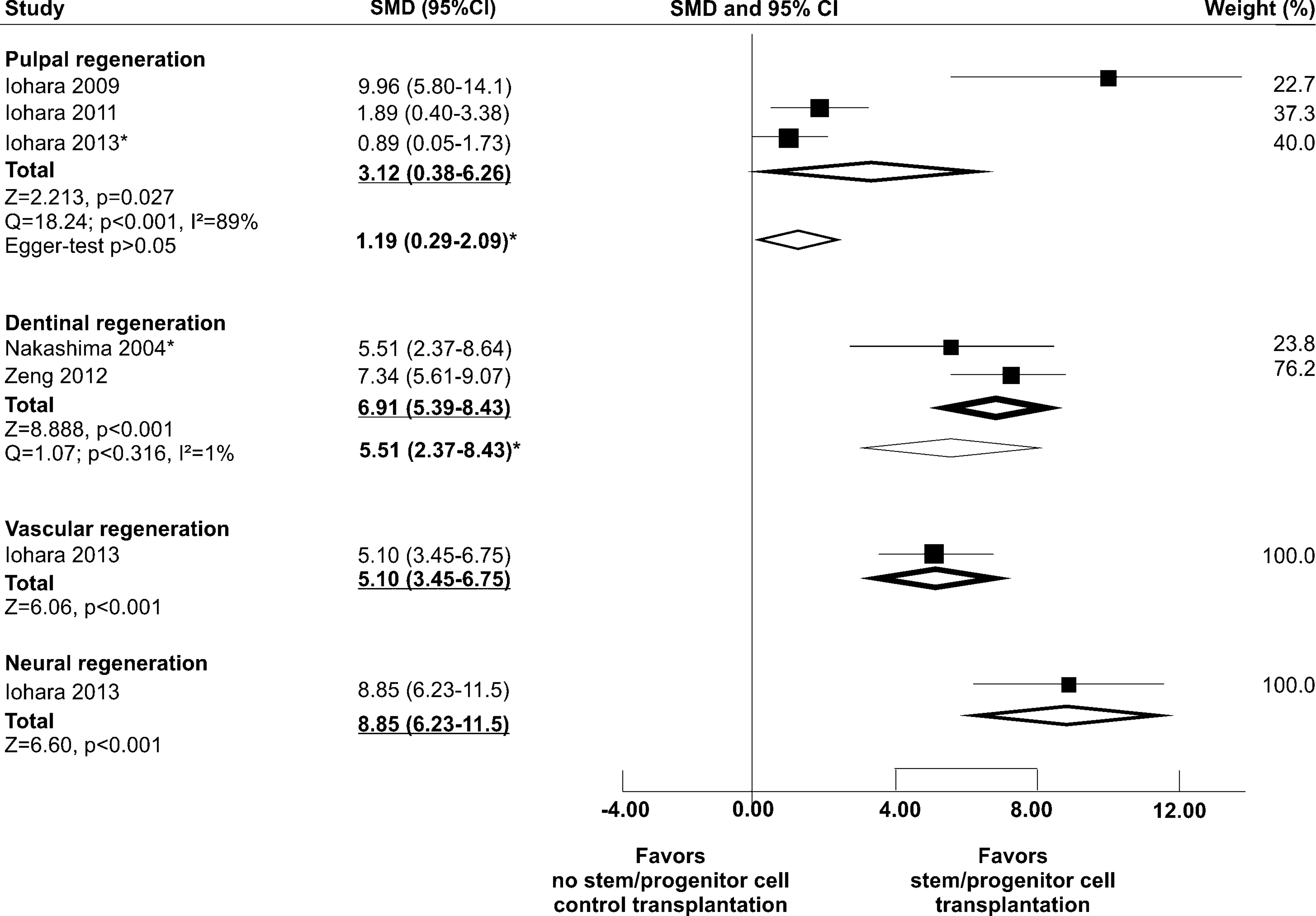
Meta-analysis for pulpal, vascular, and dentinal regeneration of pulpal defects after stem/progenitor cell or control transplantation. Study data, standardized mean differences (SMD), 95% confidence intervals (95% CI), relative weight (%), and pooled effect estimates for different outcomes (bold) from random-effects meta-analysis are presented. Heterogeneity was assessed using Cochran's Q and I 2 statistics, and publication bias was evaluated using the Egger test if more than two studies were pooled. For pulpal and dentinal regeneration, we imputed missing values from control groups (indicated by asterisk). Omitting these values from the analysis decreased the effect estimates, but did not change the level of statistical significance (asterisks, thin-lined diamonds). Z overall test statistics, p level of significance.
Discussion
Pulpal tissue regeneration is a hard-fought goal in regenerative endodontology.3,23 The efficacy of pulpal tissue regeneration has been predominantly assessed using qualitative histological approaches, with only few studies applying quantitative evaluations (defining and quantifying the amount of the experimentally regenerated tissues). A challenge to the quantitative assessment of a successful pulp–dentin complex regeneration remains—the definition of the primary regenerative outcomes; whether neural, vascular, soft, or hard tissue/dentinal regeneration. The current systematic review explored the current quantitative evidence of the capacity of stem/progenitor cells to regenerate the pulp–dentin complex in animals.
Interpretation of the results from this systematic review should be made with caution and balanced according to the limited number and quality of included studies. None of the studies had performed sample size calculations, resulting in limited statistical power. The choice of experimental animals was not standardized as well (four studies employed an experiment model in dogs, while one study used a minipig model), and further heterogeneity stemmed from differences in the creation of experimental defects, which comprised pulp chamber defects 19 and partially 22 or completely removed or amputated pulps with variable apical foramen enlargement.18,20,21 No sound evidence exists as to which of these models is most suitable to mimic the pathophysiology in humans. Moreover, no split-mouth designs were applied in the animal models to reduce interindividual variability, while clustering of statistical units within the same animal was common, which artificially decreases statistical variation. Randomization of treatments to defects was performed in only two studies,18,19 while blinding of the examiners was reported in only one study. 19 Overall, studies were at high risk of selection, performance, detection, and reporting bias.
Except for one study using autogenous stem/progenitor cell transplantation, 20 all studies transplanted allogenically isolated stem/progenitor cells. All stem/progenitor cells were isolated from pulps of adult animals, except for a single study obtaining the cells from the pulps of deciduous teeth. 19 The selection of different subcultures from the pulp stem/progenitor cells in two of the studies21,22 adds to the mentioned heterogeneity. No evidence exists regarding the influence of such subculture selection on the properties of the cells and their regenerative outcomes.
The selection of the biomaterial/scaffold used to support the stem/progenitor cells' delivery is critical in influencing the treatment outcome and the regenerated tissue types. 24 Ideally, the scaffold should mimic the cells' microenvironment, giving the required structural signals, adhesion molecules, and pore size for homing, differentiation, and phenotypic acquisition, 25 while allowing cell–cell and cell–matrix interactions. 26 Even minute differences in the scaffold geometry, pore size, elasticity, mechanical properties, chemical composition, and degradation rate can greatly influence the cells regenerative behavior in vivo.23,27 In the analyzed studies, the scaffold/carrier selection was closely related to the design of the experimental defect, with mineralized β-TCP used for capping of pulp defects, while those studies with partial to complete pulpal removal/amputation used cell pellets in the absence of a scaffold or applied cells on different collagen carriers to conform to the respective pulp chamber form. Again, these scaffolds have not been sufficiently and comparatively validated a priori while potentially affecting the transplanted cells' attributes, including cell proliferation rate and differentiation. 28
Due to the complexity of pulpal tissues, no universally accepted primary outcome is currently available to assess pulp–dentin complex regeneration. However, a consensus exists about the importance of neural and vascular reinnervation for successful pulp–dentin complex regeneration. 29 Four regenerative outcomes were investigated by the present review, namely regenerated pulp area, regenerated dentinal area, capillaries per total surface, and nerves per total surface. Insufficient studies were present to draw conclusions regarding vascular and neuronal regeneration. All outcomes had been assessed using the described specific or unspecific histological assessments. Functional pulp regeneration, however, additionally requires evidence of thermal or electric pulp testing results, which assess whether there is response to a stimulus mainly by functional Aδ-fiber innervation, in addition to using pulse oximetry or laser Doppler flowmetry evaluating the pulp's vascular supply both with high sensitivity and specificity. 30 Apart from a significant correlation recorded in case of an absence of vitality response and complete pulpal necrosis, the pulpal histological status generally poorly correlates with vitality testing results, 30 posing a limitation in relying solely on histological methods and requiring the combination with additional functional innervation and vascularization tests to comprehensively assess functional pulp–dentin complex regeneration.
The fact that four of the five studies included in the quantitative synthesis were conducted by the same group might further impact on the generalizability of the findings.18,20–22 Despite that stem/progenitor cell-transplanted defects showed significantly larger regenerated pulpal and dentinal regeneration than no stem/progenitor cell transplantation controls histologically, the clinical relevance of these effects remains unclear. Moreover, the need to impute values for control groups increases the uncertainty within the estimates, while sensitivity analyses did not find our findings to be greatly altered when omitting these values from the analysis. The variability in outcome reporting calls for a defined set of outcomes for animal studies investigating pulp–dentin complex regeneration.
Conclusion
Stem/progenitor cell transplantation seems to enhance pulp–dentin complex regeneration in intraoral animal models in vivo. However, these findings are based on a small number of included studies, with greatly deviant models, different interventions and controls, and high inherent risk of bias. Thus, our results should be interpreted with caution. Future studies should apply an accepted and standardized methodology and use a defined set of outcomes that best represent functional regeneration of pulpal tissues in humans. These outcomes should be assessed comprehensively, that is, using other than histologic means, with comparable and reproducible methods used for evaluating pulpal regeneration. Current evidence levels are insufficient for further conclusions.
Footnotes
Acknowledgment
This study was funded by the authors' institutions.
Disclosure Statement
The authors declare no conflicts of interest.
References
Supplementary Material
Please find the following supplemental material available below.
For Open Access articles published under a Creative Commons License, all supplemental material carries the same license as the article it is associated with.
For non-Open Access articles published, all supplemental material carries a non-exclusive license, and permission requests for re-use of supplemental material or any part of supplemental material shall be sent directly to the copyright owner as specified in the copyright notice associated with the article.
