




Abstract
Marine biomaterials display properties, behaviors, and functions that have not been artificially matched in relation to their hierarchical construction, crack-stopping properties, growth adaptation, and energy efficiency. The discovery and understanding of such features that are characteristic of natural biomaterials can be used to manufacture more energy-efficient and lightweight materials. However, a more detailed understanding of the design of natural biomaterials with good performance and the mechanism of their design is required. Far-reaching biomolecular characterization of biomaterials and biostructures from the ocean world is possible with sophisticated analytical methods, such as whole-genome RNA-seq, and de novo transcriptome sequencing and mass spectrophotometry-based sequencing. In combination with detailed material characterization, the elements in newly discovered biomaterials and their properties can be reconstituted into biomimetic or bio-inspired materials. A major aim of harnessing marine biomaterials is their translation into biomimetic counterparts. To achieve full translation, the genome, proteome, and hierarchical material characteristics, and their profiles in space and time, have to be associated to allow for smooth biomimetic translation. In this article, we highlight the novel science of marine biomimicry from a materials perspective. We focus on areas of material design and fabrication that have excelled in marine biological models, such as embedded interfaces, chiral organization, and the use of specialized composite material-on-material designs. Our emphasis is primarily on key materials with high value in healthcare in which we evaluate their future prospects. Marine biomaterials are among the most exquisite and powerful aspects in materials science today.
Marine Biodiversity and Medicine
T
The marine biosphere has been extensively exploited for food and raw materials, primarily along the continental shelves. Vast deep ocean areas totaling 1 billion cubic kilometers are inaccessible. Exploitation of the organic ocean specifically to extract biomaterials and chemical compounds for technology applications (Marine Organic Products) is growing once again, but it must be used sustainably. 4 Marine biomaterials are a significant fraction of marine biotechnology products and an economic asset of 64 billion dollars by 2015. To date, marine biomaterials have been utilized in technical products, such as toxins, pigments, and nanoparticles. They also provide many structural and chemical elements that play important roles in tissue engineering.5–8
Natural marine products have been widely exploited for biomedical purposes. This endeavor has been restricted over recent years because of the inability to yield sufficient quantities, characterize structures, and define and validate products' biological activities. 4 New techniques in nanoscale nuclear magnetic resonance and total chemical synthesis may alleviate definition and validation problems. 9 Natural products can uniquely offer pharmaceutical product design and development, as they are chemical compounds that are anchored in the biological chemosphere (the space reserved for all possible biological molecule combinations). Thus, they are predesigned to react with biological hosts and with exact spatial geometries, such as chirality that is vital for biological function and innovations. For example, highly configured receptor-ligand binding specificities are important for proper molecular cascades along many signal transduction pathways and, hence, cell function.
Architectural frameworks, functional group richness, rules of clustering, tailoring, and pathway construction are events that regulate native responses to developmental, regeneration, and remodeling programs.6,10,11 Synthetic chemistry methods based on combinatorial methods have yet to mimic these events. 12 The latent potential remains strong and offsets these issues because of the numerous unaccounted candidates, particularly among prokaryotic organisms. One such example is the discovery of a bacterial Taxon, Entotheonella, which has a unique and large metabolic portfolio. 13
Marine metazoans are also good candidates for productive yields of chemical compounds and, to a lesser extent, biomaterials. It has become technically feasible to grow marine sponge biomass inside aquaria and sponge cell populations and primmorphs in culture flasks with the goal of producing secondary metabolite-based drug compounds. 14 In the future, there may be techniques available to grow key organisms for many purposes, including biomedicine. These advances would relieve pressure on already heavily stressed and severely damaged marine habitats and environments.
In biomimetic approaches, where learning lessons from nature in design, synthesis, and construction is the core guiding philosophy, there is a tendency to focus on extraordinary phenomena and designs, but even technically ordinary natural adaptations and solutions with acceptable artificial versions provide us with novel potential refinements. Evolutionary products provide copious optimal solutions to problems of survival in a highly competitive environment, imposition of genetic and metabolic constraints, and restrictions from the habitat with food, energy, and living spaces. The marine environment is vast and largely unexplored in benthic and deep-sea locations. There are similar opportunities to sustainably prospect for relevant organic and inorganic products for use in the pharmaceutical, biotechnology, and materials industries.
A promising candidate in materials synthesis is silicate and its role in fabricating silica-based materials and structures. 15 These products include bioactive secondary metabolites, bioactive chemical compounds, and biomaterials. Marine sponges are a prominent target for bioprospecting and exploitation for diverse applications, as they possess genomic sequence homologies to most other metazoans and possess more genes than all other metazoans. 16 The greatest problems with bioprospecting include efficient harvesting, yield, and proper biological production. In addition, human interventions need to be sustainably practiced with extreme care for the environment with minimum habitat interference. These are considerable challenges, especially in an economic system that disregards such externalities. There are many practical barriers in translating biological products into technological products. A thorough examination, characterization, sequence profiling, and validation of datasets are necessary to generate proper biological molecules with functional technological roles.
The problem-solving landscape is distinct from the human technology landscape. However, there are commonalities and shared problems faced by the two. Even structural and material solutions in nature that are less than ideal (sufficient to increase survival and gain a competitive edge in a particular habitat) often have design concepts that can be used in human technology to solve key problems better than human ingenuity or in a way that is more efficient, more effective, and energy efficient. The latter is the biggest advantage to biomimetic routes to discovery and innovation, as humans continue to face a looming energy crisis. In this review, we highlight prominent examples of marine biomaterials that are the subject of interest in medical biomimicry by providing key innovations and improvements to materials design and performance for medicine.
Marine Biomimetics and Materials Fabrication
Biomimicry is one of the most fundamental science innovations. Mimicking nature is an ancient idea ingrained in humans, because nature was the first master of invention. Nature-derived artifacts were used as crude implants, tools, and weapons for hunting, and the marine environment has always been a rich source of useful technological products; it continues to be so today in different forms and for more advanced purposes. “Use of invertebrates and selected parts of them” for medicinal therapy dates back to ancient Egypt and ancient Asian civilizations, though many of their purposes are unknown. 17 A leading example in regeneration therapy is nacre seashell, which was first used by Ancient Mayans as a tooth replacement, owing to its strength and ability to bind into the jaw without major trauma or injury as deduced from repaired bone structure conditions.
Synthetic biomimicry of these complex natural materials is rooted in the chemistry of growing formations in solid matter. The use of a chemical-based approach to orchestrate complex form generation was first developed from the pioneering chemistry lab of Harting that is known for producing skeletal facsimilies and from the mechanistic insights of Lowenstam on facilitated biomineralization, which may be the true origin of biomimetic materials chemistry.18,19 Only recently has the emergence of complex soft matter and inorganic–organic composite formations, emulating organisms, become possible. Such materials chemistry faces the challenge of replicating chemical processes used in biomaterial fabrication. This can be achieved by pure chemical means20,21 or with biological elements and objects and systems to control construction and final structure (Fig. 1). 22

Chemical replication of “complex inorganic formations evolved by natural selection” using self-organizing media systems.
Virus capsules are a subject of intense investigation as a collective set of nano-objects that act as templates for material synthesis, fabrication, and mineralization. Single-celled Algae of marine origin could also be used as a template for directed material synthesis. Specifically, shells of Diatoms have been used to control calcium phosphate crystal shapes and growth bound to their silica surfaces (Fig. 1).
The modern revival of biomimicry originated from Schmitt, who manufactured a physical device that mimicked the way in which a nerve sends electrical pulses through fibers.23,24 The modern biomimetics field has advanced, as it began by selecting the candidate through nonanecdotal means and mere observations of individual natural candidates. It has now developed into a systematic science. Mathematical formulas based on “set theory” algorithms have been developed to seek and select the strategies, principles, and functions that best solve the problem at hand. This is one striking method of the problem-solving discovery according to a system or plan based on a framework of clearly defined biological solutions. The power of the system in generating solutions is increased by adding the solutions from all patented human innovations.24–26 This coincides with the increasing knowledge of organisms' natural history, and mechanical, material, and operational design in a variety of ecological contexts.
Biomimetic principles and concepts have informed and channeled an effective route for innovation and design. However, there are some similarities with human-driven routes to innovation. Thus, they should be used in conjunction. An outstanding question is how to collate and systematize all the biological innovations and the strategies and functions employed. It has been possible to reinvent natural solutions by detailed observation and characterization of specific examples. We suggest two main pathways for discovery with the principles of translation originating from natural examples.
Discovery organized by taxonomic group based on principles of shared properties
Material-centered innovations can be sourced across a taxonomic group, in which an individual species exhibits a known design strategy of interest. The other members of the taxon are likely to exhibit variations in the strategy to a greater or lesser extent based on the degree of genetic relatedness. The variations often correlate with different environments or external selection pressures, such as competition for space and resources. Studying design variations can point to incremental re-designs for materials and structures based on the original candidate. A rare example of this approach is the adaptive radiation of silk biomaterials. Silk's structure and mechanical properties have been subjected to strong selection pressures, leading to substantial variations in silk structure and mechanical properties between species. In one analysis, the variations in amino-acid sequences were attributed to ecology and natural history. 27 Comparisons between these species show the strong relationship between silk biomaterial performance and the host's survivability, abundance, and diversity. 28 Silk proteins have been widely investigated as a medical biomaterial due to their strength as fine threads.
Discovery based on the function and strategies of individual species
Biological databases contain lists of information filled by any systematically organized biological data. They function to direct attention to close relationships between subjects and objects in a specific category. For example, the highly accessible Ask Nature database lists functions and strategies from hundreds of different organisms (www.asknature.org). The list is continually refreshed and extended to include newly discovered functions and strategies from new and reappraised natural history and field biological observations. Evolutionary explanations of natural phenomena are necessary to properly understand the role and purpose of these strategies. Only then will it be feasible to design and manufacture a true biomimetic analog that operates within its newly defined role and with the possibility of new constraints.
Some general themes have emerged where marine organisms offer engineering solutions that have been unsatisfactorily resolved by human ingenuity and engineering design. Arguably, human ingenuity commonly goes beyond nature or has the capacity to solve problems in similar manners to the nature-derived archetypes over time, but nature is a system that resolves with superior economies and energy efficiencies. The greatest accolade from nature is how it succeeds with counterintuitive design. Some materials derived from the marine biosphere include underwater glues,29,30 other attachment mechanisms in water environments, 31 developing unpredicted methods of underwater locomotion, heat tolerance in hydrothermal conditions, pressure and cold tolerances, and materials inspiration for stimuli-responsive mechanical actuation.32–34
Structural marine biomaterials are a major target for discovery and investigation, as they have direct relevance in engineering (molecular to macro metric), architecture (megascale), and biomedical fields. 35 Several commercial products are based on marine biomaterial ingenuity. For example, marine sponge collagens have been successfully used as frameworks for tissue regeneration and for reconstitution into cell culture and tissue engineering products. Shark skin collagens (derived from Scyliorhinus canicula) have been fabricated into membranes for drug delivery 36 and into porous cross-linked hydrogels. 37 New composite variations, structural materials, and ideas on fracture toughening and material interface engineering have arisen from the careful study of many marine organisms. One example has been the study of nacre structural engineering.
Decade-long research has uncovered a cluster of novel fracture toughening designs at different scales, from fiber pull-out systems, micro cracking, crack branching, and bridging. 38 New models define the nanoscale structure and architecture in increasing resolution, but structural models of the adhesion and cohesion proteins involved do not exist. Very recently, the molecular structures of two mussel foot proteins (mfp3, mfp5) have been analyzed with respect to their adhesion properties. 39 Adhesive proteins are familiar targets. Mussel adhesion proteins proteins have been investigated and are promising candidates for biotechnology as adhesives on hydrated “polar surfaces.” 40 Typical examples of organisms studied are tube worms, starfish, and sea cucumbers. Sea cucumbers secrete proteins and carbohydrates as a glue. The primary phenolic protein involved in mussel and barnacle adhesion is mefp. However, its extraction does not readily or easily yield sufficient amounts for practical use. Therefore, emphasis has been centered on recombinant strategies and biomimetic variations. 41 However, recombinant versions of silks and mussel adhesive proteins have not matched the properties of their natural counterparts. 42
Emergence of New Structural Biomaterials from the Marine Biosphere
As the search and discovery in living oceans are being conducted, new biomaterials, new structures, and new modes of construction have emerged. Bacteria and single cell organisms are the starting point. Many organisms utilize rare biominerals and inorganic elements that were originally believed to be used only in manmade materials. Extremophiles have demonstrated new ways of processing inorganic ions and molecules from earth minerals under mild reaction conditions, at room temperature, in solution at near neutral pH, using an array of specialized enzymes, proteins, and peptides. 43 Many other organisms use inorganic matter for sensing, protein deactivation, electron transport disruption, and detoxification. Magnetite (Fe3O4), inorganic polyphosphates, and metal nanoparticles (noble metal ions) are examples of these.43,44
Marine invertebrates generate limited numbers of well-defined biomaterials with a great variation in architecture and composition across anatomical locations. Natural organisms have evolved exquisite and sophisticated control of structures, architectures, and constituents at any time and space scale. Deeply embedded interfaces provide many toughness characteristics. 45 The first step in biomimetic translation is construction from the nanoscale where the first foundation interfaces are arranged and organized. The organic components are pivotal in biomineralization from incipient nanocrystal formation and transformation from high-order liquid crystal phases to impregnation of the macroscopic organic framework in mineralization and final densification. The addition of embedded interfaces gives rise to the property of adaptations and self-adjustments to wide-ranging environmental effects on the material, which are continually changing.
The structural diversity exhibited by marine biomaterials is becoming increasingly important, not only as a statement of biodiversity and new composite engineering design strategies, but it also strongly represents a new, abundant source of replacements, fabrics, and templates for use in regenerative medicine and medicine. 46 Marine-derived collagens, gelatins, elastin, and keratins from marine vertebrates have emerged as engineering candidates. Unique structural designs in corals, marine sponge skeletons, Copepod teeth, Molluscan radula, fish scales, and fish skin have inspired engineering materials and composite structures.47,48 Ehrlich has listed and described the materials and structures across marine invertebrate clades, together with their intrinsic compositions, organization of elements, and construction phenomena. Structural proteins, collagen, and crystalline chitins predominate in bulk tissues and skeletons.
A composite materials strategy is a common theme highlighted by silica-aragonite-chitin and silica-chitin-apatite tri-phase systems. In the lower orders, there are particularly unique materials, such as antipathins, gorgonins, and spongins. Other notable two-phased materials are chitin and silk-like proteins and gels found inside marine sponges, coralline algae, and some coral species. The chitin silk complex is a notable feature of the organic matrix in nacre. Chitins seem to be the predominant structural biomaterial in lower organisms; they are replaced by collagens in the higher orders of taxa. 48 Silica, calcium carbonates, and occasionally less abundant minerals such as magnetite and iron are incorporated into skeletal structures. Some unusual halogen elements such as bromides are also included in the skeletal constitution.
Brominated compounds have been found in marine demo sponges, perhaps associated with chitin via covalent linkages. 49 Silk-fibroin-like proteins are also positioned in matrices between skeletal elements. Many marine biomaterials consist of composites of chitin nanofibrils that are embedded within a silk matrix to create a stiff but yielding fabric, due to the presence of multi-stacked hydrogen bonds within the crystalline chitin, and arranged between chitin and silk-like proteins. This structure and assembly is present in mineralized nacre seashell as a constituent of the organic matrix between microscopic crystal plates, and notably, in marine mussel byssus threads. 50 Selected biomimetic versions of the nacre organic matrix functional composition have been recreated with chitosan-silk nanofibers and natural chitin with silk. In contrast, byssus thread silk proteins have been artificially manufactured by gene modification in Escherichia coli. 50 Accordingly, silk fibroin yields are significantly higher than direct extraction approaches and do not lead to cell toxicity.
Further biomimetic translation will only be possible with deeper characterization of the whole genome and the protein profiles with post-translational modifications. Progress in these areas has been slow due to the lack of genomic maps for most marine organisms. Second, protein extraction from marine biomaterials is limited by poor solubilities and long characterization steps. 51 By pairing together genome datasets using the most complete and efficient typing method, next-generation RNA sequencing, and proteome outputs, from advanced proteomic tools such as MS, microarrays, predictive Edman degradations, and amino-acid analysis, it becomes faster to identify the “primary protein sequence.” This provides the technical molecular identities and associations that facilitate re-fabrication of artificial and replicated biomaterials. 52 Therefore, with precision typing and sequencing of amino acids and protein structures (with modeling) of any protein-based biomaterial (inferred from amino-acid associations), extrapolations into biomimetic structures are feasible, which closely relate to the end-use function (Fig. 2).
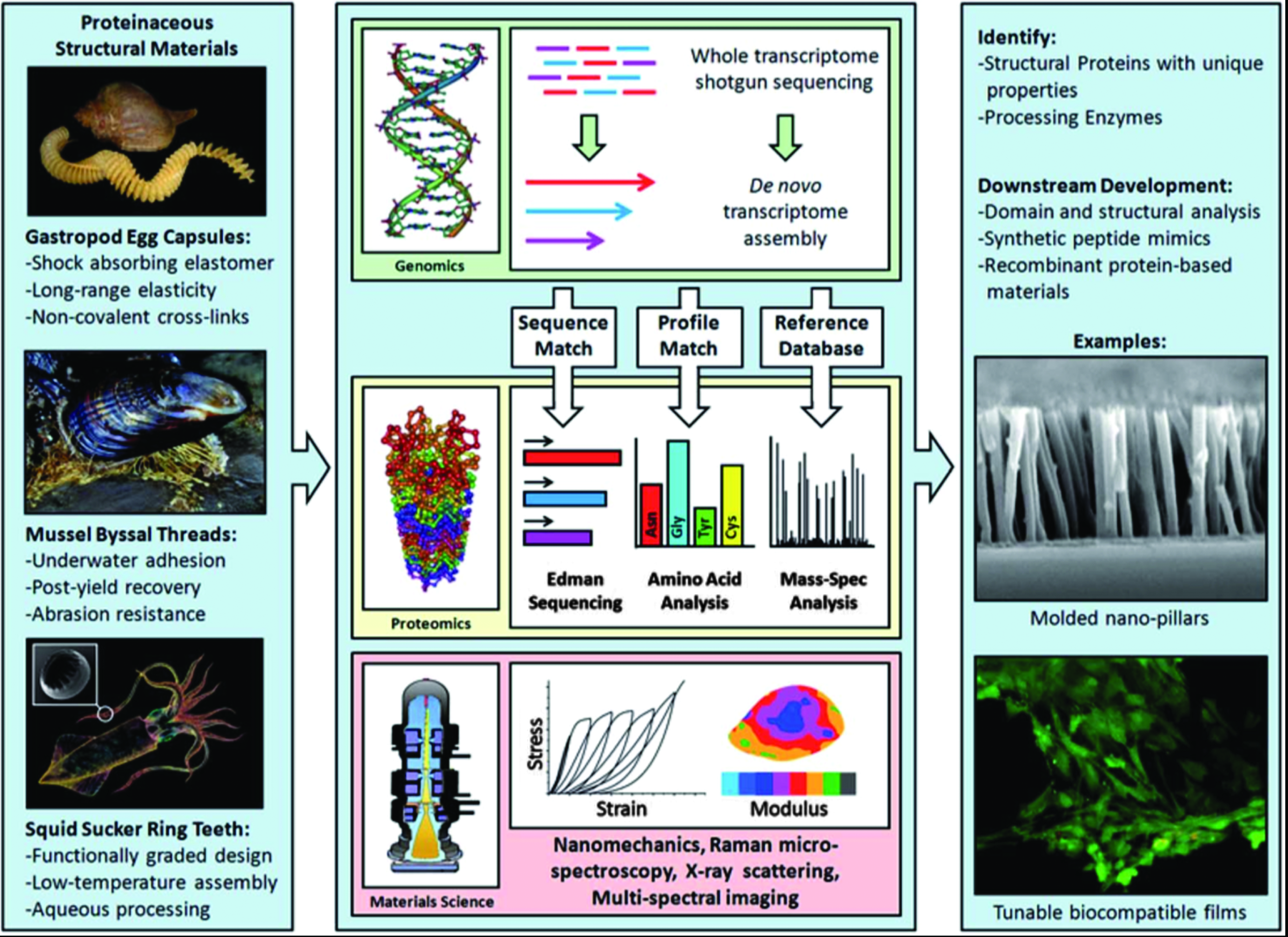
An “accelerated” pathway (procedure) for translating biological material design and fabrication into biomimetic material analogs and homologs. 53 Typical reductionist analysis of a biomaterial's composition and structure was often very cumbersome with traditional chromatography and X-Ray diffraction techniques. The genetic program for such materials sequenced at the transcriptome, co-matched with the protein infrastructure of such materials, can unravel the basis for biomaterial properties. Recombinant synthesis and expression of these sequences can lead to new biomimetic materials with matching properties and in more suitable formats (Reproduced with permission from MacMillan). Color images available online at www.liebertpub.com/teb
Using this strategy of deconstruction with reconstruction, it has been proposed that new biomaterials can be generated with physical and biomechanical properties beyond existing biomaterials and natural-based biomaterials. These new biomaterials may be suitably different from those commonly developed for tissue engineering. For instance, graphical plots of mutually paired mechanical properties, such as elastic modulus versus strain, give shapes occupied by individual biomaterials. There are large unoccupied areas where biomaterials have not evolved a function but could be synthetically engineered based on the genomic-proteomic-function datasets. 53 It is thus feasible to achieve better property optimizations and more favorable properties within an individual biomaterial; however, one would have to usually account for more than two conflicts.
Overall, strong links can be made between genotype and the material phenotype when additional materials characterization data are added to associate protein sequences with material properties using an array of cross-checking between genotype and phenotypic proteins. Sequence definition provides the primary elements for the structure, such as cross-linking density within the built material. With the properly identified building blocks and accurate sequences, they are can be recombinantly reproduced into total biomaterials. This logically integrated strategy to create biomimetic materials was illustrated using marine snail egg capsules, Mussel adhesive plaque, and squid ring sucker teeth. 51 Using the techniques mentioned earlier, PECP-1 and 2 proteins were identified as major contributors to egg case molecular coiling and the significance of lysine residue cross-linking in mechanical design of this exceptionally elastic biomaterial. In another example, amino-acid substituents were associated with the self-healing properties of mussel foot proteins, as were tyrosinase enzyme activities, which convert tyrosine into DOPA adhesion related to specific regions of the foot. Both the molecular design of proteins and “processing enzymes” can be implemented in the production of future biomimetic glues with properties of self-healing, underwater bonding, and mechanical strength.
Analysis should be performed from different regions of the same tissue, because there is functional heterogeneity within single compositionally homogenous tissues. To illustrate this point, the tooth of chitons was analyzed for its subtle chemical constitution and how this varied with tooth region and function. 54 The totality of genomic, proteomic, epigenetic, biophysical, and biochemical information will enhance the opportunities for some very sophisticated biomimicry with the molecular building blocks.
Super Surface Diversity from Marine Organisms
The functional properties of biomaterials are mainly spread at surfaces and interfaces where inter-reactions with cells, proteins, and active biomolecules occur at a structural and molecular level. The evolutionary diversity of surface structure indicates its biological significance. Major biological and physical functions are associated with particular micro-structures (such as ribbing) and nanostructures (such as nano-ridge enclosed pores). There is also chirality in surface molecules and in the patterns of surface features, both of which have important downstream biological influences (e.g., immune cells, stem cells). 55 There is vast technical and technological value in exploiting the surface structures of marine organisms, reflecting the variety of structural surfaces adapted for a multitude of strategies across taxonomic groups, such as anti-biofouling, low adhesion, drag flow reduction, self-cleaning, and oleophobicity.56,57
The surface structures of organic marine materials represent ready-made objects with specialized properties for preventing and killing microbes, encouraging human cell sheet formation attachment and self-detachment, anti-wetting, and self-cleansing. These properties have important uses in engineering, technology, and the sciences. Contemporary examples include shark, dolphin and pilot whale skin surfaces, 58 and crab eye surfaces.59,60 Biological surfaces interact with molecules and cells with weak but specific reactions. The standard method for antibacterial surfaces leads to impregnation and release of heavy metal ions, ammonium salts, and antibiotics. 61 However, these properties have limited their use in practice, as they lead to toxicity and irritation. Peptides and enzymes are nature-derived alternatives without considerable side-effects. 62
Biomimicry of algal-layered surfaces holding anti-quorum elements is another proposed strategy. A species of red seaweed, Delisea pulchra, secretes surfaces that block cell
The high levels of marine biodiversity over evolutionary history have facilitated the emergence of a rich array of preventative surfaces against the attachment and colonization of any foreign organisms. Biofilm disrupters and use of nano- and micro-structured surfaces are the main strategies with the highest potential, because they generate few toxic reactions. Calcium phosphate nanoparticles break down biofilms by flooding the film with calcium ions and disrupting bacterial communications. This has been applied to the control of oral bacterial biofilms, at least in lab-based in vitro models. 64 Surface structures can also have strong influences on attachment, proliferation, and migration of cells, spores, and microbes of every type. For instance, cicada wing surfaces were found to kill gram-negative bacteria that settled onto the surface (Fig. 3A). The nano-pillars appeared to shred the bacterial cell wall, effectively killing them.
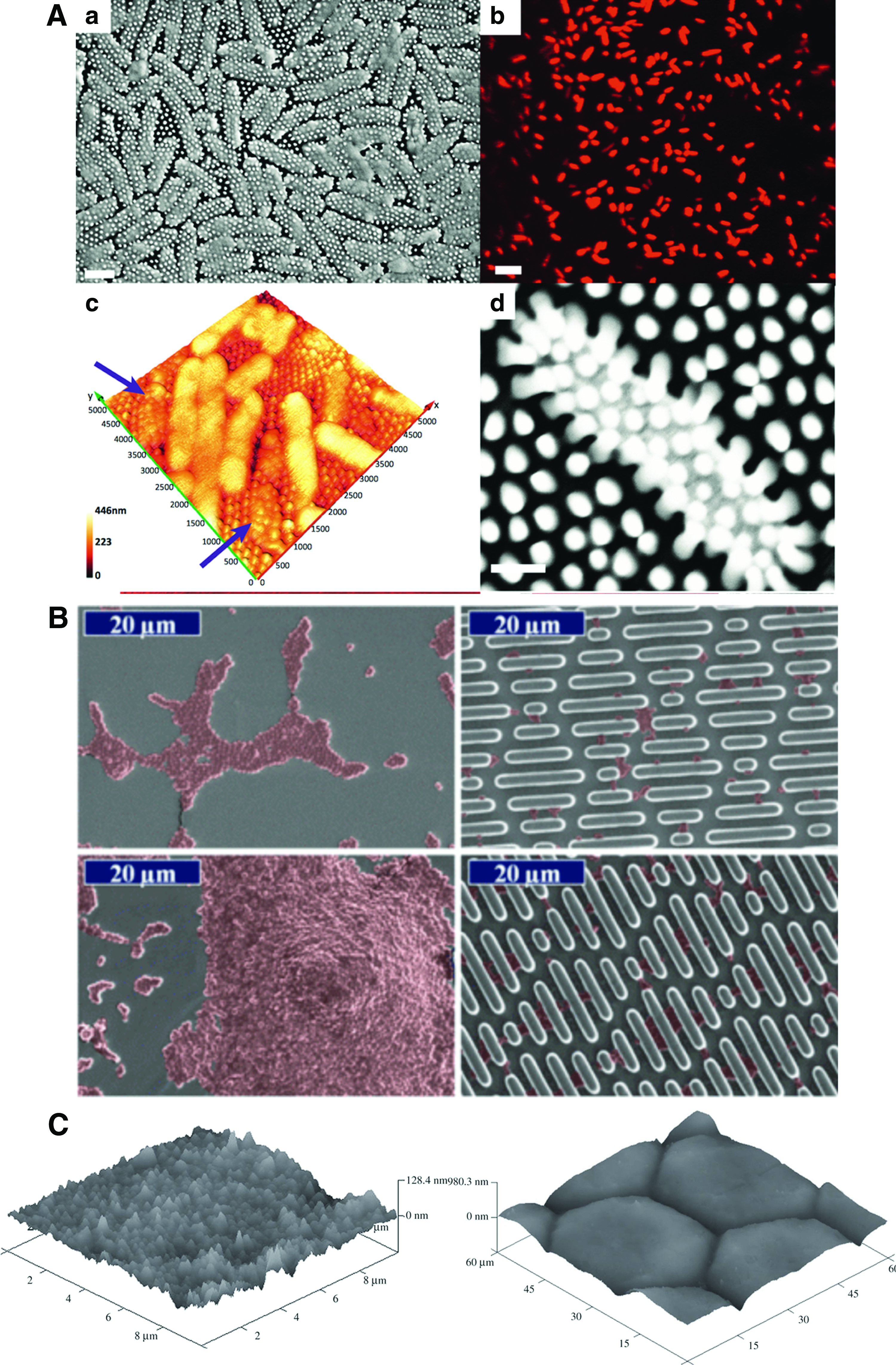
Selected examples of nature-derived surface structures with killing effect on bacteria and the prevention of future biofilm formation.
One of the first marine-based examples of an antibacterial material, at its biological interface, was shark skin (Fig. 3B). 65 In a classic biomimetic conversion, the microstructural design blueprint of micro-ridges was embossed onto a polymer surface by a micro-lithography technique. The diamond-shaped micron ridges effectively prevented attachment of seeded bacteria and clustering into a biofilm with 90% efficiency. Research based on surface topographies as an influence of biological phenomena has become prominent in the past few years, with marine organisms providing intriguing characteristic textures.66–68 One example is the “eye surface” microtopography of the crab species Carcinus maenas (Fig. 3C). 59 The rationale, although not always framed in this term, is the direct connectivity between nano-structural features and elements that texture the surfaces of extracellular matrix components and normal cell behavior within tissues. The periodic collagen banding, which is pitched in helices every 63 nm, is considered a common feature with effects on cell and tissue patterning and templating. 68 Chiral surface topologies are known to be important in biological function. The exploration of marine organism surface textures for chiral and achiral patterning related to cell and tissue engineering is worth pursuing.
Marine Biomaterial Cohesion and Integrity Via Supreme Interface and Composite Design
The precise manner in which different components and substrates are organized and arranged has dramatic effects on the overall properties and functions of the final large-scale material. Furthermore, the perfected co-arrangement of different materials into a composite structure, honed over generations of trials and tests of fitness to function in its given habitat, serves many functions. The interface between different materials is critical to design and material performance, because these are the regions that are the most susceptible to mechanical failure. Dunlop et al. illustrated the vital significance of differentially structured interfaces in biomaterials and their effects on bio-mechanical properties (Fig. 4). 69 For example, these can act as a nexus for force concentrations that develop within a loaded material. These joining regions are also flexible and moveable. They move relative to one another analogous to the moving parts of a machine mechanism. Other adjustments occur at the molecular level and most likely at the nanometric level at the joints and junctions within and between interfaces.

Evolved interface design between individual biomaterials to prevent tearing, separation, and buckling when subjected to multi-vectorial physical forces in
There are several evolved strategies for the deployment of aligned interfaces according to material types and distribution and strength of physical and mechanical force fields. Continually self-adaptive boundaries are favored during natural selection because of their large impact on survival. Interfaces are specifically arranged in such geometrical formations to control the internal and external mechanical forces buffeting the material. In addition, many biological interfaces are often highly convoluted and “interdigitated” to increase strength. Organic matrices are the major interfaces built with materials and structures and have led to composites with high strength, flexibility, and toughness. In natural materials, unique amphiphilic molecules are synthesized within the organic matrix between the predominant structural material. These molecules are especially adapted to bind the complex and attach inorganic elements within the matrix. 69
Another principle is gradation of the same materials with minor compositional and structural differences to the graded intermingling of very different highly “mismatched” materials. This coalition of variant materials (properties and composition) was modeled in the beak of the Humboldt squid. Mechanical tests identified a large “gradient in stiffness” along the beak. 70 Gradations of properties and features within individual and composite biological materials are ubiquitous phenomena. Such graded materials enable integration of materials with wholly different or incompatible structures, functions, and properties along the juxtaposed interface. The evolutionary design has been directed and constrained by economies of energy and raw materials. The incremental changes in chemistry (e.g., collagen, catchecol, mineral ions), architecture (texture), structure (at all scales; e.g., porosity), and hydration are examples. 71
Organisms have evolved interfaces with facing layers differing in structure, chemistry, hydration, and textures. These design principles enhance and optimize functions in various ways while minimizing the constraints and resolving contradictions. A perfect example of this was found in the glass sponge, Euplectella aspergillum (Fig. 4). The pore architecture resolves a functional conflict, resolved by the design of a graded pore structure that engenders highly efficient intake versus the lowest pumping energy to move water through the pore structure. This has had no parallel in human filtration technology.
Marine Biomimicry Outcomes for Medical Technology
We have surveyed and described some key adaptations and strategies evolved by marine organisms that have the potential to be re-used, in whole or in part for medical technologies, or indicative of a possible role in medicine (e.g., filtration technology of Glass sponges). Predominantly invertebrates have featured highly in marine products prospecting and discovery due to high species diversity and ease of access, but increasingly vertebrate organisms are being exploited for medically useful products having greater complementarity to human biological tissue products and biomolecules. Vertebrates are providing a new source of cartilage derivatives, biominerals, complex biocomposites and replacement collagens, gelatins, keratins, elastins, and so on. 72 These include unique micro- and nanoscale “hierarchical” structures for tissue engineering and drug delivery from mainly invertebrate marine organisms,73–75 super surfaces for programming cell fates, 76 promoting cell proliferation, 77 and preferential eradication of pathogenic microbes on biomaterials 61 (Table 1).
We have aimed the review at materials and structures where there are considerable opportunities for biomimetic translation from organisms beyond humans. Strategies to solve problems encountered by the organism are an amalgam of trade-offs between structural, mechanical, energetics, biological, and biochemical factors. We avoid discussing extracts, substrates, and recombinant products originally derived from marine organism structural biomaterials, including collagens, tropoelastins, keratins, gelatins (vertebrate derived) and chitins, glycosaminoglycans, proteoglycans, and polysaccharides since these have been covered very comprehensively by others. 72 However, there are notable developments. Fish scale collagens have provided substrates for the fabrication of an artificial cornea. 78
Hydrolyzed fish collagens have shown propensity to induce cartilage tissues from adipose-derived stem cells (ADSCs), as if TGF-beta-1 was present. Marine elastin also has biomimetic potential due to structural and biochemical similarities to human elastin. 79 When recombined, elastin peptides possess elasticity and cell compatibility together with support for cell migration suited to skin replacement. In this section, we highlight examples where these natural adaptations have been translated into specific products of application in the medical field. A lot of effort has been applied to micro- and nano fabrication of diverse structures that possess technological purpose.80,81 Marine organisms have often provided structures with exceptional, unsurpassed design typically unmatched in human based technology.
Foraminifera have been exploited to deliver antibiotics and serve as frameworks for supporting bone cell health and growth both in vitro and in vivo subcutaneously and in bone defects.82–84 In an osteoporotic mouse model, functional improvements occurred in bone mineral density and bone mineral content with addition of hydrothermally converted zinc-containing tricalcium phosphate (ZnTCP) Foraminifera spheres. Zinc has a large role in preventing osteoclastic bone loss. 85 Accordingly, cortical bone content increased by 45% and cancellous bone content increased by 20% whereas Sham, OVX, and beta-Tricalcium Phosphate control samples had bone resorption instead. 86 Simvastivin releasing hydrothermally transformed Beta-TCP Foraminifera macrospheres proved effective at treating osteoporotic bone in OVX mice. 82 They also demonstrated dual delivery of an antibiotic with a bone homeostatic factor bisphosphonate.
Similarly, Diatoms have equivalent structural features that have proved capable of delivering two drug compounds (Indomethacin [hydrophobic] and gentamicin [Hydrophilic]) at steady, persistent rates covered over 14 days only, mirroring a zero-order kinetic profile.74,86 The common drug compounds, Mesalamine, Prednisone, and Gentamicin (antibiotic) have also been retained within Diatom shells and then demonstrate release patterns that equal zero-order kinetics sometimes after an initial short phase of “burst release.” In many instances, the drug capture is aided by addition of functional chemical groups to the surface, such as 3-APTES, PEG-silanes, and 16-PHA. 86 Out of 30,000–100,000 species, the Aulacoseira sp. has been tested and validated. 87 Their loading capacity is variable between 14 and 28% owing to the presence of a large central chamber.
Only recently have studies explored the ultrastructural design of marine organisms that show new design rules and completely new material compilations (e.g., crystalline aragonite-chitin-amorphous silica in Verongida sponges and silica-chitin-apatite compilation expressed by Brachiopoda) offering unusual mechanical properties. These can be superior to their individual constituents and artificial versions. This has been underpinned with gathering nanoscale and molecular understanding of synthesis and fabrication routes. In silica biomineralization, the active molecules silicatein, silaffin, and siladicin have been identified as primary modulators of silica construction by marine sponges. 88 Silicatein-alpha is the principal enzyme in the fabrication (by hydrolyzing mineral precursors and then polymerizing them together) of templates for silica patterning and shape formation.
The fabrication chemistry learned from marine sponges has been important in developing silica structures for drug delivery (such as ordered mesoporous silica) and bone repair (Inorganic-organic nano-biocomposites). Also noteworthy are the results of fusing materials, such as metals with natural marine framework to produce novel composites. Metal ions have been implemented across organic evolution and for example, exist in co-ordinated form within fish otoliths. This type of multi-material compositing between organic and metallic materials requires application of high temperatures and pressures and has been termed “extreme biomimetics.” 89 In one instance, crystallographically pure monoclinic Zirconia was fused with a marine sponge-derived chitin framework by treatment to high temperatures and pressure-hydrothermal syntheses.
The chitin framework in its natural form, produced by the marine sponge, was perfectly stable under these “extreme” conditions. 90 Ianthella basta marine sponge can remain intact at temperatures till 325°C before degradation begins. Certain organisms inhabit extreme environments, and these are also viewed as vital sources of novel biomimetic model materials and structures with implicit utility for medical materials such as the need for better performing metallic orthopedic implants, which are more resistant to fracturing under compression. Pompeii worms (Alvinella pompejana) manufacture chitin within environments exceeding 105°C. Marcasite and sulfates are chemically incorporated into the organic framework extending the tolerance to thermal stress. 90 Further, more wide ranging natural history studies of marine biodiversity will lead to the creation of information-rich databases, as the foundation for more and more innovative biomimetic translations into medical materials solutions and products.
Conclusions
Biomimicking the rich engineering diversity and refinements expressed by all forms of marine life is necessary to manufacture materials with properties of minimal energy use, nonpetrochemical-based, and ecologically self-sustaining. The living marine biosphere contains a vast genetic reserve that sustains existing biodiversity and facilitates rapid future evolutionary adaptations. A technological goal is to harness this power to modify and adapt to create new materials and structures. Thus, marine organisms will continue to play a major role at the leading, progressive edge of biomaterials, biomimetics, and bioinspiration applied to tissue engineering. The main reason is the underlying diversity and abundance of marine materials and structures that have evolved and successfully adapted multiple functions. Still, molecular biomimetics may be able to generate diversity, but there is no easy process to orchestrate adaptations for a determined strategy or function. Chemical-based materials biomimicry is currently limited to one to two levels of hierarchy and the basic skeletal constructions exemplified by Diatoms and Coccolithophores.
Marine biomimicry is made possible by a deep knowledge and understanding of a complete biology-natural history, evolution and its constraints within genes, protein and carbohydrate operating network maps, and ecology. It is only true if these elements are understood in the context of evolution by natural selection and if they are properly harnessed with this full understanding. Direct and indirect marine biomaterials mimicry is an essential direction for propagating greater innovations and to enhance the productivity, lifetime, performance, and efficiency of new materials. The biomimetic translation pathway is far more standardized and systematic (for example, BioTRIZ inventive problem solving, Design By Analogy to Nature Engine [DANE]) than it was traditionally. The structures and properties of marine biomaterial surfaces, the carefully integrated composites with buried interfaces and unique fracture toughening mechanisms, the engineering of complex interfaces along gradations of substrate and density, and the chemical synthesis of materials based on marine organism-based biomineralization concepts and mechanisms represent key biomimetic research targets that will deliver new, innovative improvements to existing and future biomaterials.
Footnotes
Acknowledgment
This work was supported by the National Research Foundation of Korea (NRF) grant funded by the Korean government (MSIP) (No. NRF-2014R1A2A1A11050764).
Disclosure Statement
No competing financial interests exist.