




Abstract
The therapeutic potential of stem cells has fascinated those interested in treating diseases in both human and animal subjects. Although the exact mechanism of action and the definitive effectiveness of stem cell therapies remain unclear, animal owner perceptions and a desire for improved treatment options have fueled the interest of clinicians and stakeholders. Standards do not yet exist to define the critical attributes of mesenchymal stem/stromal cell (MSC)-based products derived from veterinary species such as the dog, cat, and horse. This has led veterinary stakeholders to adopt those guidelines and criteria set forth for human MSC-based products; however, these criteria are not always applicable to MSCs from dogs, cats, and horses (e.g., variability in species-specific cell surface marker expression and antibody cross reactivity). Establishing useful standards and meaningful product quality criteria as well as the understanding of full spectrum of MSC functions and preclinical evidence for safety and therapeutic efficacy for veterinary (companion and recreational animals) MSC-based-products will be critical to furthering product development, and may ultimately facilitate the availability of FDA-approved MSC-based products for use in veterinary medicine.
Introduction
A
Cell-based products for animal use, including MSC-based products that meet the definition of a new animal drug, require FDA approval to be legally marketed. Thus, approval of these products will require a demonstration of safety, effectiveness, and manufacturing quality. FDA Center for Biologics Evaluation and Research4–6 and FDA Center for Veterinary Medicine have provided general guidance on cell-based products. 7 Most of the FDA cell-based therapy guidance documents are written for the consideration of cell- and tissue-based products intended for use in humans; however, many of the scientific and regulatory considerations and challenges are similar for cell-based products intended for either human or animal use. In this article, the term veterinary MSCs refers to MSCs derived from companion animal species such as the dog, cat, and horse.
There is a growing interest in veterinary medicine in developing novel, regenerative therapies for chronic or debilitating diseases such as osteoarthritis in dogs and tendinopathies in horses.1,8 There are many conditions in veterinary medicine where functional repair of tissues is not currently possible, and regenerative therapies such as MSCs hold potential promise for addressing these unmet medical needs. Public demand for these products is high and is bolstered by anecdotal reports touting success following administration of unapproved veterinary MSC-based products. 9 The contribution of anecdotal evidence to the effectiveness of veterinary MSC-based products is limited as many reports are based on a small number of patients without adequate controls in place. In addition, there are few rigorous clinical evaluations of veterinary MSC-based products in the scientific literature and there are currently no FDA-approved cell-based products for animal use. 9 Unfortunately, the demand for, and implementation of, MSC-based therapies in veterinary medicine is often outpacing the current scientific knowledge necessary to assess the safety and effectiveness of such products.
Historically, the information and methods available for characterizing and identifying MSCs from veterinary species have lagged behind the information available for humans. The veterinary community has drawn from knowledge gained in research on similar human products. 1 However, there are limitations to these comparisons due to species-specific attributes, lack of validated methods, differences in veterinary and human medicine, and so on. In recent years, the veterinary research community and associated scientific organizations have encouraged the publication of information characterizing and identifying those veterinary MSCs used in studies in published literature. This has resulted in improvements in sharing critical information regarding characterization, identification, and methodology. However, there are several challenges to consider regarding veterinary MSC-based products, including the limitations in scientific information, reagents, and methods available for adequate characterization and identification of attributes that may impact biological activity (Fig. 1). These limitations are reflected in the current scientific literature.
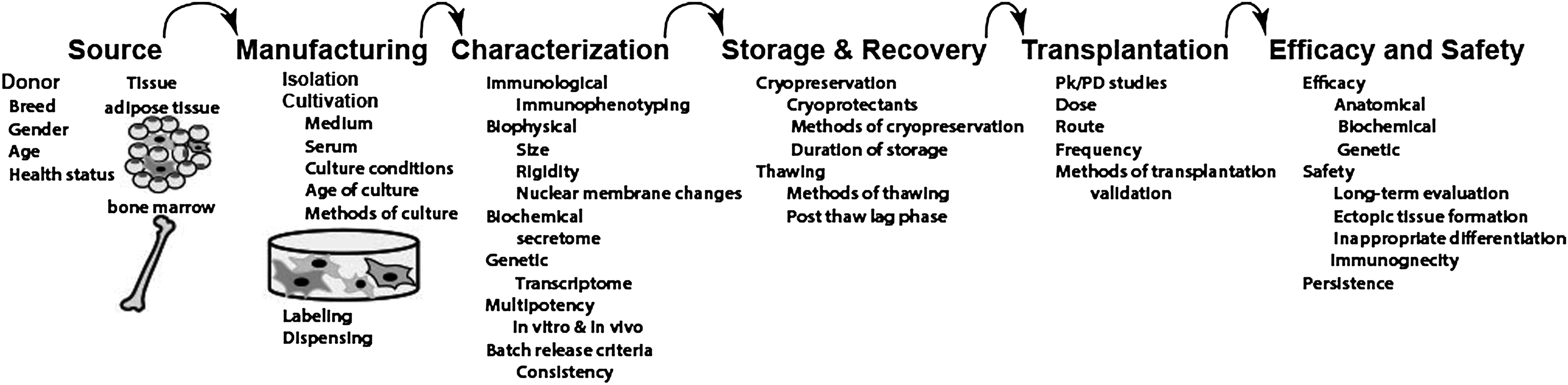
Schematic for clinical transition of veterinary MSCs. MSCs, mesenchymal stem/stromal cells.
Clinical evaluations of MSCs span a variety of conditions ranging from musculoskeletal ailments such as osteoarthritis and tendinitis to chronic renal failure to gastrointestinal diseases such as stomatitis and inflammatory bowel disease. Despite numerous published studies, the efficacy of MSC therapy is difficult to evaluate due to variations in the source of MSCs (whole stromal vascular fraction versus cultured and characterized adipose-derived MSCs)10–14 ; lack of appropriate controls12,15; and a lack of experimental power. 12 In addition, inconsistent characterization, lack of measures for potency, and variations in starting material and manufacturing processes together with inadequately controlled clinical trials make it difficult to compare results and assess the factors that contribute to safety and effectiveness.
Although there are remaining gaps in the scientific knowledge currently available for veterinary MSCs, one advantage of developing products for use in animals is the ability to evaluate these products in the target species early in product development. This provides a significant advantage in understanding the potential for clinical application of MSC-based products in animals, as well as providing a model for some human applications. A consensus among research scientists regarding best practices for MSC research, research in areas that impact product quality and consistency, establishing criteria for characterization of MSCs, confirmation of results between laboratories, as well as sharing of both positive and negative results would facilitate resolution of the challenges facing development of MSC products. Encouraging the further development of scientific criteria and methods for characterizing critical quality attributes in veterinary MSCs will support the rapid forward progress of the veterinary regenerative medicine field.
This article discusses the scientific challenges associated with characterization and identification of veterinary MSCs. The goal of this article is to identify areas where additional scientific research and discussion may positively impact the development of MSC-based products through an increased understanding of the associated scientific issues. Advancing knowledge of veterinary MSCs may lead to the development and marketing of adequately characterized, accurately labeled products of sufficient quality, safety, and effectiveness to support FDA approval for use in veterinary medicine.
MSC Nomenclature
The issues describing nomenclature of human MSCs are also applicable to veterinary MSCs. In the human literature, multipotent stem cells are described as self-renewing cells, which are capable of giving rise to cell types to recreate a functional tissue. 16 However, this definition may not fit for certain cells popularly termed “Mesenchymal Stem Cells” that can be derived from many types of tissue.17,18 They are also called “Mesenchymal Stromal Cells” 19 or “Multipotent Stromal Cells.” 20 Most recently, it was suggested that human MSCs be renamed as “Medicinal Signaling Cells” based on their ability to modulate host systems.21,22 Unlike multipotent stem cells, the type of cell popularly called MSCs most often undergo culture-dependent senescence, which raises the question of their self-renewal capacity. 23 Their ability to differentiate also diminishes concomitance with their senescence.24,25 In addition, it is unclear whether ectopically placed MSCs can differentiate in vivo. Therefore, the stem cell label is questionable because there is a lack of demonstrated self-renewal and in vivo differentiation. 26
Similar confusion surrounds the MSC term in veterinary medicine.2,27,28 Much of the early research in the veterinary literature focused on nonspecific cell fractions. These cell fractions contain MSCs but are mostly a heterogeneous mixture of cell types, which include tissue cells, leukocytes, endothelial cells, fibroblasts, and a small subset of self-renewing multipotent cells. In more recent years, research on culture-expanded MSC preparations has increased. These preparations contain a greater number of MSCs than the cell fractions but are still likely to contain a mixture of cell types. Additional research may address more purified preparations produced using specific cell selection methods designed to produce a homogenous population of cells. In the literature and media, all of these preparations are often referred to as MSCs. In cases where self-renewing multipotent cells are not separated from the rest of the cells, referring to the entire culture as MSCs is misleading. In addition, the expected activity of each preparation is likely to differ. Inadequate product descriptions and inappropriate use of nomenclature in both the literature and media create confusion for veterinarians, research scientists, industry, and the public. Consistent use of a consensus nomenclature that specifically identifies the tissue source and describes the processing would improve consistency in the scientific literature, increase accuracy of product labeling, and improve end-user understanding of the product.
MSC Characterization
Identification
Ideally, identity, strength, quality, and purity of an approved product should be consistent from batch to batch to provide an expectation of clinical effectiveness. Identification of a MSC-based product is an important component of product characterization; however, there are several challenges facing accurate identification of the components of veterinary MSC-based products. Veterinary MSCs are not characterized to the extent of human MSCs and may be physiologically different from human MSCs in some aspects; therefore, use of the human MSC criteria for identifying veterinary MSCs should be evaluated closely. While multiple criteria exist to facilitate the evaluation and identification of human MSCs International Society for Cell Therapy (ISCT),
20
parameters to identify and distinguish MSCs from other cell types in veterinary species are lacking. For human MSCs, the ISCT criteria include the following:
• Adherence to plastic. • Greater than 95% of the MSC population must express CD90/Thy1 (wound repair and cell–cell interactions), CD73/5′-nucleotidase (production of adenosine), and CD105/endoglin (vascular homeostasis). • Less than 2% of MSC population expresses CD34 (to exclude primitive hematopoietic cells and endothelial cells), CD45 (to exclude leukocytes), CD11b/integrinα M or CD14 (to exclude monocytes and macrophages), CD79α, CD19 (to exclude B cells), or HLA class II (to exclude antigen-presenting cells and leukocytes). • Multilineage in vitro differentiation potential.
The surface antigen expression criteria used by the ISCT to identify human MSCs may not be suitable to characterize MSCs for all veterinary species. The antibodies used typically do not recognize the animal surface antigen analogue with the same affinity and depending on the animal species, the expression levels of the surface antigen analogue can vary from the levels observed on human MSCs and between different animal species.29,30 Reagents developed for characterizing human and rodent MSCs are utilized to characterize veterinary MSCs, although the extent of antibody cross reactivity is often undetermined. 27 In addition, in some cases, there is conflicting information in the literature as to suitable MSC surface antigen expression. For instance, contrasting surface expression patterns for CD73 and CD90 in MSCs derived from canine umbilical cord blood were reported.31,32 Similarly, variable expression patterns for CD73 and CD105 were reported for equine MSCs.27,33,34 Confounding these issues, the true expression of a surface antigen has not been demonstrated. For example, surface expression of a marker has not been confirmed independently via gene expression determination or protein expression via immunoblotting or immunohistochemistry. Availability of species-specific antibodies would facilitate accurate and consistent characterization of veterinary MSCs. In addition, research is needed to determine if there are markers or other identifiable characteristics that may be unique to veterinary MSCs. 1
Source
True to the diversity of veterinary species, the source of veterinary MSCs is also diverse both within the donor and between donors. 35 MSCs are sourced from embryo, fetal tissues, cord blood, and a variety of adult tissues from veterinary species.8,36 Variability in both the donor and tissue source is a challenge for manufacturing of an MSC-based product with consistent identity, strength, quality, and purity. Donor and tissue source variations also present challenges in deriving broad conclusions on veterinary MSCs from the scientific literature, where these factors vary between laboratories and experiments.
An important source of variation in MSCs originates from the tissue of origin. MSCs from different tissues display varying characteristics. For instance, MSCs from bone marrow are more inclined to form osteoblasts and MSCs from fat tissue have a tendency to form adipocytes. 26 In addition, the number of MSCs recovered also varies depending on the tissue of origin. Adipose tissue tends to have more MSCs compared to bone marrow 37 based on the fact that bone marrow contains a high percentage of hematopoietic cells, unlike other connective tissues. Therefore, it is not surprising that fat tissue is the single most commonly used tissue source because of the ready availability of fat in both human and veterinary patients.8,38,39 Variation can exist even within a single tissue source. The donor is another source of variability in veterinary MSCs. For instance, breed, age, gender, and health status of a given donor significantly contribute to both quantitative and qualitative differences in MSCs.35,40 Keeping this variation to a minimum when selecting donors for allogeneic products is perhaps the most challenging aspect in sourcing MSCs. Although MSCs share many common characteristics, variation in the donor and tissue of origin may impact product consistency, potency, and safety due to preference and efficiency of different cells for certain in vivo functions.
Ensuring that donors used to source allogeneic products are free from adventitious agent contamination can also be a challenge for veterinary MSC-based products. Occult diseases, opportunistic diseases, or diseases for which no sensitive diagnostic kits are available, such as fungal osteomyelitis caused by hyalohyphomycosis, 41 pose a risk to recipients when MSCs are sourced from infected donors. In addition, the disease agents of concern differ for each species. One of the challenges for allogeneic veterinary MSC-based products is the lack of diagnostic tests available that are validated for determining absence of disease agents in an otherwise healthy appearing donor. Developing standardized, validated disease agent screening strategies for donors and donated tissue would be helpful in this regard.
Manufacturing
Due to their limited numbers in vivo, MSCs are frequently expanded ex vivo to obtain sufficient numbers for either therapy or research purposes. The processes and reagents utilized for their cultivation vary widely among individual laboratories or commercial entities, which undoubtedly contributes to variation not only in the characteristics of these cells but also in their function. For example, time in culture can impact morphology 23 gene expression, 42 cell surface antigen expression,43–45 secretome, 46 and homing capacity 47 ; and culture conditions may also impact time to senescence, doubling rate, and differentiation. 48 Variations in manufacturing processes can contribute to the difficulty in comparing results from different laboratories, and additional studies may be needed to understand the effect of a given manufacturing change on the biologic activity of the MSCs.
Quality control of the manufacturing process as well as the final product is necessary. Poor control of production processes can lead to the introduction of adventitious agents or other contaminants, or to inadvertent changes in the properties or stability of the biological product that may not be detectable in final product testing. For these reasons, the production process methods should be clearly and extensively defined and reagents well characterized. 49
FDA guidance7,49 states that controlled practices and procedures should be employed in the manufacture of cell-based products to ensure that tissue handling and cellular isolation are reliable, consistent, preserve cellular function and integrity, and prevent contamination of the product. Additional scientific research to further define and characterize veterinary MSCs will facilitate development of appropriate manufacturing controls and ultimately result in more reliable veterinary MSC products.
Storage and Administration of MSCs
Culture-expanded MSCs are often stored at ultralow temperatures during various stages of the manufacturing process. Preserving cellular function and integrity during storage is important to maintaining the safety and effectiveness of the product. Methods of cryopreservation, medium, cryoprotectants, temperature stability, and duration of storage are known to affect the quality of human MSCs.50,51 However, the effect of these parameters on the properties of veterinary MSCs is unknown. The most pressing issue is the duration of storage of veterinary MSCs. There is little information on the length of time that veterinary MSCs can be stored at ultralow temperatures without altering the biologic characteristics of the cells or the impact of various factors in the cryopreservation method on cellular function and integrity. Duration of storage of tissues and methods of separation also contribute to variations in MSCs. 50 Veterinary MSCs are often shipped to veterinary clinics; however, the effect of various shipping methods and environmental conditions on product quality is not known.
Cryopreserved cells are thawed before administration to veterinary patients. However, the characteristics of thawed cells may differ between fresh, thawed, or recultured cells. Studies evaluating these differences in prefreeze and post-thaw cells are important, given the fact that methods of thawing are known to affect the quality of human MSCs. 52 Equally intriguing is the post-thaw lag phase. Because cells are not synchronized before cryostorage, thawed cells have varying lag phases before cycling. However, the length of time necessary for thawed MSCs to recuperate before administration to a patient is not known. These studies are important to understand the effects of storage on MSCs and need to be addressed experimentally. 53 In this regard, it was shown that thawed equine MSCs need to be cultured at least 36 h before administration to recuperate growth. 28 However, it is not clear whether recuperation of growth also equates to recuperation of function. Once MSCs are thawed and recovered, the MSCs are traditionally suspended in protein-free buffered salt solutions before patient administration. The effect of these solutions on cell viability and function has not been established with veterinary MSCs. Also, stem cells tend to form clumps in protein-free solutions due to release of DNA from dead cells. 54 With regard to administration of MSCs, forcing cell clumps through a small gauge needle may result in cell lysis. Appropriate needle gauge recommendations to minimize cell lysis have not been established for veterinary MSCs.
Characteristics Predictive of the Potency of MSCs
Potency, as defined for human biologic products, is the specific ability or capacity of the product, as indicated by appropriate laboratory tests or by adequately controlled clinical data obtained through administration of product in a manner intended, to effect a given result [21 CFR § 600.3(s)]. FDA guidance also states that the relevant function of the cells, if known, and/or relevant products biosynthesized by the cells may be defined and quantitated as a measure of potency (for more information, see www.fda.gov/downloads/BiologicsBloodVaccines/GuidanceComplianceRegulatoryInformation/Guidances/CellularandGeneTherapy/ucm081670.pdf). However, the complexity of cell-based products can present significant challenge(s) to establishing potency assays. These challenges include the heterogeneity, complex mechanism of action (MOA), and complexity of the in vivo fate of the product.
The current scientific literature contains reports of variable clinical outcomes for veterinary MSCs. For example, autologous culture-expanded bone marrow-derived MSCs in autologous platelet-enhanced fibrin administered intralesionally in surgically induced cartilage defects in horses did not enhance cartilage repair and stimulated bone formation in some cartilage defects. 55 Whereas autologous culture-expanded bone marrow-derived MSCs administered intra-articularly with hyaluronan to horses 1-month post-microfracture enhanced cartilage repair quality. 56 Intra-articular administration of autologous adipose-derived mesenchymal and regenerative cells (stromal vascular fraction) to dogs with osteoarthritis of the elbow resulted in improved lameness scores for over 6 months. 11 However, dogs administered autologous culture-expanded adipose-derived MSCs demonstrated improvement in lameness lasting only 1 month. 12 Potency of an MSC product may be affected by items such as route and timing of administration, formulation, and clinical case selection as well as factors intrinsic to the MSCs. This highlights the importance of understanding factors that impact potency of veterinary MSCs to develop consistently effective products.
As stated above, potency is a measure of function. Identification of functional markers of potency and development of standardized and feasible methods to measure these markers are a major hurdle. Ideally, such measures of potency are directly linked to MOAs of MSCs (discussed in the MOA: How are Veterinary MSCs Purported to Work? section). Conflicting reports on potential MOAs of MSCs further confound the issue of potency measurements. 26 Nonetheless, a perspective from ISCT suggests guidelines for potency testing of human MSCs based on their immunomodulation properties. 57 A matrix of assays encompassing gene expression measurements, surface marker analysis, and secretome measurements is recommended as criteria for potency release criteria for human MSCs.57,58
In addition, recent evidence also suggests that properties that are intrinsic to MSCs may be of use to develop potency measurements. For instance, it was shown that biophysical properties, such as cell diameter, cell stiffness, and nuclear membrane fluctuations of MSCs, predict their potency.59,60 Although these biomechanical characteristics are useful in predicting in vitro potency of culture-expanded MSCs, it is not clear how these biomechanical parameters are governed. In addition, how these parameters will be defined in MSCs from veterinary species is an open question. Nonetheless, the quantitative nature of these parameters may have applicability in developing bioassays to predict the potency of a manufactured MSC-based product. 60 MSCs are also purported to be biochemically distinct and secrete many factors that influence the host immune system or other systems to mitigate immune or inflammatory responses. 22 Quantities of these factors in the culture supernatants of MSCs were often used as measures to predict their potency. 61 The usefulness of these biochemical parameters to predict successful clinical outcomes is debated as judged by a growing number of unsuccessful clinical trials with human MSCs. 62
FDA guidance 6 notes that there is no single test that can adequately measure those product attributes that predict clinical efficacy. Therefore, developing a panel of quantitative criteria that can be used to establish a correlation between clinical study data and a more practical potency assay could facilitate clinical translation of veterinary MSC-based therapies. Furthermore, appropriate potency assays will most likely need to be tailored to the clinical application for which the cells would be used.
MOA: How Are Veterinary MSCs Purported to Work?
As discussed above, MSCs undergo chemically directed differentiation in vitro. In the past, it was mistakenly assumed that this ability to differentiate into multiple tissue types reflected their in vivo function. Today, it is generally believed that MSCs function through trophic, paracrine, immunomodulatory, and/or anti-inflammatory effects. Collectively, these effects indicate that MSCs may have the potential to provide therapies for many disease conditions.
Many nonexclusive MOAs have been proposed for MSCs, which include (1) modulation of the adaptive immune system—direct suppression of effector T lymphocytes via cell-to-cell contact and indirectly by inducing T cell inhibitory regulatory T cells 63 ; and suppression of proliferation of B cells 64 and (2) modulation of innate immune system by promoting phenotype switching of macrophages from pro- to anti-inflammatory. 65 Effects of MSCs on the immune system are dependent on both the elaboration of soluble mediators as well as cell-to-cell contact. Although these features are potentially of tremendous value, a high MSC to lymphocyte ratio is necessary to achieve these effects, which would suggest the need for high doses of MSCs. In addition, the bulk of these immunomodulation experiments was conducted in vitro with cultured human or rodent MSCs and the true in vivo effects of cultured MSCs are unknown. Finally, immunomodulatory effects of MSCs are also common to many different kinds of cultured connective tissue cells, 66 suggesting that these properties are unrelated to any defining characteristics of MSCs. 26
Immunomodulatory aspects of veterinary MSCs are often assumed to reflect those established for human MSCs. 67 However, it is difficult to draw parallels between human and veterinary MSCs, as patterns of cytokine secretion are not identical. For instance, IL-8 secretion by human adipose-derived MSCs is important for their immunomodulation, but canine adipose-derived MSCs express negligible levels of IL-8.32,68 Therefore, it is possible that veterinary MSCs may exert their functions through different mechanisms than human MSCs. Understanding the MOA is important to developing tools to evaluate potency of MSCs; however, extrapolation of results obtained with human MSCs to veterinary MSCs, and between species of veterinary MSCs, may need to proceed with caution.
In addition to modulating immune cells, both human and veterinary MSCs are thought to dampen excessive inflammatory responses. 69 MSCs secrete antagonists to IL-1R, a receptor for IL-1α, which is produced by resident macrophages in response to injury. Moreover, MSCs also create a negative feedback loop by secreting multifunctional anti-inflammatory cytokines or prostaglandins in response to proinflammatory cytokines produced by stimulated macrophages. Various anti-inflammatory roles of MSCs have been evaluated in in vitro assays or in experimental models, but true in vivo effects need to be evaluated. It is important to note that many of these MSC-based therapies are not really based on the stem cell subset, but are based on the total population. For example, it is not known whether the paracrine, immunomodulatory, or anti-inflammatory effects are dependent on a subset of true stem cells.
Finally, MSCs are also purported to possess regenerative effects to replace or repair damaged tissues by either helping resident progenitor cells or directly replacing the damaged tissues. 70 For enduring replacement of damaged tissues by the donor cells themselves, the transplanted cells must contain a subset of stem cells, able to recapitulate the formation of appropriate tissues during tissue turnover, which occurs throughout life, although at different rates depending on the tissue (a stem cell-mediated therapy). On the contrary, inducing resident stem/progenitors to undergo repair is not necessarily mediated by the stem cell subset and may be the effect of the population as a whole.
Safety of MSC Therapy
Traditional therapies utilizing biopharmaceuticals rely on analytical methods to determine their preclinical absorption, distribution, metabolism, excretion, and toxicity (ADMET studies). However, many of these parameters are not applicable to cell-based therapies, which create new challenges in defining methods to determine the safety of cell-based products.71,72 There are several challenges in evaluating the safety of MSCs. FDA guidance4,7 notes that product-specific safety evaluations for MSC-based products may include tumorigenicity, immunogenicity, donor selection criteria, transmission of adventitious agents, long-term safety, cell survival, biodistribution, and ectopic tissue formation. Although the inherent tumorigenicity of MSCs is often purported to be low, safety of repeated administration of MSCs over the long term has not been evaluated. There is not a lot of evidence for immunogenicity for undifferentiated MSCs; however, it is prudent to evaluate recipients for evidence of immunogenicity for preparations of MSCs.
As noted earlier, donor selection criteria can impact safety due to transmission of disease agents or alterations in biologic activity due to donor variability. Adventitious agents may also be transmitted due to product contamination during the manufacturing process. Development of appropriate validated testing methods to detect adventitious agents in the healthy donor and product is lacking.
Conclusion
The transition of veterinary MSCs from the laboratory to clinical practice would be facilitated by elaboration of the scientific basis for factors affecting the safety, effectiveness, and quality of these cells. Mass media and Internet coverage have stoked high public expectations for stem cell treatments. Advances in stem cell medicine do hold the promise of novel treatments for many unmet medical needs; however, the need for additional rigorous research evaluating the factors that could affect safety, effectiveness, and quality of veterinary MSCs remains. This research is critical in facilitating the successful transition of veterinary stem cells to clinical practice. These factors include items such as cell identification, donor age, tissue source, isolation methods, subsets of MSCs, potency assays, autologous versus allogeneic source, culture conditions, culture methods, time in culture, cryopreservation methods, duration of cryopreservation, time from post-thaw to transplantation, priming or activation before administration, and long-term effect of treatment. The lack of well-understood MOAs also impedes progress in their appropriate utilization. Consensus among research protocols, improved characterization and manufacturing consistency would assist in developing a better understanding of the impact of each factor on the ultimate safety and effectiveness of veterinary MSCs. The onus lies on the scientific and veterinary practitioners to balance the hope and hype and contribute to the evidence-based body of science that will result in safe, effective, and quality veterinary MSC-based products for clinical use.
Footnotes
Acknowledgments
The authors thank Pamela Robey, Michael Brewer, Lisa Troutman, Steven Fleischer, and Kevin Greenlees for many suggestions.
Disclosure Statement
No competing financial interests exist.