




Abstract
The objective of this study was to develop a novel scaffold imitating the ingredients and their ratios of natural dermal matrix and to evaluate its biological activity. We applied different ratios and different synthetic methods to fabricate nine kinds of cross-linked (CL) collagen/chondroitin sulfate/hyaluronic acid (Co/CS/HA) scaffolds for dermal tissue engineering. On the basis of comparison among the morphology, mechanical properties, and biodegradation rates of scaffolds, we selected the novel scaffold that was fabricated under unique procedures. In the procedures, Co, CS, and HA were firstly synthesized together in the ratio of 9:1:1 to form a membrane that was then CL with 5 mM of 1-ethyl-3–3-dimethylaminopropylcarbodiimide hydrochloride (EDC) (Co–CS–HA/CL 9:1:1). From the results of comparison, we also found that the ratio of 9:1:1 was better than other ratios. So the scaffold of Co–CS–HA/CL 9:1:1 was used as experimental group with the scaffolds of Co–HA/CS CL 9:1:1 and Co–CS/HA CL 9:1:1 as control groups to evaluate their characteristics in vitro. A control group of an open wound without scaffold was supplemented to evaluate their effects on promoting wound healing in vivo. Morphological observation showed that the novel Co–CS–HA/CL 9:1:1 scaffold had uniform and widely interconnected pores with mean diameters of 109 ± 11 μm and adequate porosity of about 94%. Mechanical property and biodegradation assessment indicated that it had more degradation-resistant and higher elastic modulus than other scaffolds. Metabolic activity assay showed that it could more strongly promote celluar attachment and proliferation. When scaffolds were seeded with allogenic skin fibroblasts and implanted on the dorsum of Sprague-Dawley rats for 6 weeks, the novel Co–CS–HA/CL 9:1:1 skin equivalent could more successfully repair full thickness skin defects in Sprague-Dawley rats. The histology was more approximate to normal skin than those of the controls within 6 weeks. These results demonstrated that the novel CoCS–HA/CL 9:1:1 tri-copolymer has the potential to be used as a scaffold for dermal tissue engineering.
Introduction
Since the first collagen (Co)–glycosaminoglycan (GAG) scaffold was reported by Yannas and Burke, 5 Co materials have been extensively used for skin tissue engineering.6–9 There are two keys. Firstly, Co is a natural biomaterial and it is the major dermal constituent approximately 60–80% of the dry weight of fat-free skin. 10 Secondly, Co has many advantageous properties including hemostatic properties, low antigenicity, and high growth promotion. 11 However, high degradation rate and deficient mechanical property of Co often fail to meet the requirement of specific application.12–14 In recent years, many scholars have been interested in imitating the natural extracellular matrix (ECM) and have fabricated some scaffolds such as Co–chondroitin sulfate (CS), Co–hyaluronic acid (HA), and gelatin–CS–HA.15–17 These scaffolds had lower degradation rates and higher mechanical strength than Co alone, but their biocompatibility was not satisfactory to us. The major problem is that they only partially imitate ECM. Fortunately, these experiences lead us to believe that applying Co, CS, and HA that are the main natural components of the dermal ECM to fabricate a Co/CS/HA scaffold is feasible, and the scaffold might be a better choice for dermal tissue engineering.
Co, CS, and HA are the main natural components of the dermal ECM, but their accurate ratio remains unknown, which is a key point and a hurdle in fabrication. Moreover these elements have opposite electric charge and easily form polyion complex (PIC), which influences the structure of the scaffold. So the synthetic method is another key point in fabrication. The goal of our study was to explore a suitable ratio of Co, CS, and HA to highly imitate the ECM of dermis and to develop a feasible synthetic method to fabricate a novel Co/CS/HA scaffold for dermal tissue engineering.
Materials and Methods
Fabrication of scaffolds
Bovine tendon Co I, CS, HA, 2-(N-morpholino)ethanesulfonic acid, N-hydroxysuccinimide (NHS), and 1-ethyl-3–3-dimethylaminopropylcarbodiimide hydrochloride (EDC) were all purchased from Sigma Chemical (Badlapur, India). Co was dissolved at 4°C at a concentration of 12.5 mg/mL in a solution of 0.05 M acetic acid. CS and HA were dissolved at 4°C at a concentration of 12.5 mg/mL in a solution of double-distilled water. The synthetic methods were as follows: (1) The pH of Co was adjusted to 7.4 at 4°C. CS was added in Co solution before HA was added in it. The ratios of the three elements (v/v/v) were 9:1:1, 5:1:1, and 3:1:1. (2) The pH of Co was adjusted to 5.5 at 4°C. HA was added in Co solution at a ratio (v/v) of 9:1, 5:1, and 3:1. (3) The pH of Co was adjusted to 7.4 at 4°C. CS was added in Co solution at a ratio (v/v) of 9:1, 5:1, and 3:1. All the elements were added at a speed of 0.5 mL/min. After being well mixed in culture dish with a glass rod, the slurry was poured onto a six-well plate and was frozen at −80°C for 3 h. Then they were lyophilized. These meshes were subsequently cross-linked (CL) for 24 h at room temperature using 40% ethanol–water (pH 5.5) solution supplemented with 50 mM 2-(N-morpholino)ethanesulfonic acid, 5 mM EDC, 5 mM NHS, CS (only in solution of Co–HA mesh), and HA (only in solution of Co–CS mesh). The finally ratios (v/v/v) of Co:CS:HA were 9:1:1, 5:1:1, and 3:1:1. Then the CL membranes were rinsed twice for 1 h with 0.1 M disodium phosphate, twice for 2 h with 1 M sodium chloride, 6 times for 24 h with 2 M sodium chloride, and 10 times with double-distilled water to remove residual EDC. After being frozen again at −80°C for 3 h, membranes were lyophilized yielding nine kinds of CL Co/CS/HA scaffolds: Co–CS–HA/CL 9:1:1, 5:1:1, and 3:1:1; Co–HA/CS CL 9:1:1, 5:1:1, and 3:1:1; Co–CS/HA CL 9:1:1, 5:1:1, and 3:1:1.
Culturing of rat dermal fibroblasts
Sprague-Dawley (SD) rats were obtained from Animal Lab Center of the Fourth Military Medical University. The experiment was conducted according to the committee guidelines of the Fourth Military Medical University for animal experiments, which met the NIH guidelines for the care and use of laboratory animals. The skin that was obtained from the dorsa of 1-day-old SD rats was disinfected with 75% ethanol and washed with phosphate-buffered saline. From the skin samples, subcutaneous fat and deep dermis were excised. Remaining tissue was then cut into small fragments that were immersed in dispase (2.4 U/mL, Gibco BRL, Carlsbad, CA) solution at 4°C overnight to separate dermis from epidermis. The dermis sheets were transferred into a centrifuge tube and were treated with collagenase (625 U/mL, Sigma, St. Louis, MO) for 50 min in the CO2 incubator to harvest dermal fibroblasts. The harvest dermal fibroblasts were cultured in Dulbecco's modified Eagle's medium containing 10% fetal bovine serum (FBS) and in the CO2 incubator. The culture medium was refreshed every 2 days. The dermal fibroblasts of passages two to three were used for the experiments.
Comparison of nine kinds of CL Co/CS/HA scaffolds
Scanning electron microscope examination
Scaffolds were dehydrated by treatment with a series of grade ethanol solution (50% for 12 h, 75%, 85%, and 95% each for 2 h), and then were placed overnight in a vacuum oven at 50°C before being coated with gold for scanning electron microscope (SEM; Hitachi S-3400N, Tokyo, Japan) examination. The pore diameter of scaffolds was measured from SEM images, and five images were used for each scaffold. For each image, 10 different pores were randomly selected and their diameters were measured by using Photoshop 8.0 edition. The porosity of scaffolds was determined by a mercury porosimeter (Autopore, Shimadzu, Japan).
Mechanical assessment
Mechanical characteristics of scaffolds were analyzed using a uniaxial testing system (EZ-Test; Shimadzu 500N). Scaffolds were punched into 40 × 10 × 2 mm3 specimens that were then fixed between two platens in the set-up and were drawn at a speed of 2 mm/min. Five samples of each series were measured. The tensile strength of each scaffold was monitored after rupture.
Biodegradation studies in vitro
Scaffolds were evaluated by exposing the matrices to collagenase. Dry scaffolds were cut into 5 × 5 × 2 mm3 small strips (n = 6 per group) and were first weighed (W1). Strips were placed into culture dishes with media of collagenase (25 U/mL) before being incubated at CO2 incubator for 5 h. Samples were removed from the solution and were washed three times with phosphate-buffered saline. The scaffolds were weighed again (W2) after being lyophilized. The degradation rates (5 h) of samples were calculated according to the following equation
18
:
Metabolic activity assay
Metabolic activity was quantified using a 3-(4,5-dimethylthizazol-2-yl)-5-(3-carboxymethoxyphenyl)-2-(4-sulfonyl)-2H-tetrazolium (MTS, CellTiter 96™ Aqueous; Promega, Madison, WI) assay. Scaffolds of Co–CS–HA/CL 9:1:1, Co–HA/CS CL 9:1:1, and Co–CS/HA CL 9:1:1 were punched into 6 mm in diameter and 2 mm in height. All slices were sterilized by ethylene oxide gas and were then transferred into a 96-well plate. Fibroblasts of SD rat were suspended in the serum medium and seeded on the meshes (1 × 10⁴ cells/piece). At 1, 3, 5, and 7 days, 100 μL of FBS-free culture medium and 20 μL of MTS reagent were added into every specimen. Then plates were incubated for 2 h in CO2 incubator. The absorbance of each specimen in 96-well plates was measured in a microplate reader at a wavelength of 490 nm. At least five samples of each series were measured, and the mean of the five readings was taken for each time point. Background absorbance was corrected by subtracting the absorbance index of culture medium from the specimen data.
In vivo studies
Experimental group: Co–CS–HA/CL 9:1:1.
Control group: Co–HA/CS CL 9:1:1, Co–CS/HA CL 9:1:1 and an open wound without scaffold.
Preparation of dermal equivalents
The scaffolds (Fig. 1A) were cut into about 22 mm in diameter and 2 mm in height and were sterilized by ethylene oxide gas. They were then transferred into a 12-well plate. Allogenic skin fibroblasts of SD rat were labeled with PKH26 (Sigma). Then the cells were suspended in the sparing serum medium and were seeded in the scaffolds (2.5 × 10⁴cells/cm2). 3 The 12-well plate was put in a CO2 incubator for 4 h until cells were all attached to scaffolds. Then 1.5 mL of culture medium (Dulbecco's modified Eagle's medium +10% FBS) was added in each well. Thereafter, the matrices of cell scaffolds were transferred into a CO2 incubator, and the culture medium was refreshed every 2 days. After 1 week, the dermal equivalents were formed and were ready for use.
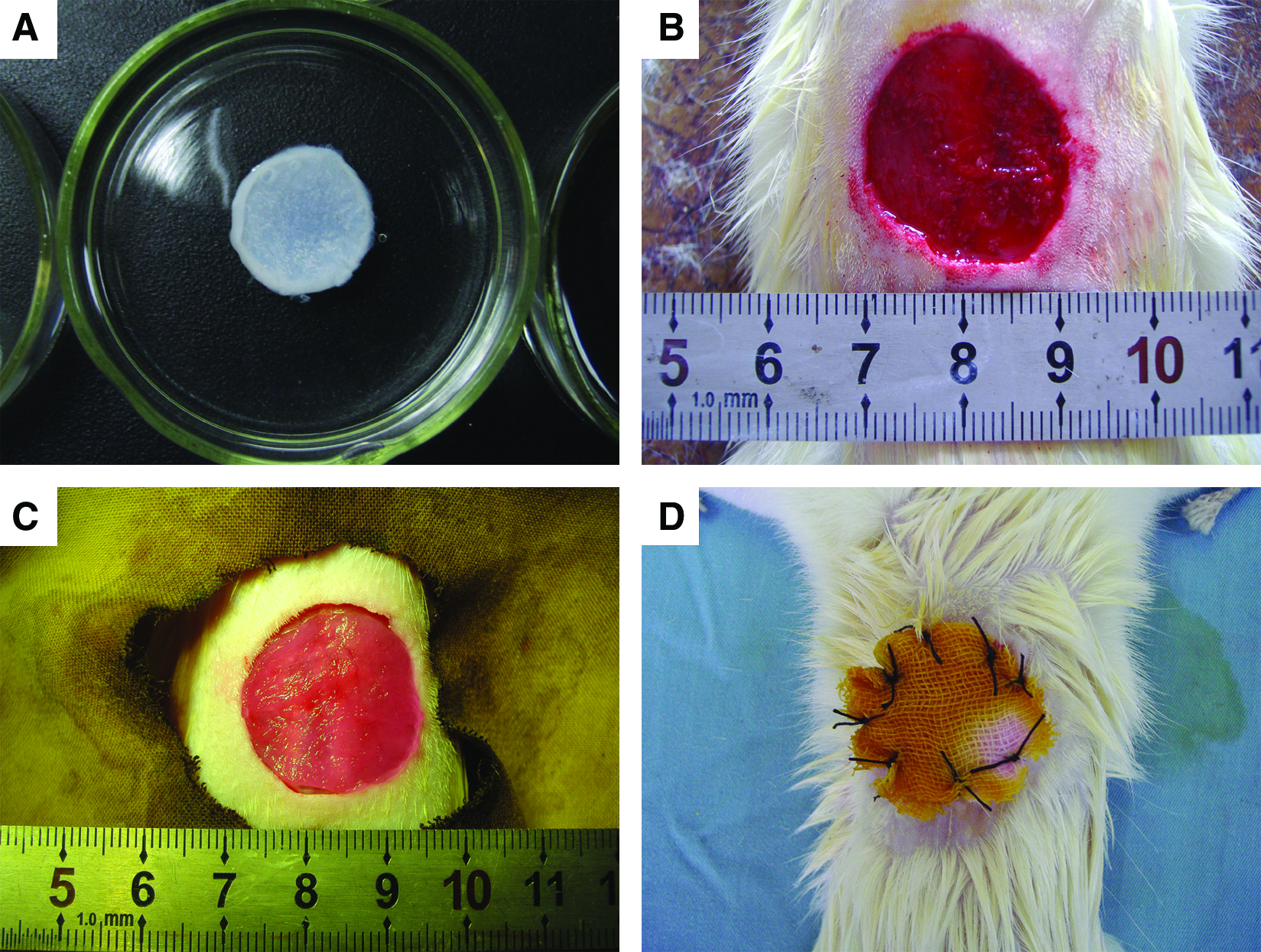
The process of animal experiment. (
Grafting of dermal equivalents
SD female rats aged 8 weeks with a weight of 180 ± 4.2 g were acclimated for 2 weeks before use. Six rats were randomly selected for each group. All procedures were performed with aseptic techniques and all materials were sterile. After disinfection of the dorsolateral surface with 70% ethanol, a 22 mm diameter full-thickness skin section was excised on each rat dorsum, sparing the panniculus carnosus (Fig. 1B). The skin equivalents with allogenic skin fibroblasts were placed on the wound (Fig. 1C). One layer of vaseline gauze was added before a tie-over dressing was created with 6–0 silk sutures, which anchored the graft to the wound (Fig. 1D). The control group of an open wound without scaffold was covered with one layer of vaseline gauze and several layers of cotton gauze. All animals were given daily injections of 3 mg ceftazidime intraperitoneally for 3 days after surgery. Macroscopic observation was made after grafting for 1, 2, and 4 weeks, and rats were killed for histological analysis after grafting for 2, 4, and 6 weeks.
Statistical analysis
Data are expressed as mean ± SD. Analysis was performed using the Statistical Program for Social Science (SPSS) for Windows. Analysis of variance by the one-way analysis of variance and pair-wise multiple comparison procedures (Tukey tests) were used to determine the significant differences among the groups. p-value less than 0.05 was considered statistically significant.
Results
Characteristics of nine kinds of CL Co/CS/HA scaffolds
Nine kinds of Co/CS/HA scaffolds fabricated by different ratios and different synthetic methods were all white porous sponges. An SEM photograph of nine scaffolds is shown in Figure 2. The tri-copolymer Co–CS–HA/CL 9:1:1 scaffold (Fig. 2A) had uniform and widely interconnected pores with mean diameters of 109 ± 11 μm and adequate porosity of about 94%. The detailed characteristics of nine scaffolds are shown in Table 1. From the table, we observed that the ultimate tensile strength (UTS) of Co–CS–HA/CL 9:1:1 scaffold was significantly higher than the others (p < 0.05), and the degradation rate was significantly lower than the others (p < 0.01). Meanwhile we also found that among the scaffolds of Co–CS–HA/CL, Co–HA/CS CL, and Co–CS/HA CL fabricated by different synthetic methods, with more Co, the pore diameter and the porosity were generally higher. And the lowest biodegradation ratio and the highest tensile strength were both observed in 9:1:1 group. By comparing the morphology, mechanical properties, and biodegradation rates, we optimized a novel scaffold of Co–CS–HA/CL 9:1:1. From the results of comparison, we also found that the ratio of 9:1:1 was better than other ratios. Therefore, to further evaluate the scaffold of Co–CS–HA/CL 9:1:1, we compared the mechanical strength, biodegradation, and metabolic activity of Co–CS–HA/CL 9:1:1, Co–HA/CS CL 9:1:1, and Co–CS/HA CL 9:1:1 in vitro.
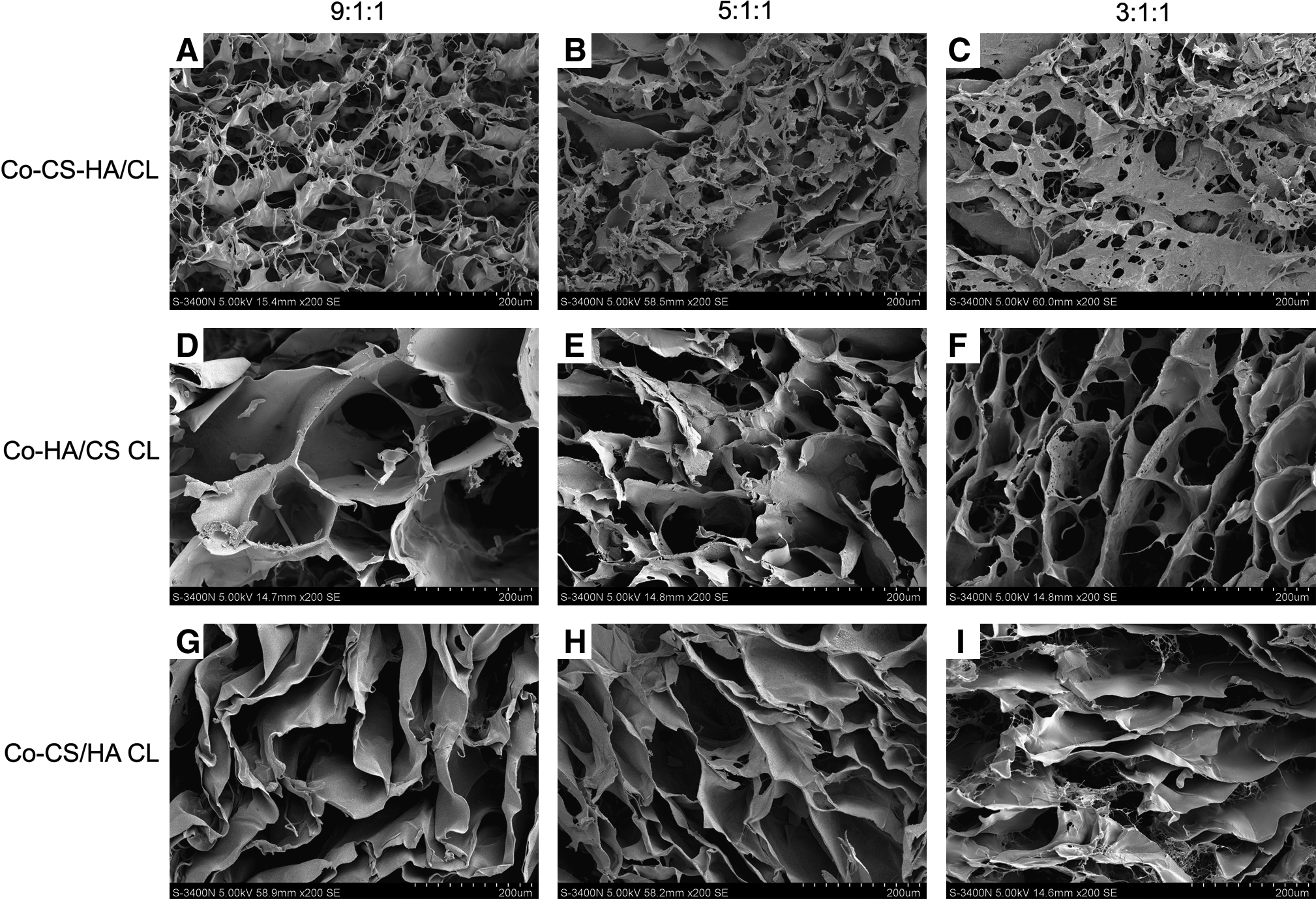
Scanning electron microscopic images of nine kinds of cross-linked (CL) Co/CS/HA scaffolds fabricated by different ratios and different synthetic methods. (
CL = cross-link with 5 mM of EDC.
One-way ANOVA, n = 24, ap < 0.05, significantly different, compared to all other groups.
SD, standard deviation; UTS, ultimate tensile strength; Co, collagen; CS, chondroitin sulfate; HA, hyaluronic acid.
Mechanical strength and biodegradation assay
The mechanical strength and biodegradation of Co–CS–HA/CL 9:1:1, Co–HA/CS CL 9:1:1, and Co–CS/HA CL 9:1:1 are shown in Figure 3. Figure 3A showed the mechanical properties of scaffolds. The UTS of Co–CS–HA/CL 9:1:1, Co–HA/CS CL 9:1:1, and Co–CS/HA CL 9:1:1 were 285 ±19 kPa, 138 ± 21 kPa, and 212 ± 10 kPa, respectively. The UTS of Co–CS–HA/CL 9:1:1 scaffold was significantly higher than the others (p < 0.05). Figure 3B showed the biodegradation rates of scaffolds. It was obvious that the lowest biodegradation rate was Co–CS–HA/CL 9:1:1 scaffold and the weight loss was 23.48 ± 1.84% after 5 h in collagenase of 25 U/mL. Under the same condition, the weight loss of Co–HA/CS CL 9:1:1 and Co–CS/HA CL 9:1:1 were 69.82 ± 1.47% and 71.50 ± 1.66%, respectively. The biodegradation rate of Co–CS–HA/CL 9:1:1 scaffold was significantly lower than the others (p < 0.01).
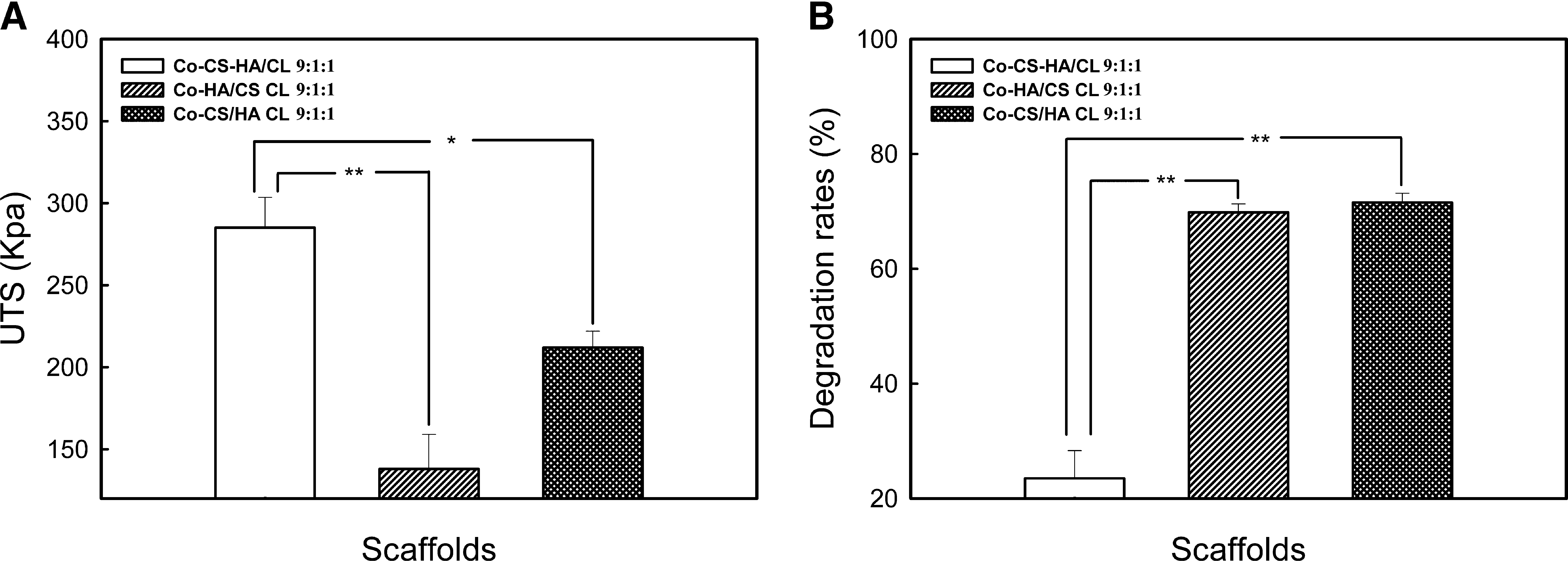
The mechanical properties and biodegradation rates of Co–CS–HA/CL 9:1:1, Co–HA/CS CL 9:1:1, and Co–CS/HA CL 9:1:1 scaffold. (
Metabolic activity assay
To monitor cellular viability of Co–CS–HA/CL 9:1:1, Co–HA/CS CL 9:1:1, and Co–CS/HA CL 9:1:1, the number of cells was determined by using MTS assay. There was no statistically significant difference in cells' number among any scaffolds at day 1 (p > 0.05) (Fig. 4). From day 3 to day 7 the number of cells increased on all scaffolds. However, it showed that cells proliferated faster in Co–CS–HA/CL 9:1:1 scaffold than in other scaffolds (p < 0.05), which may explain the result that these three kinds of scaffolds all could promote cellular attachment and proliferation, but the Co–CS–HA/CL 9:1:1 scaffold would offer a preferable environment for cellular migration and proliferation.

Assessment of cellular viability via MTS assay at 1, 3, 5, and 7 days. Differing values of OD were recorded on Co–CS–HA/CL 9:1:1, Co–HA/CS CL 9:1:1, and Co–CS/HA CL 9:1:1 groups. Statistically significant difference: *p < 0.05.
Animal experiment in vivo
Macroscopic observation
The results of macroscopic observation after transplantation of dermal substitute onto rat dorsum for 1, 2, and 4 weeks were demonstrated in Figure 5. At 1 week there was no significant difference among Co–CS–HA/CL 9:1:1, Co–HA/CS CL 9:1:1, and Co–CS/HA CL 9:1:1 groups. All the wounds in the three groups had little hemorrhage and exudate (Fig. 5A, D, and G), while the group of an open wound without scaffold had more hemorrhage and exudate (Fig. 5J). At 2 weeks, the area of wound was reduced obviously in all groups, with higher speed in Co–CS–HA/CL 9:1:1 group (Fig. 5B) than in the other groups (Fig. 5E, H, and K) (p < 0.05). At 4 weeks, no wound and tissue adhesion were seen, and the wound healing was very satisfactory in Co–CS–HA/CL 9:1:1 group. The reparation skin was more approximate to normal tissues in morphology (Fig. 5C). But there were still some linear scar or small wound on the dorsa of control rats (Fig. 5F, I, and L). These results showed that Co–CS–HA/CL 9:1:1 dermal substitute had significant promotion on wound healing compared with the control groups.

The results of macroscopic observation of experimental and control groups after transplantation for 1, 2, and 4 weeks, respectively. (
Take percentage assay
To determine the take percentages of all groups, the wounds were imaged by digital camera following surgery at 1–4 weeks. The photographs were analyzed using the Leica Q-Win image analysis software. The take percentages in all groups are shown in Table 2. The take percentage of Co–CS–HA/CL 9:1:1 group was much higher compared with the other groups from the beginning of 1 week to the end of 4 weeks. The take percentage in Co–CS–HA/CL 9:1:1 group was really satisfactory and the dermal equivalent was totally integrated in the 4 weeks.
One-way ANOVA, n = 24, ap < 0.05, significantly different, compared to all other groups. FB, allogenic skin fibroblasts.
Histological examination
Histological examinations of the central parts of the implants after grafting for 2, 4, and 6 weeks are shown in Figure 6. Two weeks after implantation, fibroblasts, inflammatory cells, and ECM were filled in the spaces of the mesh, and epithelialization was initiated from the wound edges (Fig. 6A, E, I, and M). At week 4 after implantation, the graft of Co–CS–HA/CL 9:1:1 group was completely epithelialized (Fig. 6B), but control groups still had some hematoma left (Fig. 6F, J, and N). Meanwhile the inflammatory response gradually subsided in this stage. At week 6 after surgery, thick dermis-like tissues had formed in all groups. But the cell's arrangement of Co–CS–HA/CL 9:1:1 group was more regular and the skin morphology was more approximate than normal skin (Fig. 6C and D). These results indicated that Co–CS–HA/CL 9:1:1 matrix was able to provide more suitable conditions for tissue regeneration compared with the controls.

Histological images of hematoxylin and eosin of experimental and control groups after transplantation for 2, 4, and 6 weeks, respectively. Original magnification (
Fluorescent microscope observation
To evaluate the effects of skin equivalents with allogenic fibroblasts on promoting wound healing in vivo, the allogenic fibroblasts of SD rat were labeled with PKH26, and cryostat section observations after grafting for 2, 4, and 6 weeks are demonstrated in Figure 7. It appeared that the main differences among Co–CS–HA/CL 9:1:1, Co–HA/CS CL 9:1:1, and Co–CS/HA CL 9:1:1 groups were celluar proliferation and distribution during the whole period. From 2 to 6 weeks, the proliferation of PKH-positive fibroblasts on Co–CS–HA/CL 9:1:1 matrix was significantly faster than on the other scaffolds, and the distribution was also more uniform than the others. These results demonstrated that the dermal equivalents of Co–CS–HA/CL 9:1:1, Co–HA/CS CL 9:1:1, and Co–CS/HA CL 9:1:1 were all biointegrated to become part of the ECM of the regenerative skin tissue. However, the Co–CS–HA/CL 9:1:1 dermal equivalent had more significant effect on promoting tissular regeneration in vivo.
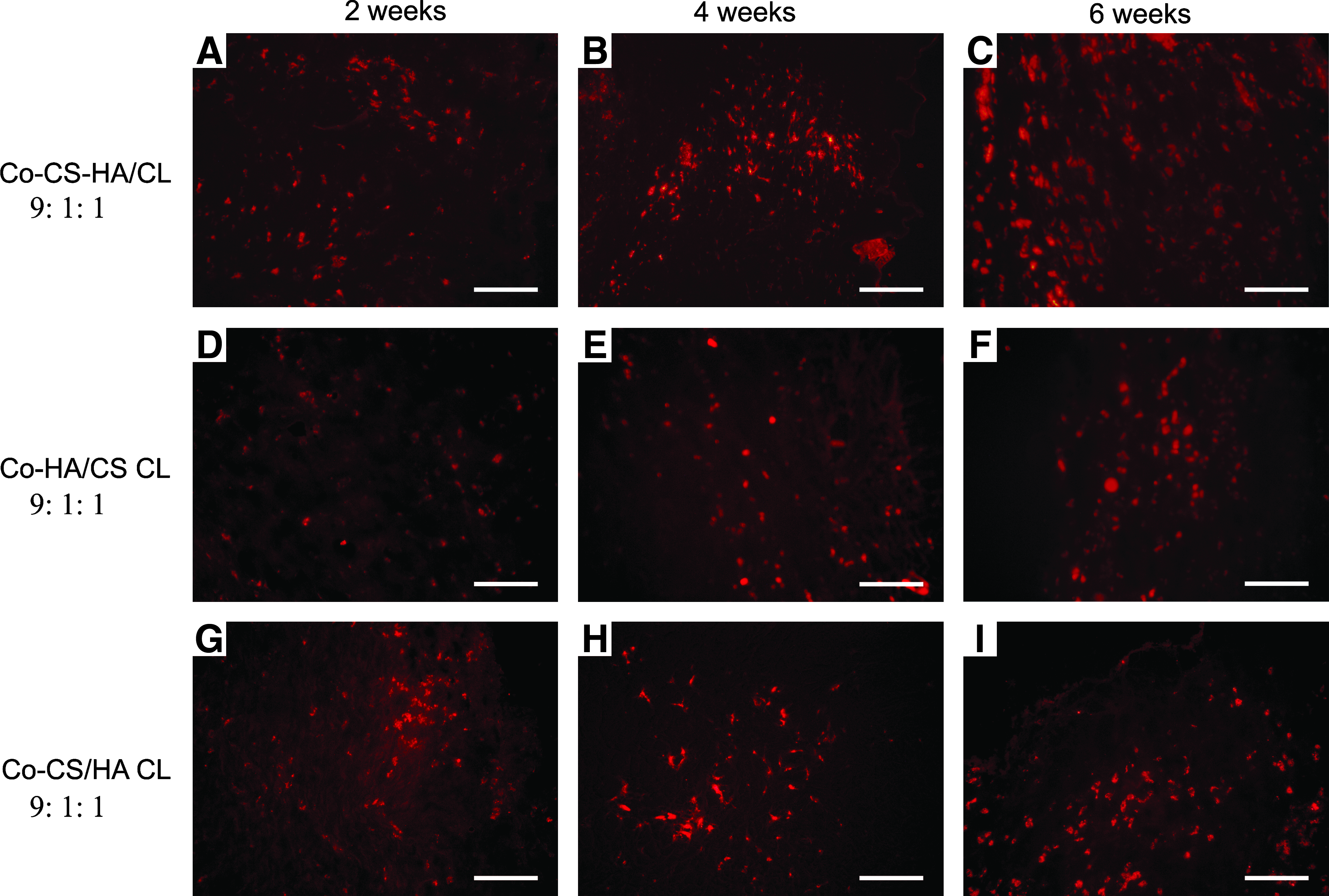
Fluorescent micrograph of experimental and control groups after implantation for 2, 4, and 6 weeks, respectively. (
Discussion
ECM is a complex mixture of structural and functional proteins, glycoproteins, and proteoglycans arranged in a unique, tissue-specific 3D structure. 19 Co is a major structural protein of ECM, supporting the growth of a wide variety of tissue. 20 Incorporation of CS, a glycosaminoglycan of ECM, into Co could improve the property of Co. HA is a mucopolysaccharide found in various types of tissular ECM and its immunoneutrality makes it an excellent building block for biomaterials to be employed for tissue engineering and drug delivery system. 21 With regard to an ideal design of scaffolds for dermal tissue engineering, it is essential to determine the components and their ratios.
To imitate the natural dermal matrix, Co, CS, and HA were chosen to fabricate tissue-engineered dermal. In this study, CS and HA were incorporated together in Co solution successfully, the technique of which had never been reported before. The key issue is that Co and HA have opposite electric charge and easily form PIC, which could influence the structure of scaffold in the end. 22 However, we solved this problem successfully by adjusting the pH of Co solution to 7.4, regulating the temperature at 4°C and determining the additional sequence of CS ahead of HA. One reason is that CS, as a polyelectrolyte, can help retain the protein better through ionic interaction. 23 The other reason probable is that low temperature and neutral pH could inhibit the form of PIC. The results showed that the scaffold of Co–CS–HA/CL 9:1:1 had more uniform pore size of 109 ± 11 μm and higher porosity of about 94%. The most fascinating part of the scaffold is its structure with widely interconnected pores. This structure could better promote cell penetration, growth, and proliferation. The other characteristics had been improved a lot (Table 1). Therefore, the selection of Co, CS, and HA as components is considered a reasonable selection and the synthesis method is considered a feasible method to fabricate the novel Co–CS–HA/CL 9:1:1 scaffold for dermal tissue engineering.
Moreover the ratio of three components in skin ECM is still not clear. Some literatures reported that Co:CS or Co:HA was 10:1, 9:1, 4:1, 1:1, and so on.24–25 In this study, to explore the most suitable ratio of Co, CS, and HA, we also tried different ratios such as 9:1:1, 5:1:1, 3:1:1 and compared them with each other. From Table 1 we can found that the characteristic of 9:1:1 groups was better than other ratio groups. Both highest porosity and tensile strength and lowest biodegradation ratio were seen in the 9:1:1 group. For a scaffold for tissue engineering, sufficient mechanical property, high porosity, suitable pore size, and biodegradation ratio are required. For implant applications, high porosity could better promote cellular penetration, growth, and proliferation. High mechanical strength is supposed to be an important factor for producing dermal substitutes and the low degradation rate shows good resistances to enzymatic in vivo. So the 9:1:1 ratio of Co:CS:HA is considered an optimal ratio and more approximate to the natural dermal ECM.
To improve the mechanical properties and biodegradation rates of Co biomaterials, chemical cross-linking is necessarily employed. Chemical cross-linking has been used for several years to improve Co scaffold stability. Glutaraldehyde is the most widely used reagent for chemical cross-linking. However, its use is associated with marked cytotoxicity and the influence of cross-linking on cell proliferation is not well characterized. 26 In recent years, we have concentrated on the water-soluble carbodiimide (EDC) as a potential cross-linking agent due to its water solubility that makes any toxic residues be easily washed away. Co cross-linking using EDC involves the activation of carboxylic groups of glutamic and aspartic acid residues and the formation of amide bonds in the presence of lysine or hydroxylysine residues. 27 Cross-linking using EDC could also make Co covalently be attached to relatively small amounts of GAGs, including CS and HA.16,28 EDC immobilizes GAG and stabilizes Co by the formation of amide cross-links. 29 So the method of using EDC cross-link is considered an optimal method to fabricate the Co/CS/HA/scaffold for dermal tissue engineering, and the characteristics of scaffolds have been improved a lot.
Moreover from the results we observed that the ratio and the synthetic method can affect the characteristic of scaffolds. However, there was no positive correlation between mechanical strength and biodegradation rate. No significant difference was detected in degradation rates of Co–HA/CS CL 9:1:1 and Co–CS/HA CL 9:1:1, but the mechanical strength indicated significant difference between them. It is known that the cross-linking degree determines the biodegradation rate of the biological materials. 30 In this study, cross-linking using EDC/NHS results not only in the formation of Co cross-links but also the covalent adhesion of CS and HA. However, the degree of cross-linking is different between Co–CS, Co–HA, and Co–HA–CS. 31 So the scaffolds fabricated by different synthetic methods have different biodegradation rates. As to the mechanical strength, it is probably determined by pore shape and ionic interaction. 32 Therefore, the results were shown above.
Some literatures reported that low concentration of EDC, specifically 5 mM, can be used to improve the biochemical stability of Co-based scaffold and to promote stable wound closure in vivo.33–34 In this study, 5 mM of EDC was used to cross-link the scaffold of Co–CS–HA. The results supported the report above. By EDC cross-linking and adding in HA and CS, Co scaffold could better stand enzymatic biodegradation and had enough mechanical stability to meet the requirements of dermal tissue engineering.
Evaluation of a biomaterial involves in vitro and in vivo. In vitro, it is well known that porous scaffold for tissue engineering should have 3D porous structure with proper porosity (normally higher than 50–60%) and pore size ranging from 100 to 500 μm. 35 Moreover the stability of scaffold has been shown to influence cell behavior such as adhesion, growth, and differentiation as well as to influence scaffold bioactivity in vivo. 36 In this study, the novel scaffolds of Co–CS–HA/CL 9:1:1 for dermal tissue engineering not only have more uniform pore size and higher porosity to promote cellular migration and proliferation but also have sufficient stability to resist handling during implantation and in vivo loading. In vivo, evaluation of the scaffold involves remodeling, inflammation, healing, and so on. Co in the scaffold can adhere well to wet wounds, absorb large quantities of tissue exudates, preserve a moist environment, and encourage the formation of new granulation tissue and epithelium on the wound. 37 CS and HA not only can provide enough elasticity and mechanical stability of the Co matrix but also can promote cell attachment and proliferation.38–39 CS and HA have the significant advantage of structural conservation in scaffolds and their degradation products may be able to modulate wound healing.40–41 So it is rationale to select the tri-copolymer of Co–CS–HA/CL 9:1:1 as dermal scaffold to restore tissue defect. In fact the morphological and histological observations demonstrated that the Co–CS–HA/CL 9:1:1 dermal equivalent had significant dominance in remodeling, inflammation, and promoting healing.
Conclusion
This novel Co–CS–HA/CL 9:1:1 scaffold imitating ECM for dermal tissue engineering has uniform and widely interconnected pores with mean diameters of 109 ± 11 μm and adequate porosity of about 94%. In vitro it has better resistance to biodegradation and higher elastic modulus. In vivo, it not only has positive effect on promoting wound-healing process but also has high percentage of graft take rate. Therefore the Co–CS–HA/CL 9:1:1 scaffold would have the potential to be applied on the clinics to overcome the shortage of donor skin area for split-thickness autografting and to heal the full-thickness skin defect of wounds in the near future.
Footnotes
Acknowledgment
This study was supported by the funding support from the National High Technology Research and Development of China (2006AA02A119).
Disclosure Statement
No competing financial interests exist.