




Abstract
Adequate sterilization procedures for soft biomaterials such as hydrogels are known to be challenging. These materials are delicate in structure, making them sensitive to harsh conditions and prone to damage. In this study, a suitable sterilization method for hydrogels composed of tri(ethylene glycol)-functionalized polyisocyanopeptides (PIC) was explored. These high biomimetic hydrogels are temperature and strain sensitive and have been presented as novel cell culturing matrices, wound dressings, and drug carriers. The methods that were investigated include autoclaving, γ-irradiation, ultraviolet (UV) light irradiation, and supercritical CO2 (scCO2) treatment. The results show that autoclaving and γ-irradiation have deleterious effects on the gelation behavior and mechanical characteristics of PIC. For γ-irradiation, cooling the gels on dry ice alleviated this negative impact, but not sufficiently enough to make the method viable. In contrast, UV light and scCO2 treatment do not affect the mechanical properties of the PIC gels. Studies with gels inoculated with 107 CFU/mL Gram-positive bacteria Staphylococcus aureus show that only scCO2 is capable of successfully sterilizing PIC hydrogels by achieving a 6-log reduction in bacterial load. It was concluded that, within the range of tested techniques, the sterilization of PIC is limited to scCO2.
Impact statement
This study grants new insights in the impact of various sterilization techniques on temperature-sensitive hydrogels and contributes to the development of new sterilization strategies. Moreover, it describes, for the first time, the sterilization of polyisocyanopeptide hydrogels, which is a crucial step for preparing this material for routine use in patients or as cell culturing matrix.
Introduction
Soft biomaterials such as hydrogels have a wide variety of application possibilities as medical devices. Regulations require medical devices to be sterile before application in or on the body. 1 Sterility can be defined as the absence of viable microorganisms. Sterilization procedures are designed to be as lethal for microorganisms as possible to achieve the highest effect on bacterial ingress. Proving that a product is completely sterile is difficult; so sterility is described by the sterility assurance level (SAL), which is the probability that a product is sterile after undergoing sterilization. Moreover, to test the efficiency of a sterilization procedure, the term log reduction is employed, which is a reduction in the concentration of contaminants in a product by factors of 10, for example, a 1-log reduction implies that a contaminant's concentration was reduced to 10%. Making the sterilization procedure as lethal as possible improves the SAL, but can also have undesirable side effects; soft biomaterials are inherently delicate and may suffer irreversible damage.2–6 In the case of hydrogels, the mechanical properties and functionalities may be changed to the point that they are no longer usable. Therefore, finding a sterilization technique that is suitable for a specific hydrogel can be challenging.
Recently, a novel biomimetic thermoreversible hydrogel based on oligo(ethylene glycol)-grafted polyisocyanopeptides (PIC hydrogel) was presented.7,8 As a fully synthetic material, it uniquely mimics the architecture and intricate mechanical properties, including strain-stiffening, of biopolymer gels that comprise the natural extracellular matrix. 9 Also, due to its thermosensitive nature, this material can reversibly switch between a polymer solution (T < 16°C) and a gel state (T > 16°C), which facilitates gel removal and, for instance, cell harvesting. Because of its biomimetic properties and its high tunability, this unique material has been previously employed as a wound dressing, as a synthetic dendritic cell, cell culturing matrix, drug carrier, and more.10–17 However, because the material is relatively soft and delicate, it was considered that traditional sterilization techniques would irreversibly damage the elastic and thermosensitive gelation behavior. Currently, PIC for cell culturing purposes is sterilized by ultraviolet (UV) light; however, for a clinical application, it would be preferable to sterilize the material in hydrogel form.
Many different sterilization methods can be applied for medical devices, but as mentioned previously, they might be incompatible with PIC hydrogels or other soft (bio)materials. For example, the heat of an autoclave or the intense radiation of a γ-source or UV light can potentially alter the molecular structure.6,18 An alternative, a recently proposed technique, for sterilizing hydrogels is exposure to CO2 in the supercritical state (scCO2).19–25 As a dense gas (plasma), CO2 gains the characteristics of both fluid and gas, allowing it to penetrate deeply into porous structures and solutions. It is theorized that bacterial inactivation is achieved through acidification of the liquid medium and disruption of cell membranes, leading to a disturbed internal pH and cell metabolism. 25 The effectivity of the procedure can be increased with additives such as acetic acid and H2O2, which will form antimicrobial peracetic acid. 19 The major benefits of this method are that CO2 is inherently nontoxic and the procedure can be run at relatively low temperatures.
In this study, the effects of UV irradiation and scCO2 on PIC hydrogels were compared to autoclaving and γ-irradiation. The study followed a go/no-go design where sterilization parameters were first identified from literature. The techniques were then serially performed to identify the impact on rheological characteristics such as stiffness (storage modulus G′) and gelation behavior (e.g., gelation onset point, thermoreversibility, and ability to pass a vial inversion test). When hydrogels successfully passed these tests, they were inoculated with bacteria (Staphylococcus aureus 26 ) to study the sterilization efficiency. We then optimized the methods and parameters of the procedure to define an effective sterilization procedure for the sensitive PIC hydrogel.
Materials and Methods
Material production and preparation
Tri(ethylene glycol)-functionalized PIC polymers were synthesized as described previously and kept in storage at −20°C for the duration of the study.7,8 PIC hydrogels were prepared at a concentration of 2 mg/mL in sterile phosphate-buffered saline (PBS) (Gibco®; Thermo Fisher Scientific, Waltham, MA) 24–72 h before sterilization procedures. Dissolution took place on ice on a shaker at ∼200 rpm for 6–8 h. For the bacterial inoculation studies, PIC gels were prepared at a 4 mg/mL concentration and then diluted to 2 mg/mL using a bacteria-containing PBS solution (see Bacterial Inoculation section). Each experiment was performed at n = 3 unless otherwise specified.
Steam sterilization
Steam sterilizations were performed using a Tuttnauer Autoclave Steam Sterilizer (model 2840 ELPV-D, Breda, The Netherlands). Hydrogels were placed in glass flasks (PerkinElmer, Inc., Waltham, MA), covered by aluminum foil, and placed in a stainless-steel tray during the procedure. Samples were treated at a temperature of 121°C or 134°C for 5 or 20 min and the cycle ended with a 60-min drying period.
γ-Irradiation
Irradiation with γ-rays was performed by Synergy Health (Etten-Leur, The Netherlands) using a Co-60 source. Gels were placed in 14 mL polypropylene tubes (Falcon™; Thermo Fisher Scientific) and packaged in a cardboard box during the treatment. Samples irradiated on ice were first frozen at −20°C, and then placed on dry ice in a Styrofoam box for the duration of the treatment. An intended dose of 25 kGy was achieved by adjusting the duration of exposure to the source, and the actual dose was determined by dosimeters post-treatment.
UV-C irradiation
Hydrogels (1.0 mL) were placed in the wells of UV-permeable film-bottom 24-well imaging plates (Eppendorf, Hamburg, Germany) with the lids removed directly underneath a CAMAG universal UV lamp type TL-900 setup so that they were irradiated from above. An OSRAM Puritec germicidal lamp HNS 8W G5 G8T5/OF (wavelength 254 nm) was used. The bottom and sides of the setup were covered in aluminum foil to reflect UV light, improving exposure and limiting the risk of undesired UV exposure to the researchers. Samples were placed directly below the lamps and the distance from the light source to the gels was ∼11 cm. The whole setup was placed at ambient room temperature. For runs performed on ice, granular ice was placed around and below the plates, as well as wells adjacent to the samples. After the treatment was completed, gelation was reversed by placing the plates briefly in a fridge (4°C) and retrieving the now liquid PIC solution with a pipette.
Super critical CO2 sterilization
Samples were sterilized in a Supercritical Fluid Extractor (Waters Corp., Milford, MA) equipped with a 500 mL extraction vessel at HCM-Medical (Nijmegen, The Netherlands). The hydrogels were placed in 15 mL filter-capped (pore size 0.2 μm) polypropylene tubes (Cellstar® cellreactor tubes; Greiner Bio-One GmbH, Frickenhausen, Germany) and transported to HCM-Medical in the frozen state, where they were thawed briefly before treatment. CO2 was preheated and guided into the treatment vessel until the desired pressure was reached. Four protocols were studied: in the pilot experiment, the temperature during the sterilization procedure was set to 37°C or 55°C at a pressure of 100 bar for 4 h. A mixture of additives consisting of 2.5 mL 1 M acetic acid (Boom B.V., Meppel, The Netherlands), 0.75 mL 30% H2O2 (Boom B.V.), and 1.25 mL purified water was added to the sterilization vessel.
In a second experiment, the sterilization time was reduced to 30 min, the temperature was kept at 37°C, and the pressure was maintained at 100 bar. Samples were treated both with and without the additives. Afterward, two additional protocols were tested: a “long-duration” protocol (8 h, 37°C, and 100 bar) and a “high-pressure” protocol (4 h, 37°C, and 250 bar). Both protocols were tested without additives and with the mixture of additives at a reduced concentration (1/4th normal concentration, volumes adjusted to 0.625 mL acetic acid, 0.188 mL H2O2, and 3.6875 mL water). An additional 30-min dynamic flushing step was added before depressurization when additives were included. Depressurization times were generally kept to 30 min (60 min for 250 bar experiments) to prevent drastic drops in temperature. Gels were frozen at −20°C after the treatment was completed and later transported to the laboratory at Radboudumc (Nijmegen, The Netherlands) for rheological measurements or QM Diagnostics (Nijmegen, The Netherlands) for bacterial inoculation studies.
Vial/plate inversion test, thermoreversibility, and pH measurements
Hydrogels were qualitatively checked for thermoreversible gelation behavior and the ability to pass a vial inversion test, either while performing rheological characterizations or immediately after sterilization had occurred. For the vial inversion test, the tube or plate containing PIC gel was kept at room temperature for several minutes. The tube is then inverted, and a gel successfully passed the test if it could maintain its weight and remained in place. Thermoreversibility was confirmed by then placing the samples at 4°C and regularly observing if and when the gelated hydrogels (gel state) turned back into their liquid form (sol state). The pH of hydrogels was measured by adding droplets to a LAQUA twin compact pH meter (HORIBA Scientific, Kyoto, Japan).
Rheology
PIC hydrogels were frozen and stored at −20°C for 12–48 h after a sterilization procedure and thawed briefly (∼30 min) before rheology. Control (untreated) samples were aliquoted and frozen immediately after stock hydrogels were created. Thawing was performed by placing the tubes/flasks in cold tap water and transferring them to ice after thawing was completed. For mechanical characterization, 350 μL of cold polymer solution was pipetted on the bottom plate of a parallel plate geometry (20 mm radius) of an AR-2000ex rheometer (TA instruments, Etten-Leur, The Netherlands). The gap size was manually lowered between 250 and 265 μm until proper loading was observed. Samples were protected from evaporation with a solvent trap and the axial force was set to zero before measurement. First, the solutions were conditioned for 2 min at 4°C and presheared at 0.1 rad/s for 30 s. Then, the shear modulus was measured under oscillatory deformation (strain amplitude 2% and frequency 1 Hz) during a temperature ramp from 4°C to 40°C (heating rate 2°C/min). Data were recorded with 10-s increments. The gelation temperature was defined as the onset point of the increase in storage modulus using the onset point feature incorporated in the TRIOS software (TA Instruments).
Bacterial inoculation
Cooled 4 mg/mL PIC solutions were inoculated with ∼1 × 10⁷ CFU/mL S. aureus containing PBS at a 1:1 ratio at cooled (∼4°C) conditions, at QM Diagnostics. After inoculation, loaded samples were briefly mixed and then prepared for the sterilization process. For UV light irradiation experiments, the control (not inoculated) samples were serially diluted and immediately placed on blood agar plates for bacterial counting. At the same time, the inoculated samples underwent UV irradiation at room temperature and were then immediately processed for bacterial counting after treatment had completed. For scCO2 experiments, all samples, including the positive control (inoculated, but not treated samples), were frozen at −20°C and transported to HCM-Medical. After treatment had completed, samples were transported back in frozen condition to QM diagnostics. Samples were placed on blood agar, incubated overnight at 37°C, and the number of colony-forming units (CFU) was subsequently counted to quantify the remaining number of bacteria in the samples. In addition, the original bacteria-containing solution was counted to confirm the dose the gels were inoculated with.
Statistics
The onset points of thermogelation and the storage moduli at 37°C of treated samples were compared to their respective control groups using the independent sample Student's t-test. The bacterial load in treated hydrogel samples was log-10 transformed and then compared to the positive control as well as among each other using an independent Student's t-test. For samples containing between 0 and 1 × 101 CFU, the value was set to 1 × 101 CFU ( = 1.0 after log-10 transformation), as (i) it cannot be stated with absolute certainty that a sample contains 0 bacteria and (ii) a value of 0 cannot be log-10 transformed. A statistical significance level of α = 0.05 was maintained.
Results
Pressurized steam sterilization
PIC hydrogels were treated in an autoclave using standard parameters, which include heating the chamber/steam to 121°C, maintaining this temperature for 20 min, and then cooling down/drying over 60 min. The impact was immediately apparent; hydrogels dehydrated and formed plaques in a shade of brown, reminiscent of the untreated polymers (Fig. 1). There was a loss in liquid volume. Moreover, the resulting plaques were incapable of reversible thermogelation and swelling behavior, or able to be redissolved in water. The experiment was repeated at a reduced duration (5 min at 121°C) and simultaneously also at reduced duration, but with increased temperature (5 min at 134°C). The same results were obtained once more; hydrogels turned into dehydrated plaques that did not display basic hydrogel characteristics.
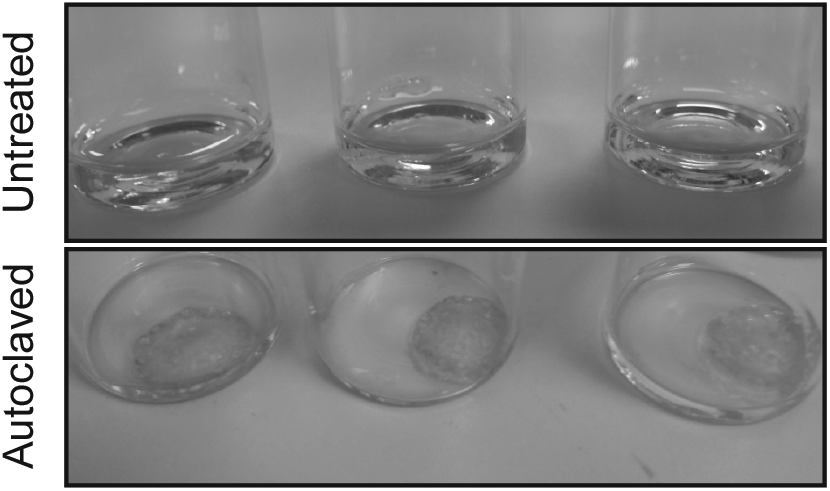
PIC hydrogels that underwent autoclaving lost volume, changed color, and could no longer be considered hydrogels. PIC, polyisocyanopeptides.
γ-Irradiation
PIC hydrogel samples were treated with both γ-radiation on ambient/room temperature (actual dose 27.5–27.7 kGy) and dry ice (actual dose 25.7–25.8 kGy). Sufficient dry ice was added to keep samples cooled (−78.5°C) and frozen for the duration of the experiment. It was found that gels treated at ambient temperature colored to a dark brown/black and were irreversibly crosslinked, as can be seen in Figure 2. These gels were shaped according to the rounded bottom of the tube they were placed in and were observed floating in the remaining nonpolymer containing liquid. After applying force (shaking) or attempting to lift the crosslinked gel, it was found to be very weak upon manual handling and disintegrated easily into smaller pieces.
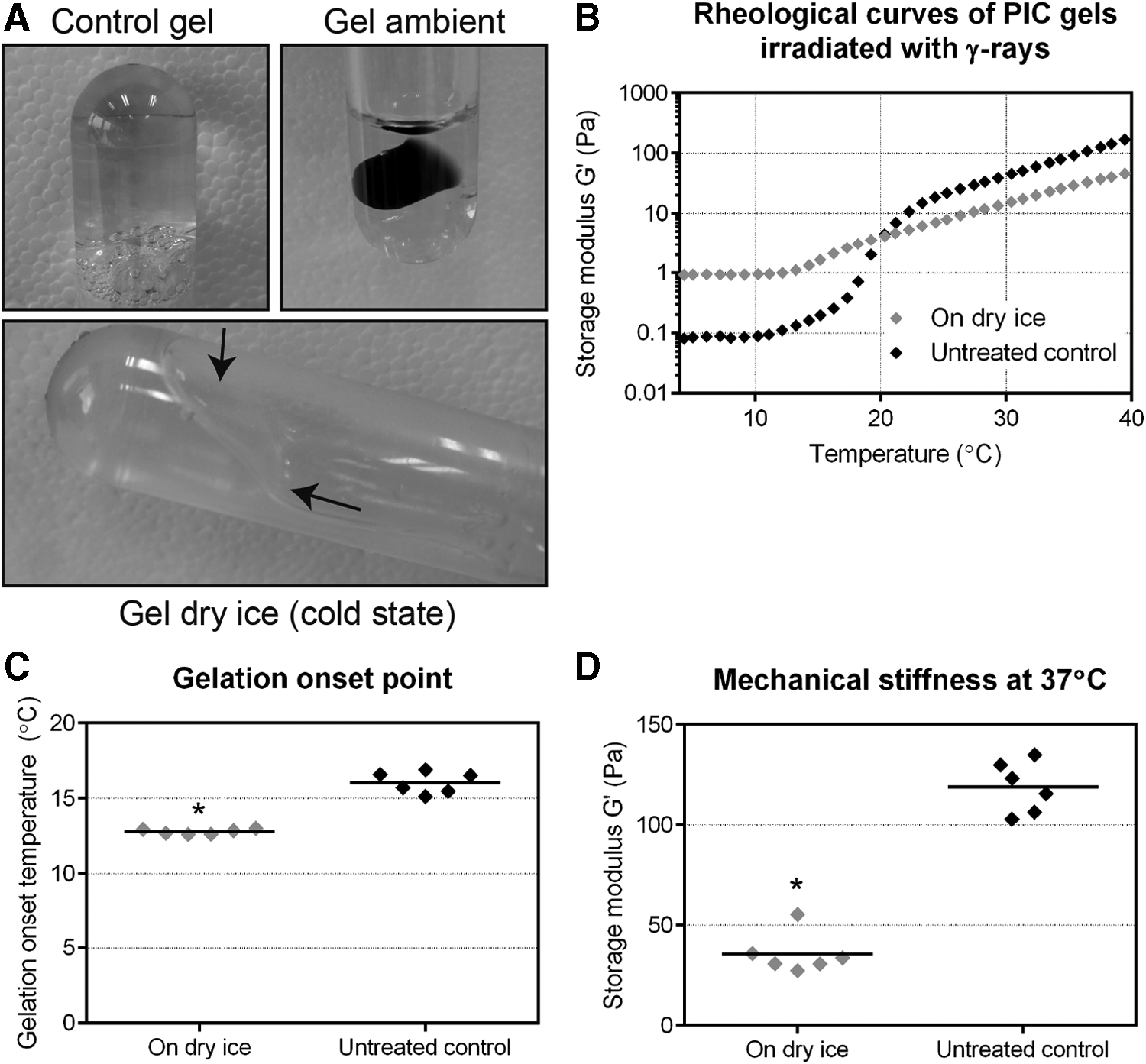
Treatment of PIC hydrogels with γ-irradiation (n = 6).
PIC gels treated on dry ice were still capable of reversible gelation and passing vial inversion tests. In addition, the gelation onset temperature was decreased by ∼2°C, which was statistically significant (p ≤ 0.001) (Fig. 2C). Moreover, the gel was partially crosslinked; when the sample was cooled to the liquid state, a mass of gel could be observed floating in the solution, indicating the gelation was not completely reversed. Mechanical characterization showed that the storage modulus was significantly reduced by roughly threefold compared to control (p < 0.001) (Fig. 2D).
UV-C irradiation
Gels that underwent UV-C irradiation were still fully thermoreversible and passed the vial inversion test. The UV lamps heated the samples and caused gelation. Only a few minutes in the refrigerator (4°C) were enough to cool the samples and revert them to the liquid state. Figure 3B shows that the stiffness of PIC hydrogels treated with UV-C light is comparable to the control group after 30, 60, and 180 min of exposure. The gelation onset point remained unaffected (p > 0.05 for all groups) (Fig. 3C). The mechanical stiffness of UV-C-treated samples is significantly reduced (p < 0.05) when comparing at 37°C (Fig. 3D). However, on a functional level, the stiffness is still within the same regime and of a comparable amount. The addition of ice around and below the gel-containing plates kept PIC in the cooled liquid state during treatment, but did not result in any noticeable benefit in regard to mechanical properties or gelation behavior.

UV light irradiation of PIC gels (n = 3).
scCO2 parameter selection
A pilot study (results not shown) indicated that polypropylene tubes with filter caps permitted gaseous exchange, did not deform/melt, and, simultaneously, prevented bacterial recontamination post-treatment. In this work, several irreversibly crosslinked hydrogel clumps were formed (n = 1), which were floating in the remaining nonpolymer containing liquid. The samples also had a strong acidic smell.
A follow-up study showed that the acidic additives cause a deviation in gelation behavior (Fig. 4B). Even though the behavior and the mechanical stiffness above the gelation point are comparable for the control group and treated groups, PIC gels treated with additives gelled at a lower temperature (13°C) compared to their control (15°C) (p = 0.022). The volumes and concentration of these additives were selected as a percentage of the volume of the sterilization vessel and adhered to standardized protocols of HCM-Medical. The presence of CO2 in the PIC gels, which was observed as minuscule bubbles floating to the surface in the cold liquid state and as larger bubbles in the warm gelled state (Fig. 4A), indicated that not all CO2 was removed from the gel.
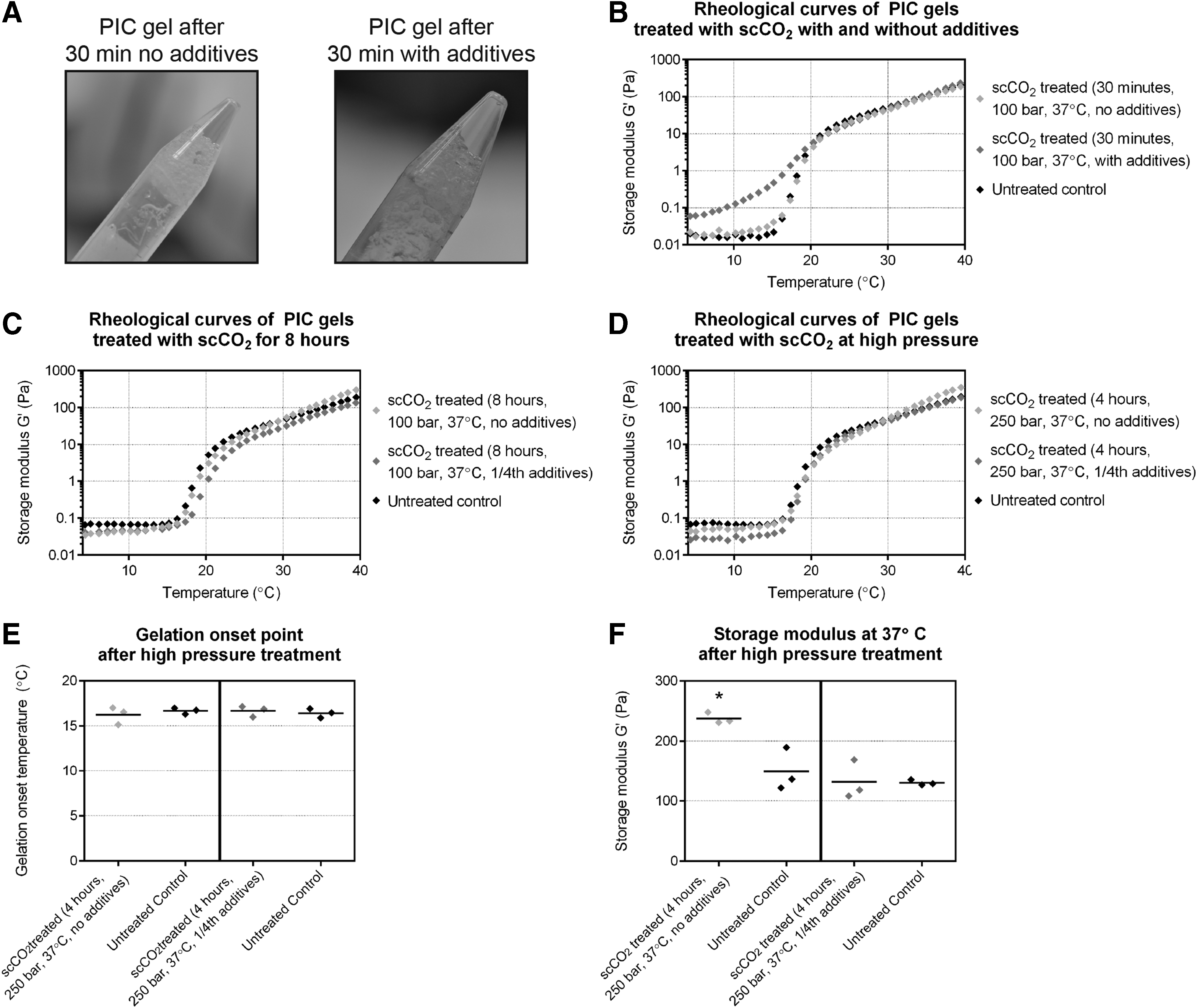
Characterization of PIC hydrogels treated with scCO2 (n = 3).
Next, the PIC gels were treated with scCO2 using the long-duration protocol (37°C, 100 bar, and 8 h) and a high-pressure protocol (37°C, 250 bar, and 4 h). The procedures were performed in the presence or absence of additives, but a reduced concentration of 1/4th of previous values. For the 8-h protocol (Fig. 4C), no difference in behavior, onset of gelation, or mechanical stiffness was noted when no additive was present. In contrast, when additives were present, the gelation onset point increased (p = 0.026) and the mechanical stiffness decreased (p = 0.008). However, when looking at the curves, the extent of this effect is negligibly small.
For gels treated with the high-pressure protocol (250 bar) (Fig. 4D), the rheological curves also appeared highly similar to the untreated control. No significant changes in the gelation onset point were observed (Fig. 4E). However, when assessing the mechanical stiffness at 37°C (Fig. 4F), it is discovered that the mechanical stiffness is elevated significantly when no additive is present. It was noted that, again, the samples treated with additives had a slightly acidic smell.
The pH of PIC gels that underwent scCO2 sterilization was measured. In the long-duration protocol (with 1/4th additive concentration), the pH dropped from 7.07 ± 0.05 (control) to 4.95 ± 0.09, while gels that were subjected to the high-pressure protocol showed a pH drop from 7.15 ± 0.1 (control) to 5.12 ± 0.13.
Bacterial inoculation studies
Based on the results from mechanical tests, we performed sterilization efficiency tests on samples treated with UV-C (30, 60, and 180 min, Fig. 5A) and scCO2 (high-pressure protocol, Fig. 5B). No log reduction was achieved using the UV irradiation method, as the bacterial populations in the samples were comparable to the positive control group (p = 0.407, 0.465, and 0.493, respectively). Bacterial populations in PIC gels treated with scCO2 underwent a significant log reduction of 4.72-log (p = 0.029) without additives and a 6.03-log reduction (p = 0.032) with a low concentration of additives. The treatment with additives was significantly more effective than the one without additives (p = 0.018).
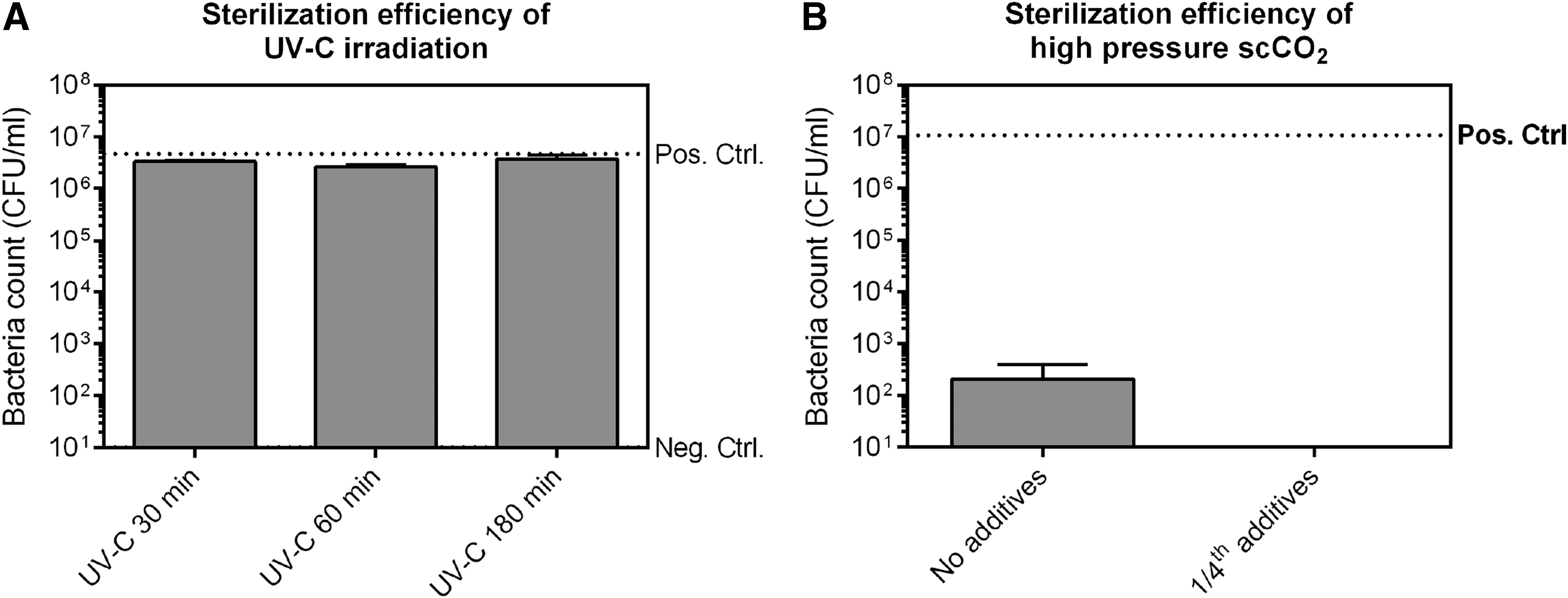
Bacterial counting of PIC hydrogels inoculated with ∼1 × 10⁷ CFU/mL Staphylococcus aureus.
Discussion
In this study, four different techniques for the sterilization of temperature and strain responsive PIC hydrogel were investigated. Steam sterilization, γ-irradiation, UV light irradiation, and scCO2 treatment were serially tested in a go/no-go design. The impact on the PIC hydrogels' mechanical properties, gelation and general behavior, was first investigated and fine-tuned. When no negative impact on these properties was observed, the materials were inoculated with 107 CFU/mL of bacterial strain S. aureus to assess the sterilization efficiency and log reduction capabilities.
The sterilization of soft biomaterials such as hydrogels is challenging and many commonly used techniques fail to preserve the properties of these gels.3,6 The golden standards for sterilization of medical devices are ethylene oxide (EtO), autoclaving (pressurized steam), and γ-irradiation.27,28 Since EtO is extremely toxic and flammable and poses the risk of leaving residues in the PIC hydrogel, it was decided to only explore the feasibility of autoclaving and γ-irradiation. Other sterilization methods were identified from literature; the first was UV light irradiation, which is typically employed for medical device surface disinfection, but can also be applied for clear liquids. 29 The next identified method was scCO2 treatment, which has been receiving an increasing number of reports as a viable method for soft biomaterial sterilization.21–25 In addition, radiofrequency glow discharge treatment using argon plasma was identified and briefly explored. Due to difficulties handling and maintaining a hydrogel in a vacuum, this method was not explored further, although it was found that this method did not affect the mechanical properties of PIC in powder form, suggesting it may be feasible for sterilizing undissolved PIC polymers (results not shown). Similarly, plasma sterilization using H2O2 may be a feasible strategy, although it was not tested at this time.
In line with the other publications, we find that autoclaving is incompatible with PIC hydrogels.6,30,31 The intense heat and drying steps cause a complete loss of the hydrogel's characteristics, making them unusable in any form. Even for short exposure times (5 min), the impact on the hydrogel's shape is extensive. In contrast, it has to be noticed that it was previously shown that thermosensitive xyloglucan hydrogels are not affected by autoclaving at the same parameters as used in our study (20 min at 121°C). 4 This result emphasizes that soft (bio)materials have vastly different origins and properties, and one cannot assume that one sterilization method works equally well for different materials.
Irradiation with γ-rays resulted in irreversible crosslinking and a strong discoloration. However, literature suggested that cooling the material to −78.5°C with dry ice can reduce the diffusion of free radicals,32,33 which prevents or limits damage to polymers and can negate crosslinking.34,35 This strategy can be used to maintain a hydrogel's mechanical characteristics. 4 It was observed that PIC gels on dry ice after a dose of 25 kGy show reduced stiffness and some degree of crosslinking. This change in hydrogel characteristics is too large to consider the dry ice method as a viable sterilization strategy, so it was not investigated further. In this study, a dose of 25 kGy was used, which is the routine procedure for the sterilization of medical devices. Although a lower dose can possibly also achieve sufficient sterilization and without deleterious effects on the material,18,36 we refrained from further studies as acquiring approval for sterilizing a medical product at doses lower than 25 kGy can be problematic.
It was found that UV-C light does not negatively impact the mechanical properties and gelation behavior of the PIC gels, but is incapable of reducing the S. aureus population. Although the mechanical stiffness was found to be significantly reduced at 37°C, it was concluded that this reduction (roughly 33 Pa in the worst scenario) is negligible. In this case, a statistical significant difference does not translate into a significant change in performance and behavior of the gel. Two earlier studies6,37 showed that UV sterilization had no impact on hydrogel characteristics, but only showed a reduction instead of complete eradication of Escherichia coli population. The authors suggested that the thickness of the gel is of great importance and that after penetration for more than 2 mm in the hydrogel, the UV-C light intensity is insufficient to kill E. coli. 37 Indeed, these studies used gels of different thicknesses and required vastly different treatment durations (40 min vs. up to 15 h). It is assumed that the thickness also plays a role for PIC hydrogels and, since our gels were roughly 6.6 mm thick, it seems unlikely for UV-C sterilization to succeed. Moreover, considering the upscaling of the technique, the sterilization of larger volumes of PIC gel is challenging due to the inability of UV-C light to properly penetrate through it. Other strategies for improving sterilization efficiency include lengthening the duration of treatment and bringing the samples closer to the light source, but were considered equally unlikely to succeed.
Ultimately, it was found that scCO2 sterilization successfully eradicates S. aureus populations from PIC hydrogel samples, while fully preserving the gel properties, in a commercially available and clinically usable setup. Indeed, after 30 min of exposure, the impact on the rheology curves is minimal, although the acidic additives slightly modify the gelation pattern and shift the gelation onset point. In addition, a high number of CO2 bubbles were observed in the solution, indicating that not all CO2 was removed from the PIC solution during the flushing and depressurization steps. 38 The presence of the harmless CO2 is not expected to affect the functionality of PIC as, for example, wound dressing or cell culturing matrix, although it is noteworthy that when these CO2 bubbles are not aerated out of the solution, it can lead to the formation of enlarged bubbles/pores after gelation (Fig. 4A). Further optimization of the flushing and depressurization protocol or the introduction of a post-treatment centrifugation step may expel the remaining CO2.
Finally, the high-pressure protocol, based on a 4-h treatment at 250 bar, was shown to perform well both with and without the additives (at reduced concentration), showing no negative impact on rheological characteristics or gelation behavior. First, several significant changes that were observed have to be explained. In the 8-h protocol, it was confirmed that the additives could cause a significant increase in the gelation onset point (of only ∼1°C) and a significant reduction in mechanical stiffness (∼35 Pa). In the high-pressure protocol, a significant increase in mechanical stiffness was observed only when no additive was present. The high-pressure protocol without additives, on the other hand, was highly comparable to the control group. It can be theorized that the high-pressure procedure causes an increase in mechanical stiffness, but this can be offset equally by the additives, resulting in no overall change. However, it must be stressed that these changes in stiffness and the gelation point are not relevant on a practical level.
Since literature states that pressure is the best way of improving sterilization efficiency, followed by temperature and then time, it was decided to proceed only with the high-pressure protocol to test sterilization efficiency. 39 For this reason, in addition to the fact that PIC is known to be sensitive to high temperatures, it was also decided to not further test the impact of temperature and instead keep it at 37°C, which is comfortably above the supercritical point and identical to human body temperature (where PIC will be routinely employed). It was found these parameters could yield a 6-log reduction with additives and a 4-log reduction without them. Typically, a 6-log reduction is desired to make a sterilization method acceptable for clinical use, which suggests additives are required to achieve a sufficient SAL.
It was repeatedly proven that a 6-log reduction of Gram-positive bacteria, such as S. aureus, can be achieved with temperatures as low as 35°C and without the use of additives. 25 Comparison of our data with other studies, which used scCO2 with very similar parameters (temperatures between 35°C and 40°C, pressures ranging from 100 to 400 bar, and exposure times between 1 min and 4 h), confirms that a 6-log reduction of S. aureus can be successfully achieved even without the use of H2O2, acidic additives, or a combination thereof.21,23,40–42
Moreover, studies performed by Hossain et al. confirmed that achieving a 6-log reduction of S. aureus and other strains from medical waste is possible with scCO2,43,44 but not always accomplished, 39 indicating that the bacterial strain, treatment parameters, and material/product type are all highly important to achieve success. When looking at other hydrogels sterilized with scCO2, it was found that eradication of S. aureus could be achieved at parameters similar to ours (1–4 h, at 40°C and 250–276 bar), even without additives.21,22 These studies also illustrated the relevance of temperature and pressure; thus, it is speculated that increasing the temperature slightly (up to 50°C) or the pressure (up to 400 bar) may be a feasible strategy for improving the efficiency of scCO2 sterilization for PIC hydrogels and possibly omitting the use of additives and/or reducing the exposure time.
Finally, in this study, the choice was made for additives based on acetic acid, H2O2, and water. This combination leads to the formation of peracetic acid that can enhance sterilization efficiency and is considered nontoxic as it degrades into acetic acid.19,45 It is evident that these additives lead to a higher sterilization efficiency, but the impact on the pH of the hydrogel is undesirable. Even if the acetic acid and H2O2 pose no risk for patients, the increased acidity may lead to other complications, such as unwanted tissue response, pain, or discomfort. To this end, further testing on the viability of cells in scCO2-treated PIC gels is desired.
When assessing the effect of additives and pH on the PIC gel, it was found that gelation behavior can become affected. This may be related to disturbance of the H-bonds stabilizing the β-helical structure of the PIC polymers or oxidation caused by H2O2. 7 As counter-point, MES buffered PIC-DTPA hydrogels were previously used at pH 5.0 without complications in an in vivo study. 11 These gels were labeled with radioactive indium-111 in a refrigerator in the liquid state and later showed normal thermoreversible gelation behavior for 7 days. It is plausible that lengthening the dynamic flushing step after the treatment is completed may help remove excess CO2 and acetic acid from the PIC hydrogels. Moreover, post-treatment readjustment of the pH is less desirable, as this would pose the risk of recontamination. Finally, one option would be to explore alternative additive choices that do not rely on acidity, such as the antibacterial peptide nisin, which has been successfully utilized in combination with scCO2 treatment, or by using only H2O2 without acetic acid. 46
Conclusion
This study aimed to identify suitable sterilization methods for the emerging PIC hydrogels. Four proven sterilization techniques were compared and the impacts on the delicate rheological characteristics and gelation behavior of the PIC gels were assessed. Autoclaving and γ-irradiating PIC hydrogels were not feasible as they had deleterious effects for the hydrogel. Irradiation with UV-C light was incapable of achieving sterility because of the limited penetration depth. Only scCO2 treatment (optimal conditions: 4 h, 250 bar, and 37°C) was proven to not affect the properties of the hydrogel and, at the same time, was also able to achieve a 6-log reduction of Gram-positive S. aureus bacteria, although only if the treatment was in combination with acetic acid and H2O2. In conclusion, our results show that for the sterilization of PIC gels for application in clinical studies, the scCO2 method proved most suitable.
Footnotes
Acknowledgments
We thank Kaizheng Liu and Hongbo Yuan from the Radboud University for the synthesis of the PIC polymers used in this study, and Ewald Bronkhorst for his assistance in designing the statistical analysis.
Disclosure Statement
No competing financial interests exist.
Funding Information
This study was financed by ZonMW grant #436001005 (Biomimetic Hydrogel allowing customizable Wound Care).