




Abstract
Background:
The incidence of papillary thyroid cancer (PTC) is growing at a faster rate than any other malignancy. However, it is unknown what effect age is having on the changing PTC incidence rates. With the goal of understanding the role of age in thyroid cancer incidence, this study analyzes the changing demographics of patients with PTC over the past three decades.
Methods:
This was a retrospective evaluation of the incidence rates of PTC from 1973 to 2006 reported by the National Cancer Institute's Surveillance, Epidemiology, and End Results database.
Results:
From 1973–2006 the age group most commonly found to have PTC has shifted from patients in their 30s to patients in the 40–50-year-old age group. In 1973 60% of PTC cases were found in patients younger than 45, and the majority of cases continued to occur in younger patients until 1999. After 1999 PTC became more common in patients older than 45 years, and in 2006, 61% of PTC cases were in patients older than 45 years. From 1988 to 2003 there has been an increasing incidence of all sizes of PTC in all age groups with the largest increase in tumors <1 cm in patients older than 45. Forty-three percent of tumors in patients older than 45 are now <1 cm, whereas only 34% are <1 cm in patients younger than 45. Of the nearly 20,000 thyroid cancer cases in 2003, 24% were microcarcinomas in patients over the age of 45.
Conclusions:
The incidence of PTC is increasing disproportionally in patients older than 45 years. The number of PTC tumors smaller than 1 cm is increasing in all age groups, and now the most commonly found PTC tumor in the United States is a microcarcinoma in a patient older than 45 years. These changing patterns relating age and incidence have important prognostic and treatment implications for patients with PTC.
Introduction
Materials and Methods
This was a retrospective analysis of thyroid cancer incidence data obtained from the National Cancer Institute's SEER 17 registry. Based on United States census data from 2000, this registry has a total population of ∼74 million people or 26% of the United States population. New cases of PTC were selected from the registry using the International Classification of Disease for Oncology codes (8050, 8052, 8130, 8260, 8340–8344, 8450, 8452) based on the American Joint Committee on Cancer (AJCC) staging system. All subtypes of PTC were included in the analysis, including, but not limited to, tall cell, columnar cell, diffuse sclerosing, insular, and follicular variant of papillary carcinoma to obtain a complete evaluation of the incidence of papillary cancer. From 1973 to 2006 patient demographic data and, starting in 1988, primary thyroid tumor characteristic data were analyzed using the SEERStat 6.5.2 program provided by the National Cancer Institute. Tumor size was determined using the SEERStat recode EOD-88, 3rd edition. Estimated U.S. incidence rates were calculated using the 2000 U.S. census estimated total population as described previously (2,5). Recognizing the importance of age in the AJCC staging system for thyroid cancer, cases of PTC were divided by age group older and younger than 45 years. Statistical differences between groups were determined with the Student's t-test or chi-squared test for trend with a p-value <0.05 considered statistically significant.
Results
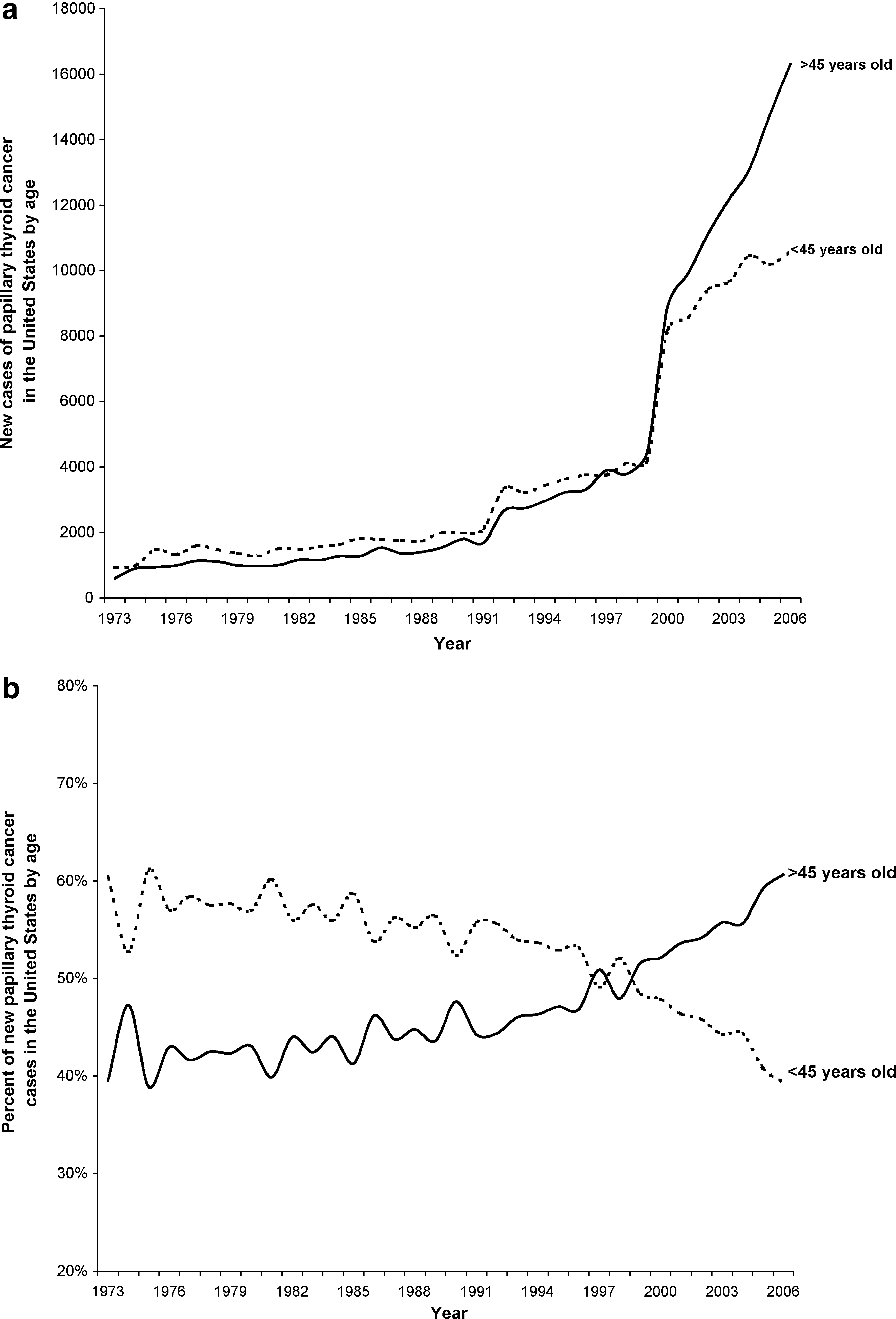
From 1973 to 2006 there were 68,803 recorded new cases of PTC in the SEER 17 registry equating to an estimated 262,000 cases in the United States over this 33-year period. There was a steady increase in the incidence of PTC during the study period, both in the older and younger than 45 age groups (Fig. 1a). Beginning in 1999 there was a significantly larger increase in the number of new cases in patients older than 45 (p = 0.002) (Fig. 1a). Until 1999 the majority of new PTC cases occurred in patients younger than 45; however, after 1999 the majority of cases occurred in patients older than 45 (Fig. 1b). Over the 7 years from 1999 to 2006 there was a steady divergence in the age distribution of newly diagnosed PTC, and in 2006, 61% of cases occurred in patients older than 45 (Fig. 1b).
When the number of new PTC cases were compared over the last 20 years the age group with the most new cases shifted from patients aged 25–34 years to patients aged 45–54 years (Fig. 2a, b). Although all age groups had an increase in new PTC cases, the largest increase occurred in patients aged 45–54 with an ∼10-fold increase over the past 20 years (Fig. 2a, b). In 1986 the most cases of PTC occurred in the 25–34-year-old age group, whereas in 2006 the majority of cases were found in the 45–54-year-old age group (Fig. 2a, b).

Since 1988, when SEER began collecting data on tumor size, the incidence of all sizes of PTC primary tumors has increased across all age groups. In patients <45 years of age the number of newly diagnosed small (0.1–1 cm) and mid-sized (1.1–4 cm) tumors has been consistently higher than that of large (>4 cm) tumors (Fig. 3a). In patients older than 45, the number of small tumors has increased at a faster rate than both mid-sized and large tumors (p ≤ 0.001) (Fig. 3b). PTC rates were similar for small and mid-sized tumors in the younger age group and for mid-sized tumors in the older age group at around 2500 new cases in the United States in 2003 (Fig. 3a, b). The most common type of PTC in 2006 was a small tumor in a patient older than 45 with an estimated 4672 cases in the United States (Fig. 3b). There was an increase in the percentage of PTC tumors classified as small (0.1–1 cm) and large (>4 cm) in both age groups and a decrease in the percentage of mid-sized (1.1–4 cm) tumors when comparing case numbers in 1988–2003 (Fig. 4a, b). In 2003, 43% of new tumors in older patients were 1 cm or less, whereas only 34% were 1 cm or less in patients younger than 45 (Fig. 4a). In 2003 there were an estimated 19,663 new cases of PTC in the United States, and of these 4671 (24%) were primary tumors <1 cm in size in patients older than 45.

New cases PTC per year in the United States from 1988 to 2003 by size of primary tumor and patient age younger
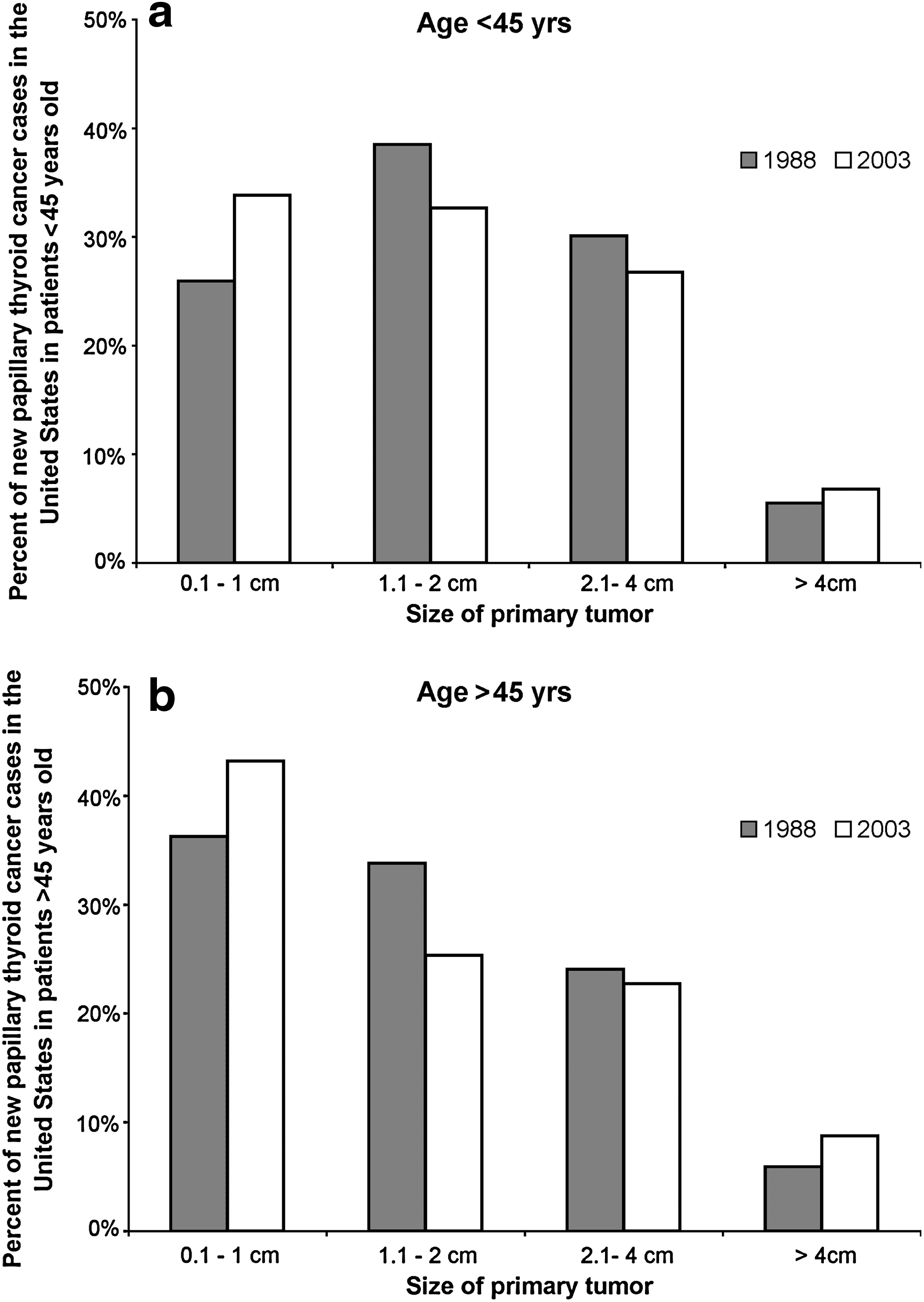
Percent of new PTC cases in the United states in 1988 and 2003 by size of primary tumor and patient age younger
Discussion
This study demonstrates the changing age demographic of PTC patients in the United States over the past 30 years. Several studies have demonstrated the increasing incidence of all types of thyroid cancer based on population database analyses (2 –4). Patient demographics and tumor characteristics have also been further evaluated using these datasets (5,12,13). To our knowledge, no other study has demonstrated the important shift in age group that has occurred in conjunction with the exponential growth of PTC incidence over the past three decades in the United States. These trends are not due to the aging of SEER population, as the distribution of patient age has remained constant since the inception of the program in 1973 (14). The majority of patients with PTC are now older than 45 years, which has important implications for prognosis and adjuvant treatment as reflected by the key role that age plays in the AJCC staging system for differentiated thyroid cancer. In the 1980s the majority of PTC cases occurred in patients in their late 20s and early 30s; thus, the majority of patients with PTC could only be classified as stage I or II by the AJCC system. However, by 2006 patients in their late 40s and early 50s had the highest rates of PTC, meaning that more patients with larger tumors, lymph node involvement, or metastatic disease would be classified as stage III or IV. This shift of stage will have important implications for not only prognosis, but also adjuvant radioactive iodine treatment after thyroidectomy based on the most recent American Thyroid Association guidelines (15,16). Several studies using population databases have demonstrated no change in thyroid cancer mortality rates despite the increasing prevalence and treatment of smaller primary tumors (2,5). The aging patient population with the shift toward a higher AJCC stage and thus higher rates of predicted mortality may play a role in current and future mortality rates.
Analysis of tumor characteristics in this study showed that the discovery of small tumors (<1 cm) increased at the fastest rate in the older patient population with almost half of all tumors now classified as microcarcinomas. The most common patient with PTC in the United States is now older than 45 with a primary tumor <1 cm, whereas 20 years ago that patient would have been younger than 45 with a tumor 1–2 cm. Nearly a quarter of all PTC cases are now microcarcinomas in a patient older than 45 and these patients are the main contributors to the rising incidence of PTC demonstrated in population-based studies. These findings raise many questions as to their etiology and implications for patient prognosis and treatment. Several studies have demonstrated the relative increased incidence in small primary tumors across all age groups (2,5). Our study demonstrates that the increase in small tumors is occurring primarily in the older patient population, whereas tumor size distribution has remained relatively constant in the younger patient population. When the rates of small tumors rise in a select group of patients, it is because of new disease (potentially secondary to environmental exposure), lead- or length-time bias, or over-diagnosis of indolent disease (17). Given the 10%–36% frequency of occult PTC on thorough autopsy studies, over-diagnosis of indolent disease in the older patient population who are more likely to have imaging studies performed is a reasonable explanation (18,19). Therefore, we speculate that one reason for the increased rates of small tumors is the increasing use of imaging studies and subsequent discovery of incidental thyroid nodules in the older patient population. Another explanation may be the increasing utilization of near-total thyroidectomy and total thyroidectomy in the treatment of benign thyroid disease and PTC with subsequent increased recognition of incidental microcarcinomas in surgical specimens (20). The ATA guidelines do not recommend routine biopsy of nodules <1 cm unless there are concerning features (15). This would suggest that many of these microcarcinomas are only recognized on thorough histologic analysis of surgical specimens and that they are not the initial indication for thyroidectomy. These possible explanations, however, would not explain the increasing number of large tumors in all age groups, suggesting that there are multiple contributing factors.
The shift to older age groups and the increasing rate of microcarcinomas may be contradictory in their implications on prognosis and treatment of this patient subgroup. Despite the potential for shift of stage because of older age, the majority of tumors in this older population are small and carry a low risk of local invasion, lymph node metastasis, or distant metastatic disease (21). Therefore, the majority of older patients will likely remain stage I by AJCC classification. Additionally, the minimal clinical significance of microcarcinomas may mean that treatment of these tumors will provide minimal to no benefit in terms of survival, recurrence, or risk of progression to locally advanced disease in individual patients or the population as a whole (18,19,21). Therefore, it is unlikely that the increasing incidence of papillary microcarcinoma in the older patient population will have a significant impact on overall patient outcomes.
The limitations of this study include data collection methods and analysis of the SEER patient registry, which includes the possibility of underreporting patients treated for PTC and the lack of standardization of histological description and diagnosis. Another limitation is the use of the 2000 U.S. census data in the relative calculation of incidence rates due to the continued expansion and changing demographics of the U.S. population, which will be reflected in the upcoming 2010 census results. The SEER database also does not include information on the patient factors and the detection method at the time of initial diagnosis of thyroid cancer, which would be valuable in further evaluating factors influencing the changing incidence rates.
In summary this 30-year population-based study demonstrates a disproportional increase in PTC rates in patients older than 45 with small (<1 cm) primary tumors. Nearly a quarter of all PTC patients are now patients older than 45 years with microcarcinomas. The etiology of this age shift may involve the increased use of imaging studies and treatment of incidentally noted thyroid nodules for which further studies are required.
Footnotes
Disclosure Statement
All authors report no conflicts of interests.