




Abstract
Background:
Fipronil represents a chemical class of insecticides acting at the γ-aminobutyric acid receptor in pests. Fipronil has been associated with a significant increase in the incidence of thyroid gland tumors concomitant with prolonged exposure to thyroid-stimulating hormone (TSH) in rats. An association between human TSH concentration and thyroid cancer has been also reported. The primary objective of this study was to test the hypothesis that chronic occupational fipronil exposure may be associated with abnormal thyroid function tests.
Methods:
In 2008, 159 workers of a factory manufacturing fipronil-containing veterinary drugs were assessed. Serum concentrations of TSH, total thyroxine, free thyroxine, fipronil, and fipronil sulfone were measured.
Results:
A positive and significant correlation was observed between serum fipronil or fipronil sulfone levels and duration of fipronil exposure. Serum fipronil sulfone concentration was negatively correlated with TSH concentration in fipronil-exposed workers, but with no significant increase in thyroid function test abnormalities.
Conclusion:
This study did not show that chronic fipronil exposure was associated with an increase of thyroid function test abnormalities. But, despite the fact that fipronil exposure in rats has been associated with increased serum TSH, fipronil sulfone concentrations were negatively correlated with serum TSH concentrations in fipronil-exposed workers, raising the possibility that fipronil has a central inhibitory effect on TSH secretion in humans. Close occupational medical surveillance, therefore, appears to be required in factory workers manufacturing fipronil-containing veterinary drugs. Larger epidemiological studies as well as investigations on possible thyroid-disrupting mechanisms of fipronil are also required.
Introduction
This study consisted of a cross-sectional analysis of a descriptive epidemiological survey carried out in workers of a French factory manufacturing fipronil-containing veterinary drugs. The hypothesis was that occupational exposure to fipronil may be associated with abnormal thyroid function tests, confirming the thyroid-disrupting properties of fipronil.
Patients and Methods
Subjects
This study is a cross-sectional epidemiological survey conducted in a factory manufacturing fipronil-containing veterinary drugs in France during 2008. The fipronil-exposed group was composed of 159 workers (79 females and 80 males), accounting for 10% of all workers of the factory. These workers were divided into 10 different work stations. The duration of occupational exposure to fipronil ranged from 1 to 11 years, with a mean of 4 years (standard deviation [SD] = 3.6). The great majority of workers had a permanent employment contract (63%). Twenty-six percent were temporary workers and 11% were subcontractors. The mean age of the subjects was 34.1 years (SD = 7.5) and 30% reported active tobacco smoking.
This study was approved by the Institutional Review Board of the Centre Hospitalier Universitaire de Toulouse, and all subjects provided their informed consent for thyroid function tests and determination of fipronil and fipronil sulfone concentrations.
Blood samples
Serum concentrations of fipronil and its metabolite were determined in the Limoges University Hospital's Pharmacology and Toxicology Department. The chromatographic system consisted of an LC-20AD microflow rate, high-pressure-gradient pumping system, and an SIL-20AC autosampler (Shimadzu). Mass spectrometric analyses were performed using a TSQ Quantum Ultra (Thermofisher) triple-quadrupole mass spectrometer equipped with an electrospray source operating in negative mode. The limits of detection and quantification for the two compounds were 0.1 and 0.2 μg/L, respectively. To assay serum concentrations of fipronil and its metabolite: calibration standards (0.2, 1, 5, 20, and 50 μg/L) were prepared by adding appropriate working standard solutions to 0.5 or 1 mL of fipronil- and fipronil sulfone-free serum prior to extraction. All validation procedures were performed daily for 5 days: intra-assay and interassay precision, accuracy, and recoveries were studied. The intra-assay and interassay precision coefficients of variations and the relative bias obtained were lower than 22% at the limit of quantification and lower than 15% at the other calibration levels. The mean recoveries were 83.8% and 83.6% for fipronil and its metabolite, respectively.
Serum concentrations of thyroid hormones (THs) were determined in the Toulouse University Hospital's Biochemistry Laboratory. The third-generation TSH assay, total T4 (TT4), and free T4 (FT4) assays were performed on an automated immunoassay system provided by ADVIA Centaur® Siemens, using a direct chemiluminescence detection system. TSH was analyzed in a two-site solid-phase format, whereas TT4 and FT4 were analyzed in a competitive assay. The reference intervals were as follows: TSH: 0.4–4.4 μIU/mL, TT4: 4.5–10.9 μg/dL, FT4: 10.7–21.1 pmol/L. Intra- and interassay coefficients of variation were 2.5% and 5.3% for TSH, 1.2% and 1.5% for TT4, and 2.3% and 2.0% for FT4.
Statistical analysis
All data were obtained from occupational medical records and blood samples. Data about personal or occupational characteristics and laboratory test results were analyzed by Stata9® software. Data are expressed as mean ± SD. Correlation analysis (Spearman's rank correlation coefficient) was performed to evaluate possible correlations between serum fipronil or fipronil sulfone concentration and serum FT4, TT4, and TSH concentrations. Linear regression analysis was used to evaluate possible correlations between the other study variables and serum fipronil or fipronil sulfone concentrations. p-Values less than 0.05 were considered statistically significant.
Results
Thirty-three of the workers evaluated had detectable serum fipronil concentrations and 155 had detectable fipronil sulfone concentrations. The mean fipronil concentration was 0.47 μg/L (SD: 0.28) and the mean fipronil sulfone concentration was 7.79 μg/L (SD: 7.65). Serum fipronil sulfone levels ranged from 0.37 to 42.45 μg/L. A positive and significant correlation was demonstrated between serum fipronil (n = 33, r = 0.38, p < 0.05) or fipronil sulfone (n = 155, r = 0.34, p < 0.05) concentrations and duration of fipronil exposure (Fig. 1).
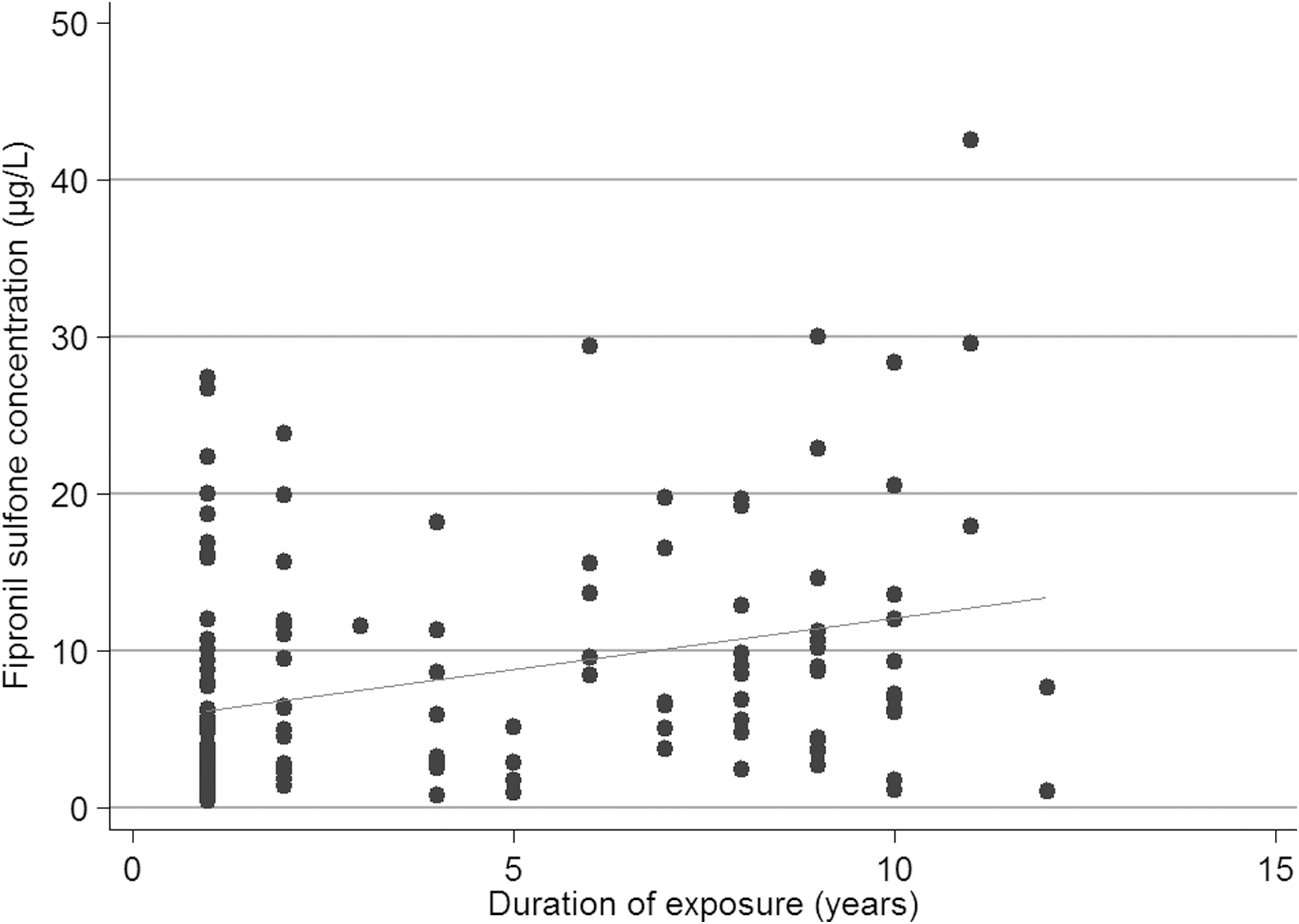
Correlation between serum fipronil sulfone concentration and duration of occupational exposure to fipronil (n = 155; r = 0.34; p < 0.05).
No significant difference was observed in terms of prevalence of tobacco smoking, gender, duration of exposure to fipronil, and serum FT4, TT4, and TSH concentrations between workers with or without detectable serum fipronil concentrations. Table 1 shows the correlation coefficients between serum fipronil or fipronil sulfone concentration and serum FT4, TT4, and TSH concentrations. The correlation coefficient between serum fipronil sulfone and TSH concentration was statistically significant. No other significant correlation was observed between the two groups.
Values presented in boldface indicate statistically significant results.
TSH, thyrotropin; FT4, free thyroxine; TT4, total thyroxine.
Eighteen workers exposed to fipronil had abnormal serum TH parameters: 7 had an elevated TSH concentration, only 1 had a low TSH concentration, 3 had a low FT4 concentration, and 11 had a high TT4 concentration. Six workers, therefore, had subclinical hypothyroidism (elevated TSH with normal FT4), representing 3.8% of the study population. Two workers had normal TSH concentrations with elevated serum TT4 concentrations and decreased serum FT4 concentrations (Table 2).
Values presented in boldface indicate abnormal values.
Missing data.
Two of the 11 workers with elevated TT4 concentrations were being treated with levothyroxine and had low or normal TSH. In other cases, TSH concentrations were in the normal range and two subjects had low FT4. Seven of these workers were women, of them five took oral contraceptives and two were pregnant.
At the time of the study, five workers were treated for hypothyroidism after total thyroidectomy (n = 1), Hashimoto's thyroiditis (n = 1), or idiopathic hypothyroidism (n = 3). In these workers, FT4 levels were in the normal range and TSH concentrations were low in one subject, normal in three subjects, and high in one subject.
Discussion
The present study investigated the influence of occupational exposure to fipronil on thyroid function tests in workers of a factory manufacturing fipronil-containing veterinary drugs in order to determine whether fipronil is a potential disrupter in humans.
Fipronil, an N-phenylpyrazole compound, represents a chemical class of insecticides (19,20). Several studies have shown that fipronil exhibits thyroid-disrupting properties in rats (14,21). In rats, fipronil treatment was associated with a significantly increased prevalence of thyroid gland tumors concomitant with increased plasma TSH concentrations and decreased T4 concentrations (15). In rats, fipronil (or fipronil sulfone) increases T4 clearance probably by inducing phase 1 or 2 hepatic enzymes. Prolonged exposure of the thyroid to increased TSH levels due to T4 catabolism and then suppression of T4 negative feedback on TSH secretion promote the development of follicular tumors in rats (1,16,17). Limited data are available in humans, demonstrating a link between plasma TSH concentration and the risk of papillary thyroid cancer (18). In the study by Fiore et al., higher TSH values, even within the normal range, were associated with an excess risk of thyroid malignancy in patients with nodular thyroids (22). Thyroxin-binding globulin (TBG) is the major transport protein of THs in man. TBG is expressed at a low level in the rat and only small percentages of T4 are bound to TBG (23). As TBG is assumed to play a protective role against TH disruption resulting from increased TH catabolism (1,24), the low level of TBG is considered to be a major limitation to the use of the rat model for evaluation of potential thyroid disruptors in man. In contrast with rats, sheep express TBG at similar levels to those observed in man. Leghait et al. did not find any significant effect of orally administered fipronil on plasma TH concentrations in sheep (25).
Our findings indicate that fipronil and fipronil sulfone concentrations are correlated with fipronil exposure. Serum fipronil sulfone concentrations were higher than serum fipronil concentrations (26). Fipronil levels were often undetectable in the workers studied. Fipronil has a short half-life in serum and serum fipronil concentrations probably correspond to the last 24 hours of occupational exposure. Serum levels of fipronil sulfone were also situated in a wide range from 0.37 to 42.45 μg/L. These results are consistent with fiprole concentrations previously reported in an occupational population (21). Fiprole is an ambiguous term referring to either fipronil metabolites (fipronil, fipronil sulfone, desulfinyl fipronil, and sulfide fipronil) (27) or the whole family of phenylpyrazole insecticides (28). As fipronil sulfone is the major metabolite of fipronil in both insects and mammals (29), the fipronil sulfone concentration can therefore be considered to be equivalent to the fiprole concentration. Following accidental exposure to fipronil, Mohamed et al. reported that the plasma fipronil sulfone/fipronil concentration ratio was about 0.25–0.5 (30). The results of the present study suggest that the fipronil sulfone concentration may constitute a cumulative tag during chronic exposure. Further, a very slow decline of fipronil sulfone concentrations after removal of exposure was observed in two workers (data not shown). Further studies are necessary to measure the real half-life of fipronil sulfone in humans with chronic exposure. Fipronil sulfone levels were also correlated with duration of exposure, but this correlation coefficient could be explained by variations of exposure during performance of the same task and the various jobs occupied by the workers during their career.
Despite the fact that fipronil exposure in rats has been associated with increased serum TSH, fipronil sulfone concentrations were negatively correlated with serum TSH concentrations in fipronil-exposed workers, raising the possibility that fipronil has a central inhibitory effect on TSH secretion in humans. Fipronil belongs to a chemical class of insecticides acting at the γ-aminobutyric acid (GABA) receptor as a noncompetitive blocker of the GABA-gated chloride channel (31,32) and the GABA system was shown to be sensitive to THs (33). Moreover, sulfone is more persistent and more potent in vitro on the vertebrate GABA receptor than fipronil (27). The major inhibitory neurotransmitter, GABA, activates three pharmacologically and structurally distinct classes of GABA receptors: GABAA, GABAB, and GABAC receptors (34). GABA is active in the pituitary gland, where it modulates the release of several hormones via A-, B-, and C-type receptors (35 –38). Several studies have demonstrated expression of various GABAA receptor subunits in the anterior lobe of the rat pituitary (39,40) and the GABAC receptor in TSH-secreting cells (41). Tapia-Arancibia et al. suggested a dual GABA-ergic control of TRH-stimulated TSH release directly on the pituitary, probably mediated by two GABA receptors: a GABAA receptor site mediating the inhibitory effect and a nonclassical GABAA receptor site with a higher affinity for its stimulatory action (36). Moreover, it has been speculated that GABA and its analogs exert an inhibitory effect on TSH secretion, presumably in the pituitary, and this effect is not mediated by dopamine (42).
Regarding the results of laboratory tests, 7 of the 11 workers having elevated TT4 concentrations were pregnant women or women taking oral contraceptives. The estrogen-induced increase in serum TBG and TT4 concentrations is dose dependent and occurs during pregnancy or with orally administered estrogens, either given alone or in combination with a progestin in oral contraceptives (43 –46). Two workers had increased TT4 during levothyroxine treatment (one with lower TSH and the other with normal TSH). Five patients had hypothyroidism due to thyroid surgery or Hashimoto's thyroiditis. Only 3.8% of the workers of this cohort had subclinical hypothyroidism, in line with current knowledge on this subject. The worldwide prevalence of subclinical hypothyroidism ranges from 1% to 10%, regardless of age and gender (47,48). The prevalence of chronic thyroiditis is less than 5% in subjects under 40 years, and the prevalence increases with age, particularly in females (48).
This study has a number of limitations. First, this cross-sectional analysis was based on analysis of blood samples and personal, occupational, and medical data. Despite cross-sectional analysis, serum fipronil or fipronil sulfone concentrations were comparable to those reported in the literature (21). However, these findings must be confirmed by a more appropriate longitudinal design. Second, fipronil exposure in workers was only evaluated by measuring serum fipronil and fipronil sulfone concentrations. The main route of exposure to fipronil via veterinary medicinal products is skin contact. Also, personal exposure to fipronil by contact with pets cannot be excluded. Finally, blood samples and a medical examination were only available for workers present at the time of the study. Three employees were excluded from the study because of missing personal, occupational, or medical data. We can therefore assume that our main results were not subject to a major selection bias.
Conclusion
The conditions of occupational exposure to fipronil in a factory manufacturing veterinary drugs were evaluated by measuring serum fipronil and fipronil sulfone concentrations. This study did not show that chronic fipronil exposure was associated with an increased incidence of abnormal TH tests, although subtle effects of fipronil exposure on TH metabolism cannot be excluded. In rats, fipronil is associated with a significant increase in the incidence of thyroid follicular tumors concomitant with prolonged exposure to increased TSH levels, and an association between increased serum TSH concentrations and thyroid cancer in man has been recently reported in the literature.
Moreover, despite the fact that fipronil exposure in rats has been associated with increased serum TSH, fipronil sulfone concentrations were negatively correlated with serum TSH concentrations in fipronil-exposed workers, raising the possibility that fipronil has a central inhibitory effect on TSH secretion in humans.
Close occupational medical supervision (clinical and hormonal), therefore, appears to be required in factory workers manufacturing fipronil-containing veterinary drugs. Larger epidemiological studies as well as investigations on possible thyroid-disrupting mechanisms of fipronil are also required.
Footnotes
Acknowledgments
The authors are grateful to the factory workers and the occupational nurse who participated in this study. This work was supported by grants from MEDD (Ministère de l'Ecologie et du Développement Durable) and Ligue Nationale Contre le Cancer (Equipe labélisée; to E.B-R.). The authors thank Dr. A. Saul for his valuable advice in editing this manuscript.
Disclosure Statement
The authors declare that no conflicts of interest exist.