




Abstract
Background:
Four goiter representations observed by the authors in the sculptures of the Sacred Mountain of Varese, Italy, are described here.
Summary:
They should be regarded as a typical and proper example of the iconography of “real goiter,” where the artists had the definite intention to depict persons with goiter.
Conclusions:
Studies of representations of individuals with goiter are not that rare, even though most of the observations reported in the literature deal with images that should be considered occasional swelling of the anterior neck, “thick neck,” or “pseudogoiter” because the artists probably did not have any intention to illustrate the pathological condition.
Introduction
The “real goiter” illustrations are mainly found when and where the artists had the definite intention to express commiseration with the persons with goiter or to identify them as executioners or tormentors. In fact, these representations have been predominantly created in the fifteenth and sixteenth centuries in alpine and poor areas where goiter was endemic and in Europe, often in a religious Christian context of passion and martyrdoms. Goiter representations in a religious context are not the only ones, and many other examples using different media (paintings, sculptures, etchings, engravings, architectural ornaments, anatomical drawings, tapestries) have been observed and described. Vescia and Basso have given a list of 56 goiter representations in the artwork of the Renaissance (7).
In recent years we have been interested in looking for depictions of goiters in an endemic area that is called Insubria, an historical–geographical region that corresponds to the area inhabited in classical antiquity by the Insubres. To find accurate information about the word “Insubria” is difficult because its geographical and cultural implications have been appraised only in the last few years. The name of this region comes from the Insubres, a powerful Celtic people of Gallia Cisalpina (Cisalpine Gaul), in northern Italy. Despite their defeat at Clastidium (modern Casteggio) by Roman forces in 222
In Insubria the main goiter zone is located on the diluvial gravels and morains along the border of the Alps and on the remains of local Ice Age glaciers. One of the causes of regional iodine deficiency of this and others areas has been established by the founder of modern geochemistry, Victor Moritz Goldschmidt, who first established that soil and water are depleted of iodine where the soil was eroded and leached during the Ice Age (30). Therefore, that widespread glaciation during the Ice Age is thought to be the primordial cause of iodine deficiency leading to endemic goiter. In addition to being an endemic area for goiter, in Lombardy and Piedmont there are nine Sacri Monti (Sacred Mountains), and they are on the UNESCO list of World Heritage Sites. The Sacri Monti of Insubria (Domodossola, Varallo, Orta, Varese, Ossuccio) are groups of chapels and other architectural elements created in the late sixteenth and seventeenth centuries and dedicated to different aspects of the Christian faith. In addition to their symbolic spiritual significance, they are of great attractiveness by virtue of the way in which they have been integrated into the surrounding natural landscape of hills, forests, and lakes. They also house much important artistic material in the form of frescos and sculptures.
In all the Sacri Monti visited, we have been able to observe depictions of goiters, but in this article, due to restriction of space, we will describe only the goiter representations found in four Chapels of the Sacro Monte in Varese.
The Sacro Monte is considered as the symbol of the city of Varese, and it is famous as a center of Marian faith and worship. Situated at a height of over 800 meters, it is dedicated to the Glorious Mystery of the Coronation of Mary, a sacred path with 14 chapels. The Sacro Monte also has a convent, where today the Romite Ambrosian sisters still live and pray in a vow of silence and perform various manual tasks.
The development of the Sacro Monte of Varese was initiated through the establishment of a small Oratorio, which then became a Santuario after the Lutheran reform, when many religious buildings dedicated to Mary were built in northern Italy as a reaction against the Protestant faith.
The structure, as it exists today, was built by a Capuchin monk from Monza, Gian Battista Aguggiari, who succeeded in persuading the entire local population to help build this ambitious project.
The Sacro Monte can be considered a symbol of the city of Varese partly because the population was actively involved in its construction. The people were inspired by the actions of the Capuchin monk, and they helped implement the project in many ways. The work was concluded in 1680 by architect Giuseppe Bernascone who requested no payment.
The Sacred Path leading to the Santuario is of great spiritual value, with interesting landscape views. The path is punctuated by 14 chapels depicting the Mysteries of the Rosary that were built in very different styles and designs. Many of the chapels contain works by the most important names in seventeenth century Lombard art, both painters and sculptors, including Pier Francesco Mazzucchelli, a Varese painter, Carlo Francesco Nuvolone, Dionigi Bussola, and Francesco Silva.
In front of the statues of the chapels of the Sacro Monte, where the Sorrowful Mysteries of the Rosary are depicted, the viewer's eye is attracted mostly by the presence of statues characterized by enormous goiters, bone deformities, and obscene gestures. The image of man is manifested by symbols with a strong visual impact, able to scare and disgust, with the intention to admonish and to redeem the crowds of pilgrims in a journey, which could ideally represent the impossible trip to the Holy Land.
The presence of goiters of enormous size, pimples, warts, crooked and pronounced noses, fingers twisted in the form of claws, glassy and bulging eyes—exophthalmos—open mouths and tongues shown for derision, create a tense and gloomy atmosphere, where disharmony, disproportion, and abnormality are, for the collective local imagination, an almost sure sign of inner deformity (31).
The Sacred Mount of Varese has four sculptures of characters with large goiters, which are found in the sixth, eighth, ninth, and tenth chapels. In the sixth chapel, the Agony in the Garden, the bearer of goiter is one of the soldiers following the directions of Judah to go and capture Christ (Fig. 1). The sculpture is by Francesco Silva, who was in 1560 in Morbio Inferiore (Canton Ticino, Switzerland). He trained in Rome in the studio of the sculptor Guglielmo Della Porta, where he worked in the atrium of the Basilica of St. Peter. He also worked in the Basilica of the Holy House of Loreto, in the Cathedral of San Venanzio in Fabriano and in Faenza. Silva was also active in Valtellina, and in Canton Ticino, in particular in Morbio Inferiore where he painted statues for the Sanctuary of Miracles. His activity is well documented in the Sacred Mountains and includes works in Locarno, Ossuccio, and especially in 10 of the 15 chapels of Sacro Monte above Varese. He died in 1643.
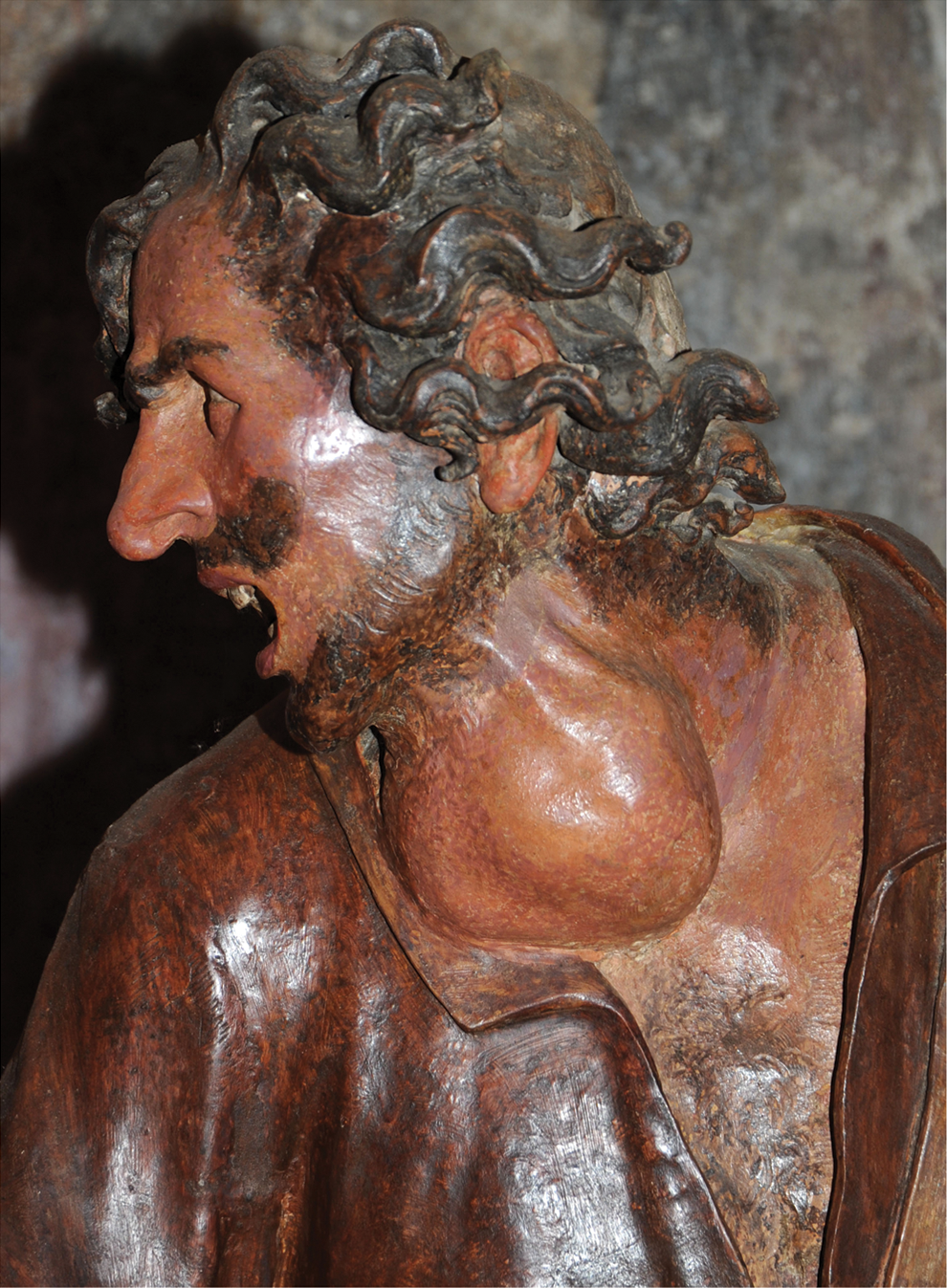
Goiter representation in a sculpture of the Sixth Chapel, Sacro Monte of Varese. Sculpture by Francesco Silva. Color images available online at
The face and the expression of the character seem to encourage the others in the group to move quickly toward Jesus. The goiter, if compared with those of the Sacred Mountains of Varallo and Orta, is smaller and the whole representation is more realistic and artistically more impressive.
The eighth chapel contains a representation of the Crowning with Thorns. Jesus is seated at the center and crowned with a crown of thorns and insulted by the surrounding soldiers, some of whom then inveigh with insults, slapping, spitting, and derision and salute him as a king. One of these characters, the man with the goiter shows him his tongue while making an obscene gesture (Fig. 2). His nose and cheeks are flushed, possibly from drinking, and there is a visible protuberance on his face. The goiter, partially hidden by the soldier's beard, is still very evident. Francesco Silva is the sculptor.

Goiter representation in a sculpture of the Eighth Chapel, Sacro Monte of Varese. Sculpture by Francesco Silva. Color images available online at
In the ninth chapel, the Carrying of the Cross, Jesus is depicted falling under the weight of the cross on his way to Calvary, while a big fellow with a massive goiter, grinding his teeth, pulls a rope tied to the cross (Fig. 3). The goiter is larger than the ones described so far, is bilobed, and is so huge that it is hanging downwards. This sculpture is also by Francesco Silva.
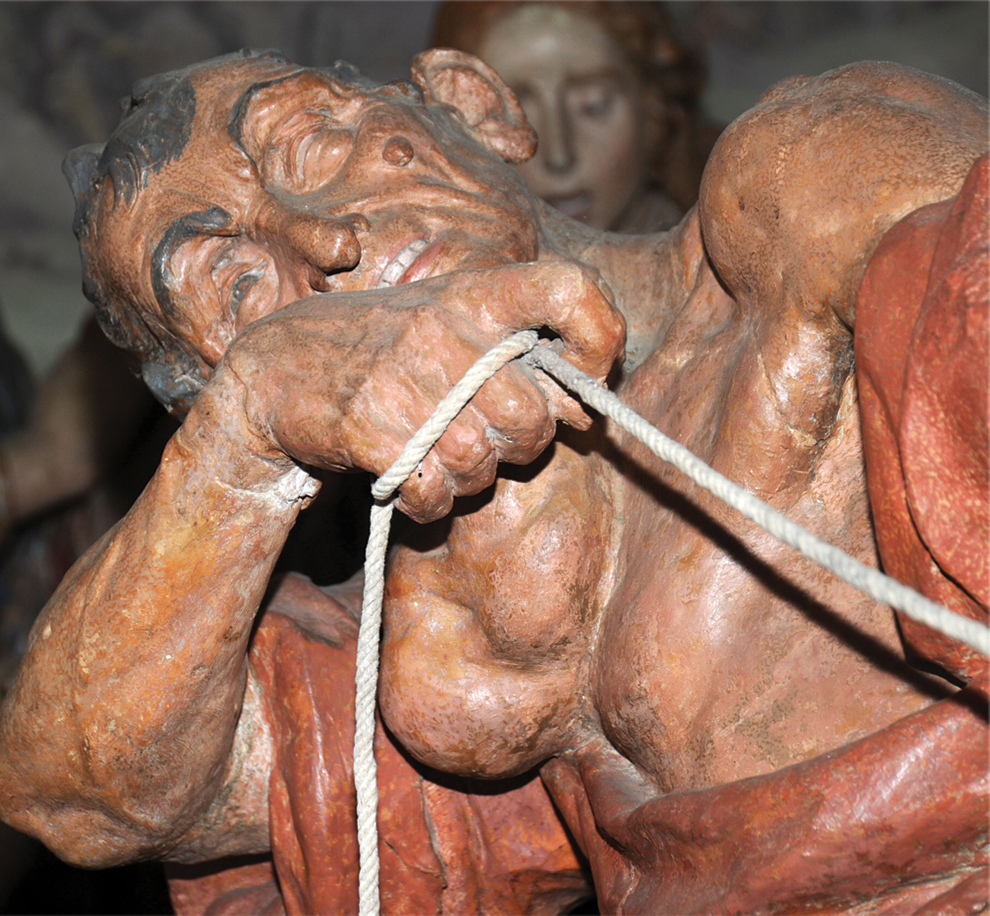
Goiter representation in a sculpture of the Ninth Chapel, Sacro Monte of Varese. Sculpture by Francesco Silva. Color images available online at
In the tenth and highest chapel is the representation of the Death of Jesus. It includes the highest number of sculptures. The floor represents the summit of Golgotha and in the back is the scene of the Crucifixion. At the center, Christ is raised on the Cross, amidst a large crowd; soldiers stand out on foot and on horseback with lances, swords, flags, and banners. In this dramatic and crowded scene, two individuals with ropes try to hoist the cross. One of these two characters has a huge trilobate goiter, which is also hanging down (Fig. 4). The face, again marked by two protuberances, shows the tension and effort of the man. The sculpture, made in the mid-seventeenth century, is by Dionigi Bussola. Dionigi or Dionisio Bussola (1615–1687) was an Italian sculptor mainly active in Milan and its environs during the Baroque era. Born in Lombardy, he trained in Rome with Ercole Ferrata, then returned to Milan in 1645 to work on the statuary for the Cathedral. He also contributed to the sculptural reliefs of the early life of Christ in the Certosa of Pavia. In addition to his work in the Cathedral and at the Certosa, Bussola is known for the sculptures that he produced for the Sacred Mountains of Piedmont and Lombardy. For nearly two decades (1666–1684), he worked in the Sacred Mountains of Orta San Giulio, Varallo Sesia, and Domodossola.
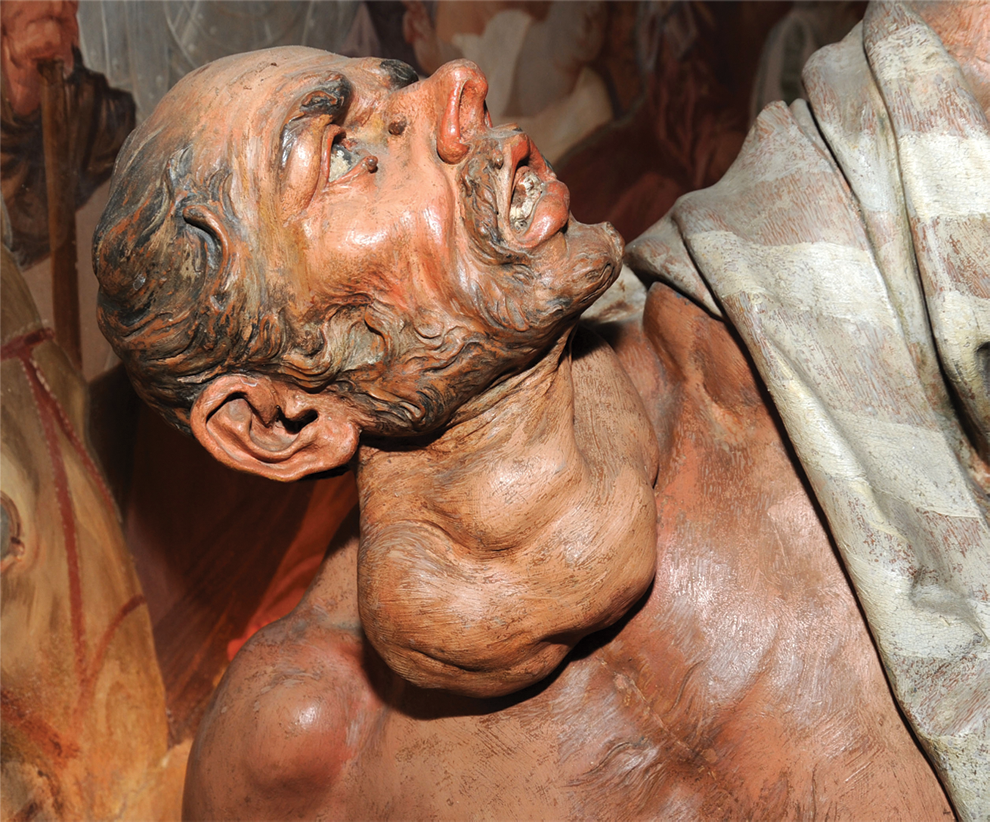
Goiter representation in a sculpture of the Tenth Chapel, Sacro Monte of Varese. Sculpture by Dionigi Bussola. Color images available online at
In conclusion, the goiter representations observed in the sculptures of the Sacred Mountain of Varese that have been described here can be regarded as typical and proper examples of the iconography of “real goiter,” where the artists had the definite intention to depict persons with goiter. In these representations the artists identify the persons with goiters as executioners or tormentors, as shown not only by the presence of goiters, but also through the representation of other physical defects such as warts, growths, pronounced and hooked noses, fingers twisted in the form of claws, hypertrophied and knotty muscles, glassy and bereft eyes. Mocking gestures, such as open mouths and tongues shown for derision, emphasize this unpleasant appearance.
It is evident that the artists are interpreting the collective imagination of the sixteenth and seventeenth centuries in Alpine and poor areas, where goiters were endemic, and in a religious Christian context of passion and martyrdom. In such a context, deformed bodies and physical blemishes could seek to represent either evil and sin, as in the Chapels of the Sacred Mountain, or to elicit a reaction of empathy, humility, and piety, as it is often the case of other goiter representations.
Footnotes
Disclosure Statement
The authors declare that no competing financial interests exist.