




Abstract

Ever since their inception, the American Association of Clinical Endocrinologists (AACE), the American Thyroid Association (ATA), and the Endo-Society ultrasound courses use turkey breasts as a media for demonstrating ultrasound-guided thyroid fine-needle aspiration (FNA). Animal tissue is used in other subspecialties for breast biopsy training (1,2). Currently, there is no cost-efficient neck model for thyroid biopsy training available. The AACE Needle me™ neck model and the Blue Phantom™ are prohibitively expensive for most fellows and training programs to use.
Animal meats carry the risk of transmitting food-borne diseases and can be unappealing to participants. Turkey breasts are thawed overnight in order to facilitate the insertion of the phantoms and remain at room temperature for several hours, facilitating bacterial growth. Even though no known illnesses have been reported by trainees, elimination of any risk is ideal. Gelatin is processed from cartilaginous tissue of animals and supplied as sterile powder. Gelatin is used for ballistic testing because it mimics human tissue in certain concentrations. Food-grade gelatin is purified for consumption. The suitability of food-grade gelatin in “ballistic concentration” for ultrasound-guided FNA was studied. Ballistic-grade gelatin was also studied.
Materials, Methods, and Techniques
Red kidney beans, garbanzo beans, olives, berries, fish oil capsules, and cocktail onions were used for nodule phantoms and drinking straws were filled with coupling gel to mimic blood vessels. The ballistic-grade gelatin (type 250 A ordnance) can be bought in bulk directly from the manufacturer in Sioux City, Iowa. Bulk food-grade gelatin was purchased from online vendors. The ballistic gelatin preparation calls for a 10% solution (3,4). The authors recommend refrigeration at this concentration to maintain integrity and observed softening of the gelatin with raising ambient temperature (3,4). Therefore, supersaturated gelatin that exceeded the ballistic concentration was prepared by adding 125–150 g of gelatin (12.5–15% solution) per liter of water. This results in a gel that sets to a firm consistency at room temperature. The only difference between the ballistic- and food-grade gelatin that was observed is a stronger odor of the ballistic gelatin. No advantage was noted beyond 15%, and more clumping was observed in higher concentrations. Gelatin powder is added to water at a temperature of 48–65°C and then stirred constantly without agitation to avoid introducing air bubbles. Adding water to powder leads to clumping at the bottom of the container. An alternate approach is to “bloom” the gelatin in room temperature water followed by gradual heating with stirring to ensure mixing (3).
Preparation of the Molds and Suspension of the Phantoms
Disposable Ziploc® (S. C. Johnson, Racine, WI) or similar tubs, styrofoam or other water-tight take-away restaurant food containers can be used for molding (Fig. 1A and 1B). The phantoms described in the earlier section all have different densities, therefore, some tended to float while others sank to the bottom of the tub in liquid gelatin. Also, the phantoms tended to collect in the lowest corner of the tubs. The dispersion of the phantoms throughout the media at various depths is achieved by using 1.25-inch beaded craft pins to affix the phantoms at desired depths. The pins are inserted through the bottom of the Ziploc® containers to affix the phantoms before pouring the dissolved gelatin (Fig. 1A and 1B). These pins are removed several hours before the gelatin mold is used for the practice sessions. This technique ensures that the phantoms stay suspended at the correct depth, irrespective of their densities. Failure to remove the pins can result in personnel injury or damage to the ultrasound transducer. Typically, it takes 6 to 12 hours for reliable setting of gelatin to occur at room temperature (20–21°C) and about half that time in a refrigerator. Freezing makes it unsuitable for use. Once the gelatin sets, it remains stable for several days, even without refrigeration. Leaking from the pin insertion sites was not observed and unmolding is unnecessary. One gallon of the dissolved gelatin provides enough liquid to make five or six 740-mL Ziploc® tubs.
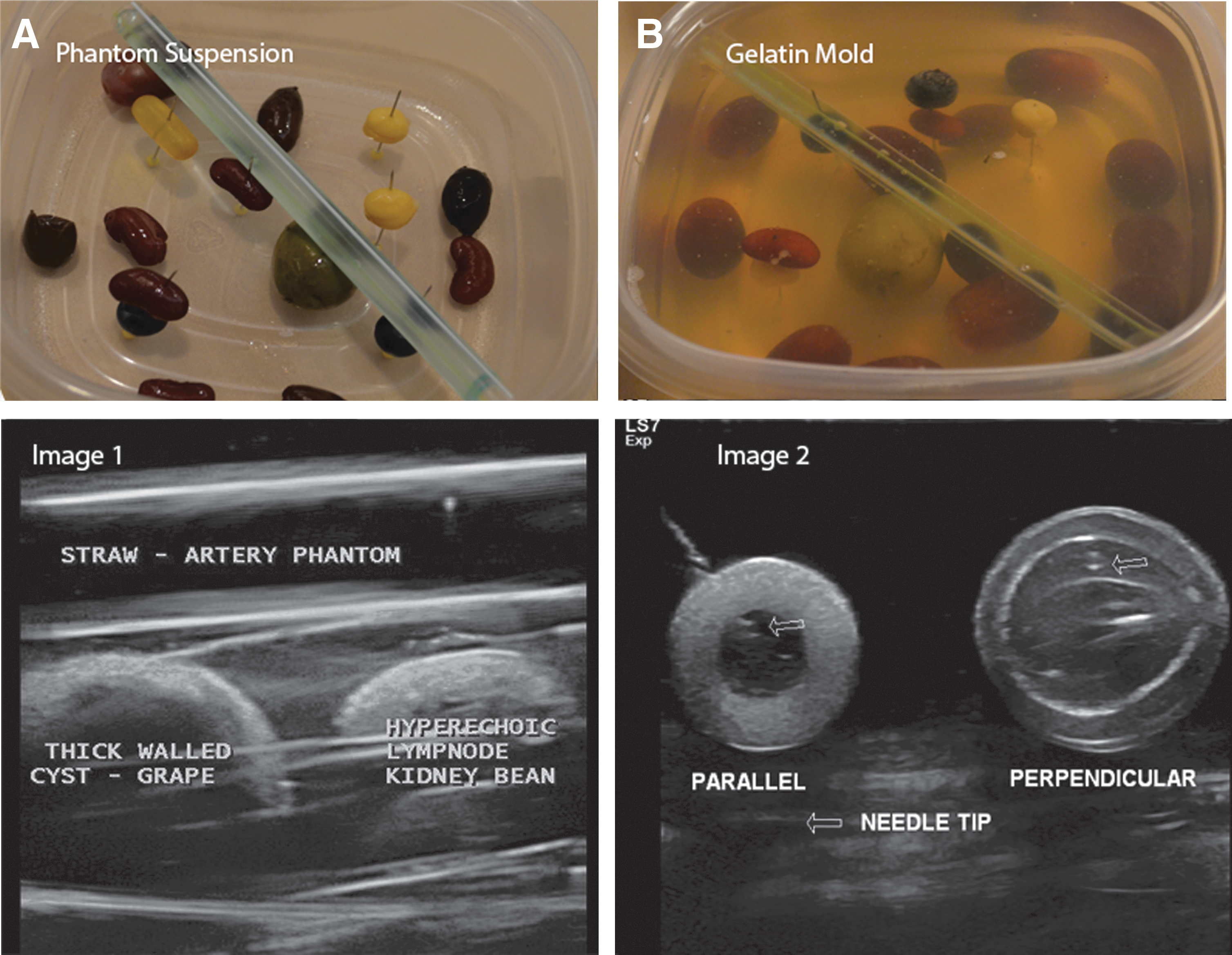
Mold preparation, phantom suspension and biopsy techniques.
Ultrasound Findings, Biopsy, and Needle Visualization
Linear multifrequency transducers were used to study the phantoms and to perform biopsy. Garbanzo beans and olives resemble hyperechoic nodules (Fig. 1, image 1 and 2). Red kidney beans mimic hyperechoic lymph nodes. Fish oils capsules are uniformly anechoic, mimicking cysts. Grapes mimic hypoechoic nodules. White cocktail onions provide excellent ecogenic targets for biopsy (Fig. 1, image 2). Linear phantoms that mimic blood vessels can be produced by using drinking straws filled with ultrasound coupling gel (Fig. 1, image 1). By placing a biopsy phantom underneath a blood vessel phantom, the level of difficulty can be increased. Needle tracks are not visualized as long as 27-gauge needles are used up to 5–10 attempts per phantom. Even 25-gauge needles leave a very faint track that gradually disappears as long as the needle is not moved side to side after insertion to avoid tearing of the gelatin. The gelatin medium is hypoechoic to anechoic in texture compared to the human neck, and lacks the heterogeneous echo texture of muscle and fat. It is impossible to mimic the various structures within the human neck in vitro using any system or medium. The visibility of the targets through the transparent gelatin aids the novice trainees to position the needles better. As experience improves, the addition of food coloring to the gelatin or applying nontransparent plastic wrap placed over a layer of coupling gel can make the targets “invisible.” No difference was observed between the ballistic-grade gelatin and food-grade gelatin during ultrasound evaluation. The food-grade gelatin costs approximately $5–8 per pound. This system is still very cost effective compared to turkey breast or other meats. The cost of a frozen turkey breast ranges from $1–2 per pound, with an average weight of 3–8 pounds. One pound of gelatin can yield as much as 6–8 tubs of gelatin for training 40 trainees in 8 groups. Approximately 50–75 g of gelatin will suffice for a single medium sized zip-lock tub. Therefore, the cost per tub is approximately $2–3, including the phantoms. The advantages of gelatin molds are low cost, the ease of use, hygiene, and the stability for several weeks if refrigerated. There is some preparation time involved, but several tubs can be made and saved for later use. Fellows in our program have used the same tub for 3 or more weeks. This has not been possible with turkey breast. In conclusion, this system is a simple way to practice ultrasound-guided FNA cost effectively and hygienically.