




Abstract
Figures affected by goiter were only sparsely depicted by Peter Paul Rubens and Albrecht Dürer among Flemish artists, because obvious goiter was not common in regions such as the Netherlands and Belgium. However, the recent observation of two figures with a goiter elegantly depicted by Rogier van der Weyden has raised our interest in this topic. When taking a close look at the paintings of this Flemish Renaissance painter, it is interesting to note that 16 portrayed subjects show an abnormal profile of the neck with swelling, suggestive of a presumptive medico-artistic diagnosis of goiter. Van der Weyden travelled to Italy where he soon acquired great fame and was second only to the other Flemish painter of the time, Jan Van Eyck. It is very likely that in Italy he had the opportunity to look at several female figures depicted with goiter, which may have influenced his paintings. Van der Weyden was appreciated because of his style to mix realistic details with idealized softened features to increase the beauty and appeal of his models. It is also likely that the integration of the goiter may have been part of the Renaissance tendency toward a more realistic and precise representation of subjects. The fact that in almost all cases the goiter was a low-to-moderate grade enlargement of the thyroid may confirm our speculation that perhaps the painter used the same model or the template derived from one model for subsequent paintings.
Introduction
F
Figures affected by goiter were only sparsely depicted by Peter Paul Rubens and Albrecht Dürer, because obvious goiter was not common in regions such as the Netherlands and Belgium. However, the recent observation of two figures with a goiter elegantly depicted by Rogier van der Weyden (Fig. 1A and 1B) has raised the interest in this topic. A detailed investigation into the works of this painter has revealed further subjects that are depicted with low-to-moderate grades of thyroid gland enlargement, which is very uncommon within the works of Dutch and Flemish Renaissance artists. In the present investigation, the accuracy of the findings and the underlying iconographical significance were explored.

(
The Painter
The Belgium-born Roger de la Pasture changed his name to the Dutch version, Rogier van der Weyden, when he moved to Brussels in 1436 in order to help people recognize him and his paintings. Three years later, he became the official painter of the city. He is considered the most influential and among the three most renowned early Flemish Renaissance painters, which include Jan van Eyck and Robert Campin (of whom van der Weyden was an apprentice from 1427).
Numerous chronological gaps in van der Weyden's biography have left question marks over the provenance of many of his works. No written work survived from the 15th century historical archives, and therefore only a few paintings have been attributed with certainty to this Flemish artist because van der Weyden never signed any of his paintings (9). These works depict mainly religious themes in the form of diptych and triptych portraits, altarpieces, and commissioned single portrayals.
When taking a close look at van der Weyden's paintings, it is interesting to note that 16 portrayed subjects show an abnormal profile of the neck with swelling, suggestive of a presumptive medico-artistic diagnosis of goiter (Figs. 1 and 2).
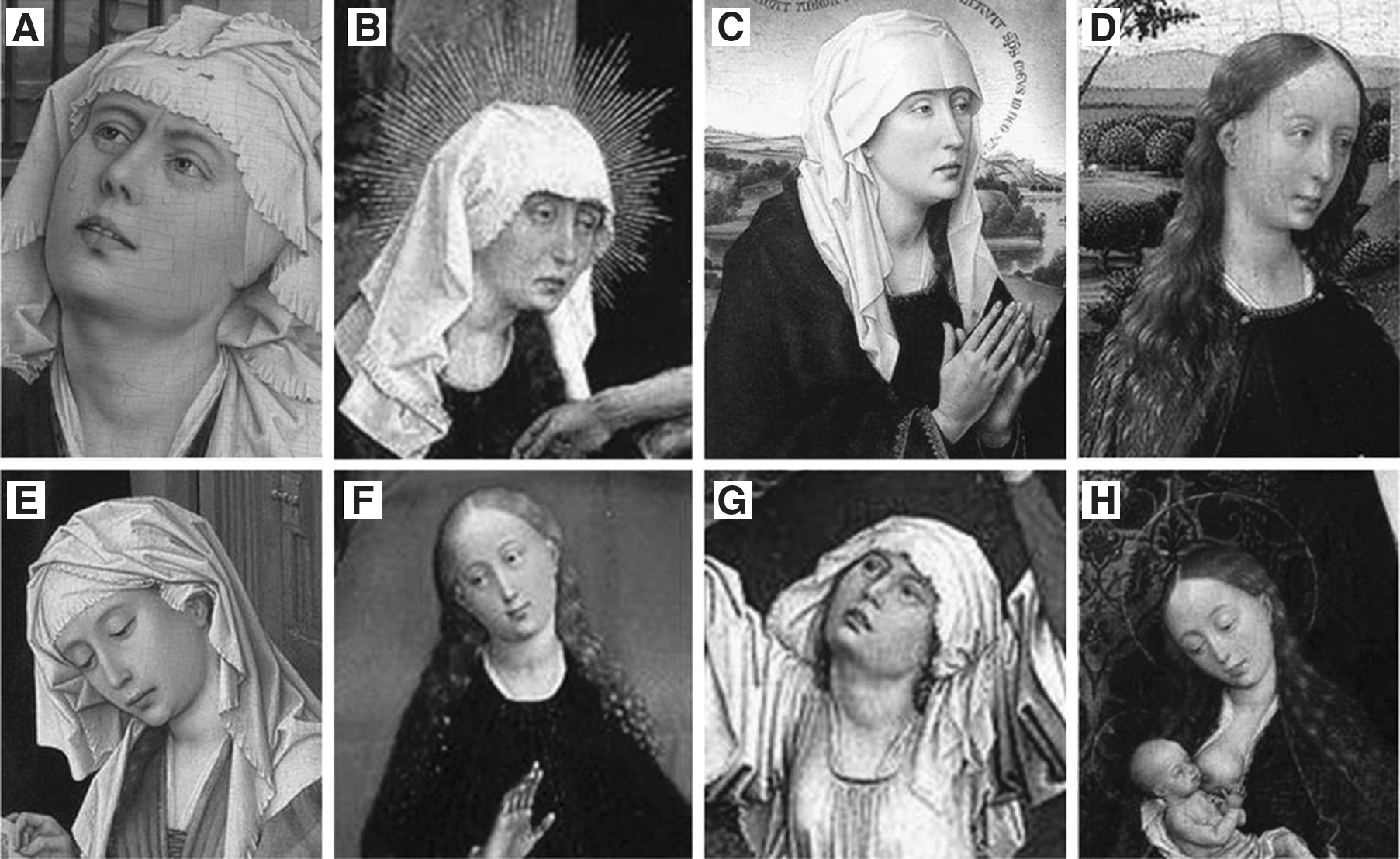
(
Discussion
Although the reasons for the depiction of a goiter could be multiple, the present investigation aimed to shed further light on van der Weyden's hallmark style.
An inaccurate depiction of the model inadvertently drawn by the artist seems unlikely because of his high reputation and because of the many paintings in which the goiter has been depicted. In almost all of their works, Renaissance painters provided detailed preliminary studies through cartoons, drawings, sketches, or designs, and an erroneous depiction of a goiter would not have been repeated by accident, especially as such mistakes would have been adjusted in the final piece.
The Renaissance was a fervid period in which a widespread interest in anatomy led to the production of lifelike portrayals of the human body. This could also be true for the neck and may explain the many paintings in which the depicted individuals were carrier of a goiter (1 –8). But a widespread depiction of goiter as shown in van der Weyden's subjects does not match with the geographic origin of the models that are presumably from Belgium and the Netherlands in which severe iodine-deficiency was not common. This is supported by the fact that only a few Flemish and Dutch Renaissance artists have depicted this anatomical abnormality. However, to explain the several figures of women with goiter painted by van der Weyden, one must consider that he travelled to Italy where he soon acquired great fame and was second only to the other Flemish painter of the time, Jan Van Eyck. Van der Weyden's trip to Italy with visits to Milan, Mantua, Ferrara, Florence, and Naples is regarded by art historians as fundamental for the early contact between the Flemish school and the Italian Renaissance, which had profound consequences for the future developments (10). First, van der Weyden introduced for the first time the technique of oil painting, of which he was a master. He served as teacher of the court painter of the Duchess of Milan, Zanetto Bugatto, and worked for the powerful d'Este and de'Medici families in Ferrara and in Florence, respectively (see The Portrait of Francesco D'Este [not shown here] and The Virgin with the Child and four Saints also known as Madonna Medici [Fig. 2H]). Second, the Flemish painter was strongly influenced by the Florentine and the Roman schools so that Italian impressions were integrated in the scenes that van der Weyden depicted after he had returned to Flanders (see Altar of St. John Baptist, triptych The Seven Sacraments and Adoration of the Magi) (9,10). It is very likely that he had the opportunity to look at several female figures depicted with goiter in Italy (2 –8), which may have subsequently influenced his paintings.
In the paintings with the Madonna and child as the theme, the swelling of the neck could theoretically be associated with an autoimmune postpartum thyroiditis. However, goiters evident in postpartum thyroiditis are modest, and generally reflect greater prominence of pre-existing goiters due to chronic or Hashimoto's thyroiditis. As an aside, it is not known if chronic thyroiditis (11) or postpartum thyroiditis (12) are even premodern era illnesses, but it is known that they are less common or at least less evident in iodine-deficient parts of the world. Alternatively, in conditions of iodine restriction, the enhanced thyroidal stimulation during gestation may have promoted the formation of the goiter that has only partially regressed after parturition (13,14). However, it seems unlikely that all of the subjects represented in van der Weyden's portraits were affected by that post-pregnancy disease, unless only a few women were used as models. The possibility of familial thyroid dyshormonogenesis is unlikely because the subject would have been affected by a goitrous gland since the birth with or without clinical manifestations of congenital hypothyroidism. Others have deliberately added a goiter to some figures within a painting to indicate poor social status or to arouse feelings of pity or revulsion. Sometimes the abnormal neck enlargement was added to mock the represented subject or as an autobiographical self-portrait feature or even as an erotic attribute (2,3). Presumably, it was also added to fill out and imbue the neck of some female figures (15).
The neck prominence depicted by van der Weyden is subtle in some of the paintings, apart from the highlighted woman depicted in Figure 1A. Therefore, one could argue that some of the women, even if accurately portrayed, did not have goiters but simply full necks or pseudo-goiters. The only subject that has findings resembling a pseudo-goiter, a long and graceful female neck associated with lordosis of the cervical spine (the reversed “C” or swan-like configuration) making the normal anterior neck structures so prominent, which could be confused with thyroid enlargement (16), may be the woman in Figure 1D. The other figures show the abnormal enlargement at the base of the neck with no other signs of pseudo-goiter or full neck. Very little is known about the artist's models for the paintings herein referenced, but the similarity of the subjects depicted with a goiter in the oft-repeated themes such as the Madonna and child (Figs. 1B, C, F, and G and 2H), the Virgin in both the Annunciation paintings and Saint Catherine (Figs. 1D and F and 2D and F), some other repeated subjects (Fig. 2A and G; Fig. 2B and C), and the absence of men depicted with goiter may strengthen the argument that only a few women affected by goiter were used as models. This could also be supported by the high number of relevant works and because only a few types of subjects were involved. Therefore, it seems plausible that he noticed the presence of goiters in one or several models and, because he was aiming to increase realism, this became an attribute that was integrated on a regular basis. One can hypothesize that the painted women with goiter are a consequence of van der Weyden's experience in Italy where he certainly noticed the presence of goiters in paintings and in real life.
Indeed, van der Weyden was appreciated because of his tendency to mix realistic details with idealized softened features to increase the beauty and appeal of his models. He used some recognizable hallmarks such as eye enlargement, increased definition of the face contours, and represented a much stronger jaw than the real ones (9). It is likely that also the integration of the goiter may have been part of the Renaissance tendency toward a more realistic and precise representation of subjects. We are in favor of this latter possibility. The fact that in almost all cases the goiter was a low-to-moderate grade enlargement of the thyroid may confirm our speculation that perhaps the painter used the same model or the template derived from one model for subsequent paintings. The absence of even a suggestion of goiter in the men whose necks are clearly depicted strengthen our theory because men's necks may also have been idealized as part of van der Weyden's stylistic feature, thereby exaggerating the discrepancy in the incidence of women compared to men depicted with goiter.
Conclusions
From the little information we have about van der Weyden's biography, we know that he always worked with real-life models (9,10). He mixed the result of accurate observations with some idealized elements of his models' facial features to create balanced compositions that were of an aristocratic and elegant construction with typically statuesque subjects. The inclusion of a goiter may be part of the stylistic hallmark of van der Weyden to optimize proportions pursuing at the same time an increasing realism of the representation that was typical of the Renaissance movement. Although we cannot reject the claim that van der Weyden used a few affected models for his portraits, it is likely that the Flemish painter was fascinated by the visual effect given by a subtle enlargement to the neck of a woman affected by a low grade of goiter. Therefore, the hypothesis that the goiter was deliberately introduced by the artist to make the neck of the women more attractive, reflecting in the same time the increased anatomic accuracy and knowledge developed in that period, seems the most likely.
Footnotes
Author Disclosure Statement
None of the authors has financial conflicts or interests to report in association with the contents of this paper. This research received no specific grant from any funding agency in the public, commercial, or not-for-profit sectors.