




Abstract

Four years have passed since the accident at Fukushima Daiichi nuclear power plant (FDNPP). Within the framework of the Fukushima Health Survey being conducted in Fukushima Prefecture, all prefectural inhabitants who were younger than 18 years of age at the time of the accident (approximately 360,000 inhabitants) have been evaluated with thyroid ultrasound examinations. The first cycle of screening, which took place between October 2011 and March 2014, showed that among 297,046 screened individuals, 112 had confirmed or suspected malignancies. Nevertheless, the causal relationship between radiation exposure and thyroid cancer in this cycle should be carefully evaluated, since the radiation dose to the thyroid gland in Fukushima was quite low when compared with that in Chernobyl. The maximum thyroid radiation dose in Fukushima was 35 mSv, whereas the mean dose in Chernobyl was 240 mSv (1,2). Furthermore, the children with thyroid cancer were younger than 10 years of age at the time of the accident in Chernobyl, whereas in Fukushima, so far, no children were younger than 5 years of age, and only a few cases were younger than 10 years of age at the time of the accident (1).
Besides ionizing radiation exposure, nitrate is considered as a risk factor for thyroid cancers. Nitrate and nitrite are precursors in the endogenous formation of N-nitroso compounds, which are potent animal carcinogens that cause thyroid and many other tumors in animal models (3). An epidemiological study in older women in Iowa showed an increased risk of thyroid cancer with higher average nitrate levels in public water supplies and with longer consumption of water exceeding 5 mg/L nitrate-N (3). The possibility of a similar relationship between the incidence of thyroid cancer in Fukushima and consumption of nitrate-containing water has not been evaluated.
We conducted a preliminary evaluation of nitrate concentrations in drinking water in Kawauchi village, Fukushima Prefecture, located within 30 km of the FDNPP. We investigated nitrate nitrogen concentrations in the drinking water of Kawauchi village (total population: 2700; total households: 1100) (4), where all inhabitants use their own private wells as the main source of drinking water. We collected water from 104 household wells in the village (Fig. 1) and analyzed the nitrate/nitrite nitrogen concentrations by the naphthylethylene-diamine method (Pack Test, Kyoritsu Chemical-Check Lab. Corp., Tokyo, Japan). The median (25th–75th) nitrate nitrogen level was 0.62 mg/L (0.20–2.51 mg/L), which did not exceed the recommended maximum contamination levels (MCL) of 10 mg/L for nitrate nitrogen in water samples in Japan. The nitrite nitrogen concentrations in any well also did not also exceed 0.005 mg/L, the recommended MCL in Japan.
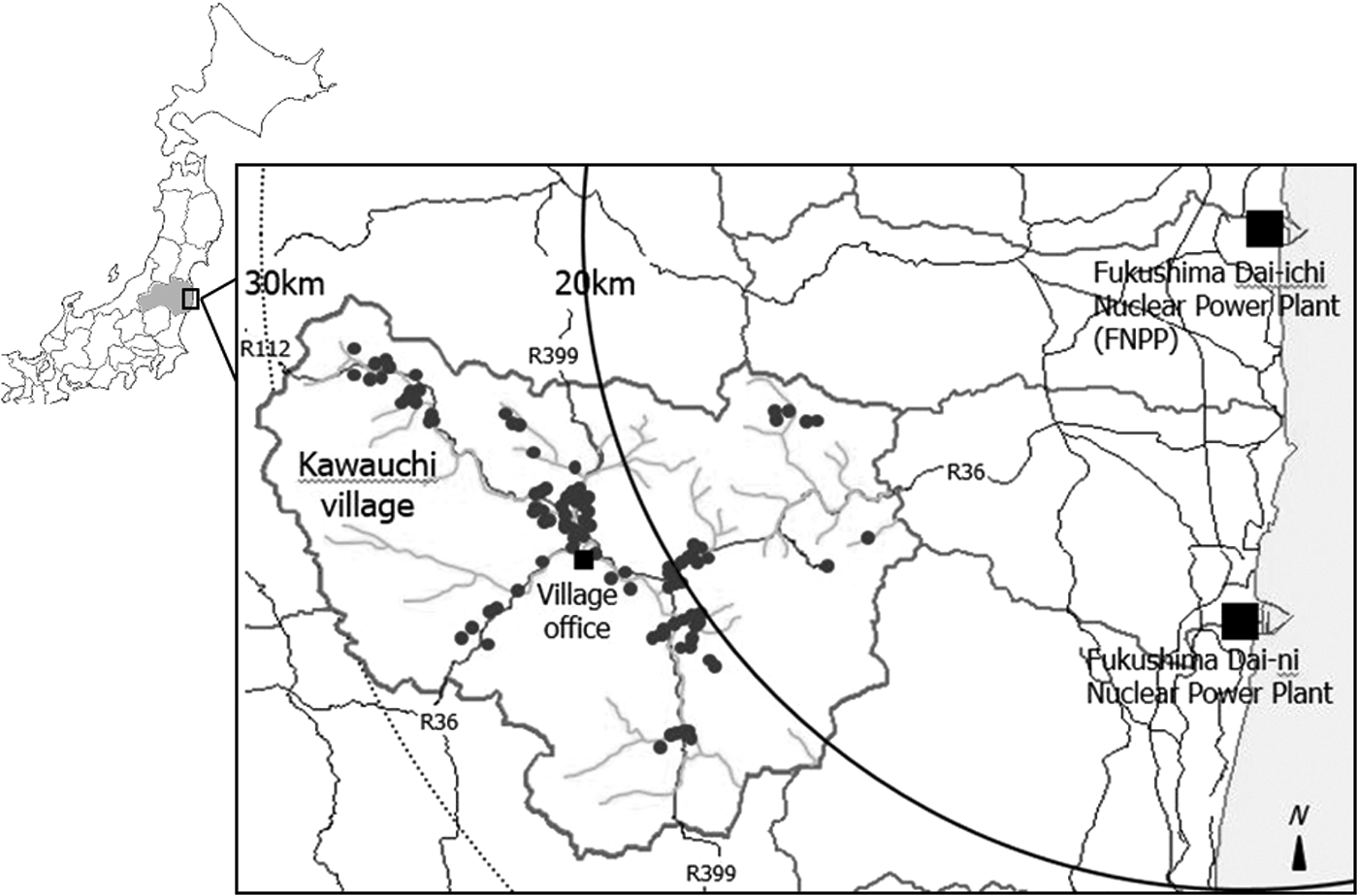
Sampling points of water for the measurement of nitrate/nitrite nitrogen concentrations in Kawauchi village.
Our preliminary results suggest that nitrate in drinking water does not contribute significantly to thyroid disorders in Kawauchi village of Fukushima. In Fukushima Prefecture, many inhabitants usually use tap water. Since tap water is more regulated than private wells, nitrate nitrogen exposure from drinking water is considered to be limited in inhabitants of Fukushima.
In addition to investigations including the evaluation of dietary nitrate intake, further epidemiological studies are needed to clarify the factors contributing to the incidence of thyroid diseases, including malignancies, in Fukushima.
Footnotes
Acknowledgments
This publication was supported by research grant (No. 26670460) from Japan Society for the Promotion of Science (JSPS).
Author Disclosure Statement
No competing financial interests exist.