




Abstract
G
Patient and public involvement (PPI) is increasingly recognized as an important and positive influence in research (13). Research funding organizations often require that applicants provide evidence of PPI in research proposals. In 2012, the first ever PPI event for inflammatory ocular diseases was organized by the Moorfields National Institute for Health Research Biomedical Research Centre in London, United Kingdom, overseen by the James Lind Alliance (14). This resulted in setting priorities for future research in inflammatory ocular conditions (15).
Here, we share our further experience with PPI leading to refinement of the priorities for future research, and translation into answerable research questions and study design outlines, through a two-day event. The event was planned by a committee representing professional and patient-led organizations (16,17). It was publicized in the media (newspaper, municipal Web sites on events, newsletters, general practitioner surgeries, patient organizations, professional organizations). Attendees registered as members of the public if they were not patients with thyroid disease or health professionals. Day 1 was aimed at patients, the public, experts, and professionals. It included an introductory session about GO for patients and the public, patient testimonies about their experience with the disease, and a breakout session into three working groups. Day 2 consisted of a scientific meeting aimed at professionals and six invited expert patients. It included reviews of the pathogenesis and clinical management of GO, highlighting recent advances in these areas. It was followed by a breakout session of three working groups for professionals, experts, and expert patients, allocated to translating the selected research questions formulated in breakout session 1, to study design outlines. The objectives of breakout session 1 were to discuss six questions per group previously set by the Sight Loss and Vision Priority Setting Partnership (15) and select a maximum of two questions per group based on scientific merit and relevance to unmet patient needs (Fig. 1). The chair and co-chair for each group were asked to use the PICO (patient, intervention, comparator, outcome) principle (18) in order to formulate the selected research questions for further elaboration in breakout session 2 on day 2. Groups in breakout session 2 consisted of a chair, co-chair, expert panelists (including two expert patients per group) and professionals. They were asked to discuss and translate the PICO questions of breakout session 1 into study designs.
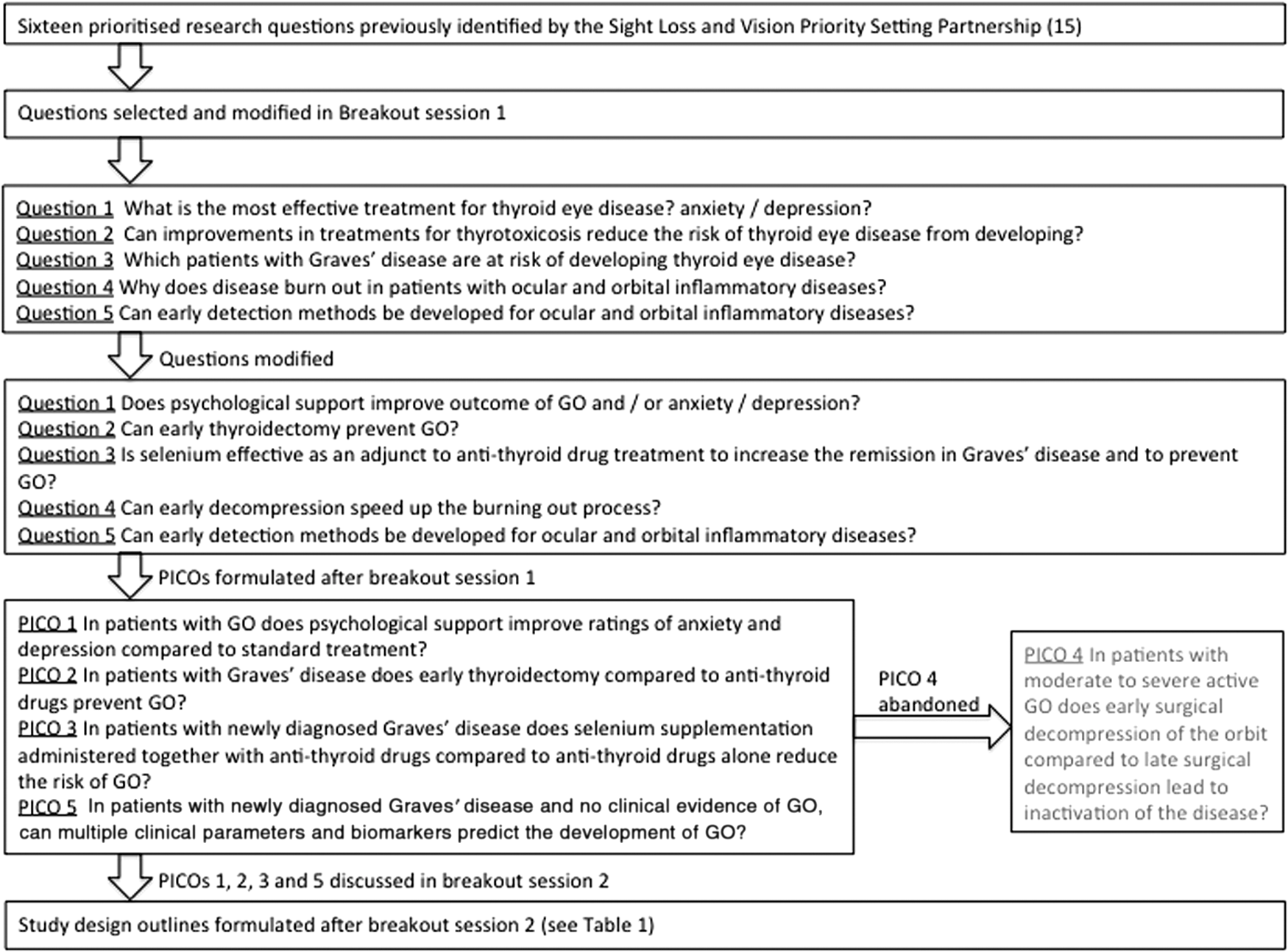
Flow diagram outlining the processes for prioritization and formulation of research questions.
The event was successful in drawing a sizeable (147 on day 1 and 131 on day 2) and diverse audience (public, patients, endocrinologists, ophthalmologists, and basic scientists from 13 different countries), and met the previously set targets for attendance and participant mix by the organizing committee. PPI was achieved as judged by the number of people who attended and the significant influence exerted by patients and the public on selection and direction of potential studies. The outcomes from breakout sessions 1 and 2 are shown in Figure 1 and Table 1. The net cost of the meeting (total cost minus registration fees) was £18,000 ($28,300).
PICO, patient, intervention, comparator, outcome; GO, Graves' orbitopathy.
The selection of psychological intervention as one of the priorities was not anticipated by the authors, but clearly this is of great interest to patients and the public, and it has now been documented as an unmet need worthy of future research. What also emerged as a priority was the importance of developing a method for predicting the development of GO with a high degree of accuracy. The number of patients with GO seems to be declining (19), and we anticipate that the emphasis of future interventions will be in prevention. In order to conduct meaningful randomized controlled trials, there is a need to target patients with Graves' disease who have no clinical expression of GO at the time of recruitment but are likely to develop the disease, and such a study was given high priority.
In conclusion, we were able to conduct a successful PPI event on GO, which prioritized 6/16 previously set research questions, and translated them into four outlines of study designs, two of which emerged as highest priorities. Unmet patient needs informed and guided the selection process. This will provide strong evidence of PPI in future bids by the thyroid community for funding these studies, and may be a useful model for PPI in research planning and prioritization for other thyroid diseases.
Footnotes
Acknowledgments
The event was supported financially from grants and donations from the European Thyroid Association, Society for Endocrinology, Biomedical Research Centre, Moorfields Hospital London, Tynesight Trust, Apitope, and RSR Limited. The authors also wish to thank Sir Leonard Fenwick, Chief Executive, Newcastle upon Tyne Hospitals NHS Foundation Trust, and Frances Blackburn, Head of Nursing, Freeman Hospital, Newcastle upon Tyne, for their support.
Author Disclosure Statement
No competing financial interests exist.