




Abstract
Background:
Robot-assisted transaxillary thyroid surgery (RATS), widely accepted and used in Asian countries, can be an appealing treatment option both for patients with major concerns regarding a cervical scar and for their surgeons. Patients benefit from scarless neck surgery, while their surgeons benefit from improved dexterity and ergonomics compared with remote-access endoscopic thyroid surgery. However, validating any novel surgical procedure for thyroid pathology should be based on evidence regarding its feasibility, radicality, and safety compared to the time-honored, safe and effective, conventional open thyroidectomy. It should also be evaluated for potential risks that are not present with conventional approaches.
Patient findings:
This study reports a patient with surgical track and cervical nodal recurrence, and distant metastasis following a two-stage robot-assisted surgery, and radioactive iodine ablation therapy for a papillary thyroid carcinoma that was initially regarded a single indeterminate nodule.
Summary:
This case emphasizes the importance of thoroughly evaluating the oncological safety of RATS, and points out the possibility of “malignant seeding along the surgical access” being an untraditional potential complication associated with the procedure.
Conclusions:
While tailoring the surgical strategy to the patients' concerns and desires is important, adhering to fundamental onco-surgical principles is a priority. Furthermore, unconventional complications associated with novel surgical procedures should be properly evaluated and addressed.
Introduction
A
Here, a patient is presented who was referred with loco-regional and surgical access recurrence, as well as distant metastasis several months following RATS.
Patient
Details of the patient's history prior to his referral to the authors' institute are based on his clinical records from the center where he was initially treated. The patient is a 65-year-old euthyroid male who was found to have a single left-sided thyroid nodule 4 cm in size. Fine-needle aspiration cytology (FNAC) reported the lesion to be suspicious for a follicular neoplasm (Bethesda category IV). He was referred to a national center for robotic surgery, to be operated by a surgeon with a personal series of >60 cases of RATS. The patient underwent a left-sided robot-assisted transaxillary thyroid lobectomy. The gross description of the specimen stated that it was received in two fragments. Histopathology showed a follicular variant of papillary carcinoma, measuring 6 cm in greatest diameter, with intrathyroidal vascular invasion and extrathyroidal extension. Therefore, he was scheduled for a completion thyroidectomy two months later. Completion thyroidectomy was also robot-assisted and was performed through the right axilla. Histological examination showed no cancerous foci. Two months later, the patient received radioactive iodine (RAI) ablation with 100 mCi of 131I following the withdrawal of thyroxine. The pre-ablation RAI uptake using 50 μCi 131I was 18.9%. His thyrotropin (TSH) and thyroglobulin (Tg) levels were 54.6 mIU/L and 184.9 ng/mL, respectively. Thyroglobulin antibodies (TgAbs) were negative. The post-therapeutic scan revealed uptake in the thyroid bed and left lateral cervical lymph nodes, and no evidence of distant metastases. A neck ultrasound (US) was performed and revealed a thyroid bed remnant. Follow-up six months later revealed a TSH level of 0.09 mIU/L, a Tg level of 24.8 ng/mL, and negative TgAbs. The patient received a second dose of 100 mCi 131I after recombinant human thyrotropin stimulation. The post-therapy whole-body scan was negative, and the stimulated Tg was 136.6 ng/mL. A neck US showed a thyroid bed remnant and suspicious subcentimetric left lateral cervical lymph nodes, as well as a left supraclavicular lesion. Positron emission tomography with 2-deoxy-2-[fluorine-18]fluoro- D-glucose integrated with computed tomography (CT) was performed and revealed left supraclavicular and lung metastases. The patient was evaluated 16 months following his first RATS. A neck US performed at the authors' center revealed a thyroid remnant on the left, suspicious lymph nodes in the central and left lateral cervical compartments varying in size between 8 and 12 mm, and a left supraclavicular/suprapectoral ill-defined lesion measuring 4 cm. The lesion was clinically palpable. A total body CT confirmed the cervical and pulmonary findings. A neck re-exploration was performed with resection of remnant thyroid tissue and comprehensive bilateral central and left lateral neck dissections. The suprapectoral lesion was also excised through a separate incision made directly over it (Fig. 1). Intraoperatively, the lesion was ill-defined, infiltrating adjacent muscles, namely the sternocleidomastoid, pectoralis major, and platysma muscles, necessitating en bloc excision of the invaded parts as well. Histopathology demonstrated a poorly differentiated papillary thyroid carcinoma (PTC) in all resected specimens, with areas of classical, follicular, and insular PTC.
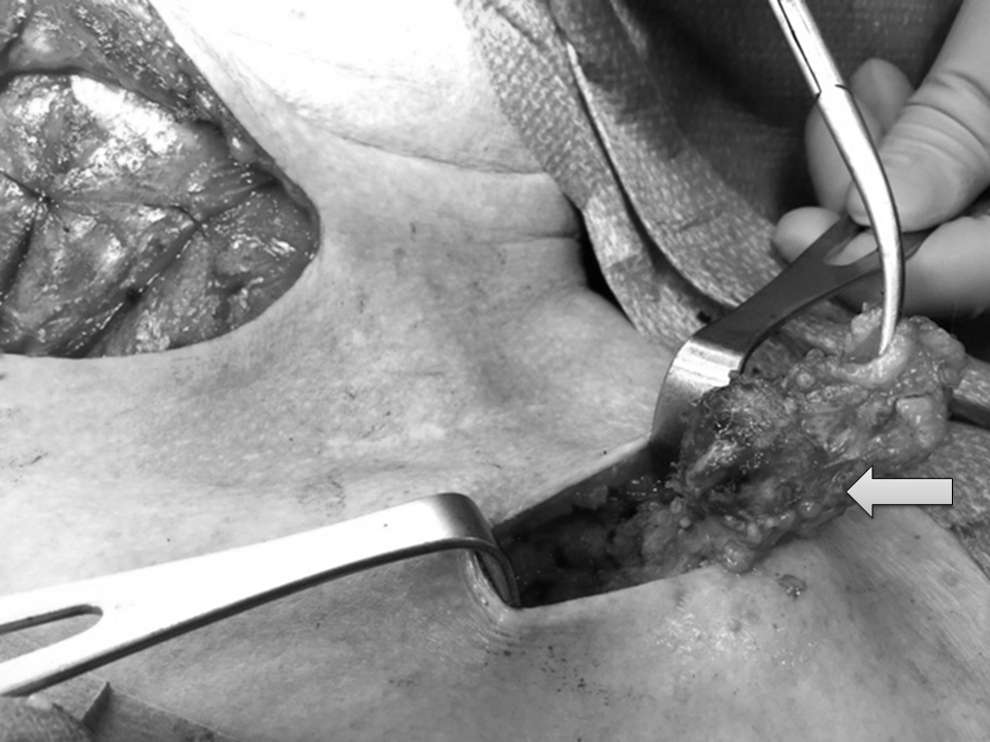
Excision of the a suprapectoral/supraclavicular ill-defined lesion (arrow) via an incision made directly over it. Histopathologic examination reported the lesion to be a poorly differentiated papillary thyroid carcinoma infiltrating surrounding muscular structures.
Discussion
RATS is a novel treatment modality for thyroid pathology. It has gained particular popularity in parts of Asia where patients have concerns about having a cervical scar. However, validating any novel surgical procedure should be based on evidence regarding its feasibility, radicality, and safety. It should also be evaluated for novel complications and their impact.
In terms of safety, the literature demonstrates that RATS is comparable to conventional open thyroidectomy (COT), but at a considerably higher cost and longer operative time (3). However, it has the potential for unconventional complications, including injury to the great vessels at the thoracic outlet, aerodigestive injuries, stretch injury to the brachial plexus, and flap paresthesia and fibrosis. Another potential RATS-related risk is the effect the incision in the tail of the breast might have on the efficacy of future mammograms or sentinel node mapping (4).
In terms of oncological radicality, current data suggest that RATS and COT are comparable in terms of surgical completeness in experienced hands (5 –7). Nevertheless, proper assessment of oncological outcome requires long-term follow-up data, which at the time are still lacking.
Many aspects of the patient's management prior to his referral are questionable, including whether it was appropriate to select a 65-year-old male with a large indeterminate nodule for RATS, the appropriateness of performing a robot-assisted completion thyroidectomy for high-risk PTC, and the initial lack of localization studies other than US to explain the persistently elevated serum Tg level. Nevertheless, this case demonstrates that the tumor was not controlled by the initial treatment because of surgical incompleteness and traumatic dissemination of malignant cells along the surgical track, and the clinical course was then associated with progressive disease with signs of de-differentiation. Of note, the slides of the original left lobectomy were reviewed by pathologists, confirming his initial diagnosis, and there were no areas of de-differentiation. It also demonstrates that for the time being, RATS should be confined to carefully selected thyroid cancer patients in terms of oncological safety (8). In high-risk tumors, it is prudent to adhere to fundamental onco-surgical principles: adequate local control is a priority, and direct exposure of the lesion is critical for that. This case also points out a potential complication of remote-access thyroid procedures, that is, implantation along the surgical access, a finding also reported by others, even following surgery for benign thyroid nodules (9 –14). In this patient, it is mainly attributed to the fact that the specimen was fractured and retrieved in two fragments. However, track-seeding could also be a potential risk inherent to RATS, even in the absence of deficiencies in surgical technique, especially in cancer cases with extrathyroidal extension. Therefore, routine retrieval of the resected specimen using a bag is suggested, regardless of its nature and size. Converting RATS to a COT is also considered a reasonable adaptation in case of the occurrence of a fractured surgical specimen. This case also highlights the importance of adhering to the framework set for the safe implementation of robotic thyroidectomy in order to avoid unnecessary harm to patients (15).
To conclude, patients, especially those with cancer, should be carefully selected for RATS. RATS has the potential for unprecedented complications that should be properly evaluated and addressed.
Footnotes
Author Disclosure Statement
No competing financial interests exist.