




Abstract

Dear Editor:
Innumerable sitters affected by thyroid gland enlargement are widespread in many European and non-European artworks spanning centuries (1 –3). The inclusion of diffuse or multinodular goiter in paintings was mainly done in landlocked regions where iodine deficiency was endemic and painters were familiar with the disease. Whether the artists selected models affected by goiter, chose goitrous sitters by chance, or deliberately included prominent anatomical characteristics remains speculative. Among others, it is not uncommon to find figures with neck enlargement in portraits with religious themes in works representing the crucifixion, the nativity, and the Virgin with child (1 –3). In these art works, the affected goitrous individuals include angels, shepherds, peasants, commoners, and even the Virgin Mary. However, to our knowledge, a crucified Christ with a full rounded neck such as the one depicted by the 20th century Italian futuristic artist Primo Conti (1900–1988) is extremely uncommon (Fig. 1). A close look at the painting reveals Christ to be depicted with an abnormal profile of the neck with swelling, which is suggestive of a presumptive medico-artistic representation of goiter.
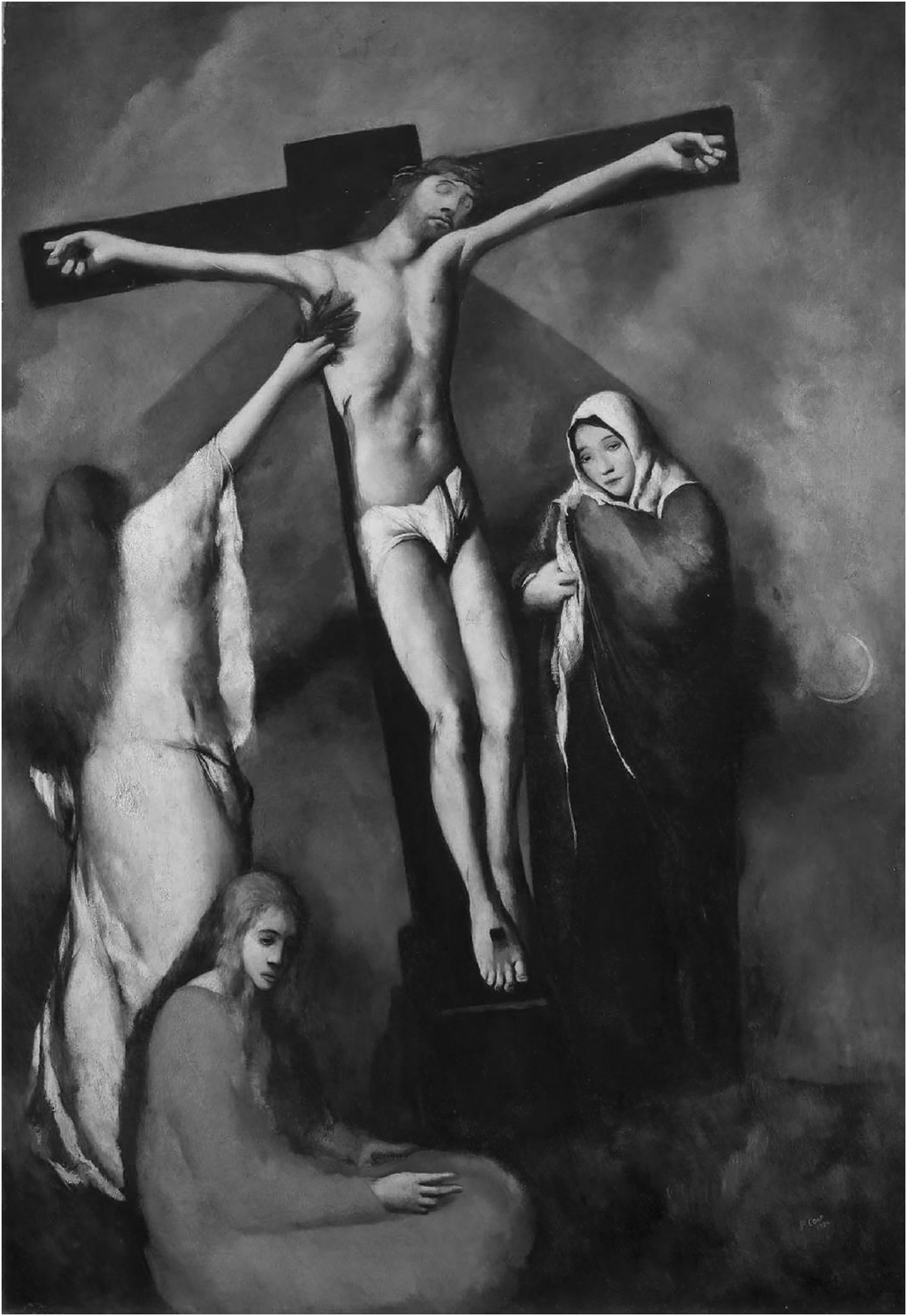
The Crucifixion (c. 1924), by Primo Conti, oil on canvas [from the Santa Maria Novella's Church, Florence, Italy].
Although it is not uncommon to find subjects affected by goiter in paintings from the Italian regions, which had a high prevalence of goiter, this case is peculiar for several reasons. We do not know whether a highly reputed painter such as Primo Conti would have been aware that he was depicting a goiter. However, an inaccurate depiction of the model inadvertently drawn by the artist seems unlikely, and an erroneous depiction of a neck enlargement would not have been repeated by accident, especially as such mistakes would have been adjusted in the final piece. The biography and the paintings of Conti suggest that he was not affected by goiter, and it can therefore be assumed that it was not added as an autobiographical self-portrait feature.
The neck of the crucified Christ herein described does not have the masculine features that are common in the Christian iconography such as strong sternocleidomastoid muscles, and it lacks a prominent thyroid cartilage. Christ has been rendered with a mild swelling at the base of the neck, which was considered a sign of beauty in the Renaissance and Baroque periods, especially for female sitters, and associated with valuable virtues including purity, moral strength, and holiness. Similarly, in The Last Supper at Emmaus, Caravaggio depicted an adult beardless Christ without noticeable male characteristics and with a large smooth and diffuse goiter, making his neck look more graceful (4). As in Caravaggio's work, the neck of the crucified Christ is characterized by an ethereal and feminine grace. Besides, the lack of the traditional structure in the composition, together with the less formal pose of the sitters who wear modest clothes, further highlight the humane aspect of the masterpiece.
The definite intention of the painter to depict a goiter in Christ's neck remains unknown. The fact that Conti portrayed a Christ with a full rounded neck without masculine features perhaps reflects that the painter used a stylistic hallmark that was typical of the 15th and 16th centuries to optimize proportions and include positive symbolic meanings while pursuing at the same time an increased realism of the representation.
Footnotes
Author Disclosure Statement
None of the authors has financial conflicts or interests to report in association with the contents of this article. This research received no specific grant from any funding agency in the public, commercial, or not-for-profit sectors.