




Abstract

Over the last decade, the incidence of cancer in adolescents and young adults (AYAs) aged 15–39 years has increased, along with a dramatic increase in thyroid cancer. Since 2010, thyroid cancer has been the most common cancer in American men and women aged 16–33 years, and it is the second most-common cancer in older AYAs. The majority of new cases are papillary thyroid cancers that do not impact disease-specific mortality (1,2). We sought to describe the impact of the rapid rise in thyroid cancer incidence on the overall increased incidence in and survival rate of AYAs with cancer.
Incidence, including average percent change (APC) in incidence and statistical significance, and survival data were obtained from the National Cancer Institute's Surveillance, Epidemiology, and End Results (SEER 18) program (2). For five-year rates, the last year of available data was 2008. Linear regressions were applied to the incidence and survival rates. Observed, relative, and cancer-specific survival rates were compared and were found not to alter the results reported here.
Figure 1 shows the annual incidence from 2000 to 2012 of invasive cancer with and without thyroid cancer among AYAs by sex (left panel) and for all age groups for men and women combined (middle panel). From 2000 to 2012, the all-cancer incidence in male AYAs increased at a slow but steady rate (APC = 0.28, p = 0.01) when thyroid cancer was included, but there was no change when it was not included (APC = 0.01). In women, the all-cancer incidence increased dramatically (APC = 1.03, p < 0.0001), but if thyroid cancer was excluded, the rate did not change significantly. Linear regression analysis quantitated the thyroid cancer incidence during 2000–2012 to account for 95% of the overall increase in males and 80% of the overall incidence in females. When compared with younger and older ages, the APC in overall cancer incidence showed that only AYAs had a statistically significant increase in incidence in invasive cancer, and that this increase was essentially eliminated when thyroid cancer was excluded. The five-year relative survival of female AYAs increased from 2000 to 2008 by 3.48% when thyroid cancer was included and by 2.89% when it was not. Including thyroid cancer raises the relative survival rate by 20.4% (right panel).
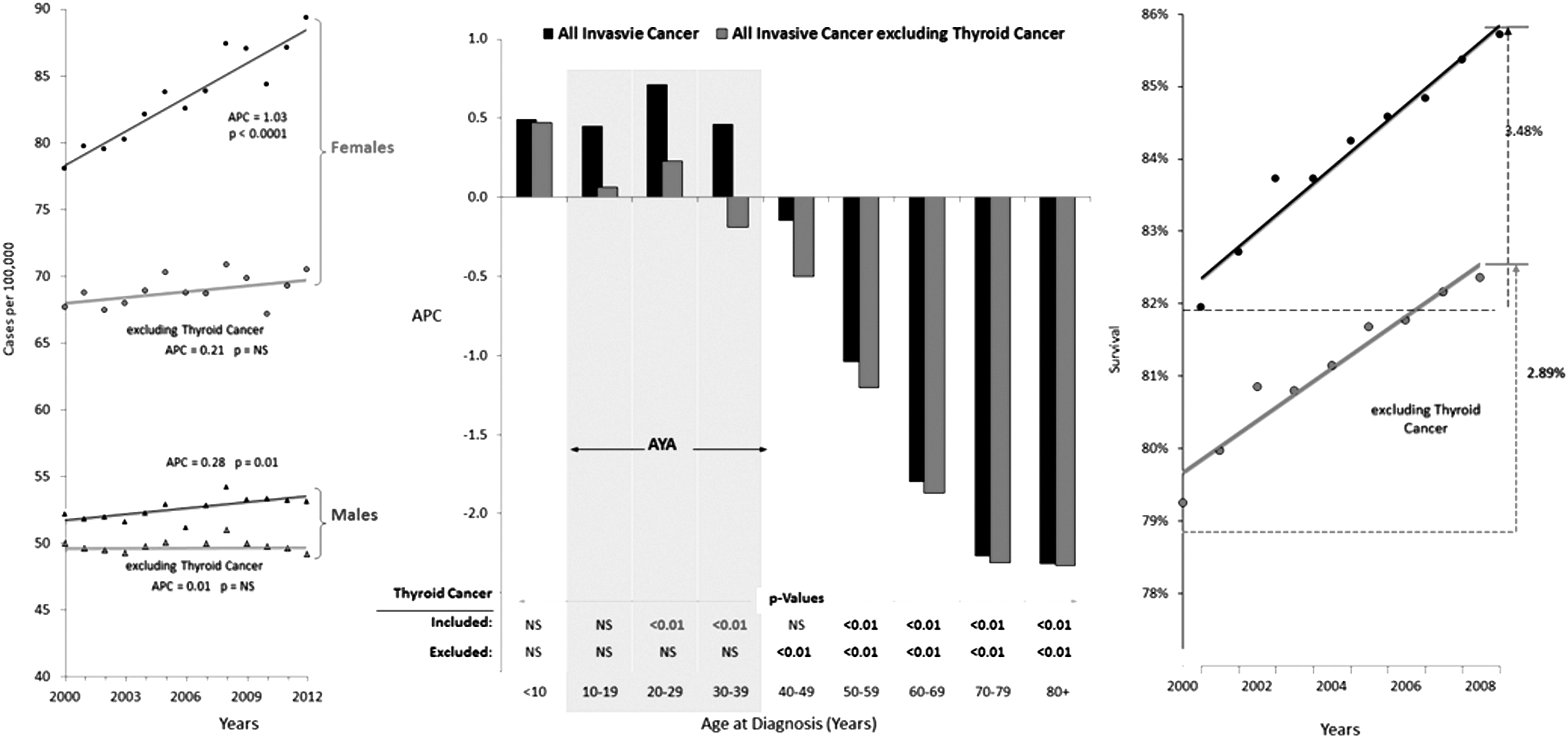
Left: Annual incidence of invasive cancer in AYAs aged 15–39 years with and without thyroid cancer, 2000–2012, SEER18 by sex (total number of AYAs: 31,931). Regressions are linear. Middle: Annual percent change (APC) in incidence of invasive cancer by age, 2000–2012, with and without thyroid cancer, SEER18. The AYA age range is shaded. Right: Five-year relative survival of females with cancer, age 15–39 years, by year of diagnosis, 2000–2008, with and without thyroid cancer, SEER18. Regressions are linear (total number of AYAs: 19,480). SEER18, Surveillance, Epidemiology, and End Results program.
By itself, the thyroid cancer incidence increase accounts for nearly all of the recent increase in cancer incidence among AYAs. Its incidence increase therefore significantly inflates the overall survival rate among patients in this age group. While the effects of thyroid cancer increased diagnosis have not been completely elucidated, patients diagnosed with thyroid cancer report poor quality of life after diagnosis and treatment (3) and high rates of financial distress, including bankruptcy (4), compared with age-matched people without cancer. For AYAs, the morbidity of thyroid resection includes neck scars, risk of hypoparathyroidism, and lifelong hormone replacement therapy and the associated cost of the surgery and treatments. Additionally, some AYAs may also require radioiodine therapy and additional financial challenges in this group who are often underinsured. Future research should help to identify factors driving the diagnosis of thyroid cancer among AYAs.
Footnotes
Author Disclosure Statement
Dr. Bleyer was a consultant for, and on the speaking bureau of, Sigma-Tau Pharmaceuticals. No other disclosures are reported.