




Abstract

Worldwide, thyroid disorders are among the commonest endocrine disorders. In India, about 42 million people reportedly suffer from thyroid disorders such as hypothyroidism, hyperthyroidism, Hashimoto's thyroiditis, and thyroid cancer (1). The prevalence rates of hypothyroidism and hyperthyroidism are 3.9% and 1.3%, respectively. The prevalence rate of subclinical hypothyroidism is reported as 9.4% (1). The data indicate that there is a high burden of thyroid disorders in India, which is unaddressed at the population level. The present medical education system is inadequate to form the competency of physicians in the management of chronic conditions (2). With this in mind, the Public Health Foundation of India, Delhi (PHFI), following the public–private partnership model, has launched the Certificate Course in Management of Thyroid Disorders (CCMTD) for primary care physicians (PCPs) in collaboration with the Chellaram Diabetes Institute (CDI) and with an educational grant support from GlaxoSmithKline (GSK) Pharmaceuticals Ltd., covering the majority of the project cost, partially recovered from course fees (Fig. 1) (3). This course is unique in that it is probably the only national-level thyroid disease training program to be undertaken in the country.
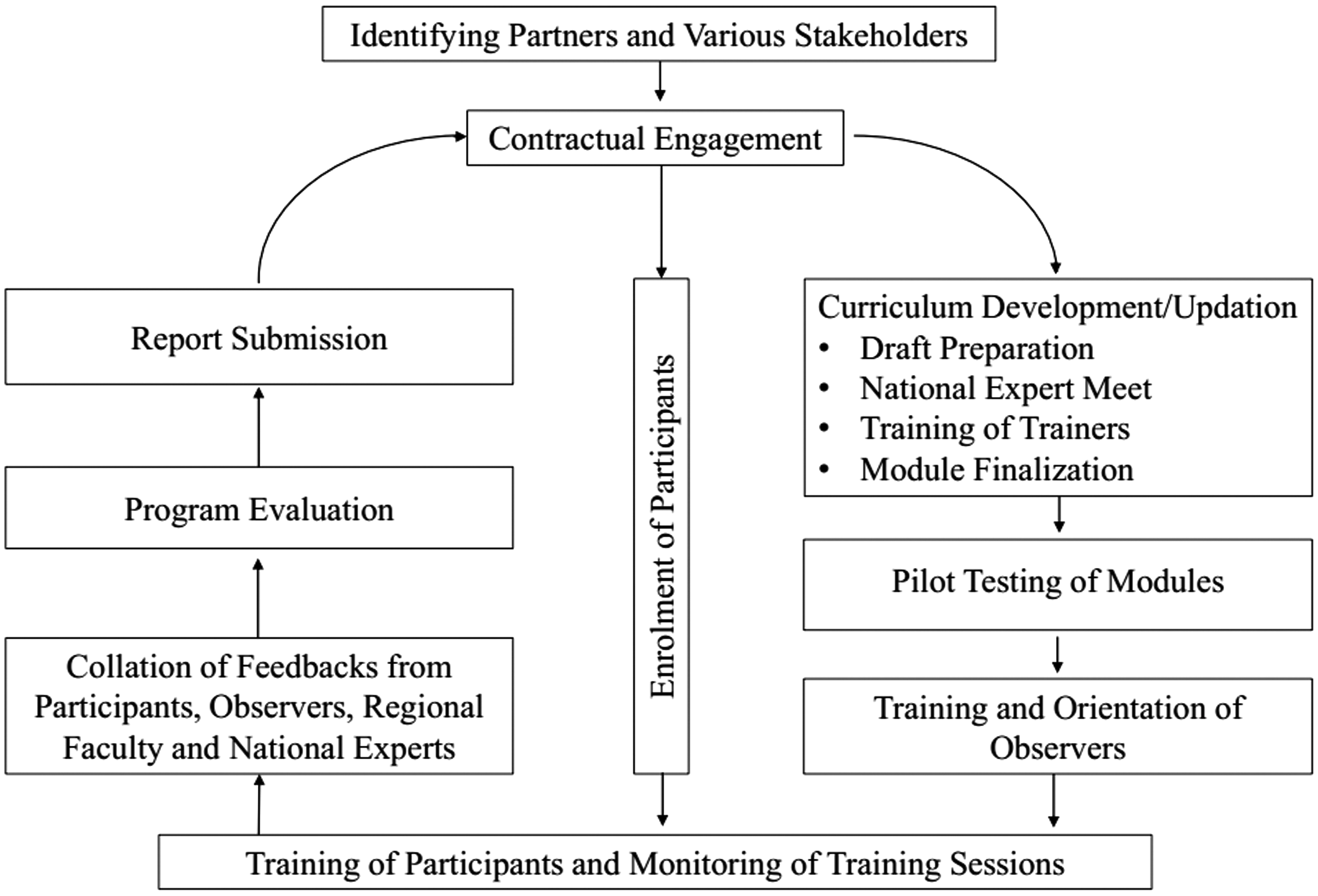
Implementation of the Certificate Course in Management of Thyroid Disorders.
The partnership model was launched with the primary objective of enhancing the knowledge and skills of PCPs in the management of thyroid disorders. Two iterations of the program have already been completed, and the third round started in August 2016.
The program aims at covering various aspects of thyroid disorder management, reflecting the epidemiological variations across the country, deliberated over a period of four months with each single contact session per month on a designated weekend (Supplementary Table S1; Supplementary Data are available online at
The eligibility criterion for PCPs to participate was the primary graduate medical degree in India (MBBS) and more than three years of clinical experience. Final evaluation results and feedback from participants, observers, regional faculty, and national experts were used for program appraisal, improvement, and assurance.
The course has been delivered in 38 centers across 18 states and one union territory, and it has been attended by participants from 259 districts of the country. Out of 1765 enrolled participants (average clinical experience of 14 years), 77% were postgraduates (MD/MS or Diploma), 29% were from the government sector, and 30% were female doctors. The compliance rate of attending the course was 89.9% (1587/1765). During pre/post-test assessment, an average increase of 1.25 unit scores (on a scale of 10) was observed. The final evaluation of the course by participants showed an overall rating of 9.1 on a scale of 10.
Physicians lack resources to tackle the growing burden of thyroid disorders. The high enrolment rate in the course reveals a need for education on thyroid disease management in the physician community of India. To combat the burden, developing nations such as China and Brazil have already introduced a variety of short courses and diplomas to educate and improve the skills of PCPs, which have resulted in significant improvements (4). The present course is designed to improve the basic knowledge in the management of thyroid disorders and to facilitate a system of referral networks among the medical community. The course is accredited by the South Asian Federation of Endocrine Societies for the year 2016–2017, and endorsed by the Asia and Oceania Thyroid Association for the period 2016–2025.
To ensure sustainability of the course model, we plan to develop the course into an e-learning module, which could eventually be adapted to other developing countries. The project team also plans on advocating for a policy change with the Government of India, so that the government may take ownership of this competency building program for training of physicians across India.
With focus on India's social and geographical complexities, the CCMTD program is designed to be adaptive to the needs of the PCPs, so that its access and impact reaches the most remote areas.
After completion of each cycle, a yearly final evaluation is being conducted to identify the need for changes in the curriculum and implementation of the course. We plan to study the impact of this course periodically to assess the improvement in care of thyroid disease, as well as fulfillment of the knowledge gap of the clinicians.
Footnotes
Author Disclosure Statement
The authors have no competing interests to declare. The course has received a partial educational grant support from GlaxoSmithKline Pharmaceutical Limited, India.