




Abstract
Introduction
R
In recent years, there has been much interest in the use of multi-kinase inhibitor (MKI) therapy for the management of metastatic thyroid cancer. These novel agents are usually prescribed as single medications when used in routine clinical care. Some of these agents are also being evaluated as combination therapies or in conjunction with RAI as part of several ongoing clinical trials. MKI therapy demonstrated promising results in clinical trials by inducing tumor shrinkage and prolonging progression-free survival (PFS) (4,5). Recent studies suggest that initiation of MKI therapy at a smaller disease burden may provide a PFS benefit when compared to starting MKI therapy after larger-volume disease develops (6). However, more data are needed with regard to the impact of MKI on overall survival and quality of life. In clinical practice, the lack of a uniform consensus regarding the indications for initiation of MKI therapy, the unproven overall survival and quality-of-life benefits, the significant costs, and the potential adverse effects of these agents often make it difficult to decide when to initiate these therapies for an individual patient.
Defining RAI-R Thyroid Cancer
When evaluating a patient with disease progression after RAI therapy, several critical questions need to be addressed in order to determine the most appropriate management (Fig. 1). The first step in evaluating a patient's eligibility for MKI therapy is determining whether the patient has convincing evidence of RAI-R disease. Patients are classified as having RAI-R disease if they have: (i) lack of RAI uptake on post-therapy scan after RAI-administered activity >30 mCi following appropriate iodine deprivation and adequate thyrotropin (TSH) elevation; (ii) lack of RAI uptake on a properly conducted diagnostic whole-body scan in the setting of known structural disease, as demonstrated by cross-sectional imaging; (iii) lack of demonstrable ability of the tumor to concentrate sufficient RAI for tumoricidal effect, based on lesional dosimetry (i.e., delivered RAI dose to metastatic foci <8000 cGy) when available; (iv) structural progression of thyroid cancer 6–12 months after RAI therapy; (v) a rising Tg level 6–12 months after RAI therapy; and (vi) continued progression of thyroid cancer, despite cumulative RAI-administered activities >500–600 mCi in adult patients (7,8). While it is often difficult to ascertain if a patient had a significant clinical response to RAI if stable structural disease is seen after RAI therapy, repeat RAI therapy is not usually advocated in that situation (8).

Critical questions that guide decision making with regard to radioiodine-refractory (RAI-R) thyroid cancer.
Guidelines Positions in Respect to MKI Therapy Initiation
Recommendation 96 of the 2015 American Thyroid Association (ATA) guidelines for adult patients with thyroid nodules and differentiated thyroid cancer (DTC) states that the use of MKI therapy “should be considered in RAI-R DTC patients with metastatic, rapidly progressive, symptomatic and/or imminently threatening disease that is not otherwise amenable to suitable control via other approaches” (9). Given the lack of evidence of improved overall survival and quality of life with the use of these MKI therapies, the guidelines committee advocates that “patients who are candidates for kinase inhibitor therapy should be thoroughly counseled on the risks and benefits of this therapy as well as alternative therapeutic approaches including best supportive care” (9). It is important to note that not all patients with RAI-R thyroid cancer will be candidates for MKI therapy under these recommendations. Based on expert opinion, the ATA guidelines suggested that patients who “demonstrate at least 20% increase in sum of longest diameters of target lesions over 12–15 months follow up, the appearance of significant new metastatic lesions, or development of disease-related symptoms should warrant consideration of appropriate systemic therapies beyond TSH-suppressive thyroid hormone and/or directed therapies.” Asymptomatic patients with RAI-R thyroid cancer without clinical evidence of structural progression or with slow disease progression that does not fulfill the above definition and without an indication for localized therapies can be monitored with serial cross-sectional imaging every 3–12 months.
On the other hand, while the National Comprehensive Cancer Network guidelines generally recommended the use of MKI therapy for progressive metastatic thyroid cancer that is unresponsive to RAI therapy, the guidelines cautiously avoided providing specific tumor size or tumor growth-rate recommendation for the initiation of these therapies (10).
Inclusion criteria for the sorafenib and lenvatinib registration trials included the presence of RECIST measurable disease (i.e., structural disease site >1–1.5 cm) and documentation of at least a 20% increase in the sum of the longest diameters of target lesions over either 13 months (lenvatinib) or 14 months (sorafenib) (4,5).
Clinical Practice Dilemma When Considering MKI Therapies
In clinical practice, there are several issues that come up when considering the initiation of MKI therapy. First, the current ATA recommendation recognizes the development of “significant” new metastatic foci as an indication for systemic therapy, but stops short of defining what “significant” and “insignificant” new metastases are (9). More importantly, the registration trials used Response Evaluation Criteria in Solid Tumors (RECIST) to assess eligibility for MKI therapy (4,5). While this approach is easily applicable in the setting of clinical trials when cross-sectional imaging is obtained at specified intervals, its applicability in general clinical practice has not been validated. While the ATA guidelines shied away from using RECIST per se for its recommendation for MKI therapy initiation, it nevertheless recognized the need to identify a minimum amount of disease progression that should be documented prior to initiation of MKI therapy. That amount of disease progression was defined based on expert opinion and was different from the eligibility criteria used in the Phase III registration trials. Additional studies are needed to better define the association between the rate of disease progression and survival from thyroid cancer. Nonetheless, it is clear that the rate of disease progression will be an important variable in the decision regarding the optimal time to start MKI therapy.
It is also important to recognize that these recommendations are only minimum requirements for eligibility for MKI therapy and do not take into consideration the impact of structurally progressive thyroid cancer and its treatment on patients' symptoms and/or quality of life. With that in mind, the intent of this statement is to provide direction for physicians and patients regarding the current indications for the use of MKI therapies in metastatic DTC. The decision-making process regarding the management of RAI-R metastatic thyroid cancer is described, and specific cohorts of patients that are selected for cautious observation, localized treatment, or systemic therapies are defined (Fig. 2).
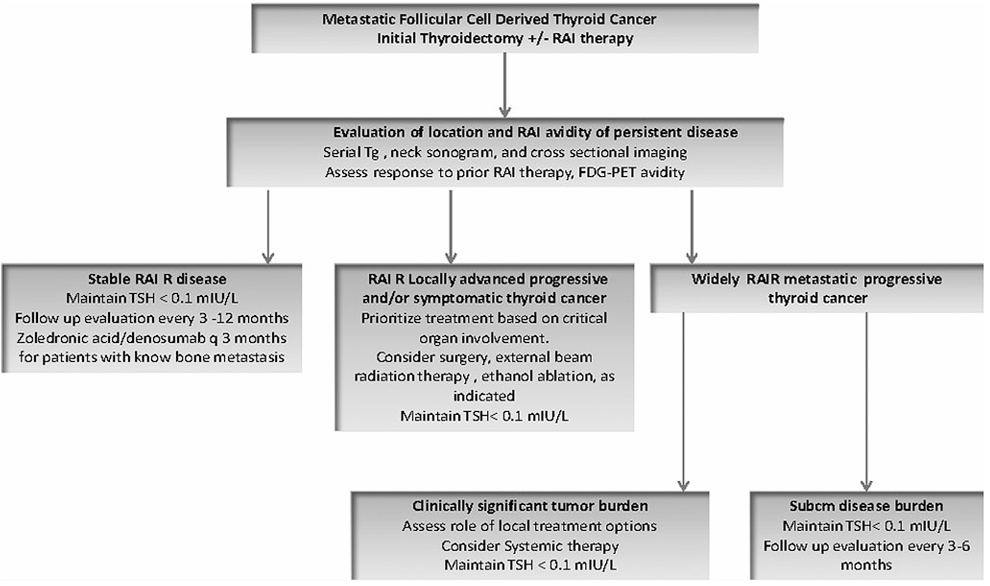
Schematic of approach to management of metastatic RAI-R thyroid cancer.
Specific Clinical Situations
A subset of patients with RAI-R metastatic thyroid cancer have persistent low-volume disease (largest documented lesion <1 cm, no new lesions) that remains stable or is slowly progressive with time (mm growth over intervals >1 year). Others have rising Tg levels over time without structurally identifiable disease progression by cross-sectional imaging. It is the authors' opinion that patients with stable small-volume disease (even if the serum Tg is rising) are unlikely to benefit from MKI therapy and are better managed with some degree of TSH suppression and serial cross-sectional imaging over time.
In some patients with structurally progressive thyroid cancer, continued growth of a specific tumor focus or the appearance of a new metastatic focus in a critical organ may put the patient at risk for significant symptoms and complications. Here, a clinician should determine if the patient is a candidate for other localized treatment options that may provide effective control of disease and/or symptom relief. It is important to involve a group of specialists (endocrinologists, radiation oncologists, surgeons, medical oncologist, interventional radiologists, and pulmonologists) in the treatment decision-making process so that a multidisciplinary management plan can be established in order to provide the appropriate systemic or localized therapies. As such, airway involvement (trachea, larynx, major bronchi) should be addressed in priority with either surgery and/or radiation therapy. Patients with bone metastasis with or at risk for impending fracture should undergo embolization followed by surgical resection and internal fixation ± radiation therapy. Those presenting with large brain metastasis may benefit from surgery and/or radiation therapy. Those presenting with base of the skull metastasis or spinal metastasis with cord compression or who may be at risk for cord compression need to be evaluated by neurosurgery and radiation oncology prior to initiating MKI therapy.
In some instances, patients present with isolated recurrent or progressive disease in the neck without evidence of distant metastasis or with stable distant metastasis. In this situation, surgical resection of the progressive disease is recommended. While the neck surgery may not be curative in patients with distant metastatic disease, thorough removal of the cancerous tissues reduces the overall burden of cancer and protects against locoregional disease progression and associated potential quality-of-life consequences, including recurrent laryngeal nerve dysfunction or esophageal encroachment with resultant voice and swallowing impairment. Effective local treatments can often delay the time to initiation of MKI therapy.
Alternatively, ethanol ablation may be used to treat small progressive nodal metastasis in patients who are not surgical candidates. Ethanol ablation is most effective when used to treat a small number of small lymph nodes presenting as isolated recurrences. One exception is metastatic nodes in the central compartment that may not be optimal candidates for ethanol ablation, given the potential of extravasation and injury to the recurrent laryngeal nerve (11).
In rare instances, patients present with a synchronous or asynchronous isolated distant metastasis or with rapid progression in a single metastatic focus with stability of the remainder of their tumor burden. In these situations, a localized therapy approach is more controversial. Definable treatment objectives may include (i) relief from a symptomatic lung nodule amenable to wedge resection or lobectomy or, alternatively, radiation therapy; (ii) management of a bone metastasis causing intractable pain or risk for spinal cord compression with surgery and/or radiation therapy; (iii) resection and/or irradiation of an isolated brain metastasis; or (iv) resection or embolization of an enlarging symptomatic liver metastasis. The benefits of the chosen intervention must be weighed carefully against procedural risks and the overall morbidity of that intervention. Patients who exhibit multiple sites of progressive metastatic cancer are appropriate candidates for MKI therapy.
Symptomatic structural disease progression may be amenable to localized therapies or MKI therapy, depending on the location, specific symptoms involved, rate of disease progression, and extent of other metastatic foci. In some instances, worsening pulmonary function in patients with progressive lung metastasis may be an indication for MKI therapy. In contrast, MKI therapy would not be considered for those patients with stable lung capacity and slowly progressive metastasis. The patient's age and functional status are important factors to be considered when MKI therapy is being entertained.
In asymptomatic patients, the clinically significant tumor burden, or minimal tumor size requirement, needed for eligibility for molecular targeted therapy is at least one lesion with largest diameter >1.5 cm in the shortest axis for lymph nodes and 1 cm in the longest axis for non-lymph nodes, and/or rapid development of new lesions, as defined by RECIST (12). Here, it is important to note that in metastatic thyroid cancer of follicular cell origin, the majority of patients presenting with structural disease progression (68%) demonstrate new lesions with a corresponding increase in the volume of known foci, while only 15% of patients develop new lesions with continued stability of previously identified tumor metastasis (13). “Rapid development” of new metastasis is defined as the appearance of new tumor foci at 3- to 12-month intervals. Furthermore, a 20% increase in the longest tumor diameter of any given tumor foci >1–1.5 cm in size within 6–15 months is considered as the minimum requirement for consideration of MKI therapy in asymptomatic patients (Table 1). For lesions <1 cm, a 3–5 mm increase in the size of the longest diameter of a dominant lesion at 6–15 months is considered significant. However, MKI therapy should not usually be initiated until the tumor passes the threshold of clinically significant tumor burden (i.e., 1–1.5 cm in size). Until then, close observation with serial imaging at shorter interval (3–6 months) would be recommended. Molecular testing of the metastatic tumor, particularly for TERT promotor, RAS, or BRAF mutations, and other targetable mutations, may be obtained for prognostication and guidance regarding the patients' eligibility to specific MKI clinical trials.
Clinically significant disease burden is defined as target lesion(s) measuring at least 1.5 cm in diameter and likely to cause symptomatic disease if left untreated.
RAI-R, radioiodine refractory.
MKI Therapy for Follicular Cell–Derived Thyroid Cancer
There are two Food and Drug Administration (FDA)-approved drugs that can be used for RAI-R DTC: sorafenib and lenvatinib. Additionally, a number of other commercially available drugs have been studied in clinical trials and have shown promise for treatment of RAI-R disease, locally advanced/unresectable or metastatic DTC. Table 2 lists drugs that are commercially available and are either FDA approved, studied in Phase I or II clinical trials, or are currently recruiting to a clinical trial. While there are no combination trial results reported at this time, several agents are being studied within the context of clinical trials in combination with another kinase inhibitor or RAI (to enhance RAI uptake). A complete list of clinical trials related to metastatic thyroid cancer can be found on the National Cancer Institute Web site (
FDA, Food and Drug Administration; PTC, papillary thyroid carcinoma.
Sorafenib was FDA approved based on the results of a randomized, placebo-controlled, Phase III clinical trial (DECISION trial) (4). Patients enrolled in this trial were treatment naïve, RAI-R, and had evidence of structural disease progression. The median PFS in the sorafenib-treated patients was 10.8 months versus 5.8 months in the placebo-treated patients (hazard ratio [HR] = 0.59). There was no overall survival advantage. However, patients were allowed to cross over from the placebo arm. While objective responses in the sorafenib group were only 12.2% (all partial responses), most patients had tumor regression that did not meet the criteria for partial response. No complete responses were observed. The starting dose of sorafenib is 400 mg twice daily.
Lenvatinib was FDA approved based on the results of a randomized, placebo-controlled, Phase III clinical trial (SELECT trial) (5). Similar to the sorafenib trial, patients were RAI-R and had evidence of structural disease progression. However, in the SELECT trial, patients were allowed previous treatment with vascular endothelial growth factor–based therapy. This previously treated group comprised 24% of the study population. The PFS in the lenvatinib treated patients was 18.3 months versus 3.6 months in the placebo-treated patients (HR = 0.21). The response rate in lenvatinib treated patients was 64.8%, mostly consisting of partial responses but also including four complete responses. The starting dose of lenvatinib is 24 mg once daily.
The BRAF inhibitors have garnered much attention in DTC due to the high incidence of BRAFV600E mutations observed in papillary thyroid cancer (PTC). In the early trials of the selective BRAF inhibitor vemurafenib, a few responses were observed in patients with PTC (14). This led to a Phase II trial of vemurafenib, which has been completed and was reported at a national meeting (15). Patients were enrolled into two cohorts: treatment naïve and previously treated with a MKI. The response rate in the treatment naïve patients was 38.5% (all partial responses) and the PFS was 18.8 months, whereas in previously treated patients, 27.3% achieved partial responses and the PFS was 8.9 months. Dabrafenib is another selective BRAF inhibitor that was also studied in an early phase trial in solid tumors in which 13 BRAF-mutated PTC patients and one BRAF-mutated anaplastic thyroid cancer patient were enrolled (16). Partial responses were seen in 29% of patients. A Phase II trial with single agent dabrafenib or in combination with the MEK inhibitor trametinib is underway (NCT01723202).
Selumetinib has been used in conjunction with RAI in clinical trials of RAI-R thyroid cancer patients with promising results. It was shown to increase RAI uptake significantly in metastatic tumor foci and induced tumor shrinkage after high-dose RAI, mainly in patients with RAS-mutated tumors (17). Dabrafenib has also been used to re-induce RAI uptake in BRAF-mutated PTC (18). Other clinical trials are underway to validate this approach in patients presenting with various tumor genotypes.
Similar to other solid tumors, resistance to kinase inhibitors develops over time. The mechanism of resistance to kinase inhibitors in DTC is not well elucidated. Salvage therapy with a similar class of drugs has been described after sorafenib failure by Dadu et al. (19), and this strategy is currently under investigation using the anti-angiogenic drug cabozantinib (20). Further data are needed to conclude that this is an effective strategy. However, salvage therapy appears to be a reasonable strategy for patients who have progressed on first-line kinase inhibitors.
While great strides have been made in the past decades with the discovery of the kinase inhibitors, these drugs have toxicities, some of which are tolerable while others can be life-threatening. Effective management of these toxicities is critical in order to maintain patients on treatment. Furthermore, patients should be educated regarding the potential adverse effects with these drugs, and informed consent should be obtained. There are various publications available to help clinicians to manage toxicities from kinase inhibitors (21 –25). The most common adverse effects of the anti-angiogenic kinase inhibitors are hypertension, diarrhea, fatigue, weight loss, hypothyroidism, and skin changes, including hand–foot skin reaction and, in the case of sorafenib, squamous-cell carcinomas of the skin. Rare but serious adverse events of anti-angiogenic drugs include intestinal perforation, tracheoesophageal fistula formation, bleeding, thrombosis, and heart failure. Although there are no contraindications, it is our opinion that comorbid conditions such as colitis, history of diverticulitis, congestive heart failure, and tracheal invasion should be taken into account when considering which kinase inhibitor is most appropriate for a patient. The most common adverse effects associated with the selective BRAF inhibitors are fever (mostly associated with dabrafenib), arthralgias (mostly associated with vemurafenib), fatigue, nausea, and skin changes, including hand–foot skin reaction and squamous-cell carcinomas of the skin. Effective strategies to manage adverse effects can be found elsewhere (23). Although BRAF inhibitors are not approved for thyroid cancer, in patients with relative contraindications to lenvatinib or sorafenib and in the absence of available clinical trials, these drugs may be considered for patients with BRAFV600E mutations.
Finally, quality of life and the “financial toxicity” of the kinase inhibitor drugs must be considered. In the DECISION trial with sorafenib, quality of life was evaluated. Sorafenib-treated patients had slightly lower quality-of-life scores compared to placebo-treated patients at first assessment, and this remained relatively stable throughout the trial (26). These drugs are continued until the patient is no longer responding or has developed an intolerable/unmanageable or life-threatening toxicity. Thus, patients could potentially be taking the drug for an extended amount of time, resulting in diminished quality of life and very high financial cost ($95,832–142,560 per year) (27,28).
In conclusion, MKI therapy plays an important role in the management of patients with RAI-R structurally progressive metastatic thyroid cancer. This consensus statement summarizes the current approach to the management of these patients. It is recognized that more studies are needed to help guide clinicians in properly selecting patients who are most likely to benefit from MKI therapy.
Footnotes
Author Disclosure Statement
M.E.C. received grant funding from Eisai, Exelixis, and Roche. D.J.T. is on the speaker bureau for Genzyme. No competing financial interests exist for M.M.S.