




Abstract

Dear Editor:
A good gulp of hot whisky at bedtime—it's not very scientific, but it helps.
—(Alexander Fleming, Scottish inventor of penicillin, on how to prevent the common cold).
On a visit to a distillery in Islay, Scotland, it was noted that malt whisky, typically aged in wooden casks generally made of charred white oak (1), may contain iodine. Indeed, Laphroaig whisky was the only one allowed to be consumed during the prohibition in the United States (1920–1933) because of its “medicinal properties” related to the iodine content (1). We measured iodine in samples produced in Scotland, Ireland, and Wales. Approximately 1 mL of whisky was pipetted into small plastic bottles and transported at ambient temperature to the Swiss Federal Institute of Technology (ETHZ) in Zurich, Switzerland. Iodine was determined in duplicate using a modification of the Sandell–Kolthoff reaction with spectrophotometric detection (2). A difference test was run to determine if different concentrations of iodine in tap water could influence taste. Concentrations were chosen to match the concentration of iodine in the whisky samples: 0, 10, 25, and 40 μg/L. Six participants, blinded to what they received, compared every concentration to tap water for taste difference.
The iodine concentrations in 23 samples ranged 3.85-fold from 11.6 to 44.8 μg/L (Table 1) and varied by distillery region. An iodine concentration of 40 μg/L was found to be different from water by only 50% of participants, with no significant findings for concentrations <40 μg/L. Whisky has a strong flavor already, which will make it even harder to find a taste difference based on iodine concentrations up to 40 μg/L.
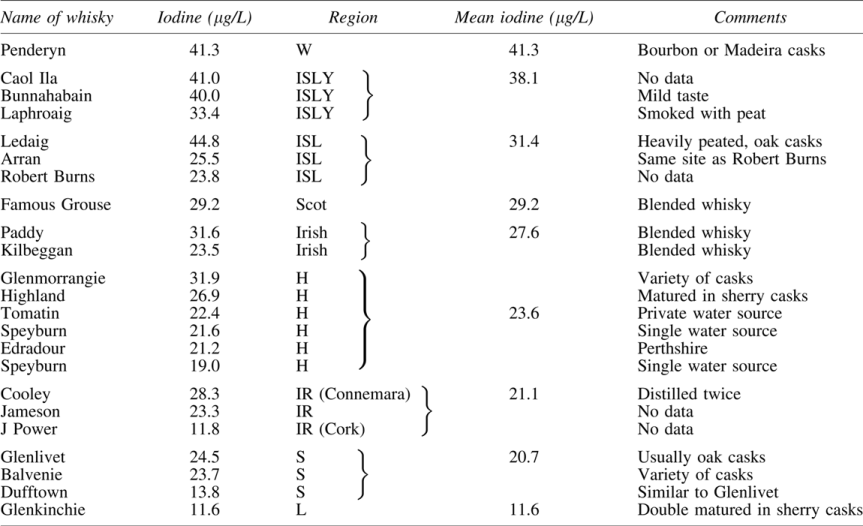
Islay, Island, Highland, Speyside, and Lowland are all Scotch malts.
SLY, Islay; ISL, Island; H, Highland; S, Speyside; L, Lowland; IR, Irish malt whiskey; Scot, Scottish blend; Irish, Irish blend.
The maximum iodine content was observed in the Welsh malt whisky Penderyn, a malted barley whisky not distilled on an island and not smoked under peat. However, it is aged in bourbon barrels or Madeira casks whose iodine contribution is unknown. The iodine content of the fresh natural spring water used in distillation is not known, but nearby water samples contained very low levels of iodine (3). The whisky brands produced on Islay are generally subject to smoking during the manufacturing process using local supplies of peat, which are slowly burnt underneath the still, resulting in the smoky flavor. The peat is indigenous to Islay and subject to exposure to sea spray and wind from the sea, which accounts for its iodine content. Water iodine in Islay and in other locations is not known. The flavor is probably not due to iodine, as Laphroaig contains significant concentrations of bromophenols, specifically 2,6-dibromophenol, 2,4-dibromophenol and 2,4,6- tribromophenol, more that many other malt whisky samples (4). However, the contribution of these compounds together with iodine to the taste is unknown.
The iodine concentrations are not a significant nutritional source of the element. Even “a double” whisky (70 mL in the United Kingdom) would only provide 2.9 μg of iodine (around 3% of the recommended daily intake). Whether the variation in iodine concentrations documented might at least be partially responsible for different whisky flavors is not clear. It is very difficult to sense low concentrations of iodine, even in water. As whisky itself has a strong flavor, this would make it even harder to find a taste difference based on iodine concentrations up to 40 μg/L. Iodine is present in small but variable amounts in malt whisky but not in sufficient concentration to influence iodine nutrition. Its presence does not seem to influence the taste of the whisky.
Footnotes
Author Disclosure Statement
The authors declare no conflict of interest.