




Abstract
Background:
Data on the risk stratification of pediatric differentiated thyroid cancer (DTC) remain scarce. This study aimed to evaluate the predictors of structural persistent/recurrent disease and revise an initial risk-stratification system in pediatric DTC patients.
Methods:
This retrospective cohort study included 203 patients (aged <20 years) from two tertiary referral centers in Korea. The extent of cervical lymph node (LN) metastasis was classified based on the location or number of metastatic LNs.
Results:
During a median follow-up duration of 5.5 years, structural persistent/recurrent disease was observed in 51 (25%) patients, including 22 (11%) with distant metastases. The presence of extrathyroidal extension (ETE) and lateral cervical LN metastases or more than five metastatic LNs were independent predictors for structural persistent/recurrent disease. The presence of bilateral lateral cervical LN metastases or >10 metastatic LNs were independent predictors for distant metastasis. A total of 67 (33%), 72 (35%), and 64 (32%) patients were classified into the low-, intermediate-, and high-risk groups, respectively, based on the presence of ETE and the extent of cervical LN metastases. Compared to the low-risk group, the intermediate- and high-risk groups had a significantly greater risk of structural persistent/recurrent disease (hazard ratio = 7.32, p = 0.008, and hazard ratio = 24.28, p < 0.001, respectively).
Conclusions:
This revised initial risk-stratification system based on the presence of ETE and the extent of cervical LN metastasis is useful for predicting the clinical outcomes of pediatric DTC patients. The findings could facilitate the practical use of a risk-stratification system.
Introduction
T
In pediatric and adolescent patients, thyroid cancer almost exclusively manifests in the form of differentiated thyroid cancer (DTC), most of which present as papillary thyroid cancer (PTC). Compared to adults, pediatric DTCs more often exhibit lymph node (LN) and distant metastases. Despite the presence of more advanced disease at the time of diagnosis, pediatric patients tend to have more favorable outcomes, including a lower mortality rate, compared to adult patients (4,5). Previous studies indicated that male sex, large tumor size, and the presence of extrathyroidal extension (ETE), cervical LN metastasis, and multifocal tumors are potential risk factors for pediatric DTC (6 –9). However, these studies usually included relatively small cohorts.
Due to the overall low incidence of pediatric thyroid cancer, data on the risk stratification of pediatric DTC patients remain scarce. The American Joint Committee on Cancer (AJCC) Tumor Node Metastasis (TNM) system has certain limitations when predicting the prognosis of pediatric DTC patients (10,11). Recent pediatric DTC guidelines from the American Thyroid Association (ATA) stratified pediatric patients into low-, intermediate-, and high-risk groups according to the likelihood of developing persistent disease and/or distant metastases after initial therapy (4). However, these guidelines did not specify any cutoff points for cervical LN metastasis when classifying the risk, and only defined cervical LN metastasis as minimal or extensive disease. Hence, the clinical usefulness of such risk stratification is limited. A recent study proposed the practical cutoff points for initial ATA risk stratification based on tumor size and the number of metastatic cervical LNs (12), but the cutoff points for this stratification were derived from an analysis of adult PTC patients (13).
The present study aimed to evaluate the predictors of structural persistent/recurrent disease and/or distant metastasis in pediatric DTC patients. Based on these factors, an initial risk-stratification system is revised for practical use in pediatric and adolescent DTC patients.
Materials and Methods
Study cohort
The medical records of 218 pediatric patients aged <20 years old at the time of initial diagnosis and who were diagnosed with DTC after initial thyroid surgery from 1995 to 2014 at the Asan Medical Center (n = 88) or Samsung Medical Center (n = 130), Seoul, Korea, were reviewed. Fifteen patients without adequate follow-up data were excluded. Finally, 203 pediatric DTC patients were included in this retrospective cohort study. Patients were managed and followed up according to the management protocol of each institute based on the current guidelines for pediatric DTC patients (4,14). In brief, patients underwent initial surgery with or without radioactive iodine (RAI) remnant ablation therapy. During initial surgery, 181 (89%) patients underwent concomitant neck dissection, including 107 patients who underwent prophylactic central neck dissection. Patients were followed by regular physical examination, thyroid function tests, neck ultrasonography (US), and serum thyroglobulin (Tg) and anti-Tg antibody (TgAb) level measurements at 6- to 12-month intervals after initial therapy (12). Additional therapies, such as RAI therapy or reoperation, were also performed in patients with structural persistent/recurrent disease.
This study was approved by institutional review board of the Asan Medical Center and Samsung Medical Center.
Definitions
Synchronous metastases were defined as distant metastases that were confirmed prior to surgery for thyroid cancer, during the first RAI therapy, or within six months after RAI therapy. Metachronous metastases were defined as distant metastases that were detected more than six months after the first RAI therapy (15).
ETE was divided into microscopic ETE and gross ETE in this study. Microscopic ETE was defined as minimal tumor extension into the perithyroidal soft tissues or sternothyroid muscle detected only microscopically. Gross ETE was defined as extensive tumor invasion into subcutaneous soft tissues, larynx, trachea, esophagus, or recurrent laryngeal nerve detected by preoperative images or surgical fields (14).
Cervical LN metastases were categorized into four groups according to the location and the number of metastatic LNs. Based on the location of metastatic LNs, cervical LN metastases were categorized into no cervical LN metastasis (N0/Nx), central cervical LN metastasis alone (N1a), unilateral lateral cervical LN metastases (unilateral N1b disease), and bilateral lateral cervical LN metastases (bilateral N1b disease). This classification was adopted from the seventh AJCC TNM staging system (10), which further subclassifies patients with lateral cervical LN metastasis (N1b) into two groups with unilateral and bilateral disease (13,16). Based on the number of metastatic LNs, cervical LN metastases (12) were categorized into N0/Nx, cervical LN metastases (N1) with ≤5 metastatic LNs, N1 with 6–10 metastatic LNs, and N1 with >10 metastatic LNs. This classification was mainly adopted from previous studies (12,17) and took the receiver-operating characteristics (ROC) curve analysis conducted in the present study into account.
Clinical outcomes
The primary outcome of this study was the presence of structural persistent/recurrent disease, which was defined as the presence of pathologically or cytologically proven metastatic lesions or metastasis in distant organs detected via imaging, with detectable serum Tg levels during follow-up (18,19). Disease-free survival (DFS) was defined as the time interval between the initial surgery and the first detection of structural persistent/recurrent disease.
Patients were classified into four groups via the dynamic risk stratification based on the response to initial therapy, as previously reported (12,19,20). In brief, patients were classified as having an excellent, indeterminate, biochemical incomplete, or structural incomplete response based on the levels of serum Tg and TgAb and the results of imaging studies performed during the first two years of follow-up.
The final clinical outcomes of patients were determined at the end of the follow-up. In patients who underwent total thyroidectomy with RAI therapy, no evidence of disease (NED) was defined as a suppressed Tg <1 ng/mL, negative TgAb, and no evidence of any structural disease on imaging studies. In these patients, biochemical persistent disease was defined when the suppressed Tg level was >1 ng/mL or TgAb was positive without suspicious structural disease on imaging studies. In patients who underwent lobectomy, a Tg level of 30 ng/mL was used as a cutoff point to determine NED or biochemical persistent disease (21). Structural persistent disease was defined as the presence of pathologically or cytologically proven metastatic lesions or metastasis in distant organs detected via imaging with detectable Tg levels at the end of follow-up period after additional therapy (12).
Statistics
R studio v0.98.1091 and the R libraries survival, car, pROC, and gdata were used to analyze the data in the present study (R Foundation for Statistical Computing;
Results
Baseline characteristics of pediatric patients with DTC
The baseline characteristics of the study patients are presented in Table 1. The median age of the patients was 17 years (IQR 15–18 years; range 5–19 years), and 64% of these patients were aged ≥16 years. Most of the patients were female (169 patients; 83%) and initially underwent total thyroidectomy (167 patients; 82%). RAI therapy was performed in 166 (82%) patients, and the median cumulative RAI dose was 4.8 GBq (IQR 3.0–6.0 GBq). The median primary tumor size was 2.4 cm (IQR 1.3–3.5 cm). The major pathologic subtype was classical PTC (153 patients; 75%), followed by the diffuse sclerosing variant of PTC (18 patients; 9%). Only one patient had an aggressive variant of PTC (columnar variant), as classified according to the recent adult ATA guidelines (14). For further analysis, the diffuse sclerosing variant of PTC was also considered as an aggressive variant of PTC in the present study (22). ETE was present in 119 (58%) patients, and multifocal DTC was detected in 53 (26%) patients. Cervical LN metastasis was observed in 148 (72%) patients, including 74 with lateral cervical LN metastasis (N1b disease). Distant metastases, which included pulmonary metastases in all the cases, were detected in 22 (11%) patients, including 16 with synchronous metastases.
LN metastasis was classified according to the seventh TNM staging system.
DTC, differentiated thyroid carcinoma; IQR, interquartile range; RAI, radioactive iodine; PTC, papillary thyroid carcinoma; FTC, follicular thyroid carcinoma; LN, lymph node.
Predictors for structural persistent/recurrent disease of DTC in pediatric patients
During a median follow-up duration of 5.5 years, structural persistent/recurrent disease was observed in 51 (25%) patients, including 22 (11%) with distant metastases, 25 (12%) with lateral cervical LN metastases, and 4 (2%) with central cervical area metastases. Patient age and sex, primary tumor size, pathologic subtype, presence of ETE or multifocal tumors, and extent of cervical LN metastasis were considered as possible predictors for structural persistent/recurrent disease in pediatric DTC patients. In particular, cervical LN metastases were categorized according to the location or the number of metastatic LNs.
On univariate analysis, young age (<16 years), large primary tumor (>2 cm), aggressive variants of PTC, presence of ETE (including both microscopic and gross ETE), multifocal tumors, and presence of lateral cervical LN metastases or presence of cervical LN metastases with more than five metastatic LNs were significantly associated with structural persistent/recurrent disease in pediatric DTC patients (Table 2 and Fig. 1).

Disease-free survival (DFS) curves of pediatric patients with differentiated thyroid cancer according to the extent of cervical lymph node (LN) metastasis. (
Multivariate analysis #1 used age, primary tumor size, pathologic subtype, presence of extrathyroidal extension or multifocal tumors, and the location of LN metastasis as variables.
Multivariate analysis #2 used age, primary tumor size, pathologic subtype, presence of extrathyroidal extension or multifocal tumors, and the number of LN metastasis as variables.
Aggressive variants of PTC included columnar cell and diffuse sclerosing variants of PTC.
HR, hazard ratio; CI, confidence interval; Ref, reference.
On multivariate analysis, according to the location of metastatic LNs, the presence of microscopic and gross ETE (HR = 3.30 [CI 1.20–9.10], p = 0.021, and HR = 3.73 [CI 1.29–10.81], p = 0.015) and the presence of lateral cervical LN metastases were independent predictors for structural persistent/recurrent disease in pediatric DTC patients. Compared to unilateral N1b disease (HR = 4.52 [CI 1.24–16.46], p = 0.022), bilateral N1b disease exhibited significantly higher risk for structural persistent/recurrent disease (HR = 8.09 [CI 2.10–31.23], p = 0.002). On multivariate analysis according to the number of metastatic LNs as well, the presence of microscopic and gross ETE were independent predictors for structural persistent/recurrent disease in pediatric DTC patients (HR = 3.35 [CI 1.22–9.17], p = 0.019, and HR = 4.22 [CI 1.47–12.14], p = 0.008, respectively). Furthermore, the presence of cervical LN metastases along with 6–10 metastatic LNs (HR = 4.43 [CI 1.20–16.36], p = 0.025) and cervical LN metastases with >10 metastatic LNs (HR = 6.27 [CI 1.75–22.50], p = 0.005) were independent predictors for structural persistent/recurrent disease in pediatric DTC patients (Table 2).
When the data were analyzed after excluding 29 (14%) patients who underwent lobectomy, or after excluding 29 (14%) patients aged >18 years, the results did not change. Both the presence of ETE and the status of cervical LN metastases were independent predictors of structural persistent/recurrent disease (data not shown).
Predictors for distant metastases of DTC in pediatric patients
The predictors for distant metastases in pediatric DTC patients were also evaluated. On univariate analysis, young age (<16 years), large primary tumor (>2 cm), presence of bilateral N1b disease, and cervical LN metastasis with >10 metastatic LNs were significant predictors for distant metastases. On multivariate analysis according to the location of metastatic LNs, young age (HR = 4.08 [CI 1.59–10.50], p = 0.003), and the presence of bilateral N1b disease (HR = 19.14 [CI 2.39–153.53], p = 0.005) were independent predictors for distant metastases. On multivariate analysis according to the number of metastatic LNs, young age (HR = 4.08 [CI 1.59–10.50], p = 0.004), and the presence of >10 metastatic cervical LNs (HR = 11.05 [CI 1.43–85.69], p = 0.004) were independent predictors for distant metastasis in pediatric DTC patients (Supplementary Table S1; Supplementary Data are available online at
Revised initial risk stratification of pediatric DTC patients according to the predictors for structural persistent/recurrent disease
Based on the results of the multivariate analysis, patients were classified into three groups according to the presence of ETE and the status of cervical LN metastases. The definitions used in this initial risk-stratification system are presented in Table 3. Patients without ETE and cervical LN metastases or patients without ETE and with five or fewer metastatic LNs in the central cervical area were assigned to the low-risk group for structural persistent/recurrent disease. Patients with bilateral N1b disease or >10 metastatic cervical LNs or synchronous distant metastases were assigned to the high-risk group for structural persistent/recurrent disease. The remaining patients were included in the intermediate-risk group. Thus, 67 (33%), 72 (35%), and 64 (32%) patients were assigned to the low-, intermediate-, and high-risk groups, respectively. Figure 2 shows the DFS curves according to the risk group, as well as the significant differences in the DFS among the groups (p < 0.001).
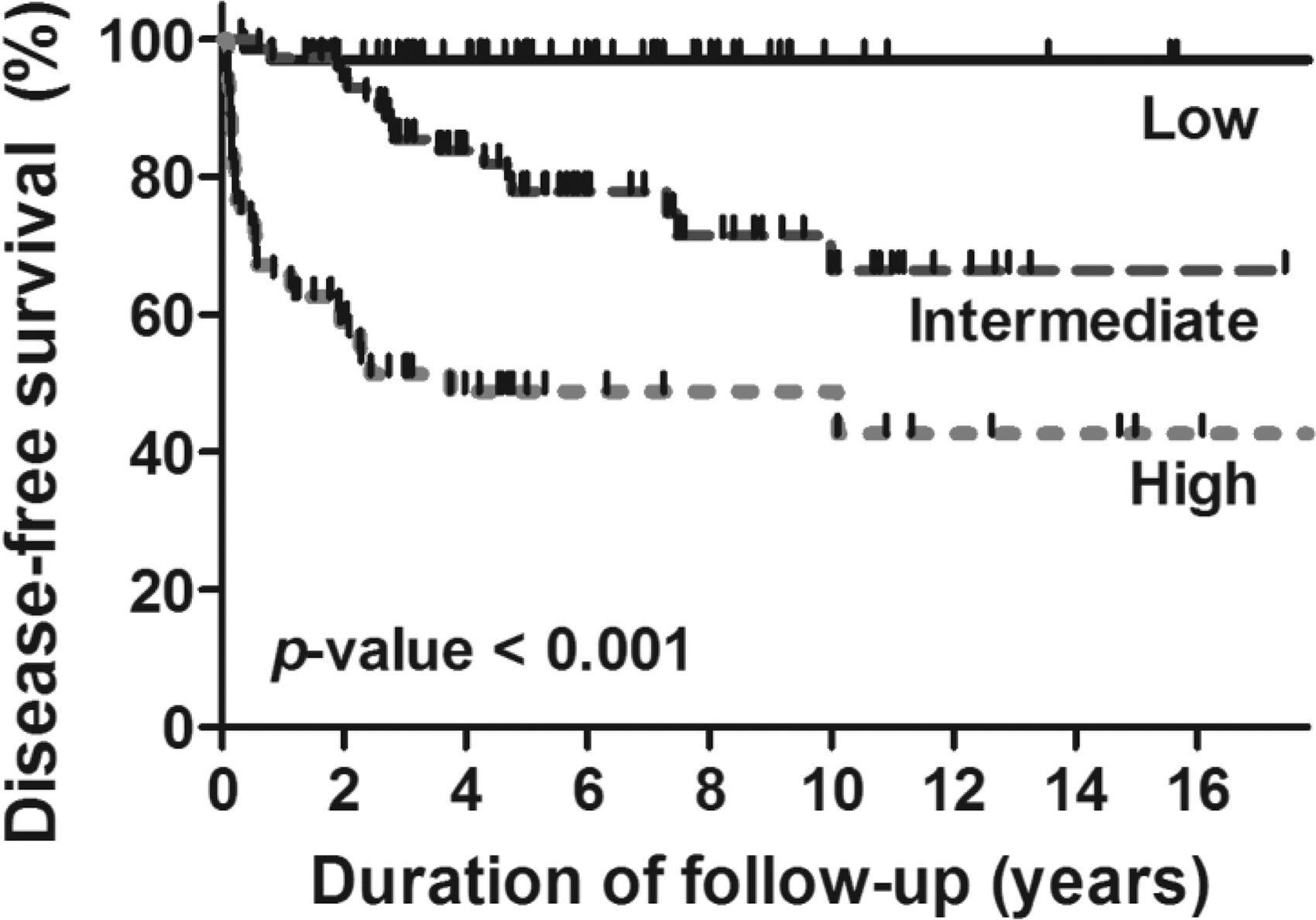
DFS curves of pediatric patients with differentiated thyroid cancer according to the revised initial risk stratification. p-Values were obtained using the log-rank test.
Clinical outcomes of pediatric DTC patients according to the revised initial risk stratification
As indicated, the DFS significantly differed between the three risk groups, and reduction in the DFS in the high-risk group was evident, as shown in Figure 2 (p < 0.001). Compared to the low-risk group, the intermediate- and high-risk groups showed significantly greater risk of structural persistent/recurrent disease (HR = 7.32 [CI 1.60–31.79], p = 0.008, and HR = 24.28 [CI 5.81–101.47], p < 0.001, respectively). The dynamic risk stratification and final outcomes were assessed of patients according to the revised initial risk stratification. Among 67 patients in the low-risk group, 84% showed an excellent response to initial therapy, and 97% achieved NED status at the end of the follow-up period. In contrast, in the high-risk group, 44% of patients showed a structural incomplete response to initial therapy, and only 53% achieved NED status. These differences in the dynamic risk stratification and final outcomes according to the initial risk stratification were significant, as indicated in Table 4 (p < 0.001 and p < 0.001). None of the patients died during follow-up period in the present study.
Values presented were the number of patients and the proportion (%).
The final outcomes were determined at the end of follow-up period.
NED, no evidence of disease.
Discussion
This study found that the presence of ETE and extent of cervical LN metastases are independent predictors for predicting structural persistent/recurrent disease in pediatric and adolescent DTC patients. Although the presence of cervical LN metastases is a well-known risk factor for pediatric DTC patients (5,6,9), the extent of LN metastasis was further classified according to the location or the number of metastatic LNs. As the presence of gross ETE showed similar HR compared to microscopic ETE in multivariate analysis, the extent of cervical LN metastases was considered to be a more important factor for defining the initial risk for structural persistent/recurrent disease in the present study. Therefore, an initial risk-stratification system is proposed that classifies patients into three groups based on more detailed criteria. Our initial risk-stratification system is based on the recent pediatric ATA guidelines (4) and indicates practical cutoff points for defining risk groups by using risk factors from the pediatric population. This revised risk-stratification system clearly categorizes the risk of structural persistent/recurrent disease in pediatric DTC patients and was found to be significantly associated with the response to initial therapy, DFS, and final outcomes of pediatric DTC patients.
As the location and number of metastatic LNs were closely correlated, and both of these parameters were significant predictors for pediatric DTC, the extent of LN metastasis was classified according to the location and the number of metastatic LNs. Patients with bilateral N1b disease or >10 metastatic cervical LNs had the highest HR for structural persistent/recurrent disease in comparison to those without cervical LN metastasis, and these characteristics appear to be independent predictors in distant metastasis in pediatric DTC patients. Therefore, these patients were assigned to the high-risk group. Patients with 6–10 metastatic cervical LNs had similar HR for structural persistent/recurrent disease compared to patients with >10 metastatic cervical LNs. However, the presence of 6–10 metastatic cervical LNs was not associated with distant metastasis in pediatric DTC, and hence patients with 6–10 metastatic cervical LNs were assigned to the intermediate-risk group.
Younger age (<16 years) was an independent predictor for distant metastasis of pediatric DTC, consistent with that noted in previous studies, where young patients, particularly prepubertal children, showed poor clinical outcomes (16,23). However, patient age was not considered in the risk assessment, as it was not an independent predictor for structural persistent/recurrent disease of pediatric DTC patients.
Consistent with previous studies (4,9,24), pediatric DTC patients in this study presented with more advanced disease at the time of diagnosis. Cervical LN metastasis was observed in 72% of patients, whereas synchronous distant metastasis was detected in 8% of patients at the time of diagnosis. However, the overall clinical outcomes of pediatric DTC patients were excellent, and 80% of patients eventually achieved NED status (4,9,24). Furthermore, none of the patients died during the follow-up period. These findings indicate the need for an optimal risk-stratification system to reduce unnecessary RAI therapy, RAI dose, or vigorous imaging studies in pediatric DTC patients. The goal of treatment for pediatric DTC is to eliminate any evidence of the disease, although there are also concerns regarding the side effects of radiation, including secondary malignancies in children (4,25,26). Thus, detailed definitions have been provided for an initial ATA risk-stratification system, and the findings may be helpful in the individualized management of pediatric patients with DTC.
Even though the recent pediatric ATA guidelines defined age ≤18 years as an appropriate cutoff point based on expert opinion (4), patients <20 years of age, including 29 (14%) patients aged >18 years, were included in this study. However, the results did not change after excluding patients aged >18 years.
This study has an inevitable limitation due to its retrospective design. The clinical impact of metastatic LN size, presence of extranodal extension, or presence of lymphovascular invasion on the prognosis of pediatric DTC patients could not be evaluated due to missing data. Moreover, the median follow-up duration was not long. In addition, patients were enrolled from only two tertiary referral centers, which could have led to selection bias. However, a relatively large number of pediatric patients with DTC were included in the cohort. Hence, this evidence-based risk-stratification system with the practical cutoff points from the pediatric DTC cohorts may be relevant, useful, and practical for clinicians.
In conclusion, the presence of ETE and the extent of cervical LN metastases are independent predictors for structural persistent/recurrent disease in pediatric and adolescent DTC patients. Detailed definitions have been provided for an initial ATA risk-stratification system based on these factors to predict the clinical outcomes of pediatric and adolescent DTC patients. This revised initial risk-stratification system is practical, and can facilitate the individualized management of pediatric DTC patients.
Footnotes
Acknowledgments
This study was supported by the National Research Foundation (NRF) of Korea Research Grant (NRF-2015R1C1A1A02036597).
Author Disclosure Statement
The authors have nothing to disclose.