




Abstract
Many of the representations of individuals with goiters reported in the literature actually refer to occasional swelling of the anterior neck, or “pseudogoiter,” the artists not having any plan to expose this pathology. The article describes five representations of goiters, as observed by the authors in the sculptures of the Sacred Mountains of Varallo, Orta, and Varese, Italy. They are classical and appropriate examples of the iconography of “real goiter,” since in these cases the sculptors had the definite aim of showing persons with goiter.
A
The iconography of goiter has attracted wide interest and has been discussed extensively by several authors, including detailed overviews by Merke, Clark and Clark, and Martino, among others (2 –4).
Illustrations of “authentic goiter” can be found in various religious representations when and where the artists wanted either to express commiseration for persons with goiter, or to identify them as executioners, tormentors, or rascals (5). Since the Middle Ages, according to the Roman Catholic Church, there was no separation between bodily conditions and spiritual implications; every disharmony within the body was seen as a punishment from God, and this idea continued through the end of the 17th century. Disease and deformity of the body were connected with sin, with the rejected, the outcast, and the deviant, and sometimes with the insane. At that time, goiter, as many other diseases, did not have any remedy and was of unknown origin; the common belief was that they were ill because they were sinners. Michel Foucault in his Folie et Déraison: histoire de la folie à l'âge classique, an examination of the evolving meaning of madness in European culture and art, speculates that even within the society of the Renaissance and the “Classic Age” (the later 17th and most of the 18th centuries), conditions such as madness, prostitution, vagrancy, and incurable diseases were seen as moral errors deserving punishment (6).
These images are particularly evident in the sculptures inside the chapels of the Sacred Mountains in Italy, where this credence often led to represent the executioners and the tormentors as goitrous individuals (7,8). Such an assumption, therefore, is to be contextualized within the local religious beliefs from which the representation arises. This concept about body illness, unthinkable and unacceptable today, is clearly expressed by Jacques Le Goff in his work Une histoire du corps au Moyen Âge. It was long-lasting, and it deeply influenced the Modern Age too, being surpassed only with the Enlightenment (6,9,10).
Most of these representations were mainly conceived in the 15th and 16th centuries in poor alpine areas, where goiter was endemic, and in Europe, primarily in the context of the Passion of Christ and martyrdoms.
In recent years, we have been looking for representations of goiters in an endemic area called Insubria, a historical-geographical region that corresponds to the area inhabited in classical antiquity by the population of the Insubres. At present, Insubria is identified as an area of Northern Italy with the following boundaries: River Adda (east), River Po (south), River Sesia (west), and Canton Ticino, Switzerland (north) (11).
In northern Insubria, there are five sacri monti, or Sacred Mountains: Domodossola, Varallo, Orta, Varese, and Ossuccio, which are listed among the UNESCO World Heritage Sites. They are some of the most important pilgrimage sites in Italy and consist of groups of churches and chapels built in the 16th and 17th centuries. In addition to their religious, symbolic, and spiritual significance, these structures are also very attractive for the way in which they have been integrated into the surrounding natural landscape of hills, forests, and lakes. Nevertheless, they are mostly noteworthy for their architectural features and their rich and amazing artwork, as they house very important artistic material in the form of frescos and sculptures.
In all the Sacri Monti we visited, we have been able to observe representations of goiters, but in this article, due to restriction of space, we will describe only the sculptured images of goiters found in the chapels of the Sacred Mountains of Varallo and Orta and at the Monastery of the Romite Ambrosiane within the Sacred Mountain of Varese. Other sculptures of goiters have been previously described by Hart (12) and Merke (2).
The history of the Sacred Mountain of Varallo started from a pragmatic necessity. In fact, once the Turks had conquered Constantinople, pilgrimages to Jerusalem had become increasingly hazardous. A Franciscan monk from Milan, who had been living for many years with the Custodian of the Holy Land, with a typically Franciscan realistic attitude, thought, “If we can no longer go to Jerusalem, then let's bring Jerusalem here.” The monk's name was Bernardino Caimi, and at the end of the 15th century, having received great support for his idea, he found the perfect place for a New Jerusalem: Varallo, in the Sesia Valley, which was then part of the diocese of Milan. Scattered in the forest, there were some small chapels, in some cases with statues representing episodes of the life of Christ.
We have been able to observe sculptures of individuals with goiter in three chapels: Chapel XXXVI (Christ on the Road to Calvary), Chapel XXXVII (Jesus nailed to the cross), and Chapel XXXVIII (The Crucifixion).
The first figure with a goiter can be seen in Chapel XXXVI, where Jan de Wespin, between 1599 and 1602, sculptured most of the figures of the Procession to Calvary. Jan de Wespin, known as “Il Tabacchetti” (Dinant, circa 1568; Costigliole d'Asti, circa 1615), was a Flemish sculptor and architect who worked mainly in Piedmont in the field of sacred art. The nickname seems to be the Italianization of “Tabaguet,” applied to the original family of Camasco, in Valsesia (13). He was assisted by his brother Nicolas, and the name “Tabacchetti” refers to both brothers. Little is known about his initial activities in Flanders, nor do we have any information of the events that took him to Piedmont, where he started working as a “plasticatore” (sculptor) in the late 16th century and the first two decades of the 17th century as part of that considerable group of artists engaged in the Sacred Mountains. In the production of polychrome terracotta statues, he had to relate his Nordic style with that of the other Italian sculptors and with the manner of the frescoes painted on the walls of the chapels.
His most important work in Varallo is the sculptural setting for the chapel of the Procession to Calvary (1599–1600). The typical realistic manner characteristic for Flemish art of this period, with a marked search for detail, is evident in this representation. The terrifying face of the man with a huge goiter, who coerces Jesus to rise, is certainly the most remarkable sculpture of the entire group. His look, the facial mimicry, and gesture express violence and cruelty with the utmost effectiveness. A marked superficial venous reticulum is evident on the goiter (Fig. 1).

Goiter representation in a sculpture of the Sacro Monte of Varallo, Chapel XXXVI. Sculpture by Jan de Wespin (Il Tabacchetti).
The second man with a goiter can be seen in Chapel XXXVII, where a crowded group of 64 terracotta statues are present when Jesus is nailed to the Cross. The artist is Giovanni d'Enrico (1559–1644), an Italian architect and sculptor, older brother of Antonio d'Enrico, usually called Tanzio da Varallo. He distinguished himself mainly in the construction of Sacro Monte di Varallo, where he worked uninterruptedly for about 40 years. His talent was great, and his artistic language was focused on an extraordinary realism and a strong sense of theatricality.
Jesus is lying on the grounded cross surrounded by many executioners; a man with a goiter is holding his legs with a rope, while others are proceeding to nail his feet. The man is immersed in his task, forcefully holding the rope. The beard hides a large goiter covering the upper part of his chest. He doesn't show the aggressiveness shown by the man with goiter of Chapel XXXVI; he seems mainly involved in performing his job (Fig. 2).
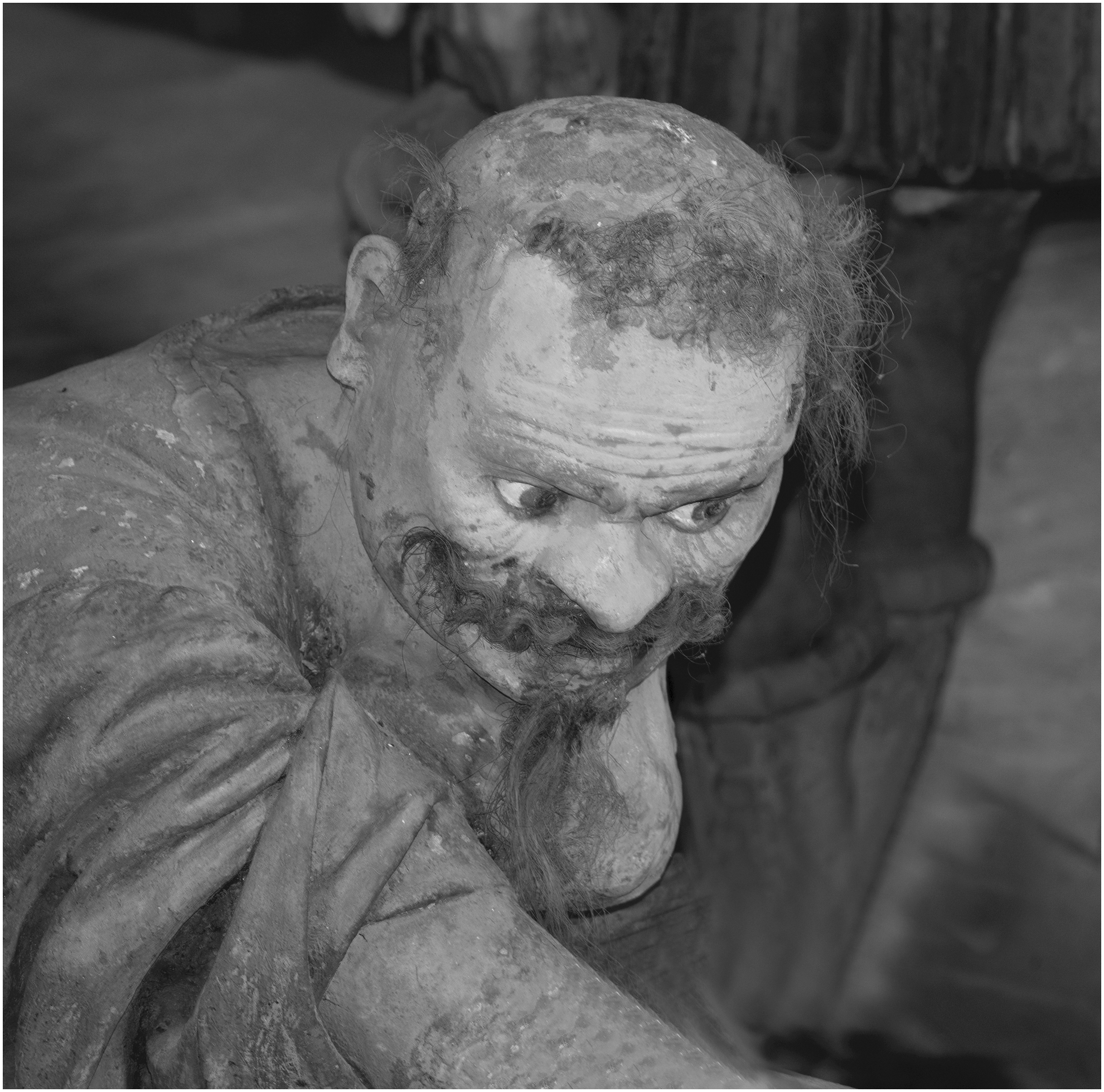
Goiter representation in a sculpture of the Sacro Monte of Varallo, Chapel XXXVII. Sculpture by Giovanni d'Enrico.
The third man with a goiter is in Chapel XXXVIII: The Crucifixion, where Gaudenzio Ferrari made more than 20 sculptures. Gaudenzio—a great artist, born just a few miles from Varallo, and whose talent had developed by working in the Room of the Signatura in the Palace of the Vatican, side by side with Raphael—entered the scene of the Sacro Monte in 1514. Ferrari was architect, painter, and sculptor, and he was able to develop Father Bernardino Caimi's germinal idea fully. He designed with extraordinary synthesis the group of the chapels of the Nativity, and a few years later those of the Crucifixion, on the highest point of the Sacred Mountain, which is, in this context, his masterpiece.
In the past, people could enter it freely, thus finding themselves at the foot of the crosses raised in front of them. Today, the chapel is closed to the public, but two glass windows still allow visitors to get in touch with that space somehow, and to experience, at least in part, that dramatic scene. Here is the description of the Chapel, as given by Edith Wharton in 1905: The Crucifixion is fitly the culminating point of the series. Here, Gaudenzio lined the background with one of his noblest frescos, and the figures placed before it are worthy, in expression and attitude, to carry out the master's conception. The goldbucklered Roman knight on his white charger, the eager gaping throng, where beggars and cripples jostle turbaned fine ladies and their dwarfs, where oval-faced Lombard women with children at the breast press forward to catch a glimpse of the dying Christ, while the hideous soldiers at the foot of the cross draw lots for the seamless garment.” (14)
In the chapel of the Crucifixion, a dramatic tension invests all the atmosphere of the painful scene, emphasized by the many contrasts between tranquil and distressed figures, between sorrowful, impulsive, violent, and hysterical expressions.
Here, the figure of the man with the goiter, in his murderous and unforgettable act of raising the stick to strike Jesus furiously, is impressive and very characteristic. This grotesque figure of a man, of natural height, stays on the left of the central cross, almost hidden between the two horses; his complexion is dark, and the huge goiter is under his elevated bearded chin. He is laughing with his toothless mouth and, as described in the Bible, “…got a sponge. He filled it with wine vinegar, put it on a staff, and offered it to Jesus to drink” (15). The goiter is of exceptional size, and its surface shows an evident venous reticulum. The goiter, if compared to those of other Sacred Mountains, is larger, and the whole representation is artistically very impressive (Fig. 3).
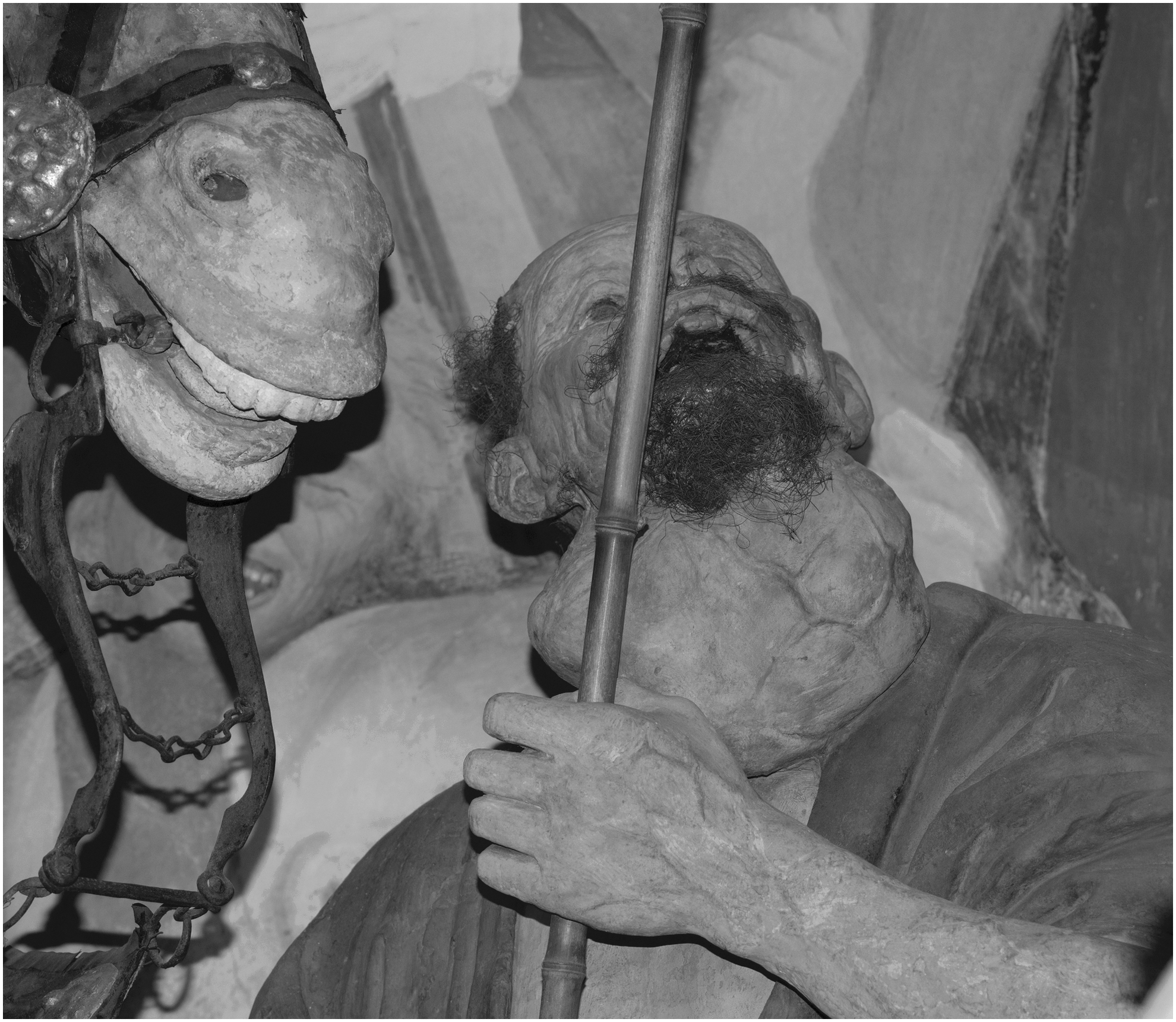
Goiter representation in a sculpture of the Sacro Monte of Varallo, Chapel XXXVIII. Sculpture by Gaudenzio Ferrari.
Another figure with a huge goiter can be seen in Chapel XVI at the Sacred Mountain of Orta. Placed on the summit of a hill overlooking Orta Lake, this Sacred Mountain fits in perfectly with the surrounding landscape. The woods, the enchanting panorama over the lake, and the variety of architectural and decorative styles are elements that make this place unique, pervaded by a sense of meditation and serenity. The Sacred Mountain of Orta is dedicated to Francis of Assisi, and each of its 20 chapels recalls episodes of the life of the saint, interpreted in parallel with the life of Jesus. It is this dedication to a saint, instead of to Christ or the Madonna, that makes it different from the other Sacred Mountains. The construction of this devotional complex was started, emulating the nearby Sacred Mountain of Varallo, at the end of the 16th century, on the initiative of the Novara abbot, Amico Canobio.
Chapel XVI, finished at the end of the 17th century, represents a very ill Francis, coming back to Assisi shortly before his death. Francis, unable to walk because of his illness, is carried to the Porziuncola on a donkey: his fame prompts people to line up along his passage, waving olive branches, while the sick want to touch his clothes to be healed.
The author of the statues, Dionigi or Dionisio Bussola (1615–1687), was an Italian sculptor active mainly in Milan and its environs during the Baroque era. He trained in Rome with Ercole Ferrata and then returned to Milan in 1645 to work for the cathedral. He also contributed with sculptural reliefs about the early life of Christ to the Certosa of Pavia. In addition to this work in Milan and Pavia, Bussola is known for the statuary which he produced for the sacri monti of Piedmont and Lombardy. For nearly two decades (1666–1684), he worked in Orta San Giulio, Varallo Sesia, Varese, and Domodossola. For the Sacro Monte of Orta alone, he created hundreds of terracotta figures.
The man with a large goiter in Chapel XVI is not a violent and terrifying figure as seen in Varallo, but in this case he is an afflicted, sick man, humbly kneeling at the passage of Francis to beg for the grace of healing. It is quite possible that he has hyperthyroidism: the goiter is huge, with an evident cutaneous venous reticulum (Fig. 4).
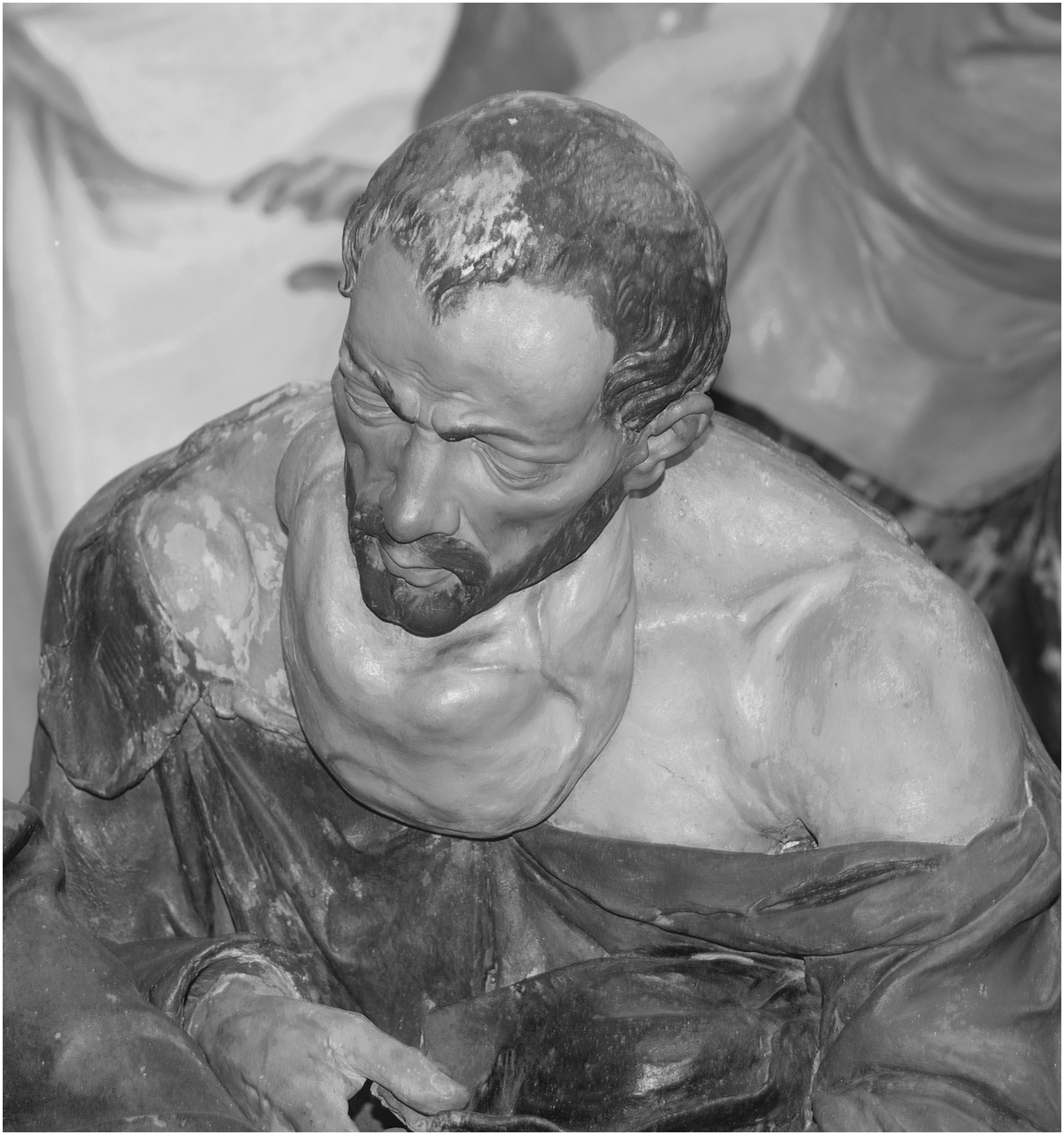
Goiter representation in a sculpture of the Sacro Monte of Orta, Chapel XVI. Sculpture by Dionigi Bussola.
In the monastery of the Romite Ambrosiane, built in 1474 on the top of the Sacred Mountain of Varese, where the nuns still live their primitive contemplative vocation, visitors are not allowed. Permission is very rarely given to selected devotees, who can then contemplate some wooden statuary groups, depicting themes related to the Passion of Christ, as the torment of the Virgin (the Madonna faints in front of the pain of the Son), and a Crucifixion.
The Crucifixion is a polychrome wooden bas-relief of exquisite workmanship. It includes a high number of sculptures. At the center, Christ is raised on the Cross, amid a large crowd; soldiers stand out on foot and on horseback with lances and swords.
In this dramatic and crowded scene, one individual has a huge goiter, which is hanging down. Most of the art historians attribute the sculpture to the Maestro di Trognano, an anonymous Italian sculptor who in the last quarter of the 15th century realized highly regarded works in Lombardy during the rule of the Duchy of Milan by the Sforza family. The representation of this bas-relief is clearly inspired by a niello plate by Maso Finiguerra (1426–1464), now in the depository of the National Gallery of Art in Washington (16). The only difference between the two works is the presence of a man with a goiter raising a stick to strike Jesus.
It is plausible that this figure inspired Gaudenzio Ferrari, who created his man with goiter around 1514. The man is dark-skinned and has a noticeable hooked nose. Being part of a bas-relief, he is carved in profile to highlight his diffuse goiter better. He does not have the terrible and aggressive look of the Varallo executioner; he seems forced to act as he does, and his bulging eye (exophthalmos ?), his open mouth, the expression of his face, and his overall unpleasant appearance seem to belong to a disturbed personality (Fig. 5).
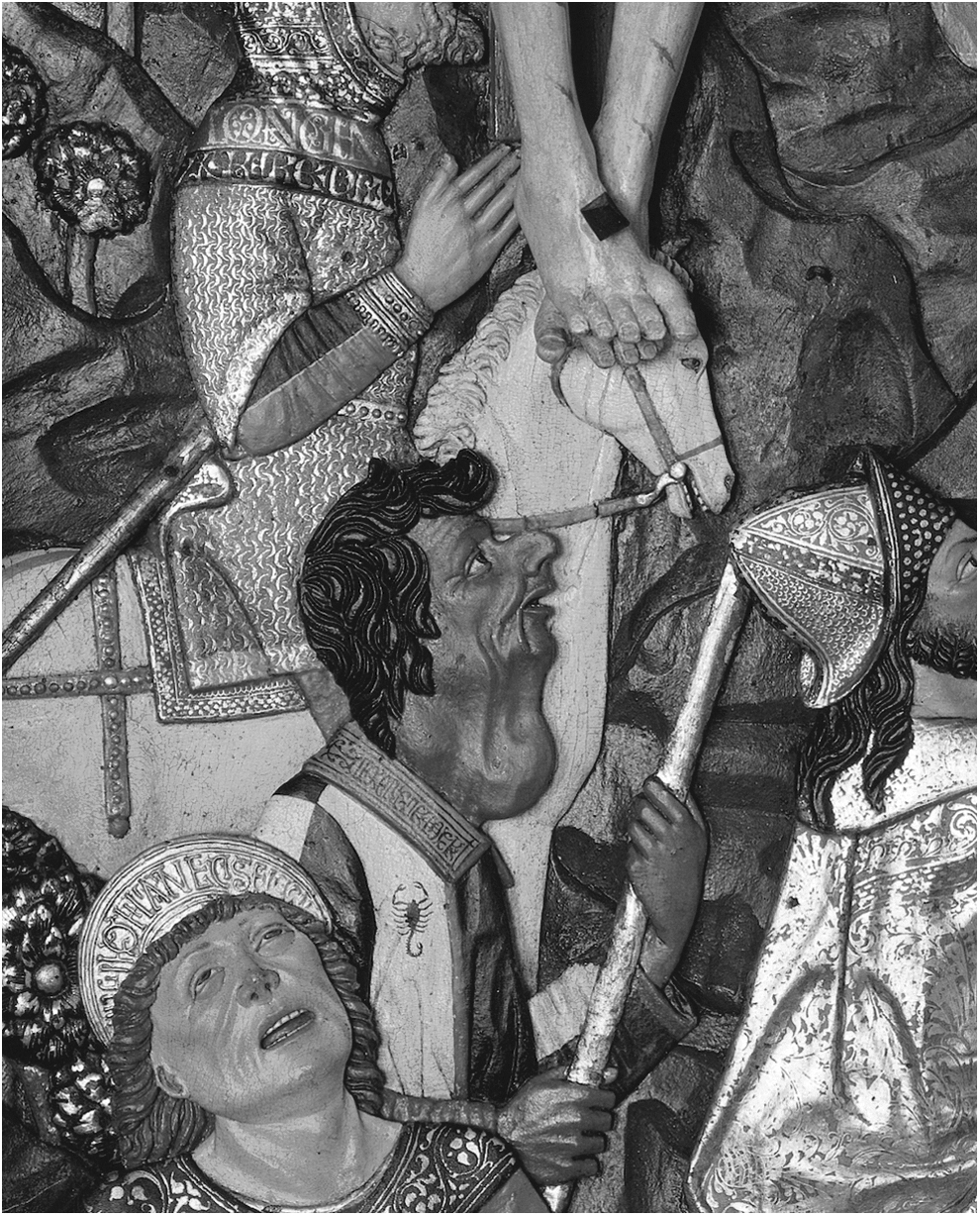
Goiter representation in a sculpture of the Sacro Monte of Varese, Monastery of the Romite Ambrosiane. Sculpture by Dionigi Bussola.
In conclusion, the goiter representations observed in the sculptures of the Sacred Mountains of Varallo, Orta, and Varese, described here, can be regarded as classical examples of the iconography of “real goiter,” where the sculptors had the obvious intention to depict persons with goiter. In these representations, the artists identify the persons with goiter not only as executioners or tormentors, but also as humble individuals, who elicit a strong reaction.
Footnotes
Author Disclosure Statement
No competing financial interests exist.