




Abstract
Leucine 341 has been predicted from crystal structure as an important residue for thyroid hormone receptor beta (TRβ) function, but this has never been confirmed in functional studies. Here, a novel p.L341V mutation as a cause of resistance to TRβ is described, suggesting an important role for L341 in TRβ function. In silico and in vitro studies confirmed that substituting L341 with valine and other non-polar amino acids impairs sensitivity of TRβ for triiodothyronine to various degrees, depending on their side-chain size and orientation.
Introduction
Mutations in the THRB gene that affect the function of thyroid hormone receptor beta (TRβ) cause resistance to thyroid hormone beta (RTHβ). The biochemical characteristics are elevated thyroxine (T4) and triiodothyronine (T3) with non-suppressed thyrotropin (TSH) concentrations. Based on the TRβ1 crystal structure, L341 has been predicted as an important residue for the binding of T3 (1,2). Here, the crucial role of L341 in T3 binding and TRβ1 functions is verified—studies that were prompted by the identification of a novel p.L341V mutation in an RTHβ patient.
Patient
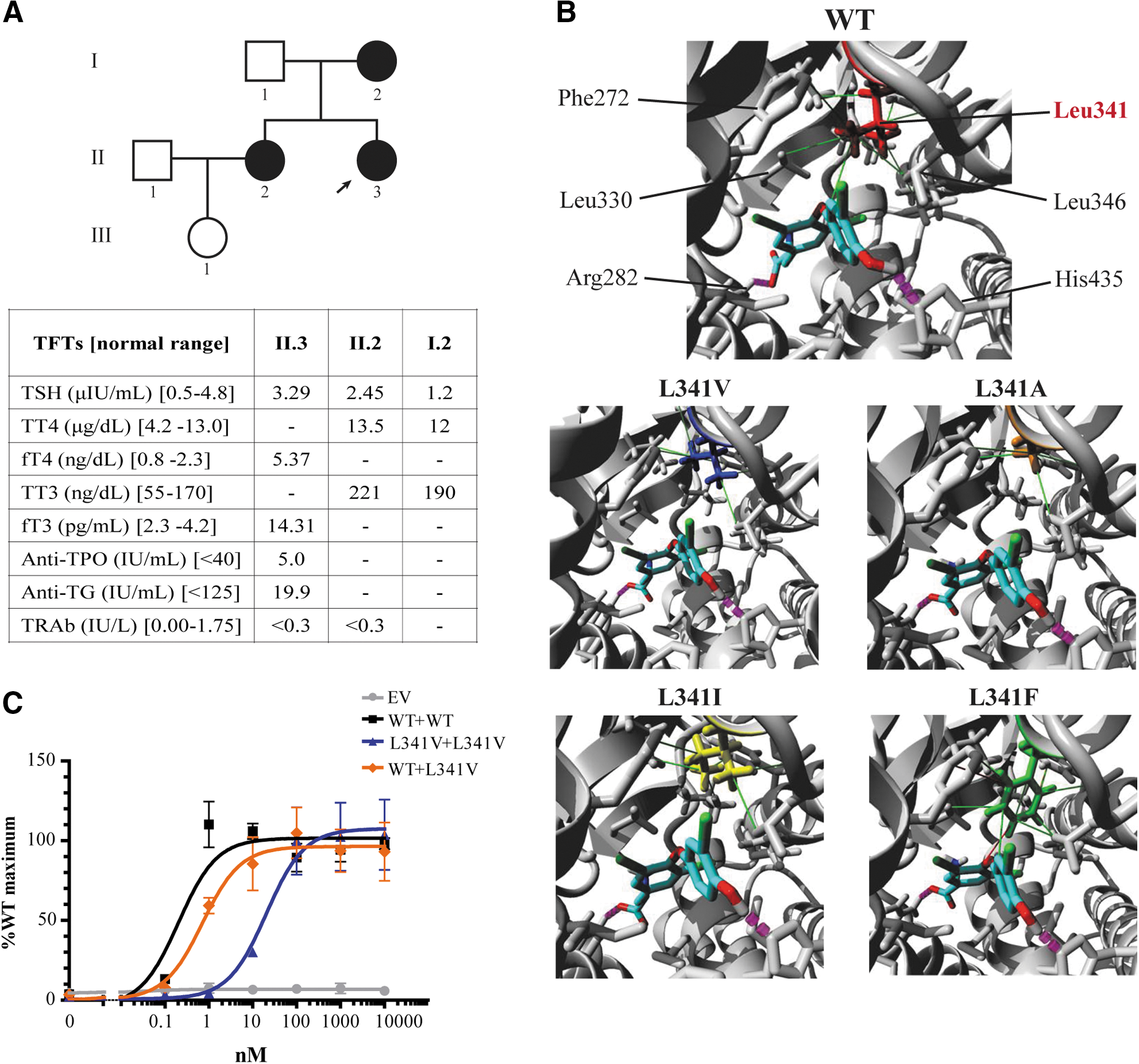
A 12-year-old Thai girl (II.3) presented with short stature (height 134 cm [−3.17 SDS], weight 27.2 kg, body mass index 15.1 kg/m2 [−1.83 SDS]), diffuse goiter, and palpitations (heart rate 144 bpm). She had been misdiagnosed with Graves' disease and treated with methimazole for three years. During treatment, she had fluctuating thyroid hormone and increased TSH concentrations. Her older sister (II.2) and mother (I.2) also suffered from presumed Graves' disease, for which the mother had undergone a subtotal thyroidectomy and subsequently developed postoperative hypothyroidism, which required high doses of levothyroxine (300 μg/day). Their thyroid function tests showed high T4 and T3 with non-suppressed TSH concentrations, suggesting RTHβ (Fig. 1A and Supplementary Fig. S1; Supplementary Data are available online at
(

Results
After obtaining informed consent, sequencing of exons 7–10 of the THRB gene identified a novel heterozygous p.L341V (c.1021C>G) mutation in all affected members (methods are shown in Supplementary Data). This mutation is not present in public databases (dbSNP, 1000 Genomes, and Exome Aggregation Consortium).
Based on the crystal structure (PDB-ID: 3GWS) (3), L341 is located in the T3-binding pocket of wild-type (WT) TRβ1, and its aliphatic side chain forms hydrophobic interactions with the outer ring of the T3 molecule and surrounding residues to maintain the shape and integrity of the T3-binding pocket (Fig. 1B and Supplementary Fig. S2). TRβ1-L341V and three artificial mutants (L341I, L341A, and L341F) with hydrophobic side chains of different sizes and structural properties were subsequently modeled (Fig. 1B). Because the side chain of valine is shorter than that of leucine and has a different orientation, the interaction with T3 and surrounding residues of TRβ1-L341V was predicted to be disturbed. Given its very small side chain, these alterations were even more pronounced in the alanine substituent. Even though the size and branched-chain character of isoleucin is similar to leucine, the altered side-chain orientation affects direct contacts with T3 and interactions with the surrounding residues in TRβ1-L341I. Although TRβ1-L341F was predicted to slightly alter the architecture of the T3-binding pocket, the direct interactions with T3 and most of the surrounding residues were preserved.
In vitro studies confirmed the functional impairment of these mutants. In [125I]T3 competitive binding assays, the dissociation constant (Kd) of all mutants was higher than WT, indicating a reduced T3 affinity. Interestingly, the shift in Kd was related to the size of the introduced side chain and the distance to T3 and surrounding residues (Fig. 1D). Substitution by alanine and valine, which have a smaller side-chain size than leucine, isoleucine, and phenylalanine, produced larger shifts in Kd. The shift of T3-induced transcriptional activity of the mutant receptors on the direct repeat (DR4)-thyroid hormone response element (TRE) luciferase reporter showed a similar trend. The half maximal effective T3 concentration (EC50) of all mutants was higher than that of WT, indicating their impaired transcriptional activity (Fig. 1E). In addition, the degree of the shift in EC50 also depended on the size and orientation of the side chain. The EC50 of co-expressed WT and TRβ1-L341V was also significantly higher (threefold) than that of WT only, suggesting a dominant-negative effect of the TRβ1-L341V (Fig. 1C). Together, these in vitro studies support an important role for L341 in T3 binding and receptor function.
Discussion
Here, it is demonstrated that L341 of TRβ is crucial for T3 binding, prompted by the identification of a novel L341V THRB mutation in an RTHβ family. The in-depth functional studies confirm the crucial role of this residue for TRβ function, which had been predicted by crystallographic studies and the identification of a previously reported L341P mutation in a patient with RTHβ (4).
The in silico models used in this study correctly predicted the degree of receptor impairment, as found in the in vitro studies. In addition, the creation of artificial mutations based on the in silico modeling provides more detailed insights about the T3–TRβ interaction. It suggests that the exact side-chain size and orientation at residue 341 are of vital importance for T3 binding and hence receptor activity. These findings also indicate that the in silico prediction is a good approach to explore the role of certain residues in TRβ function further and may enhance the understanding of the pathogenic effects of mutations therein.
Footnotes
Acknowledgments
We thank Dr. Dounghatai Pongpanat for helping to provide the patients' information and contact family members. This work was supported by Zon-MWTOP grant (91212044), an Erasmus MC Medical Research Advisory Committee grant (R.P.P. and M.E.M.), Chiang Mai University (K.W.), and NIHR Cambridge Biomedical Centre (V.K.C.).
Author Disclosure Statement
The authors have nothing to disclose.
References
Supplementary Material
Please find the following supplemental material available below.
For Open Access articles published under a Creative Commons License, all supplemental material carries the same license as the article it is associated with.
For non-Open Access articles published, all supplemental material carries a non-exclusive license, and permission requests for re-use of supplemental material or any part of supplemental material shall be sent directly to the copyright owner as specified in the copyright notice associated with the article.
